AI search has changed the way buyers discover, compare, and eliminate brands.
In the old search journey, a prospect might Google a category, open five or ten tabs, read a few review pages, scan your website, compare competitors, and slowly form an opinion. That process gave brands multiple chances to explain themselves. If there was one negative comment, one vague pricing concern, or one outdated third-party mention, the buyer might still keep researching before making a decision.
That is not always how discovery works anymore.
Today, more buyers are outsourcing the research process to AI tools like ChatGPT, Claude, Gemini, Grok, Perplexity, and other AI search engines. That shift matters because AI does not just return a list of links. It summarizes the market, compares options, interprets trust signals, and often adds context about who a product is best for, what its limitations are, and whether there are concerns a buyer should know about.
Negative brand sentiment in AI can shorten the buyer journey in the worst possible way: by removing you from consideration before the prospect ever visits your site. Which is why “Brand Sentiment” in AI is such an important AEO KPI for both growth and brand marketers to measure.
If an AI answer tacks on negative information about your brand, product, pricing, support, use case fit, or trustworthiness, the searcher may stop considering you much earlier than they would have in a traditional search experience. And if enough negative sentiment surrounds your brand, or if the negative sentiment falls into certain trust-related categories, it may reduce how often you appear in AI-generated recommendations at all.
This is why fixing negative brand sentiment in AI is becoming a core part of brand strategy, content strategy, and Answer Engine Optimization (AEO).
What Negative Brand Sentiment in AI Responses and LLM Answers Looks Like
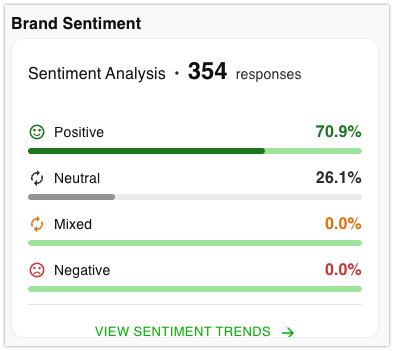
Negative brand sentiment in AI is the unfavorable language, framing, or implied judgment that AI systems attach to your brand when answering buyer questions.
It can show up in obvious ways, such as:
- “Users report that the platform is expensive.”
- “The product may not be ideal for smaller teams.”
- “Some customers mention a steep learning curve.”
- “There is limited public pricing information.”
- “The company has mixed reviews for support.”
It can also show up in subtler ways:
- Your brand appears only as an “also consider” option while competitors are recommended more strongly.
- AI describes your product as useful for the wrong audience.
- AI repeats outdated positioning from older pages.
- AI summarizes neutral third-party language in a way that sounds negative.
- AI omits you from prompts where you should logically be included.
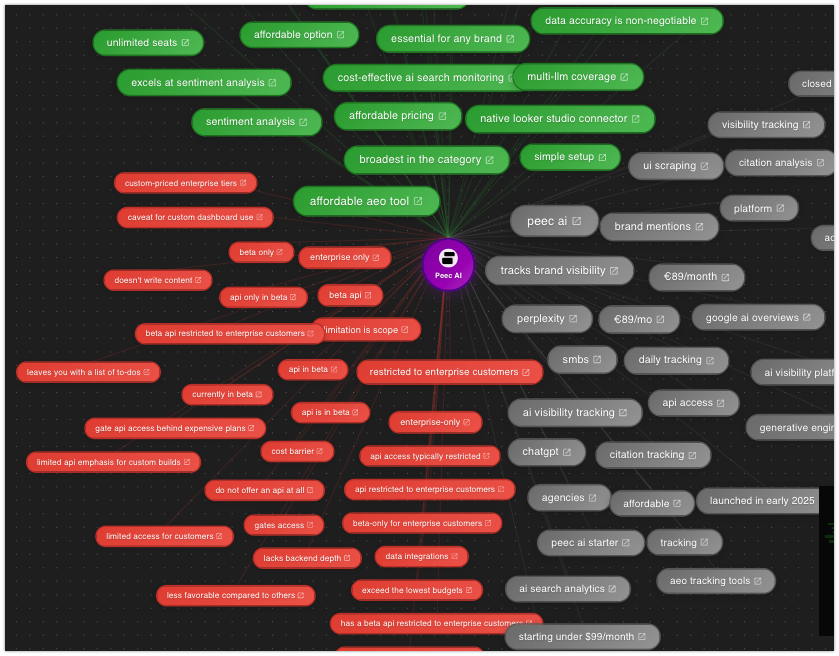
The important point is that AI-generated sentiment is not limited to reviews. It can come from your own website, third-party pages, comparison articles, forums, podcasts, directories, Reddit discussions, YouTube transcripts, and other content that AI systems can access, summarize, or infer from.
How Positive and Negative Brand Perception Affects AI Recommendations
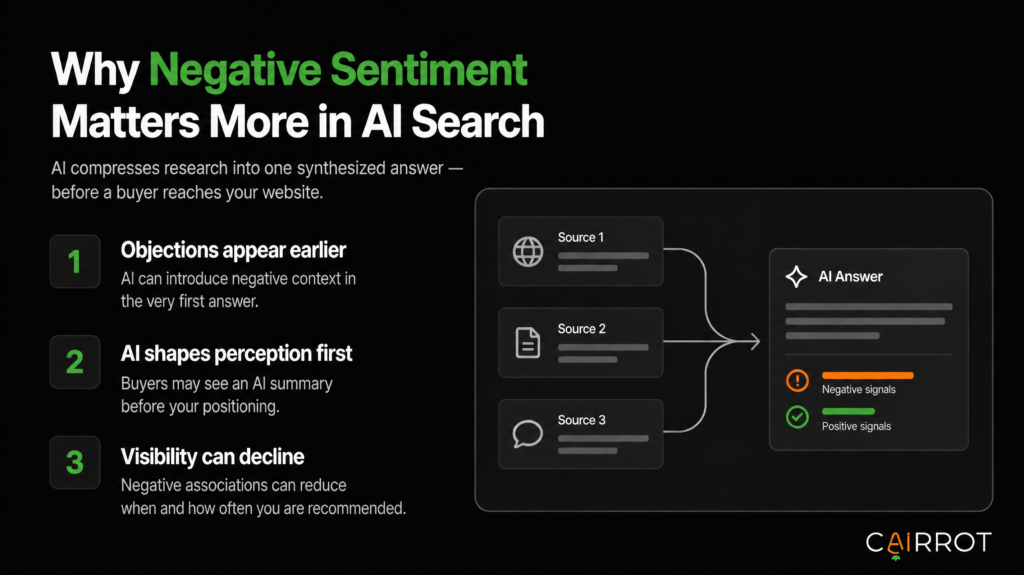
AI search compresses the research process.
A traditional searcher might inspect multiple sources before deciding whether a negative claim is fair. An AI-assisted searcher may ask one question and receive one synthesized answer. If that answer includes negative context about your brand, the user may treat it as a pre-vetted conclusion.
That changes the stakes in three major ways.
1. AI Can Introduce Negative Information Earlier in the Sales Journey
In traditional search, a buyer often encounters negative information after they already know who you are. They might read your homepage, compare your features, or check your pricing before finding objections.
In AI search, objections can appear in the first answer.
A buyer might ask:
- “What are the best AI visibility tools for B2B SaaS?”
- “Which agencies help with AEO?”
- “What is the best platform for tracking brand sentiment in AI?”
- “Compare [your brand] vs. [competitor].”
If the AI response includes negative phrasing before the user clicks anything, your brand has to overcome friction before you even get a visit.
2. AI Shapes the Buyer’s Perception Before Your Website Does
Your website used to be one of the primary places where buyers learned your positioning. Now, AI tools may interpret your positioning for them.
That means your own pages still matter, but they are no longer the only place where your message is formed. AI systems may combine your website with third-party sources, user discussions, and competitor content to generate a summary of what your brand is, who it is for, and where it may fall short.
If that summary is wrong, outdated, or overly negative, your website may never get the chance to correct it.
3. Negative Sentiment May Affect Whether You Appear at All
AI systems are often trying to recommend options that match the user’s intent. If your brand is repeatedly associated with poor fit, unclear pricing, limited trust, weak support, or the wrong audience, AI may be less likely to mention you for certain prompts.
That does not mean there is a single universal “trust score” that every AI engine uses in the same way. But it does mean that negative sentiment can influence how AI systems classify your brand, which use cases they associate you with, and whether they see you as a strong answer to a buyer’s question.
In other words, negative sentiment can hurt both perception and visibility.
How to Measure the Sentiment of Your Brand in Every LLM
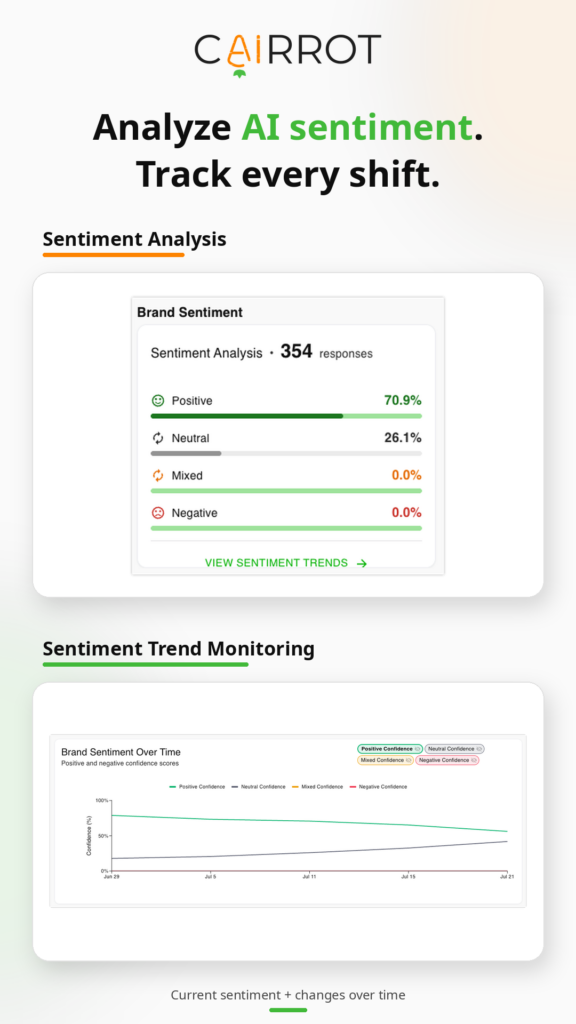
You cannot fix what you cannot see.
The first step is to discover how AI systems currently talk about your brand. There are two practical ways to do this: manually or with a dedicated tracking tool.
Option 1: Use an AEO Tool That Tracks Brand Sentiment in Your Target LLMs
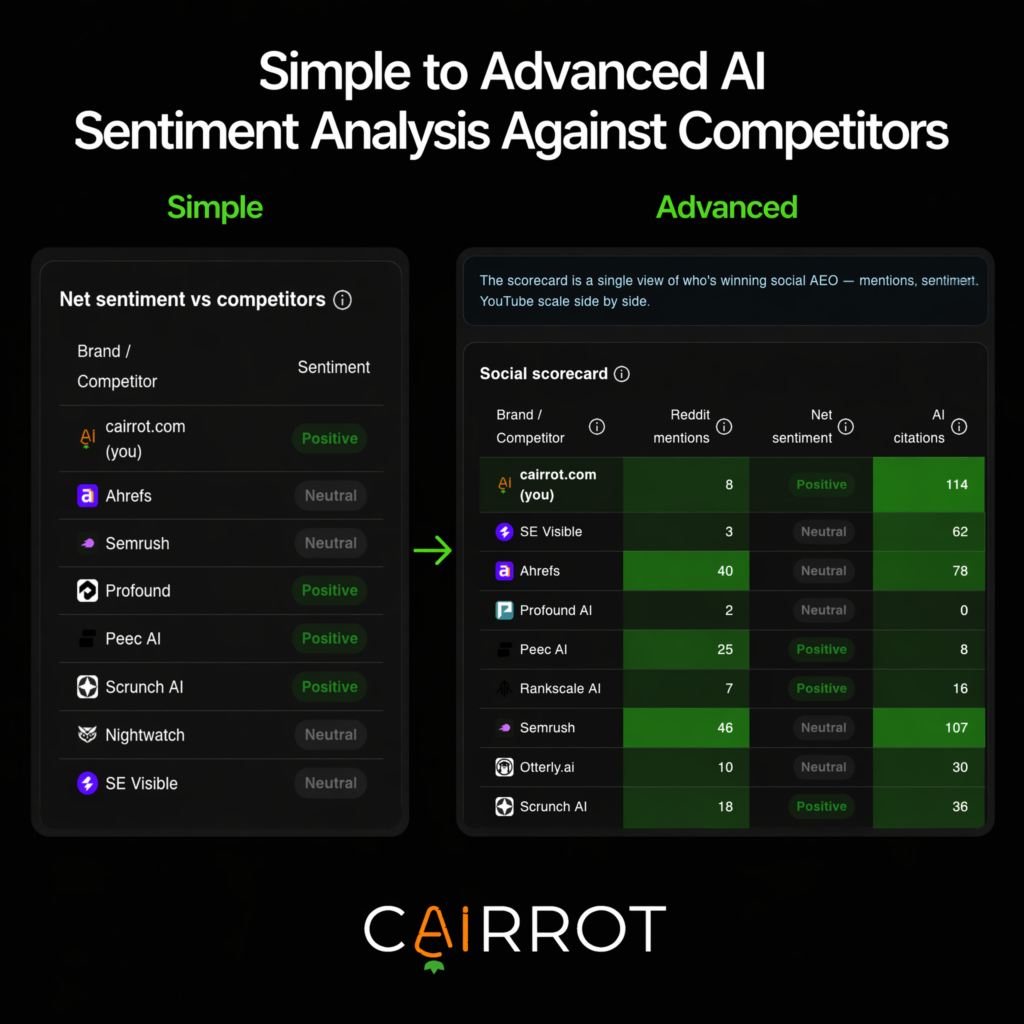
The easiest approach is to use a tool that already tracks brand sentiment in AI responses.
A platform like Cairrot can help monitor how your brand appears across AI engines, which prompts mention you, what language AI systems use to describe you, and where negative or positive sentiment is emerging.
You can do this yourself if you are willing to connect via API to each LLM or a prebuilt aggregator, build the prompt sets, measure brand mentions, classify sentiment, and track changes over time. But for most teams, using an existing AI sentiment tracking tool is faster and easier.
The goal is not to push a tool for the sake of it. The goal is to make the work measurable. Whether you do it manually or use software, you need a repeatable way to answer one question: When buyers ask AI about our category, our competitors, or our brand, what does AI say about us?
Option 2: Manually Connect to Each LLM and Test Your Target Prompts
The manual approach is straightforward if you have a technical background and only need simple rank tracking or visibility metrics from LLM responses.
You enter a combination of branded and unbranded prompts into the AI engines that matter to your market. That may include ChatGPT, Claude, Gemini, Grok, Perplexity, and any other LLM or AI search tool your buyers are likely to use.
You should test prompts across several categories:
- Branded prompts: “What is [Brand]?” or “Is [Brand] a good option for [use case]?”
- Comparison prompts: “Compare [Brand] vs. [Competitor].”
- Category prompts: “Best tools for [problem].”
- Use case prompts: “Best solution for [target user] that needs [specific outcome].”
- Pricing prompts: “How much does [Brand] cost?” or “Is [Brand] expensive?”
- Risk prompts: “What are the downsides of [Brand]?”
- Alternative prompts: “What are the best alternatives to [Brand]?”
For each prompt, record:
- Whether your brand is mentioned
- Where your brand appears in the answer
- What sentiment is attached to the mention
- Whether the answer includes misinformation
- Which competitors are positioned more favorably
- Which sources, if any, are cited
- Whether the negative language appears across multiple AI engines
Manual testing is useful because it helps you see the experience from the buyer’s perspective. The downside is that it is hard to scale. You have to test many prompts, across many models, repeatedly over time.
What to Look for When Evaluating Your AI Sentiment
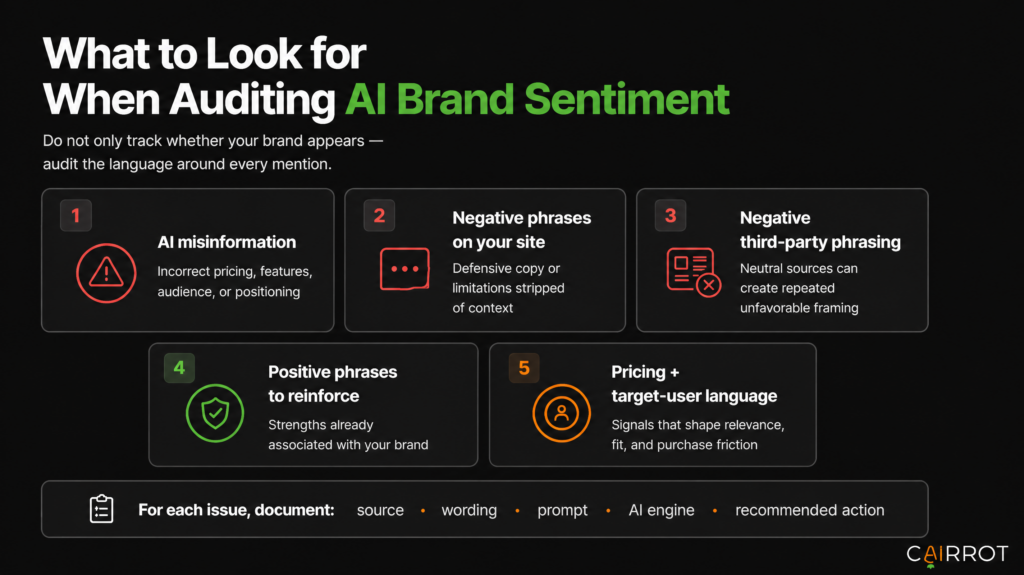
Once you start collecting AI responses, do not only look for whether your brand appears. Look at the language around the mention.
The most useful audit looks for five categories.
1. Misinformation From Specific LLMs
Misinformation is any inaccurate statement AI makes about your brand.
Examples include:
- Incorrect pricing
- Outdated feature descriptions
- Wrong target audience
- Incorrect company category
- False limitations
- Old positioning that no longer applies
- Confusing your product with a competitor
Misinformation should be prioritized because it is often the clearest issue to correct. If AI is repeating an outdated claim, you need to identify where that claim may be coming from and publish clearer, fresher information that corrects it.
Start with your own site. If your messaging is vague, outdated, or inconsistent across pages, AI systems may fill in the gaps incorrectly. Then review the third-party sources AI cites or appears to rely on.
2. Outdated or Negative Phrases That Come From Your Own Website
Sometimes AI does not invent the negative framing. It gets it from you.
This can happen when your website includes defensive language, unclear disclaimers, outdated positioning, or copy that unintentionally emphasizes limitations.
For example, your own pages might say things like:
- “Not designed for enterprise teams”
- “Pricing varies and depends on several factors”
- “Setup may require technical support”
- “Best for simple use cases”
- “Currently limited to select industries”
Those statements may be accurate in context, but AI may extract them without the nuance around them. A sentence that was meant to qualify your fit can become the main thing AI remembers.
The fix is not to hide limitations. The fix is to explain them clearly, frame them accurately, and pair them with the right buyer-fit context.
3. Negative Phrases From Neutral Third-Party Websites
Neutral sources can still create negative sentiment.
A comparison page, software directory, Reddit thread, Medium article, podcast transcript, YouTube description, or industry blog may describe your brand in a way that is not hostile, but still unfavorable.
For example:
- “A newer entrant in the market”
- “Less established than larger competitors”
- “Pricing information is limited”
- “Best for a narrow set of use cases”
- “Not as widely reviewed as alternatives”
These phrases may seem mild, but AI systems can amplify them when summarizing your brand. If several sources use similar language, AI may treat that framing as a reliable pattern.
When you find third-party phrases that influence AI sentiment, document the source, the wording, and the prompts where it appears. Then decide whether the issue can be addressed through outreach, new content, clearer owned content, or better distribution.
4. Positive Phrases You Should Lean Into
A sentiment audit should not only focus on problems.
Look for positive phrases AI already associates with your brand. These are signals you can reinforce.
Examples might include:
- “Strong for AI visibility tracking”
- “Useful for monitoring brand sentiment in AI”
- “Helpful for AEO-focused teams”
- “Good fit for agencies”
- “Clear reporting for brand mentions”
If AI already understands something positive about your brand, make that message more consistent across your website, sales materials, FAQs, comparison content, and third-party content strategy.
Positive sentiment is not just a nice-to-have. It gives you a foundation to build from.
5. Pricing and Target User Phrasing
Pricing and target user language is often the easiest to influence quickly because it connects directly to buyer decision-making.
AI may describe your brand as:
- Expensive
- Enterprise-only
- Better for small teams
- Not transparent on pricing
- Best for agencies
- Best for SaaS companies
- Too advanced for beginners
- Too basic for mature teams
Some of that may be true. Some may be wrong. Either way, pricing and user-fit language matters because it can determine whether a buyer sees your product as relevant.
If AI says your product is for the wrong user, you may be losing qualified buyers. If AI says your pricing is unclear, you may be creating unnecessary friction. If AI says you are expensive without context, you may need clearer value framing, pricing guidance, or comparison content.
Effective Ways to Fix Negative Brand Sentiment in Any LLM (and AI Overviews)
Fixing negative sentiment in AI is not about manipulating LLMs. It is about making the public evidence around your brand clearer, more accurate, more consistent, and easier for AI systems to summarize.
Here are the highest-impact tactics.
1. Update the Key Pages on Your Website
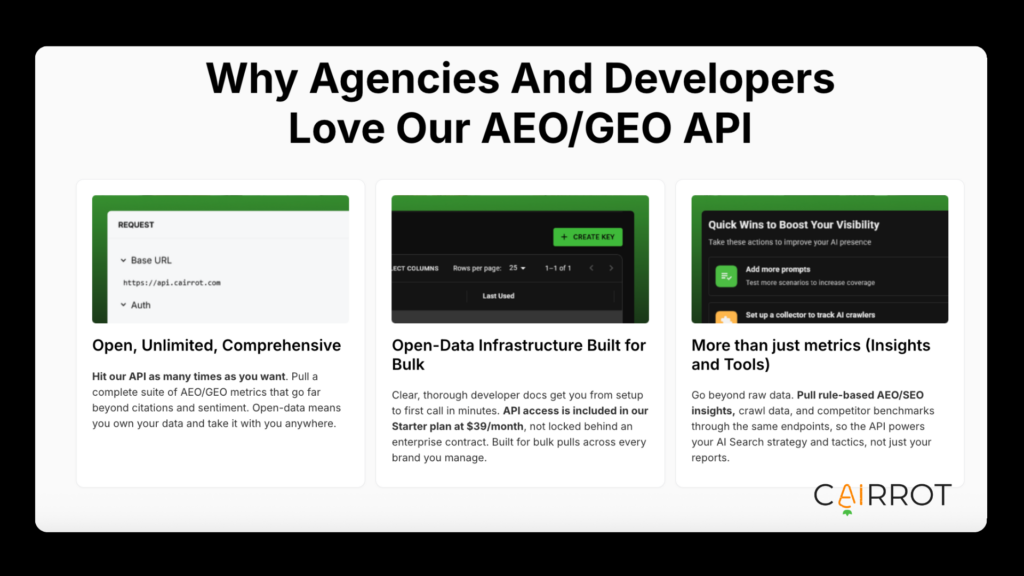
Start with the pages you control.
Your homepage, product pages, service pages, pricing page, comparison pages, about page, and high-traffic blog posts are likely to shape how AI understands your brand. If those pages are vague, outdated, or inconsistent, AI has more room to misclassify you.
Update these pages to clarify:
- What your product does
- Who it is for
- Who it is not for
- What outcomes it supports
- How your pricing works
- How you compare to alternatives
- What misconceptions buyers often have
- What use cases you serve best
Use direct, self-contained sentences that AI can extract without needing surrounding context.
For example:
- “Cairrot helps brands track how AI engines describe and recommend them.”
- “AI brand sentiment tracking shows whether LLMs attach positive, neutral, or negative language to a company.”
- “Cairrot is designed for teams that need to monitor brand visibility across AI search engines.”
This type of sentence is easier for AI to quote accurately than vague marketing language.
2. Add FAQs That Address Negative Sentiment Directly
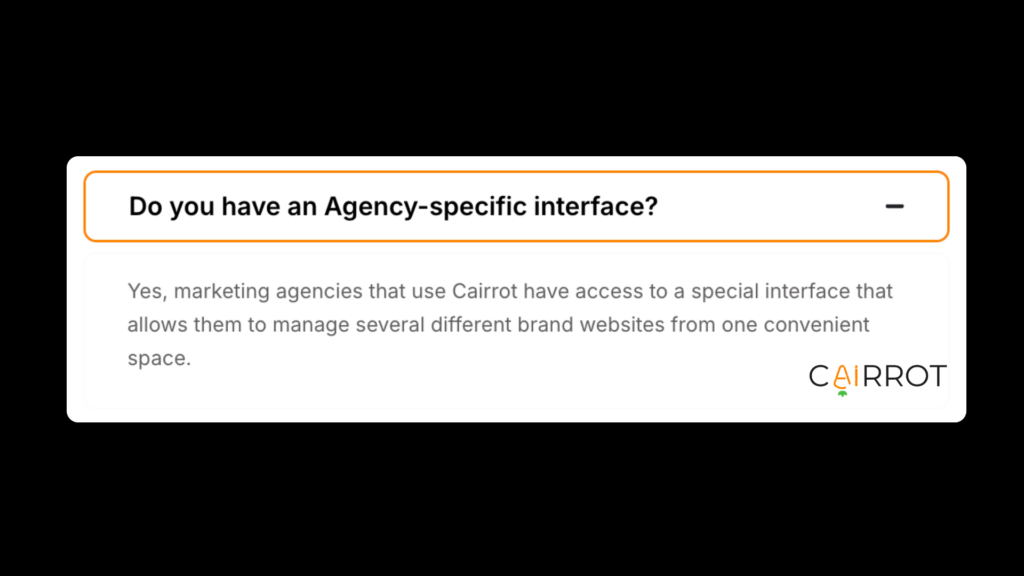
FAQs are one of the most practical ways to correct misunderstanding.
If AI repeatedly attaches a negative phrase to a product or service area, create a clear FAQ that addresses the issue directly. Do not bury the answer inside a long narrative. Put the direct answer first, then add context.
Examples:
Is [Brand] only for enterprise teams?
No. [Brand] is built for [primary audience], but it can also support [secondary audience] when they need [specific use case].
Why does AI say [Brand] is expensive?
AI may describe [Brand] as expensive when pricing context is missing. [Brand] pricing depends on [factors], and the value is strongest for teams that need [outcome].
Is [Brand] a good fit for agencies?
Yes. [Brand] is useful for agencies that need to monitor AI visibility, track brand sentiment, and report how clients appear across AI search engines.
Add FAQs to the pages where the concern is most relevant. Product-specific objections belong on product pages. Service-area concerns belong on service pages. Pricing concerns belong near pricing information.
3. Add Pricing Information Where Transparency Is Missing
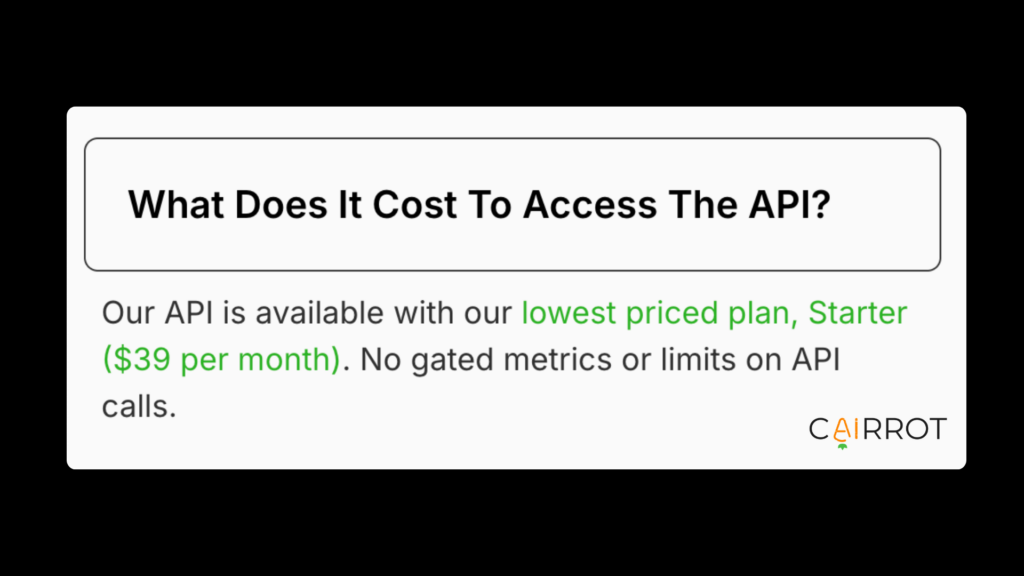
Lack of pricing transparency can easily become negative sentiment.
If AI cannot find clear pricing information, it may summarize your brand as having “limited pricing transparency” or “unclear pricing.” That phrasing can discourage buyers who are trying to qualify options quickly.
You do not always need to publish exact prices. But you should give buyers and AI systems enough context to understand how pricing works.
Helpful pricing content can include:
- Starting price
- Pricing ranges
- Plan types
- What affects cost
- Who each plan is for
- What is included
- When custom pricing applies
- How to request a quote
The goal is to reduce ambiguity. Clear pricing context helps both buyers and AI systems describe your offer more accurately.
4. Create New Content Where Existing Pages Cannot Carry the Full Answer
Sometimes your existing pages are not enough.
If AI sentiment issues come from category-level questions, competitor comparisons, or use-case prompts, you may need new content that answers those questions directly.
Useful formats include:
- Blog posts
- Use-case pages
- Competitor comparison pages
- Alternative pages
- Buyer guides
- Industry-specific landing pages
- “Best tools for” pages
- Problem/solution explainers
Competitor comparison content is especially effective because AI search often responds to comparison prompts. If buyers ask AI to compare you with competitors, you should have accurate, balanced, and detailed content that explains the differences.
Strong comparison content should not be a hit piece. It should explain:
- Who each product is best for
- Where each product is strongest
- Where each product may be limited
- How pricing or implementation differs
- Which use cases should choose which option
This gives AI better source material and gives buyers a more useful answer.
5. Increase Distribution Across AEO-Focused Channels
Your website matters, but AI systems learn from more than your website.
A strong Answer Engine Optimization strategy includes distributing content across channels that AI tools may summarize, cite, or use as supporting evidence. These can include:
- YouTube
- Podcasts
- Medium
- Third-party blogs
- Industry newsletters
- Software directories
- Partner websites
- Community discussions
- Expert interviews
This is where content distribution becomes a brand sentiment strategy.
If your brand is only described on your own website, AI has fewer external signals to validate your positioning. If your brand is discussed consistently across relevant third-party channels, AI has more evidence to understand what you do and who you serve.
For Cairrot, this also connects naturally to broader AEO channel strategy. If you are building a content distribution plan for AI visibility, start by identifying which channels are most likely to influence AI-generated answers in your category. Cairrot’s related guide on AEO-focused digital marketing channels can support that strategy: https://cairrot.com/blog/best-digital-marketing-channels-for-aeo/
6. Reach Out to Neutral Websites Already Being Cited
If AI repeatedly cites or appears to rely on a neutral third-party website, that site is worth your attention.
You may not be able to control the page, but you may be able to improve the accuracy and completeness of your mention.
Possible outreach angles include:
- Correcting outdated information
- Offering updated product details
- Providing clearer pricing context
- Sharing a new use-case explanation
- Contributing expert commentary
- Collaborating on a comparison article
- Asking whether a current mention can be updated
The goal is not to pressure neutral sites into promotional language. The goal is to make sure their information is accurate, current, and complete enough that AI systems do not summarize your brand unfairly.
7. Build Mentions on Niche-Relevant Websites
Do not only focus on websites that are already cited.
You should also look for niche-relevant websites that are willing to mention your brand, feature your content, interview your team, or collaborate on useful resources. These sites may not be heavily cited today, but they can still contribute to the broader evidence layer around your brand.
Good targets include:
- Industry blogs
- Vertical-specific publications
- Partner resource pages
- Community websites
- Expert roundups
- Podcast show notes
- Guest post opportunities
- Relevant newsletters
The best opportunities are not generic link placements. They are context-rich mentions that help explain what your brand does, who it is for, and why it is credible.
A Practical Workflow for Fixing Negative AI Sentiment
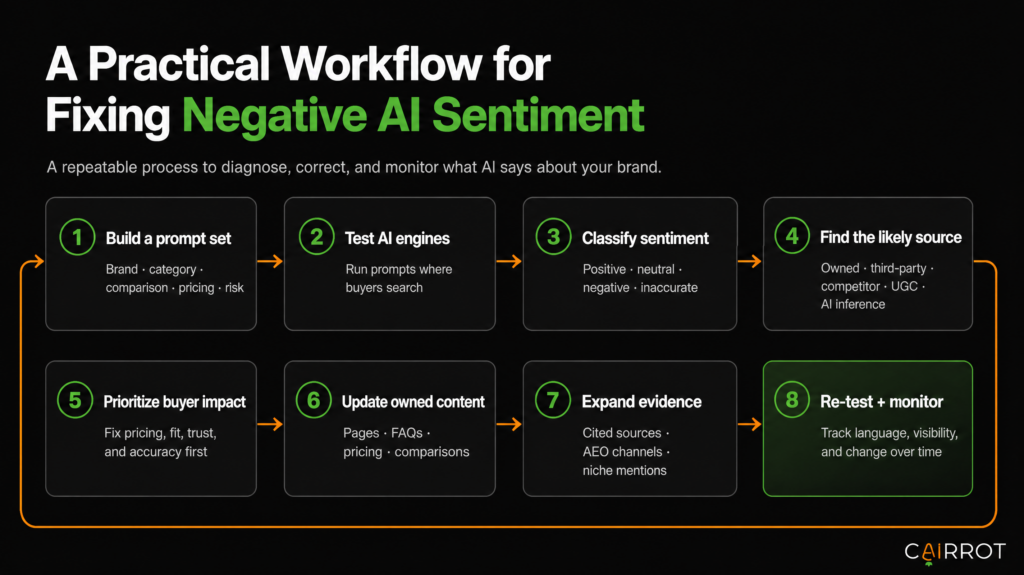
Here is a simple process your team can use.
Step 1: Build a Prompt Set
Create a list of prompts that reflect how real buyers search. Include branded, unbranded, comparison, pricing, use-case, risk, and alternative prompts.
Step 2: Test Across AI Engines
Run those prompts across the AI tools your buyers use. If you are doing this manually, record the responses in a spreadsheet. If you are using a platform like Cairrot, use its AI sentiment tracking to monitor mentions and sentiment more efficiently.
Step 3: Classify the Sentiment
For each response, classify the language as positive, neutral, negative, inaccurate, outdated, or missing. Pay special attention to pricing and target-user phrasing.
Step 4: Identify the Likely Source
Determine whether the phrasing appears to come from your own website, a neutral third-party source, competitor content, user-generated content, or AI inference.
Step 5: Prioritize Fixes by Buyer Impact
Fix issues that affect buying decisions first. Pricing confusion, wrong audience fit, trust concerns, and inaccurate limitations usually matter more than minor wording issues.
Step 6: Update Owned Content
Revise key pages, add FAQs, clarify pricing, publish comparison content, and create new pages where needed.
Step 7: Expand Third-Party Evidence
Distribute content across AEO-focused channels, reach out to cited neutral websites, and build accurate mentions on niche-relevant sites.
Step 8: Re-Test and Monitor
AI sentiment will not change instantly. Re-test prompts over time and track whether the negative phrasing decreases, whether your brand appears more often, and whether AI describes your brand more accurately.
Here’s how to track LLM rankings and AI traffic so you can confirm the fixes are moving both perception and mentions.
Example: Turning a Negative Phrase from AI Into a Content Fix
Imagine AI says:
“[Brand] may not be ideal for smaller teams because pricing information is limited.”
That one sentence contains two issues:
- The brand may be misclassified as a poor fit for smaller teams.
- The pricing information may be too vague or hard to find.
A good fix might include:
- Adding a pricing FAQ that explains how pricing works
- Creating a “Who [Brand] is best for” section on the product page
- Publishing a blog post about how smaller teams can use the product
- Updating third-party profiles with clearer pricing and fit language
- Adding comparison content that explains when smaller teams should choose you versus alternatives
The key is to trace the negative phrase back to a fixable content gap.
How Long Does It Take to Fix Negative Sentiment in AI Responses?
There is no universal timeline. But if the client executes quickly, I often see changes start within 30 days and significant results are possible for most clients within 90 days. If it’s a major enterprise or long-term institution, changing AI’s perception of you in a meaningful way will take 3-6 months.
AI systems update at different speeds, rely on different sources, and may respond differently depending on the prompt. Some changes may appear quickly when AI tools retrieve fresh web results. Other changes may take longer if a model relies on older indexed information or does not cite live sources.
Instead of expecting an immediate fix, treat AI sentiment improvement as an ongoing process:
- Monitor your most important prompts
- Update source content regularly
- Build stronger third-party evidence
- Track which negative phrases disappear
- Reinforce positive phrases that already appear
- Keep pricing and positioning information current
The brands that win in AI search will not be the ones that make one update and stop. They will be the ones that continuously manage how AI systems understand, classify, and recommend them.
Improving AI Sentiment Is Now Part of Brand Management
Negative brand sentiment in AI is not just a visibility problem. It is a conversion problem.
If AI systems describe your brand inaccurately, attach negative pricing or fit language, or omit you from relevant recommendations, qualified buyers may never reach your website. That makes AI sentiment a new layer of brand management, reputation management, and AEO strategy.
The good news is that negative sentiment is not mysterious. You can discover it, classify it, trace it to likely sources, and fix the content gaps that allow it to spread.
Start by asking the same questions your buyers ask AI. Look at what comes back. Then improve the evidence AI has available.
If you want a faster way to see how AI engines describe your brand, check your brand’s sentiment in AI today with Cairrot.