
An enterprise SEO analytics platform is subscription software that pulls crawls, rank and visibility tracking, research and reporting for very large sites into one place, with shared access, permissions and history. The best ones now also show how your brand appears inside AI-generated answers, because organic growth no longer stops at ten blue links. Below you will find what the category does, the features worth paying for, how to evaluate a platform, and how we think about measurement at Cairrot.
TL;DR
- An enterprise platform replaces a pile of disconnected tools with one agreed definition of performance, shared by SEO, content, dev and leadership.
- Prioritize rank and share-of-voice tracking, technical and page-level analysis, role-based dashboards, and open APIs for exporting data to your BI stack.
- In 2026, add AI visibility to the list: share of model, citation likelihood and brand accuracy across ChatGPT, Gemini, Claude, Perplexity and others.
- Run a baseline audit first, then judge any platform on scale, data trust and how fast your team acts on its output.
- Cairrot covers SEO and AEO analytics in one workspace, with plans from $39 per month and custom pricing for enterprise needs.
Table of Contents
- What an enterprise SEO analytics platform actually is
- The capabilities that matter at scale
- What a good enterprise SEO dashboard shows
- Measuring AEO: the new half of enterprise analytics
- Integrations and APIs: where control lives
- Platform or tool stack?
- What enterprise SEO analytics software costs
- How to evaluate and roll out a platform
- Our perspective: analytics is only worth what you do with it
- See it on your own data
- FAQ
- Sources
What an enterprise SEO analytics platform actually is
Start with scale. Search Engine Land describes enterprise platforms as built for organizations managing thousands, tens of thousands or millions of pages, keywords and related search data, where the value comes from cutting manual work and reporting errors.
A platform consolidates crawls, rank and visibility tracking, keyword and content research, and reporting. It adds shared access, permissions and history. That last part matters more than it sounds. One analysis of the category points out that a stack of separate tools can produce different metric definitions, which makes it hard for teams to agree on what happened.
Platform versus point tool
A point tool answers a narrow, current-state question: how does this keyword rank today? Analytics answers a broader one. Metabase’s SEO analytics guide separates the two: analytics combines dated visibility signals, measured Search Console clicks, history, joins and governance.
The practical difference:
| Point tool | Enterprise analytics platform | |
|---|---|---|
| Question answered | What is true right now? | What changed, why, and what did it cost or earn? |
| Users | One specialist | SEO, content, dev, leadership, agencies |
| Data | One source | Many sources, joined and dated |
| Governance | Little | Permissions, history, shared definitions |
| Reporting | Exports | Role-based dashboards and scheduled reports |
The same analysis frames the platform as a governance instrument more than an operator. Its value is not one feature but one agreed definition of success across departments that rarely share a spreadsheet.
The capabilities that matter at scale
Feature lists in this category run long. Search Engine Land’s rundown of enterprise features is a useful reference point: keyword research and rank tracking, page-level SEO analysis, content optimization, link analysis, site-error detection, competitive and international search analysis, internal cross-linking, and APIs for third-party data integration and export.
Turn that into a buying checklist:
- Rank and visibility tracking across markets, devices and locations, not only a handful of head terms.
- Crawling that does not choke. Ask whether the platform can process tens of millions of URLs and log lines without manual sharding, a criterion one enterprise analytics framework lists.
- Competitive benchmarking with share of voice, so leadership sees market position, not only your own trend line.
- Technical and on-page analysis tied to prioritized tasks. A crawl that produces 40,000 issues without ranking them is noise. Guides on turning crawl data into actionable SEO insights make the same point about moving from findings to a short, sequenced fix list.
- APIs and exports so data can flow into your warehouse and BI tools.
- Governance: roles, audit history and change logs.
On that last point, Search Engine Land’s piece on SEO changelogs recommends recording schema updates and other site changes with their context, stakeholder and expected or observed impact. When a traffic dip appears, that record is how you find the cause in minutes instead of weeks.
What a good enterprise SEO dashboard shows
People searching for an enterprise SEO dashboard usually want one screen that ends the Monday-morning scramble. A comprehensive dashboard helps teams monitor SERP rankings and trends, competitor performance and share of voice, according to Search Engine Land’s buyer guidance. The same guidance adds that integrating and prioritizing tasks, reporting and user permissions benefits enterprise operations, and that customized reports should export to business intelligence or analytics software.
Build dashboards by audience, not by data source:
- Executives: share of voice, market position, organic revenue or pipeline, and AI visibility trend. Four or five numbers, month over month.
- SEO leads: ranking movement by page group, indexation, crawl health, top opportunities.
- Content teams: pages losing visibility, gaps against competitors, citation sources that AI answers pull from.
- Developers: technical regressions, schema validation, API status and release annotations.
- Agencies: one view per client, white-label reports and bulk management.
One rule keeps dashboards honest: every number must trace to a source and a definition. If two teams quote different organic traffic figures, the dashboard has failed, however attractive it looks.
Measuring AEO: the new half of enterprise analytics
Traditional rank tracking cannot tell you whether ChatGPT recommends you or a rival. That gap is why enterprise AEO analytics has become its own requirement. Search Engine Land describes three measures teams can use:
- Share of model: how often your brand or entity appears in generative responses for category queries.
- Citation likelihood: how probable it is that an answer cites your pages.
- Brand accuracy: whether the AI’s description of you matches what your declared schema says.
The same source ties governance to this work: entity ownership and automated validation that flags schema inconsistencies. In plain terms, someone must own how your brand is described, and a system must catch it when the data drifts.
We go deeper on this in our guide to AI search visibility and how to measure it and on the share of voice in AI feature page. If your team needs the monitoring side, see our AI brand monitoring software overview.
Integrations and APIs: where control lives
Enterprise teams rarely accept a closed system. They want their own warehouse, their own BI layer and their own scripts. The Google Search Console API remains a foundational data source, supporting programmatic queries for site traffic, sitemap management and URL indexation status. Any platform you buy should combine that data with its own, not hide it.
Developers are also building their own automation. One practitioner describes using Python scripts with Claude Code to pull Google API data and analyze it across sources. That is a sign of where expectations are heading: if your platform has a clean API, your engineers can build on it rather than around it.
When you evaluate integrations, check for:
- GA4 and Search Console connections that need no custom work.
- Bing and Cloudflare or CDN integrations for crawl and edge data.
- Export paths to BI tools such as Databox.
- A documented API with enough rate headroom for bulk jobs.
- A CMS connector, such as a WordPress plugin, for teams that publish at volume.
Cairrot ships with all of these: GA4, Search Console, Bing, Databox, Cloudflare and CloudFront integrations, a WordPress plugin, and unified API access included in base plans. Details are on our API and MCP developer page.
Platform or tool stack?
There is no universal winner. A comparison from an enterprise SEO services firm argues that tool stacks are neither better nor worse than all-in-one platforms; the choice depends on existing data fitness, technical control requirements and internal development capability.
A useful way to frame it is the same build-versus-buy logic that applies to any software decision, as covered in this comparison of SaaS and on-premise approaches.
| If your organization… | Lean toward |
|---|---|
| Has a data engineering team and clean warehouse pipelines | A stack, with a platform API feeding it |
| Has many teams, markets or clients and little shared reporting | An all-in-one platform |
| Needs fast time to value | A platform with ready integrations |
| Must keep full control of raw data | A platform with open API and export |
Most mature teams land in the middle: a platform as the system of record, with an open API so nothing is trapped.
What enterprise SEO analytics software costs
Prices in this category are mostly quoted, not posted. In the United States, dedicated enterprise suites are typically sold on annual contracts that scale with the number of domains, tracked keywords, crawled pages and user seats, and the spread between entry plans and large-scale deployments is wide. Before you request quotes, write down your volumes in each of those four dimensions. Vendors price against them, and a clear brief shortens negotiation.
Also count what the license does not include: onboarding, data engineering time for warehouse pipelines, and the analyst hours to run it.
Cairrot publishes its prices:
| Plan | Price |
|---|---|
| Starter | $39 per month |
| Pro | $99 per month |
| Enterprise | $299 per month |
| Grok monitoring and analytics | from $25 per month |
Large-scale and enterprise deployments can be set up with custom pricing, and API access is included in base plans. See the pricing page for what each plan includes.
How to evaluate and roll out a platform
A revenue-driven analytics framework lays out implementation as a baseline audit, a shared event taxonomy, warehouse pipelines, attribution validation against financial results, and role-based dashboards and alerts. We would reorder it into a practical sequence:
- Baseline audit. Record where you stand today: visibility, technical health, AI citations. You cannot prove progress without a starting line.
- Agree the definitions. Decide what counts as a visit, a conversion and a brand mention before connecting anything.
- Trial with real data. Connect GA4 and Search Console, run your actual site, and test your hardest use case, not the demo path.
- Validate attribution. Check platform numbers against finance or CRM outcomes.
- Set roles and alerts. Executives get summaries, specialists get issues, and nobody gets a firehose.
- Review at 30, 60 and 90 days. Judge by decisions made and fixes shipped, not by logins.
Score each candidate on scale, data trust, integration depth, governance, reporting flexibility and total cost. Weight them by what your organization struggles with most.
Our perspective: analytics is only worth what you do with it
We built Cairrot because we kept seeing the same pattern. Teams had plenty of data and very little agreement. SEO reported rankings, content reported traffic, and nobody could say whether the brand showed up when a buyer asked an AI assistant for a recommendation.
Our view is that an enterprise analytics platform should do three things. First, unify AI and traditional search in one place, so one report tells the whole organic story. Second, stay open: an API, clean exports and integrations mean the network is part of the product, not a walled garden. Third, pair measurement with action, so every audit ends in a prioritized opportunity list rather than a PDF.
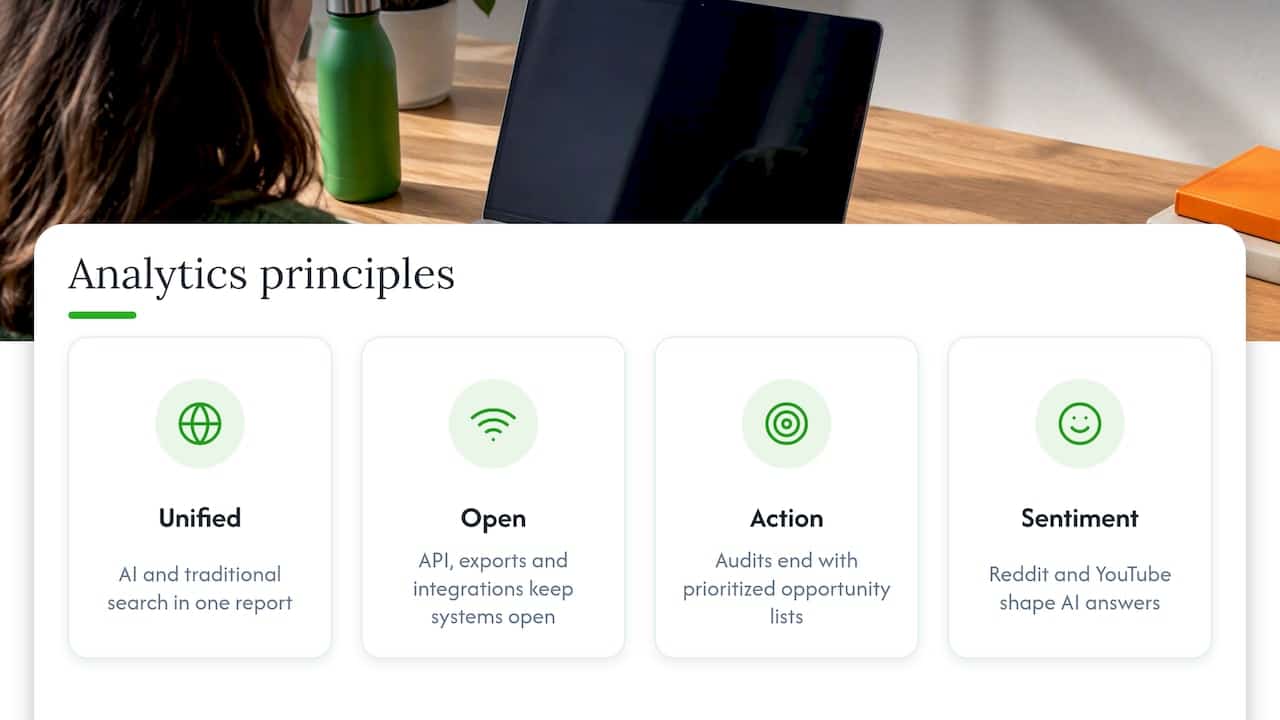
Sentiment is the piece most teams overlook. AI answers lean on sources like Reddit and YouTube, so what people say there shapes what models say about you. We track sentiment across those platforms because visibility without context can mislead. A brand cited often but described poorly has a problem that rank tracking will never reveal.
Finally, we think speed matters. Users typically see measurable AEO results within as little as 60 days when they work from a baseline audit and a short, prioritized plan. Enterprise rollouts should aim for the same rhythm: small, measured moves, shipped often.
— Dr. Patrick McAvoy
See it on your own data
If you are comparing platforms, the fastest test is a trial on your real site. Cairrot gives agencies, content teams, enterprise organizations and developers one workspace for audits, competitor benchmarking, unified AEO analytics, customizable white-label reporting and bulk client management. Start with the Cairrot platform or compare plans on the pricing page. Prefer reporting first? Our AEO and GEO reporting tools page shows what stakeholders will see.
FAQ
What is an enterprise SEO platform?
It is subscription software that combines technical auditing, rank tracking, competitive analysis and reporting for large sites with thousands of pages or multiple domains. It adds permissions, shared history and one set of metric definitions across teams. Modern platforms also track visibility in AI-generated answers.
How is an enterprise SEO dashboard different from Google Search Console?
Search Console shows how Google sees your own site, and it is an essential data source. A dashboard joins that data with rankings, competitors, crawl health, AI visibility and revenue, then organizes it by role. Most platforms pull Search Console in through its API.
How do I measure visibility in AI answers?
Track share of model for category queries, citation likelihood and brand accuracy, as described by Search Engine Land. Run the same prompt set on a schedule across the major assistants and compare results over time. A platform automates the prompts and records the history.
Do small and mid-size teams need an enterprise platform?
Not always. If you manage one site and one team, a lighter plan often covers it. The case for an enterprise platform grows with the number of sites, markets, clients and stakeholders who need the same numbers. Cairrot’s Starter and Pro plans cover smaller teams, and Enterprise is there when you scale.
Sources
- How to choose an enterprise SEO platform, Search Engine Land
- 9 important features of enterprise SEO platforms, Search Engine Land
- Why entity authority is the foundation of AI search, Search Engine Land
- SEO changelogs: The missing layer of enterprise site governance, Search Engine Land
- How to turn Claude Code into your SEO command center, Search Engine Land
- Search Console API reference, Google for Developers
- Enterprise SEO Platform: What It Does and What It Doesn’t
- SEO Analytics in Metabase
- A Revenue-Driven Enterprise SEO Analytics Framework
- Enterprise SEO Tools Evaluation Guide