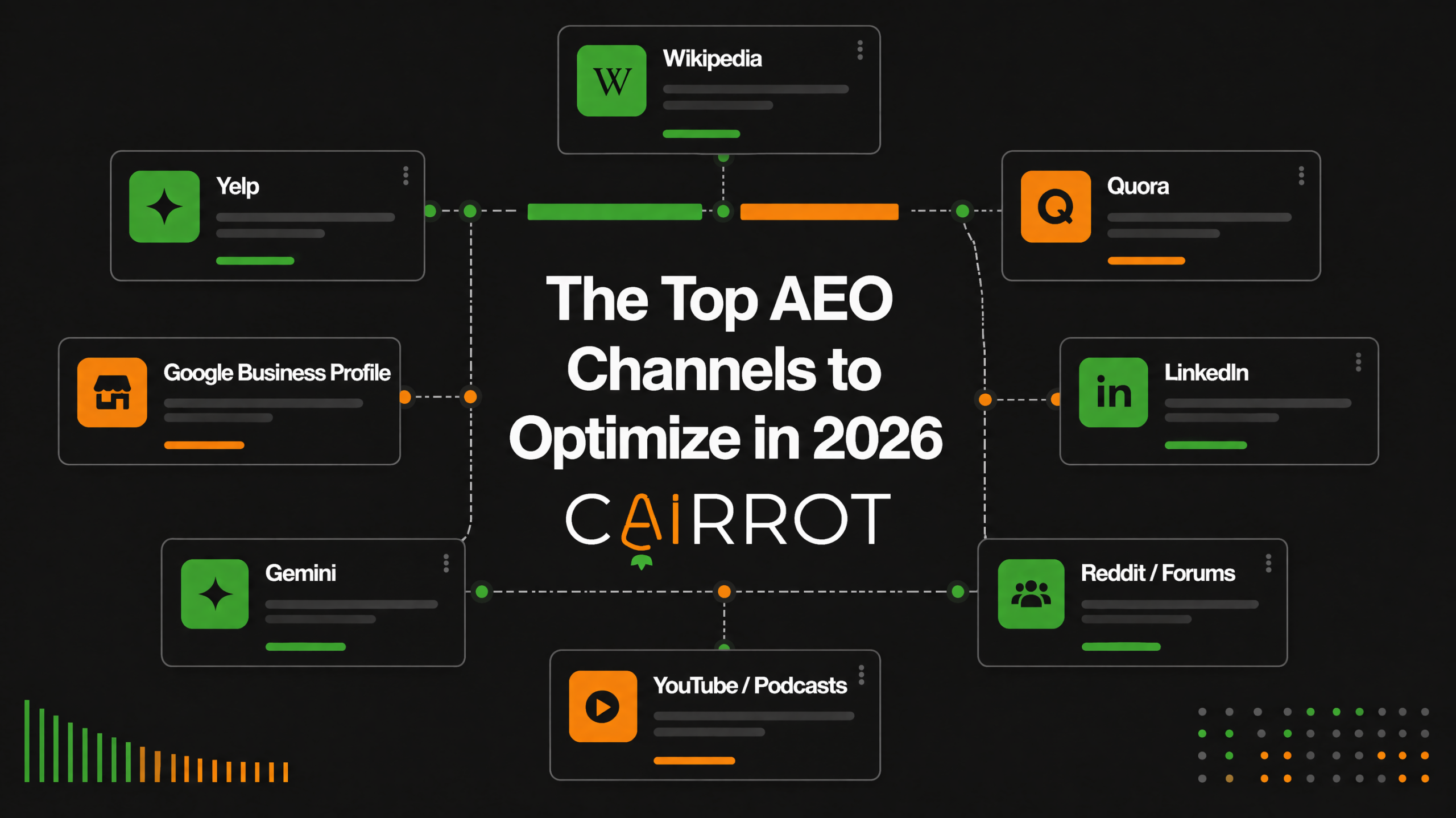
Best Content Distribution Channels for AEO
One of the fastest ways to get mentioned more often in AI search results is to improve your distribution.
Specifically, get mentioned (and hopefully linked) in the right places, with the right context, and with enough frequency to be competitive in your market. Specifically, focus on the places with the best ROI for your time.
And in 90% of cases, one of the first three things I recommend for most companies trying to launch or improve their AEO is to add and optimize at least one more key content channel to their distribution system. Preferably several channels over time, but virtually every company I’ve spoken to, of every size and industry, would enjoy a noticeable AEO boost by adding just one of the key channels covered below.
Some channels are universally recommendable for pretty much any company, some are industry specific.
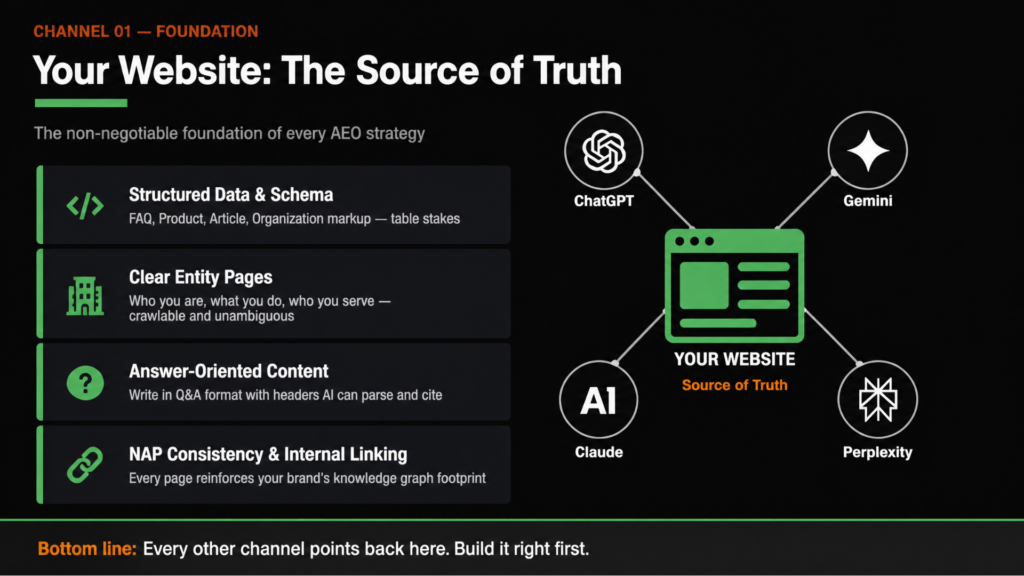
- No channel is more important than your website. Your site website is still the base of operations, and first source of truth most AI bots check and most frequently refer to. It’s the most important distribution channel for your content, and it’s where 99% of your “AEO infrastructure” lives.
- Google Business Profiles are recommended for all companies but they are critical for any local company or location-specific offering. Apple Maps and Bing Places are still relatively high on the priority list for North American companies but if you only get one done I recommend Google. Complete profiles, reviews, categories, photos, services, and review responses help you rank better in local AI searches.
- YouTube is universally recommendable for any company, any industry, and any country. Despite how popular youtube marketing has become across verticals, it’s still underused considering how strongly YouTube content marketing correlates with more mentions in AI platforms, especially Google’s Gemini and AI Overviews/AI Mode features in search.
- Reddit, Quora, Stack Exchange, and niche forums matter more than ever. Forum marketing has always been a great SEO tactic to mix in over time, but now many companies are prioritizing single forums like Reddit in their launch strategies.
- Wikipedia and Wikidata are hard to earn, but they are powerful entity grounding surfaces when a brand is actually notable enough.
- LinkedIn and review platforms are must-have channels for B2B. They help AI systems verify who is credible and which tools are worth mentioning.
- Directories, review sites, Medium, Substack, podcasts, TikTok, GitHub, and digital PR all play supporting roles depending on the client.
- Digital PR, industry publications, guest posts, and earned mentions are still the unfair advantage. Being mentioned near your category can matter as much as ranking for it.
What Counts as an AEO Content Channel?
An AEO channel is any place an answer engine can use to understand, verify, recommend, or cite a brand. That includes your website, social profiles, review sites, directories, videos, community threads, data repositories, podcasts, and earned media.
In other words, if posting content on a website or platform has AEO value, we consider it an AEO channel.
AI systems evaluate clarity, authority, comprehensiveness, recency, and structure when selecting answers. Google’s quality systems also rely heavily on experience, expertise, authoritativeness, and trust, which means authorship, citations, first-hand examples, and external recognition matter.
Explain your points clearly, prove you have the expertise to make those points, and make sure other websites and platforms are providing the same information.
Types of AEO Channels
Twenty-plus channels is a lot to hold in your head, so before the full map, here is the mental model we use at Cairrot. Every AEO channel rolls up into one of three pillars, and the pillar mix shifts a little depending on whether the client is a local business or a national B2B brand.
- Local brands (services, multi-location): All three pillars work together (Website, Maps, and External Signals).
- National and B2B brands: Website and External Signals. Maps is still an important box to check, but it requires much less attention than it would for a location-based service.
Here is what each pillar actually covers:
- Website (also called “On-page” AEO): Anything you do on your own site, such as homepage, offer and use-case pages, content, FAQs, schema, and structure. It is the most important surface, the only one you fully own, and the base every other pillar points back to.
- Maps (Google, Bing, and Apple): Anything tied to your Google Business Profile, as well as Apple Maps and Bing Places. This pillar is essential for local and multi-location businesses, but much less important for national or global services that are not reliant on local search visibility.
- External Signals: Anything that happens off your website. That includes your brand being linked to or mentioned somewhere else, including traffic and mentions from social media. Backlinks, digital PR, directory citations, reviews, and social profiles all live here. These are the third-party trust signals AI engines lean on when they decide who to cite.
The ten deep-dives below map straight onto these pillars: your website is Pillar 1, Google Business Profile and local directories feed Pillar 2, and everything from Reddit to LinkedIn to digital PR builds Pillar 3.
AEO Marketing Channels: 20+ Great Websites for AEO Content
All 20 channels from our source review, plus a few additional high-value surfaces worth tracking. The top 10 have dedicated deep-dive sections below. The remaining channels are covered in the “Beyond the Top 10” section.
20+ AEO Content Channels
Every channel worth tracking, ranked by priority. The top 10 have dedicated deep-dives below.
| # | Channel | Best For | Section |
|---|---|---|---|
| 1 | Owned website | Every brand | Section 1 |
| 2 | Google Business Profile and Maps | Local and multi-location clients | Section 2 |
| 3 | YouTube | How-to, explainers, demos, expert POV | Section 3 |
| 4 | Recommendations, comparisons, UGC trust | Section 4 | |
| 5 | Wikipedia and Wikidata | Notable entities, entity grounding | Section 5 |
| 6 | B2B expertise and founder-led content | Section 6 | |
| 7 | Quora | Long-tail Q&A, evergreen question intent | Section 4 (forums) |
| 8 | G2, Capterra, Trustpilot (review platforms) | SaaS, agencies, professional services | Section 7 |
| 9 | Medium and Substack | Syndication, newsletter audience, SEO reach | Section 8 |
| 10 | Podcasts (Spotify, Apple) | Brand authority, transcripts, backlinks | Section 8 |
| 11 | X (Twitter) | Real-time commentary, Grok feed | Section 9 |
| 12 | GitHub | Developer tools, technical credibility | Section 10 |
| 13 | Visual, lifestyle, DIY, ecommerce | Section 9 | |
| 14 | TikTok | Consumer discovery, younger demographics | Section 9 |
| 15 | Instagram and Threads | Brand discovery, entity reinforcement | Section 9 |
| 16 | Facebook and Groups | Local reach, niche community authority | Section 9 |
| 17 | Yelp and vertical directories | Local citation consistency, category answers | Beyond Top 10 |
| 18 | Crunchbase and entity databases | Firmographic answers, structured company data | Beyond Top 10 |
| 19 | Stack Exchange and niche forums | Technical and specialized query authority | Section 10 |
| 20 | Industry publications, guest posts, digital PR | Authority, earned training-data signals | Beyond Top 10 |
| + | Apple Maps and Bing Places | Local NAP consistency (complement to GBP) | Section 2 |
| + | Clutch, Houzz, Healthgrades, Avvo | Vertical directory presence by industry | Beyond Top 10 |
1. Your Website
| By the numbers: In a 6.8-million-citation analysis, first-party brand websites were the single most-cited source: 44% of all AI citations, the largest share of any source type. |
It should be no surprise that me, an SEO guy, thinks your website matters more than anything else. Even without an SEO background, this should be obvious.
The website is still the only surface you fully own. It is where every other AEO channel should point back. Your homepage explains the entity. Your offer pages explain what you sell. Your blog explains what you know. Your case studies prove it worked. Your schema helps machines understand the whole thing. And the stakes keep rising: traffic from AI platforms grew roughly 796% year over year, and AI answers now reach about 2.5 billion people a month.
This came through clearly in the source notes: the website is the base of operations, with the homepage and dedicated offer pages as the first priorities, then blog and resources building underneath.
For AEO, the website should do five jobs:
- Define the entity: who the company is, who it serves, where it operates, and what categories it belongs to.
- Define the offers: dedicated pages for every meaningful product, service, location, or use case.
- Answer the obvious questions: direct answers, FAQs, comparisons, definitions, and “best for” use cases.
- Publish citable proof: original data, client examples, screenshots, pricing logic, benchmarks, and strong opinions. (Original research and proprietary-data pages get cited at far higher rates than standard blog posts.)
- Connect the web: internal links to related pages, outbound citations to credible sources, and schema for Article, FAQ, Organization, Person, and Breadcrumb where appropriate.
| Agency note: Do not sell AEO as “write more blogs.” Sell it as entity infrastructure.If the client does not have clear offer pages, fix that before chasing Reddit threads.If the site makes vague claims no one else can verify, AI systems have no reason to trust it. |
2. Google Business Profile, Apple Maps, and Bing Places
| By the numbers: AI use for local recommendations jumped from 6% to 45% in a single year, and AI Overviews now appear on about 68% of local business queries. |
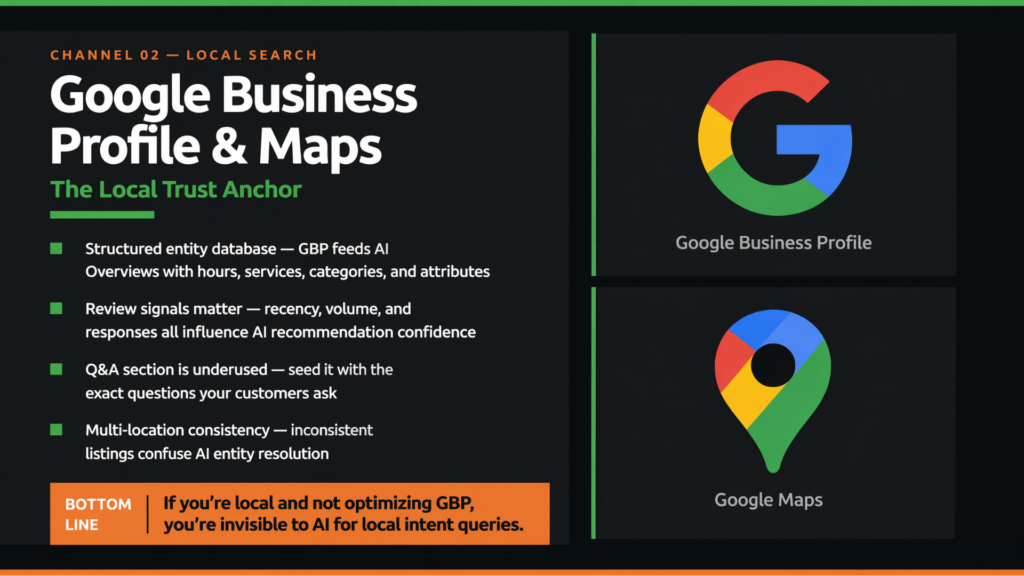
For local clients, Google Business Profile and Maps are almost as important as the website. Sometimes equally important.
The source notes call out the basics that still get ignored: keep the profile accurate, fill it out completely, add images, maintain services, use location and category language where appropriate, and respond to reviews with specific service language rather than generic “thank you” replies.
That last part is underrated. If a client gets a review about a “deep tissue massage” or “emergency roof repair,” the response should naturally mention the service. Not in a spammy way. Just clearly. AI systems and local search systems need language to connect the business to the thing people ask for.
Current local AEO research also points to Google Business Profile as a major surface for local AI answers, with reports showing AI Overviews appearing across a large share of local business queries and ranking signals that emphasize reviews and citation authority . Treat specific third-party percentages as directional, not gospel, but the strategic point is obvious: local AEO without GBP work is not a serious plan. GBP is now the single largest local ranking factor, at about 32% of local-pack weight, and it feeds AI Overviews, Maps, and Gemini directly.
Google Business Profile optimization checklist
- Audit name, address, phone, website, hours, services, categories, photos, products, attributes, and appointment links.
- Build a review response playbook that mentions the actual service, location, problem, and outcome when natural.
- Add photos regularly, especially for location, staff, product, before and after, and service proof.
- Check NAP consistency across Yelp, Apple Maps, Bing Places, Facebook, vertical directories, and local citations.
- Create local landing pages that support the profile with matching services, FAQs, reviews, and location-specific proof.
3. YouTube: The Highest ROI AEO Channel For Most Companies
| By the numbers: Across 75,000 brands, YouTube mentions were the strongest single predictor of AI visibility (0.737 correlation) — more than 3x the predictive power of backlinks. |
YouTube is annoying because it requires actual effort. You have to record. You have to sound decent. You have to publish consistently. Horrible, I know.
But that is also why it works.
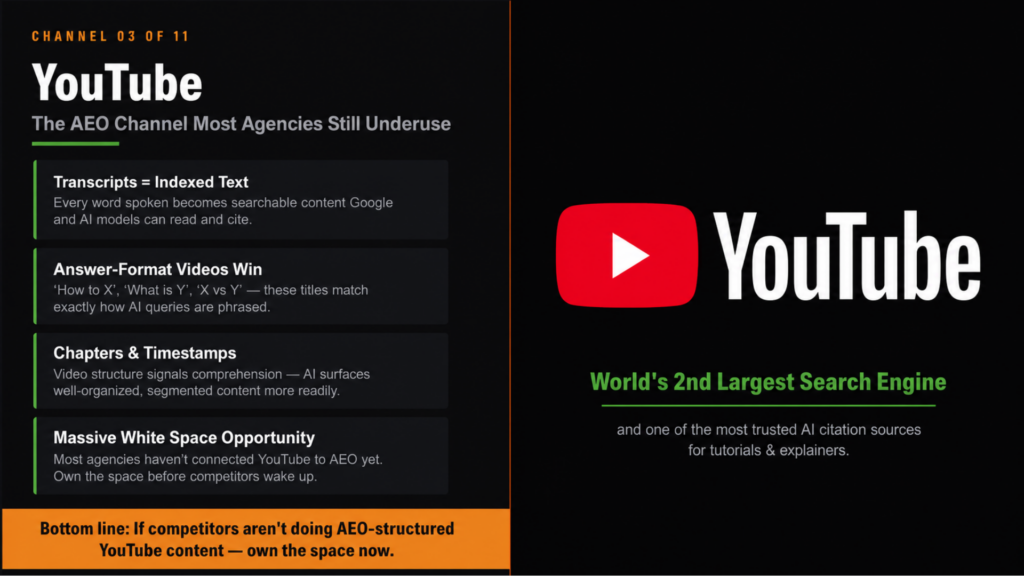
The source notes describe YouTube as a high-ROI AEO channel because AI engines can parse transcripts quickly, and because many brands still are not producing serious video content. External AEO research also identifies YouTube as a major citation source for LLM answers, with some datasets showing it cited 200x more than any other video platform because of how cleanly AI can parse transcripts and structured metadata. The platform now has roughly 2.7 billion monthly users and streams over a billion hours a day, and it already appears in about 16% of LLM answers.
The practical opportunity is not “become a YouTuber.” The opportunity is to turn client expertise into a library of machine-readable explanations.
How to make YouTube work for AEO
- Record answer-first videos. One question, one direct answer, one useful explanation.
- Use descriptive titles that match real prompts, not cute internal campaign names.
- Write strong descriptions with the entity, service, location, category, and supporting links.
- Clean up transcripts when possible and repurpose them into blogs, FAQs, LinkedIn posts, and newsletter sections.
- Embed videos on relevant website pages so your owned site and YouTube presence reinforce each other.
For agencies, this is a killer offer because you can productize it. One recording session can become a YouTube video, short clips, a blog, an FAQ block, a LinkedIn post, a newsletter section, and sales enablement copy. That is not content repurposing fluff. That is AEO distribution.
4. Reddit, Quora, and Forums (User-Generated Content)
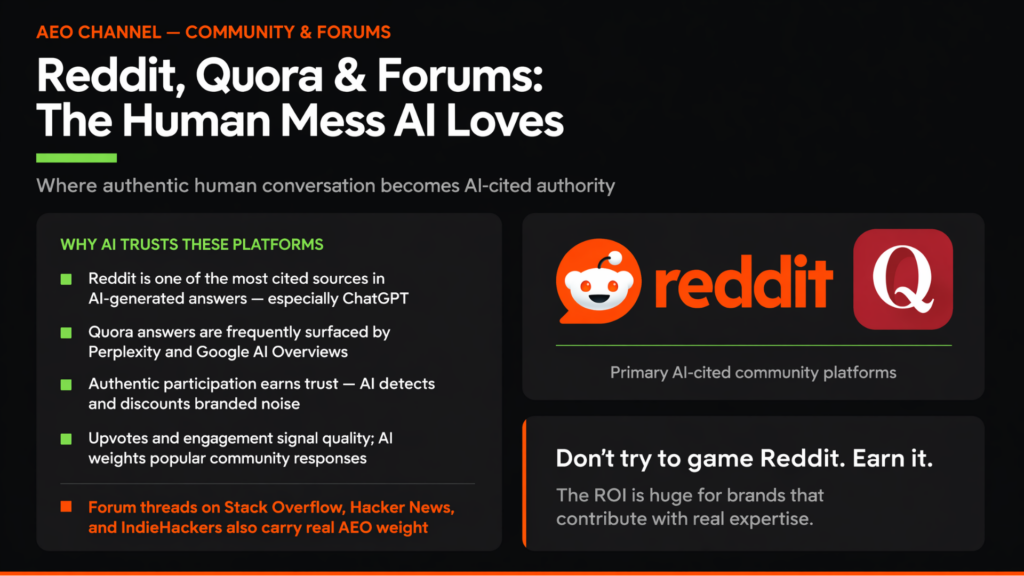
| By the numbers: Reddit is the #1 most-cited domain across every major AI engine, cited at roughly 40% frequency across LLMs. |
Reddit has been the biggest winner as searchers transition to AI tools. Maybe that is because Reddit is so naturally trustworthy and popular among consumers in every industry… or maybe their $60 million a year deal with Google in 2024 (they also signed a deal with ChatGPT the next year) helped jumpstart them as the leading forum site influencing AI search.
Reddit marketing is a top-tier tactic because it’s so effective on its own, but it is extremely difficult for most companies to implement. Reddit is the flagship example of AI engines treating user-generated community discussions as trust signals. Google also announced an expanded partnership with Reddit in 2024 that included access to Reddit’s Data API, giving Google more efficient access to Reddit content for products and model training. That probably explains why Reddit suddenly appeared in Google results far more often, and it has a direct impact on AI surfacing. Reddit is growing fast on its own too: about 126.8 million daily active users in early 2026, up roughly 19% year over year, with 471.6 million weekly.
That does not mean agencies should go spam Reddit. You’re welcome to try, but you’ll be banned and blocked before you generate any results.
Best Forums (Besides Reddit) for Influencing AI Search Results
Quora is Reddit’s quieter cousin. It is less of a cultural phenomenon but still regularly pulled into AI answers for question-shaped queries, and the content ages well. In one 129,000-domain study, a strong Quora presence carried a 4.1x lift in ChatGPT citations. Stack Exchange, niche Slack communities, and dev forums round out the forum tier for technical clients.
The right play is:
- Listen first. Identify the actual questions, objections, phrases, competitors, and comparison language people use.
- Participate when you can add something genuinely useful. No fake founder accounts. No “just discovered this amazing tool” nonsense.
- Use forum language to improve owned content. If Reddit users ask “Is X worth it for Y?” then build the best answer to that question on your site.
- Watch Quora, Stack Exchange, niche Slack communities, industry forums, and category-specific boards, not just Reddit.
- Report AEO insights back to clients as voice-of-customer research, not just “community management.”
This is where AEO starts feeling more like market research than classic SEO. Good. That is the point.
One tactical note from the source conversation: first-person, forum-like titles can sometimes give regular website content a little edge because they match the way real people ask and answer questions. Use that carefully. “I tested X for Y” can work. Fake confessionals and clickbait still smell fake.
Why is Reddit Marketing So Effective for AEO?
We’ve run several internal data studies to determine which websites are most valuable to get mentioned in if you want visibility in AI. In every scenario, Reddit is among the top 2 most cited domains (usually #1), regardless of which niche, for Gemini, ChatGPT, Perplexity, and Google AI Overviews.
Examples:
- Peec AI’s analysis of 30M sources across ChatGPT, Google AI Mode, Gemini, Perplexity, and AI Overviews found Reddit was either the #1 or #2 most-cited domain on every engine tested.
- Profound’s 680M-citation dataset (Aug 2024–June 2025) found Reddit led both Google AI Overviews and Perplexity, while Wikipedia led ChatGPT. P
Both of these results are consistent with our own findings across hundreds of thousands of prompts tracked across thousands of websites.
Trustworthy Reddit Marketing Services for AEO and GEO
I’ve reviewed at least 10 agencies offering Reddit content marketing, but I’ve only seen a few that I would feel confident recommending to most clients. My favorite Reddit marketing services are:
- Foundation’s Reddit Service, usually combined with Website and YouTube content, is a key pillar of their three-pronged AEO/GEO strategy that provides incredible results for large B2B brands. Foundation’s GEO service is masterminded by Ross Simmonds, one of my top-rated AEO/GEO speakers in 2026, and one of the industry thought leaders I respect.
- Authority Engine’s Reddit service, created and managed by Dr. Patrick McAvoy, offers more Reddit content than Foundation’s service does at a much lower price (starting at just $6,000 per mont). Dr. Patrick McAvoy is one of my favorite AEO experts to follow, and his services for both Reddit and Wikidata AEO tactics are more effective than 99% of services I’ve reviewed.
- Red-engage, a Reddit agency started by Michael Hajtas, is on my shortlist of trusted Reddit due to their impressive portfolio of case studies, which I was able to verify while speaking with Nicolas Marié, Red-engage’s growth leader.
5. Wikipedia and Wikidata: Powerful but Painfully Difficult
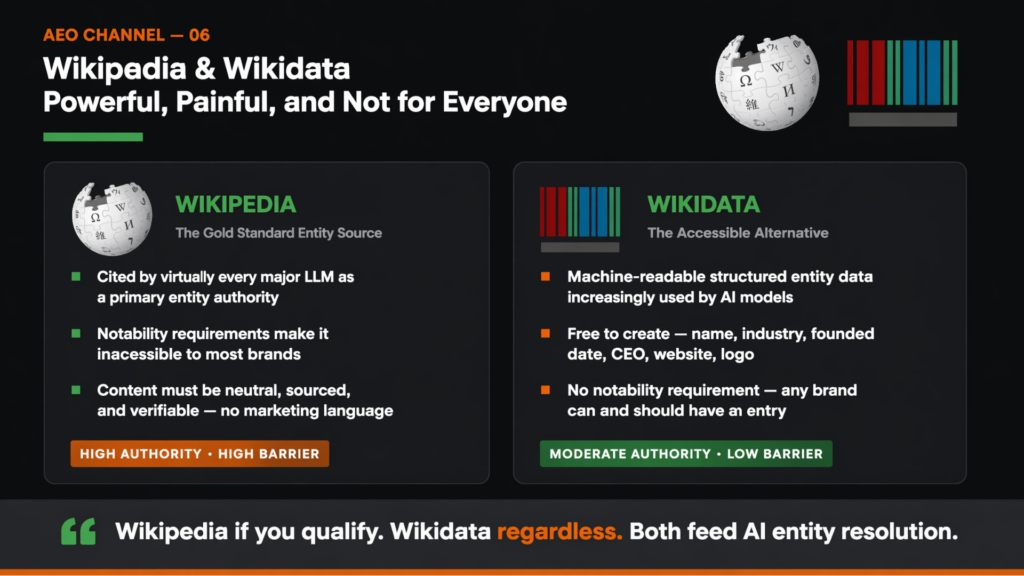
| By the numbers: Wikipedia is ChatGPT’s single most-cited source, making up about 48% of its top-10 citation share. |
A dedicated Wikipedia is maybe the single most powerful authority signals a company could have. And according to multiple studies from Profound, it is the #1 cited source in ChatGPT. One reason for that is because it is so difficult to build a dedicated Wikipedia page that gets by moderator approvals.
Wikipedia has to be mentioned this high on the list because of how powerful it is, but most clients will not be able to take advantage of this tactic when you first start working with them. Wikipedia requires notability, reliable secondary sources, neutrality, and independence. If the client is not notable, forcing it is a waste of time.
Wikidata is a different but related opportunity. It can help define entity relationships in a structured way when the entity belongs there. Current entity SEO guidance also emphasizes that LLMs rely on entity units, not just document matching. Brands not registered in Wikidata or Wikipedia risk being invisible to AI models that use these surfaces for ground-truth verification. Wikipedia’s reach is enormous, roughly 4.25 billion visits a month, making it one of the most-visited sites on earth. Like Reddit, Dr. Patrick McAvoy is one of my favorite experts to reference when it comes to Wikidata optimization for AEO ->
| Wikipedia sanity test: If the only sources about the company are its own website, press releases, and paid placements, it probably is not ready. If independent publications already cover the company in depth, there may be a path. If you have to ask whether promotional copy is okay, the answer is no. |
6. LinkedIn (Especially for B2B Content)
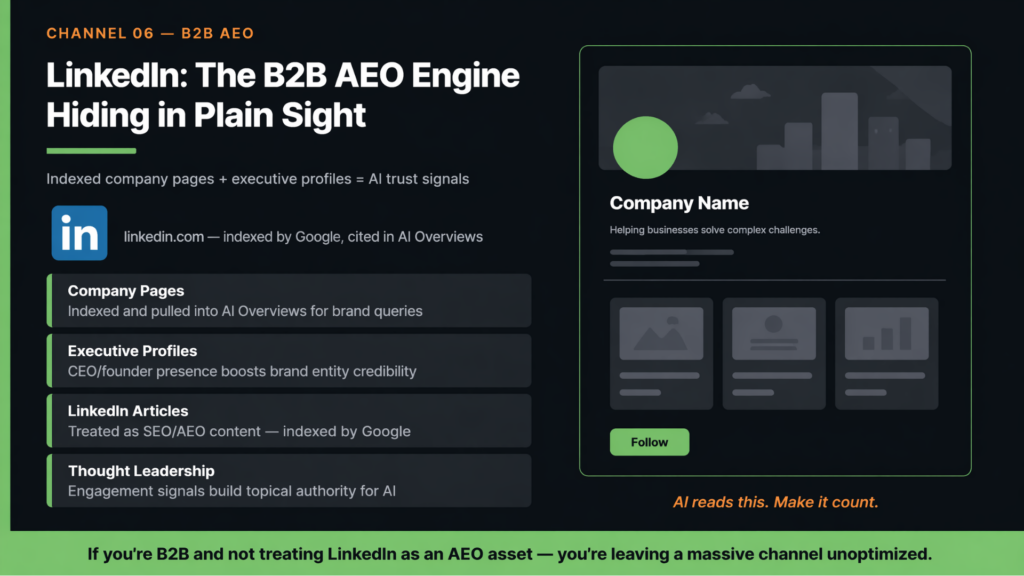
| By the numbers: LinkedIn is a top-five cited domain across major AI engines, and Google’s AI Mode references it in nearly 15% of its answers. |
For B2B, LinkedIn is not optional anymore. It is where buyers, founders, consultants, operators, and category experts make their opinions visible.
The source notes describe LinkedIn as a prime channel for B2B, enterprise, high-skill, and professional industries. The author tone reference also notes that LinkedIn is one of the strongest platforms for building consistent topical presence, which matters because AEO is increasingly tied to expert and entity signals.
From an AEO perspective, LinkedIn helps with three things:
- Author identity: Who is the expert behind the ideas?
- Topical authority: What themes does this person or company consistently talk about?
- Social proof: Do other credible people engage with, cite, or repeat the POV?
LinkedIn articles also publish at a relatively high domain authority and index reasonably well, which means a well-written LinkedIn article can show up in AI Overviews and standard search results. That is a free piece of real estate if you actually write something worth indexing. Google’s AI Mode cites LinkedIn in nearly 15% of its responses, and the platform keeps growing: 1.3 billion members, adding around 70 million a year, with Gen Z its fastest-growing cohort.
For agency clients, the LinkedIn play is simple: build a small number of credible voices around the topics the company wants to own. Not motivational mush. Not “10 lessons I learned from my dog about SaaS.” Real POVs, examples, customer lessons, teardown posts, conference notes, and opinionated explanations.
7. Review and Comparison Platforms (G2, Yelp, Trustpilot, Capterra, and More)
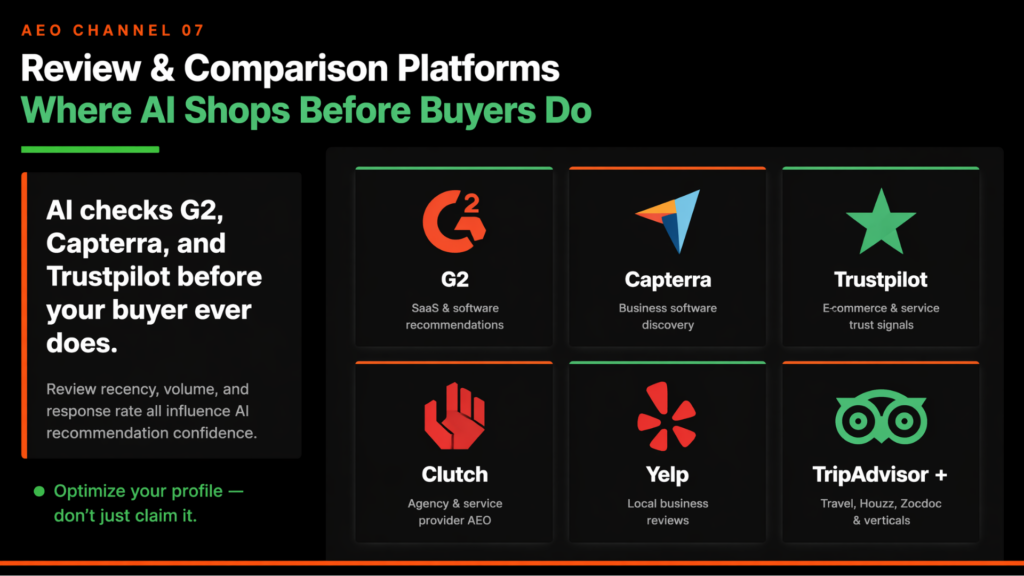
| By the numbers: 97% of consumers read reviews and the average buyer now checks six different platforms, the exact signals AI leans on to build “best X” answers. |
If your client sells software, review platforms matter. G2, Capterra, Trustpilot, SourceForge, Gartner Digital Markets, and category-specific review sites often shape “best X” and “alternative to Y” conversations.
The source notes call G2 a top priority for B2B SaaS and mention Capterra, Trustpilot, and SourceForge as important review surfaces. G2 shows up directly in Perplexity’s top domains for B2B queries, and the average buyer now consults about six different review platforms.
External research on review platforms and AI Overviews finds that these platforms remain heavily cited in software and comparison-style answers even as some review sites lose organic traffic to zero-click AI summaries . The buyer may never click the G2 page. But the AI answer may still be shaped by the review ecosystem. Reviews determine whether visitors find you at all in the AI discovery phase.
That sentence should scare review platforms a little. It should excite agencies.
Agency playbook for review channels
- Audit profiles for category fit, positioning, screenshots, pricing, review recency, and competitor comparisons.
- Build ethical review generation into customer success workflows.
- Track language customers use in reviews, then feed that language back into site copy and sales pages.
- Create comparison pages on the owned site that reflect real buyer criteria, not strawman competitor bashing.
- For non-SaaS clients, map the equivalent review ecosystem: Yelp, Healthgrades, Avvo, TripAdvisor, Clutch, Houzz, Zocdoc, or industry-specific directories.
8. Medium, Substack, and Podcast Sites (Secondary Sources)
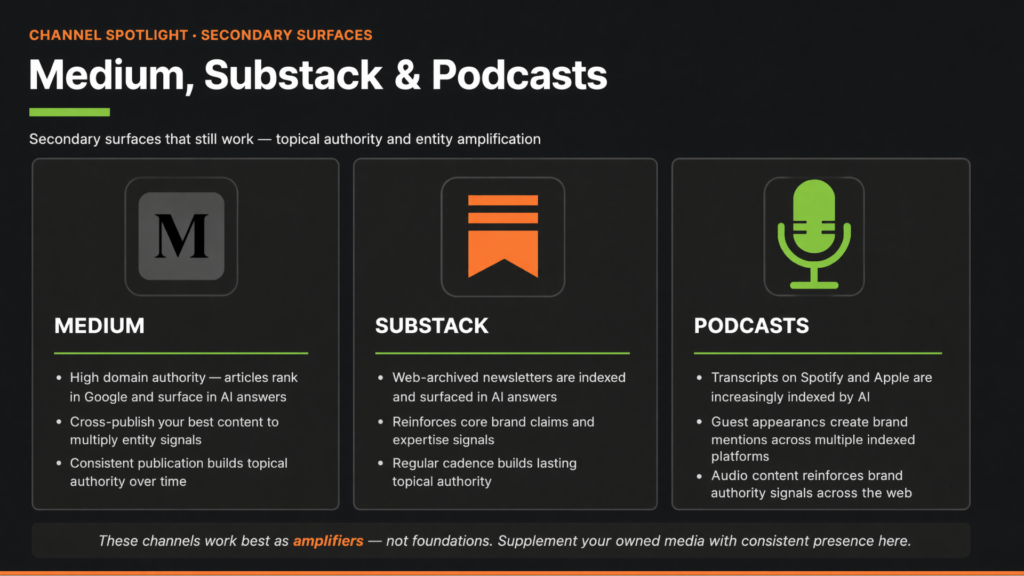
| By the numbers: Substack’s paid subscriptions doubled to 5 million+ in under two years, and podcasts now reach one in three Americans every week. |
Medium and Substack are not substitutes for your website. But they can be useful secondary surfaces when used correctly.
The source notes mention Medium as a syndication channel that previously helped listicles rank alongside the original article, while Substack is worth testing for audience and link distribution. The key is canonical discipline. Your owned site should remain the primary version when the goal is building your entity and content library. Medium was one of the biggest gainers in ChatGPT citations after September 2025, and Substack has scaled fast: paid subscriptions doubled to more than 5 million in under two years, with monthly app usage up 139% year over year.
Podcasts are also more interesting than most agencies realize. A podcast appearance creates a page, a transcript, a set of clips, host bios, guest bios, platform listings, and often a backlink. If transcripts are indexed, the conversation can become a searchable source of expert language. Podcasts now reach one in three Americans every week, and YouTube alone accounts for about 42% of podcast consumption, so those transcripts double as machine-readable answer content.
The source notes call podcasts a strong underused link and entity channel, especially because relatively few brands are doing it well. Podcast links are scarce enough that when you do earn them, they stand out.
If you already run a show, great. If not, start smaller: guest appearances, expert interviews, webinar-to-podcast republishing, and partner conversations.
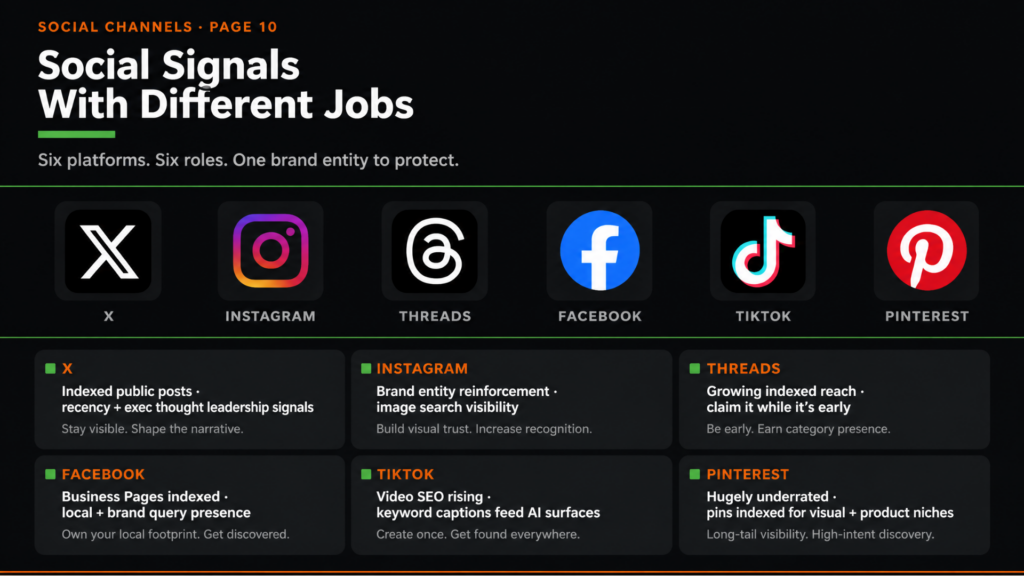
9. X, Instagram, Threads, Facebook, TikTok, Pinterest, and Other Social Medias
| By the numbers: 41% of Gen Z use TikTok as a search engine, and 53% now turn to TikTok, Reddit, or YouTube before Google for information. |
Not every social platform deserves the same level of effort. This is where agencies need to be adults in the room.
The source notes frame X as especially relevant because it feeds Grok and can re-enter the broader information ecosystem. Instagram, Facebook, and Threads are useful for brand discovery and indexed social surfaces. TikTok matters as a genuine search behavior channel, especially for younger audiences. Pinterest is useful for visual, lifestyle, DIY, design, and ecommerce intent. These surfaces are not fringe: Pinterest alone reached 631 million monthly users, and Google’s AI Overviews actively favor social content like Facebook and Yelp.
The AEO question is not “Should we post everywhere?” It is “Which platform produces evidence AI systems and buyers can actually use?”
Social Platforms: Where the Effort Actually Pays Off
Not every platform deserves the same investment. Here is what each one is genuinely good for.
| Platform | Best Use | AEO Angle |
|---|---|---|
| X (Twitter) | Real-time commentary, founder POV, technical discussions | Useful for Grok-adjacent visibility and fast idea distribution. |
| Instagram and Threads | Brand discovery, visual proof, creator-led content | Helpful for entity reinforcement and social proof, especially when content is indexed. |
| Facebook and Groups | Local reach, niche community, interest groups | Useful for intent-rich discussions and local audience signals. |
| TikTok | Short educational video, consumer discovery, demos | Increasingly used as a search behavior channel by younger audiences. |
| Visual search, ecommerce, lifestyle, design, DIY | Evergreen discovery surface for image-led categories. |
One note on Threads specifically, it is Meta’s answer to X, so if a client is already posting on Instagram and Facebook, Threads is a natural extension. It is indexed reasonably well and showing up in more search results.
Best AEO Services for Social Media Optimization
Social media content is one of those marketing channels that can easily get expensive, but it’s actually very afffordable to get started. Social media marketing services that I trust for AEO campaigns specifically include:
- Northview Agency in Tampa Florida: Northview is run by Hayden DeMars, one of the most promising young AEO experts I’ve worked with before. He specializes in AEO, SEO, and paid advertising for local service businesses. Getting Hayden to manage your social media video content starts at an affordable $900 per month and also includes website optimization.
- beCreative: For most brands, you can get all the professional level video editing you need for under $1,000 per month with a service like beCreative. Most of their team is in Slovenia, speak excellent englishl, and are commited to doing great work.
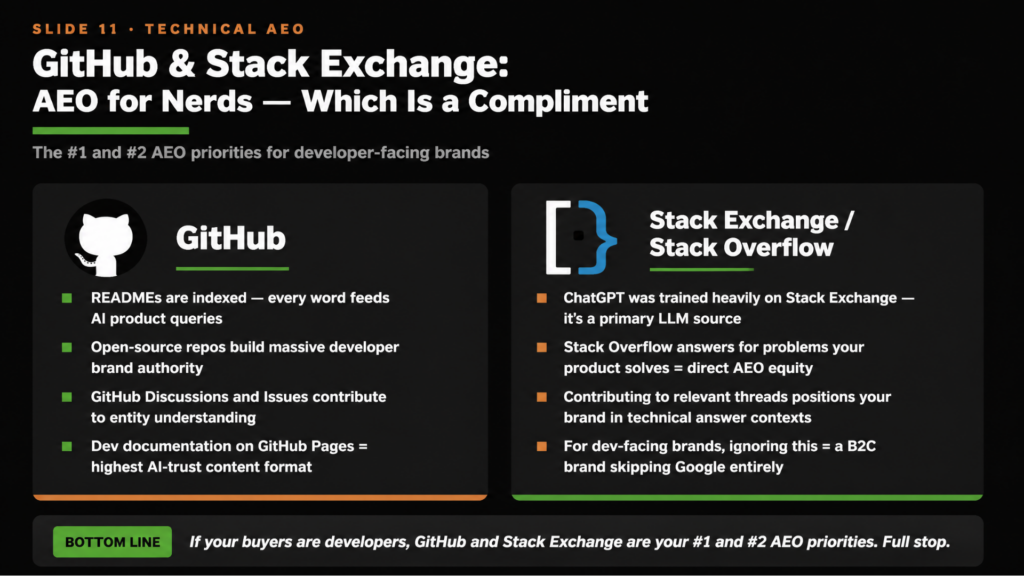
10. GitHub and Stack Exchange: AEO for Selling to Developers and Engineers
| By the numbers: GitHub hit 180 million+ developers in 2025 — adding 36 million in a single year, its fastest growth ever, atop the world’s largest code corpus of 630 million repositories. |
If your client sells to developers, engineers, data teams, IT teams, or technical buyers, technical proof matters more than polished marketing copy.
The source notes call out GitHub as a credibility channel for technical audiences and Stack Exchange plus niche forums as deep authority surfaces for specialized questions. External GEO resource lists also emphasize GitHub and technical documentation patterns as part of the broader generative engine optimization ecosystem.
For technical clients, AEO assets might include:
- Open-source repositories with real documentation.
- Example apps, SDKs, API docs, and changelogs.
- Stack Overflow or Stack Exchange answers where participation is appropriate and non-promotional.
- Technical explainers written by actual practitioners.
- Benchmark pages and comparison docs with transparent methodology.
This is also where lazy content gets exposed fast. Developers do not want a 1,500-word “ultimate guide” that never shows the command. Give them the command. The scale is the point: Stack Overflow still draws over 100 million monthly visitors and its human-curated answers are a licensed AI training source, while GitHub sits on the world’s largest code corpus, 630 million repositories that models train on and cite.
Beyond the Top 10: Directories, Entity Databases, and Digital PR
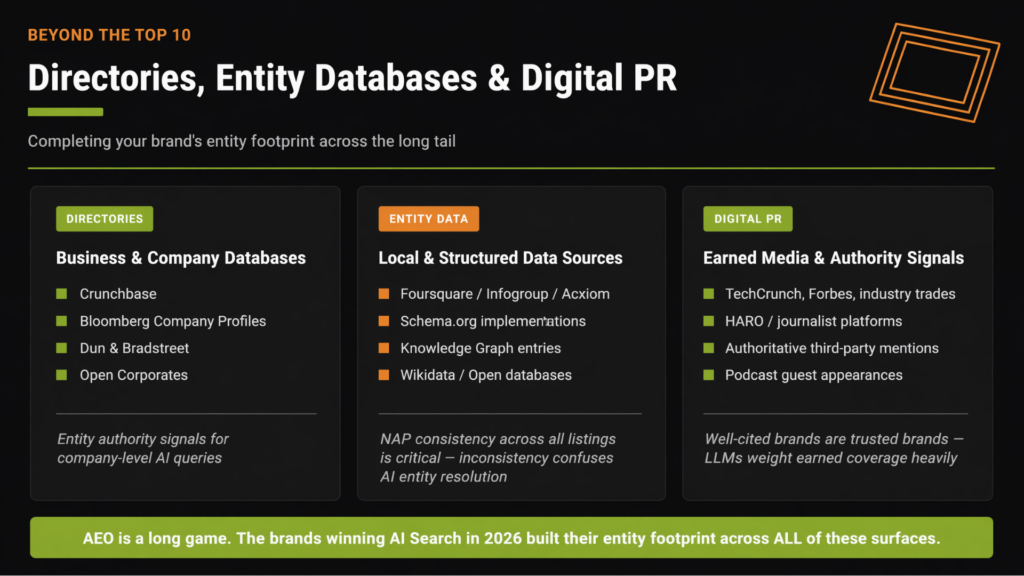
Three more channel categories from the full list deserve a real mention even without their own dedicated section.
Yelp, Vertical Directories, and Local Citations
Local citations are not glamorous. Neither is flossing. Still important.
Yelp, vertical directories, Yellow Pages-style listings, Apple Maps, Google Maps, and industry-specific directories as important for local and category-specific AI answers. For local AEO, these listings help confirm the basic facts: business name, category, address, service area, reviews, and reputation.
The agency mistake is treating directories as a one-time cleanup. For multi-location clients, accuracy decays. Hours change. Staff change. Services change. Locations close. New categories appear. Reviews pile up with no responses. Build a recurring citation maintenance process.
Crunchbase and Entity Databases
Crunchbase, Wikidata (covered in Section 5), and structured company databases give AI models structured firmographic data: founding year, team, funding, category, and description. For B2B brands, this is often the first place AI pulls a quick company summary. Keep those profiles accurate and complete. The effort is low, the ROI disproportionate.
Industry Publications, Guest Posts, and Digital PR
This is the hard one. Which is why it works. The source notes put industry publications, guest posts, and manual digital PR at the end of the list because they require the most effort, but also describe earned mentions on high-power websites as the breakthrough channel that helped Cairrot move quickly through organic connections, agency friendships, and natural relationships rather than just paid links. Conductor’s 2026 AEO/GEO benchmark research also points to the growing importance of AI referral traffic: being mentioned alongside the category in credible industry contexts is part of the brand’s external evidence layer. Digital PR will not be measured only by referral sessions anymore. It will be measured by whether the brand starts appearing in answers.
Digital PR ideas agencies can actually sell
- Original data reports built from client data or surveys.
- Partner guest posts with a real point of view, not generic contributed content.
- Expert quotes for industry roundups and journalist requests.
- Podcast guest tours for founders and subject-matter experts.
- Comparison studies that fairly explain the market and cite competitors where useful.
- Conference recaps and speaker reviews that create industry relationships and citations.
How to Prioritize AEO Channels by Client Type
How to Prioritize AEO Channels by Client Type
Where to start, what to layer on next, and what to leave alone until the base is built.
| Client Type | Start Here | Add Next | Avoid at First |
|---|---|---|---|
| Local services | Website, GBP, Maps, reviews, Yelp, vertical directories | YouTube, local PR, Facebook Groups, local publications | Wikipedia unless genuinely notable |
| B2B SaaS | Website, G2/Capterra, LinkedIn, YouTube, comparison pages | Reddit, Quora, podcasts, digital PR, GitHub if technical | Pinterest unless visual use case exists |
| Agency or consultancy | Website, LinkedIn, case studies, YouTube, podcasts | Guest posts, Reddit listening, newsletter, industry reports | Review platforms without a review generation process |
| Developer tool | Website docs, GitHub, technical blog, Stack Exchange | YouTube demos, Reddit, Hacker News-style communities, digital PR | Generic social posting without technical proof |
| Ecommerce or lifestyle | Website, reviews, YouTube, TikTok, Instagram, Pinterest | Reddit, influencer content, digital PR, buying guides | LinkedIn as a primary AEO channel |
The 90-Day AEO Channel Plan
If I were building this as an agency retainer, I would not try to do all 20 channels in month one. That is how you create a beautiful strategy deck and then absolutely nothing happens.
Days 1 to 30: Build the base
- Audit the website for entity clarity, offer pages, FAQs, schema, internal links, and answer-first structure.
- Audit Google Business Profile, Maps, directories, and review surfaces where relevant.
- Map the client’s top “AI answer” queries: best, alternatives, near me, how to, cost, comparison, and recommendation prompts.
- Identify the top 5 external surfaces that already appear for those prompts.
- Fix the most obvious profile and citation gaps.
Days 31 to 60: Create citation-worthy assets
- Publish or improve offer pages and comparison pages.
- Record 4 to 8 answer-first YouTube videos or expert clips.
- Build FAQ blocks and schema for the highest-intent pages.
- Create a review generation and response workflow.
- Turn real customer questions into blogs, LinkedIn posts, and support content.
Days 61 to 90: Expand the evidence layer
- Pitch guest posts, podcast appearances, and expert quotes.
- Participate in relevant Reddit, Quora, Stack Exchange, or niche community discussions where appropriate.
- Build or improve G2, Capterra, Yelp, Trustpilot, Clutch, or vertical directory profiles.
- Publish one original data asset, benchmark, teardown, or opinionated industry guide.
- Measure AI answer visibility, citations, brand mentions, referral traffic, and query coverage.
How to Measure and Report AEO Channel Performance
Do not measure AEO only with old SEO dashboards. Rankings still matter, but they are not enough.
AEO measurement should include:
- AI Visibility (Share of Voice): What % of time does a brand appear as a recommendation in relevant prompts within ChatGPT, Perplexity, Google AI Overviews, Bing Copilot, Gemini, Claude, and other answer environments for target prompts?
- AI Referral Traffic: How many real users hit your website because they clicked a referral link within an LLM? As visibility improves, traffic should naturally rise as well.
- Brand Sentiment in AI: How many real users hit your website because they clicked a referral link within an LLM? As visibility improves, traffic should naturally rise as well.
- Search Visibility (High-intent phrases): SEO and AEO are deeply connected. AEOs should track how many impressions target terms are getting in Google Search Console. Gains and losses in Google impressions, especially for high-intent phrases, is a leading indicator for what is about to happen to actual organic traffic.
- AI Crawls: How many times did an AI bot crawl your website in a given period? If crawls are increasing, this aQuery type coverage: best, alternatives, local, how-to, comparison, pricing, and problem-aware prompts.
- Organic Revenue and Leads: At the end of the day, the only thing that matters to most decision makers is revenue. Revenue indicators (usually tracked in GA4 or your CRM), assisted conversions, demo requests, form fills, calls, branded search lift, and sales-team anecdotal evidence.
You can do a deep-dive on AEO specific KPIs here, and see examples of how Agencies report AEO to stakeholders here ->
Examples of AEO Performance Reports & Dashboards
The AEO metrics that matter to marketing teams focused on revenue can all be analyzed and monitored within Cairrot. The following five KPIs have the closest correlation with actual revenue driven by AEO.
AI Visibility (Share of Voice)
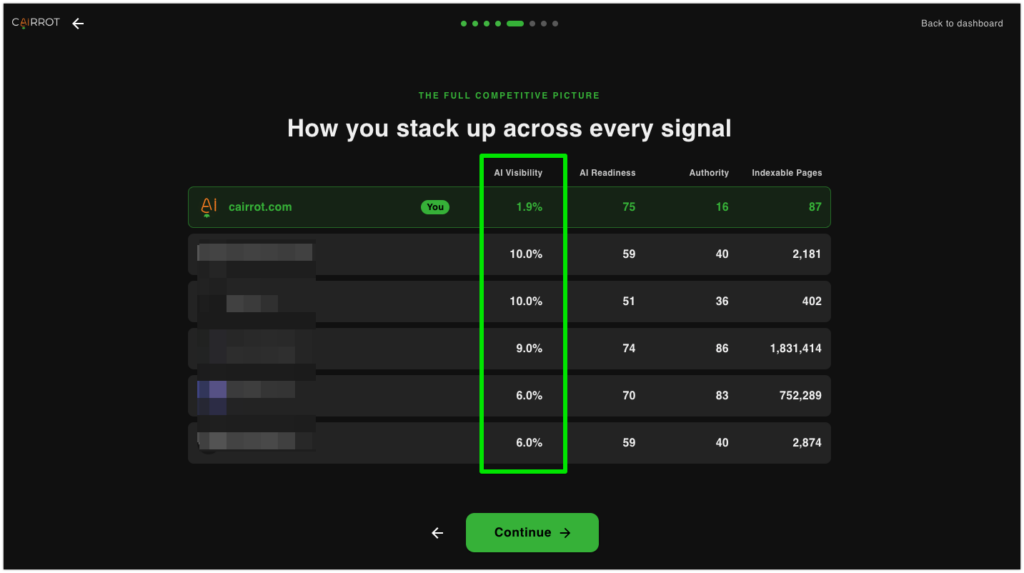
AI Visibility or AI Share of Voice is a percentage score showing how often AI mentions your brand when asked for recommendations related to your offer.
AI Referral Traffic
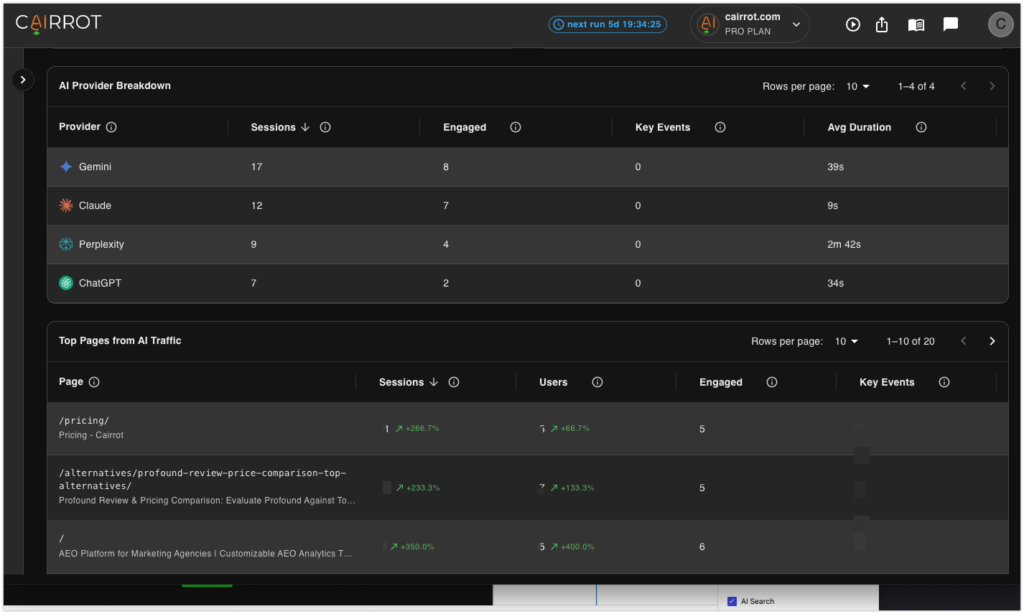
How many times did a real user click on a link on AI and land on your website? Many AEO experts would argue this is the most important metric outside of actual leads and revenue generated.
Brand Sentiment in AI
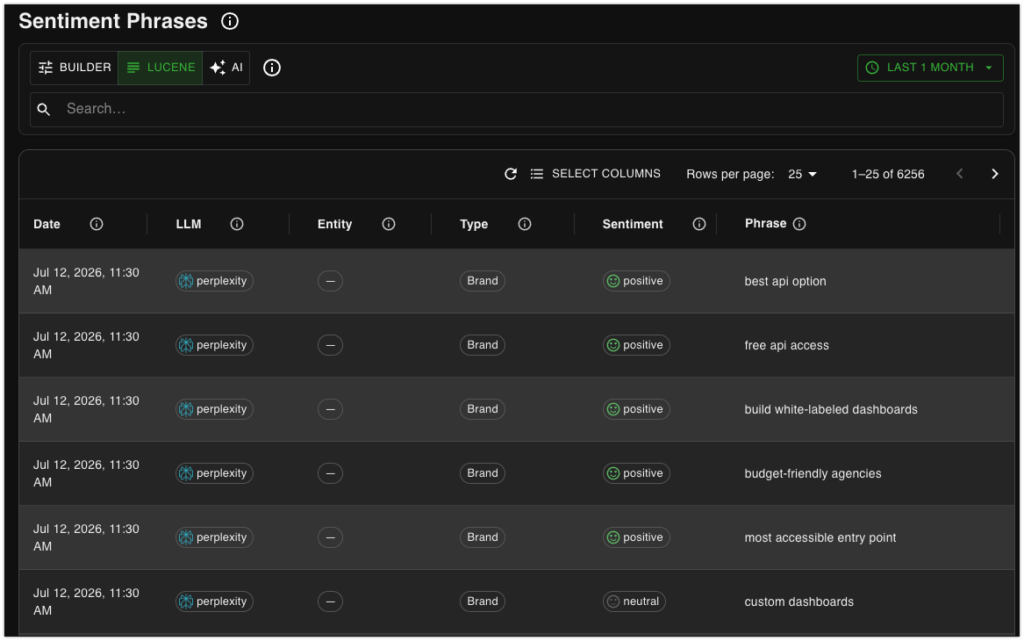
How are AI platforms describing your brand? Is story they tell both accurate and positive for you?
Search Visibility
Search visibility refers to impressions for high-intent terms within Google Search Console. If you keep appearing more often on pages 1-3 for high-intent searches, you will almost certainly be cited by AI more often.
AI Crawls
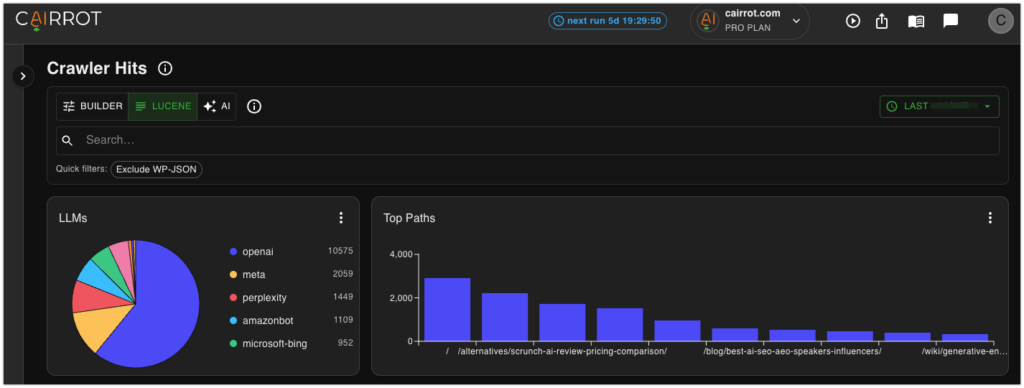
Measuring how often AI bots from different platforms crawl your website is a great leading indicator to show if AI is considering your website more often.
Common Mistakes Agencies Make Choosing Their Priority Channels
- Treating AEO like a blog package. Blogs help. They are not the whole system.
- Trying to manipulate Reddit before understanding Reddit. Bad idea, man.
- Ignoring review platforms because they do not always drive clicks. AI can still use them as evidence.
- Creating social content with no website connection. Distribution without an owned source of truth is weak.
- Chasing Wikipedia before notability exists. Build real mentions first.
- Reporting only rankings. AEO needs answer visibility, citation coverage, and entity consistency.
- Publishing generic AI content. If it could be written by any competitor, why would an AI cite you?
AEO Channel FAQ
What is the most important AEO channel?
Your website is the most important AEO channel because it is the owned source of truth. For most companies, YouTube is likely the most underused and high-ROI content channel to focus on for AEO. For local clients, Google Business Profile and Maps can be just as important. For B2B SaaS, LinkedIn and review platforms become top supporting channels.
Is Reddit really important for AEO?
Yes, but not because brands should spam it. Reddit and other forums are valuable because they contain authentic questions, comparisons, objections, and recommendations. AI systems can use that language to understand what real buyers care about.
Should every client invest in YouTube?
Not every client needs a recurring YouTube show, but most experts can benefit from answer-first video. Transcripts create machine-readable explanations, and videos can be repurposed into blogs, FAQs, LinkedIn posts, and sales content.
Do review platforms matter if AI answers reduce clicks?
Yes. A buyer may not click through to a review platform, but AI systems can still use review platforms to summarize market options, strengths, weaknesses, and category leaders.
How many AEO channels should an agency manage at once?
Start with the client’s owned website plus the two or three external surfaces most likely to influence their buyer. Local clients need GBP and directories. SaaS clients need review platforms and LinkedIn. Technical clients need GitHub and docs. Then expand.
What structured data should a blog like this include?
Use Article schema, Breadcrumb schema, Person or Organization schema, and FAQPage schema if the FAQ is published on the page. Keep dates, author details, and citations visible.
Analyze Your Brand’s Top AEO Opportunities Today
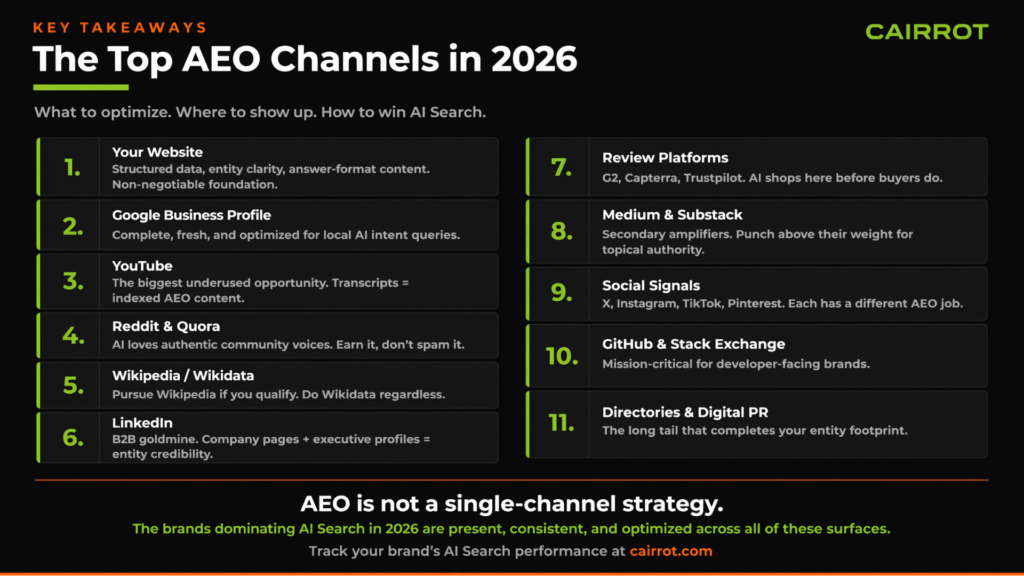
AEO is not one trick. It is not “add FAQ schema” and call it a day. It is not “post on Reddit” and pray.
AEO is the work of making your client the obvious answer across the sources AI systems already trust.
Start with the website. Lock down local and review surfaces. Turn expert knowledge into video and structured content. Listen to forums. Build real authority through LinkedIn, podcasts, publications, and digital PR. Then measure whether the brand actually shows up in answers.
That is the game. Messier than SEO? Yes. More interesting? Also yes.
And if your competitors are still treating this like a keyword spreadsheet, cool. Let them do that while you focus on actions that drive results.
Cairrot scores your Website, Maps, and External Signals in one dashboard and ranks your highest-impact fixes across every channel in this guide. Sign up and run your first AI Visibility audit in minutes ->