Cairrot

AEO Strategy Guide (2026): 32 Ways to Optimize for AI Search

aeo strategy guide (best ai seo strategies in 2026).pptx

Every SEO client I have, as well as every new company I consulted with in the latter half of 2025, have asked me about optimizing for AI search (a process known as AEO). With learnings from Cairrot’s huge bank of AI Visibility data, my own consulting practice, and partnerships with AI SEO agencies like EWR Digital, I’ve put together this guide and included over 30 examples of AEO tactics I’ve used to deliver positive results for my clients and my own brands. 

Key Takeaways

  • AEO is the new SEO: Answer Engine Optimization is about becoming the authoritative source cited in AI-generated answers (e.g., Google’s AI Overviews, ChatGPT, Grok, Perplexity), rather than just traditional blue links in Google or Bing. 
  • AI search continues to shift in 2026: LLM adoption is exploding, and as direct answers are reducing click-through rates, traditional SEO tools are insufficient. New AEO tools are needed to track AI visibility.
  • Effective AEO strategies have 6 key pillars:
    • Deep, sensical website structure (Information Architecture) with dedicated pages for products, use-cases, industries, locations, and multilingual content if applicable.
    • High-intent, authoritative content tactics: Prioritize competitor comparisons, price guides, commercial listicles, interactive tools, link magnets, and glossaries.
    • Digital PR for authority: Regular press releases, diverse link building, and strategic content repurposing across owned sites.
    • Social media & UGC engagement: Optimize profiles and contribute value on X (threads for Grok), Reddit (helpful answers), LinkedIn (professional expertise), YouTube (question-answering videos), and Meta platforms.
    • Structured data mastery: Implement schema markup (tailored for SaaS, industrial, or ecommerce) and llms.txt to make entities unambiguously clear to machines.
    • Modern KPI tracking: Shift from rankings to AI Visibility/Share of Answer, branded mentions in responses, citation clicks, and supporting metrics like traffic to high-intent pages.
  • Success requires machine-readable clarity: Combine factual accuracy, structured data, topical authority, and web-wide trust signals so AI engines confidently cite your content as the definitive source.

Table of Contents

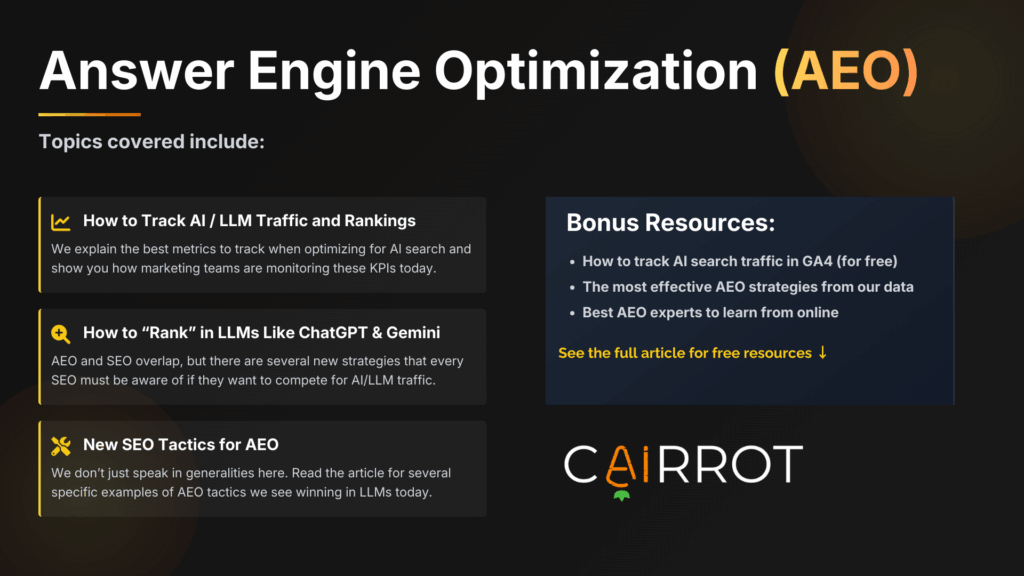
Answer Engine Optimization 101

answer optimization guide (how to do aeo, best strategies, best ways to learn, how to track, and best tools for aeo)

Answer Engine Optimization (AEO) is the strategic process of creating and optimizing digital content so it can be easily found, understood, and presented as a direct answer by AI-powered search technologies. These “answer engines” include Google’s AI Overviews (powered by Gemini), OpenAI’s ChatGPT, xAI’s Grok, Perplexity, and others. AEO moves beyond traditional SEO by focusing not just on ranking a link, but on becoming the authoritative source for the information that forms the AI’s generated response.

At their core, they help you answer critical questions like:

  • Is my brand being mentioned when users ask relevant questions?
  • What is the context and sentiment of those mentions?
  • Are my competitors showing up more often than I am?
  • Which of my web pages or data sources are being cited by the AI?
  • How is my visibility changing over time across different AI models?

How Is AEO Actually Different Than SEO?

SEO and AEO are different but deeply interconnected. Think of AEO as the next evolution of Search Engine Optimization (SEO). While SEO primarily focuses on ranking your webpage in a list of blue links, AEO aims to have your content, facts, and brand directly integrated into the AI-generated answer itself. This often means the user gets their answer without ever clicking a link.

  • SEO Goal: Achieve a high rank for a webpage link in search results.
  • AEO Goal: Become the cited, authoritative source within a direct, AI-generated answer.

AEO builds on SEO principles but places a much heavier emphasis on content clarity, factual accuracy, structured data (like Schema markup), and establishing topical authority in a way that is digestible for machines, not just humans.

How Is AEO Actually Different Than SEO?

You may see several acronyms used to describe this new field. Here’s how they relate:

  • AEO (Answer Engine Optimization): The broadest term, encompassing the entire marketing strategy of optimizing for AI-driven answer platforms.
  • GEO (Generative Engine Optimization): Essentially a synonym for AEO, focusing on optimizing for “generative” AI engines.
  • LLMO (Large Language Model Optimization): A more technical and specific subset of AEO. LLMO focuses on the tactics of structuring content and data to be perfectly parsed and understood by the Large Language Models that power answer engines.

We treat all these terms as the same thing at Cairrot. 

Digital Marketers Are Transitioning From SEO to AEO in 2026

answer optimization guide (how to do aeo, best strategies, best ways to learn, how to track, and best tools for aeo)

The transition from traditional search to answer engines is already here. In 2026, the search marketing landscape will be reshaped by this transition (even more than it already was in 2025). Here’s how we can visualize the change:

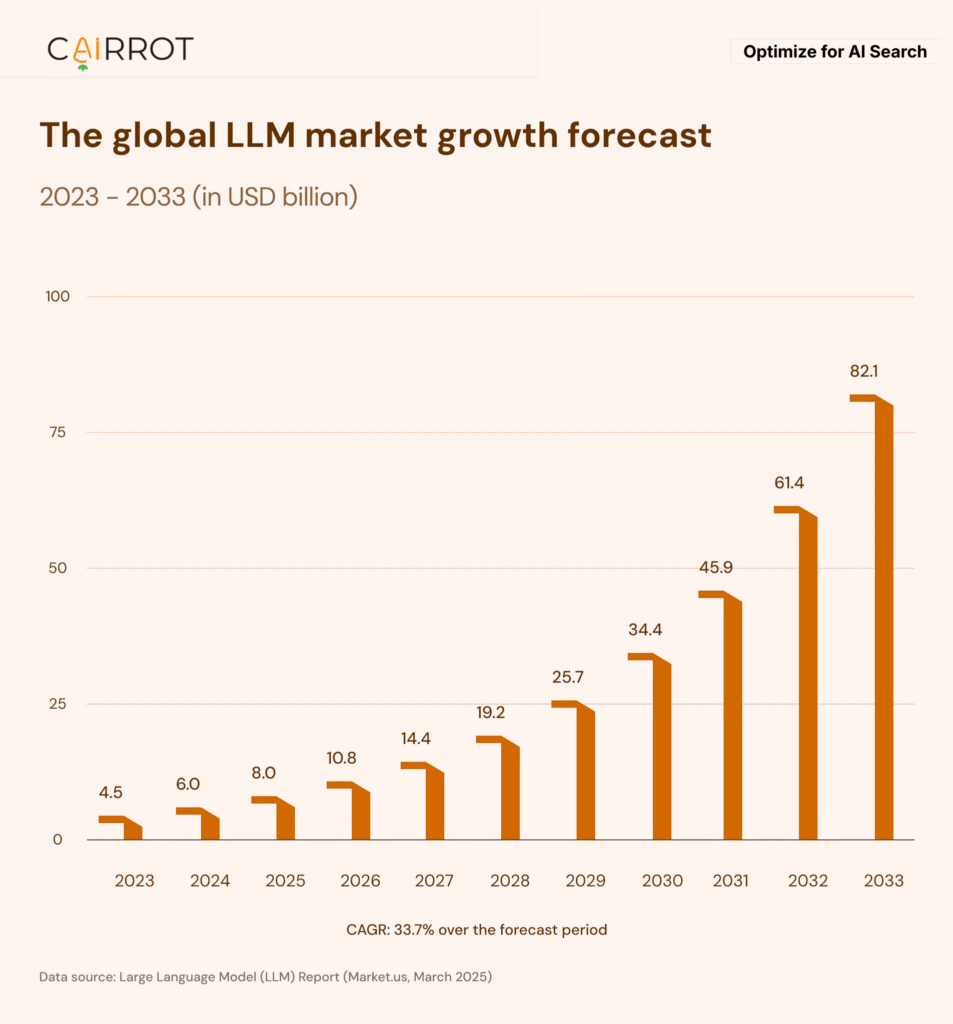
AI Search and LLM Growth Is Explosive

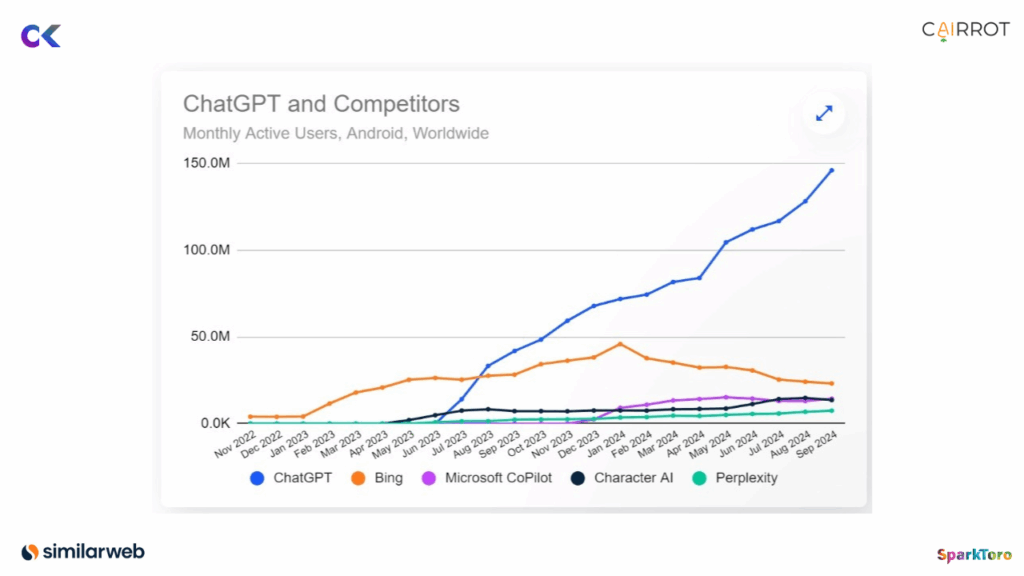
The adoption rate of Large Language Models (LLMs) for information retrieval has been meteoric. Users are increasingly turning to conversational AI for complex questions, product recommendations, and summaries, bypassing traditional search methods.

global llm market growth forecast

As someone who has been in the trenches with with SEO clients for years, I have never seen anything shake up the digital marketing landscape more dramatically and quickly than the introduction of LLMs and AI search features like Google’s AI Overviews. In the last six months, all my current clients have asked about AI search, and every new client that found me say they were specifically searching for an AEO expert to help them (although some of them used other terms like “AI SEO” or “GEO.”

And if LLMs grow at the rate they are forecasted (or even moderately close to predictions), marketing companies are only going to see more aggressive demand for AEO-related tools and services.  

Early AEO Strategies Revolved Around ChatGPT, But Gemini, Claude, and Grok Are On the Rise

ChatGPT sprinted ahead of competitors in 2024-2025, achieving unprecedented user growth and establishing itself as a household name and becoming synonymous with conversational AI. Its widespread use has conditioned millions of users to expect direct answers over lists of links.

best llm to optimize for (chatgpt vs competitors)

However, ChatGPT (and OpenAI’s Sam Altman) have been under intense pressure in recent headlines as competitors like Grok, Gemini, and Claude continue to overperform expectations in industry benchmarks and become popular for niche-specific use-cases (more on that further in the article). 

Leading AI Chatbot Platforms Comparison (as of early 2026)
Leading AI Chatbot Platforms Comparison (as of late 2025)
Platform User Base Growth in 2025 Latest Model & Benchmark Performance
Grok (xAI) 38 million MAU
(as of mid-December 2025)
Grew from 0 users at the start of the year to 38 million MAU by mid-December; 6% quarterly user growth.
Overall traffic to GenAI sites increased 76% YoY, with Grok leading in user engagement time at nearly 8 minutes per session (33% longer than ChatGPT).
Grok-4 leads in coding (75% on SWE-bench) and reasoning (87.5% on GPQA Diamond, 100% on AIME 2025 math reasoning), outperforming GPT-5 (74.9% SWE-bench, 83.3% GPQA), Claude 4 Sonnet (72.7% SWE-bench, 75.4% GPQA), and Gemini 2.5 Pro (67.2% SWE-bench, 86.4% GPQA).
Competes strongly in autonomous coding and complex logic but has higher costs ($3/$15 per million tokens).
ChatGPT (OpenAI) 800–900 million WAU
(equivalent to roughly 1–1.2 billion MAU; DAU/MAU ratio of 36%)
Doubled weekly active users from 400 million in February to 800 million by late 2025; 23% YoY desktop user growth, 7% quarterly growth; global MAU climbed 180% YoY as of November.
Paid subscriptions grew 155% YoY.
GPT-5 excels in complex coding (74.9% SWE-bench) and reasoning (83.3% GPQA); balanced performance with low costs ($1.25/$10 per million tokens) and good speed (65.5–122.8 tokens/second).
Dominates market share (61.3%) but saw slower growth compared to competitors.
Gemini (Google) Approximately 350–450 million MAU
(34–40% of ChatGPT's scale; reached 450 million by July)
155% YoY desktop user growth (accelerating monthly); Pro subscriptions up nearly 300% YoY; 12% quarterly user growth.
Market share rose from 5% to 18%.
Gemini 2.5 Pro strong in reasoning (86.4% GPQA) and large codebases (67.2% SWE-bench); leads in speed (275 tokens/second for Flash-Lite) and cost ($1.25/$10 per million tokens).
Best bang-for-buck in coding and writing per some analyses.
Claude (Anthropic) 19–30 million MAU
(19 million in Q3, up to 30 million in Q2)
40% increase in MAU from Q2 2024 to Q2 2025; 14% quarterly user growth; expected to reach 18.9 million in H2.
Focused on prosumer tools like Claude for Chrome.
Claude 4 Sonnet performs well in coding (72.7% SWE-bench) with strengths in documentation; reasoning at 75.4% GPQA; higher costs ($3/$15 per million tokens) but twice as fast as previous versions.
Often tops in writing and depth.

B2B Companies Are Shifting Towards Claude and Gemini Optimization While B2Cs See Growth in Grok and Niche-LLMs

The market is not a monopoly. Google is integrating its powerful Gemini model directly into its search results. Elon Musk’s xAI is leveraging the real-time data of X (formerly Twitter) to power Grok. This multi-platform environment means a successful AEO strategy cannot focus on just one answer engine.

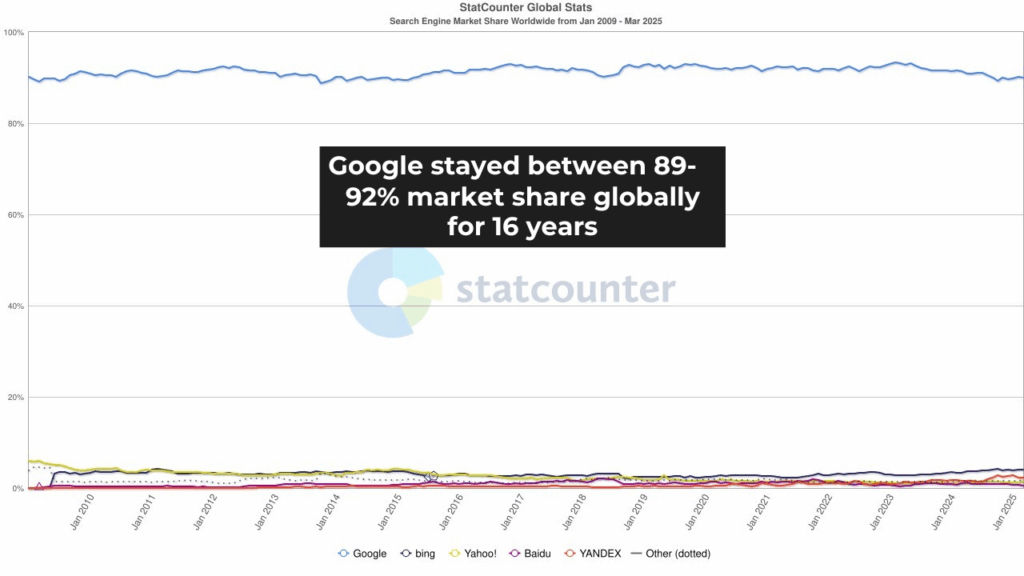
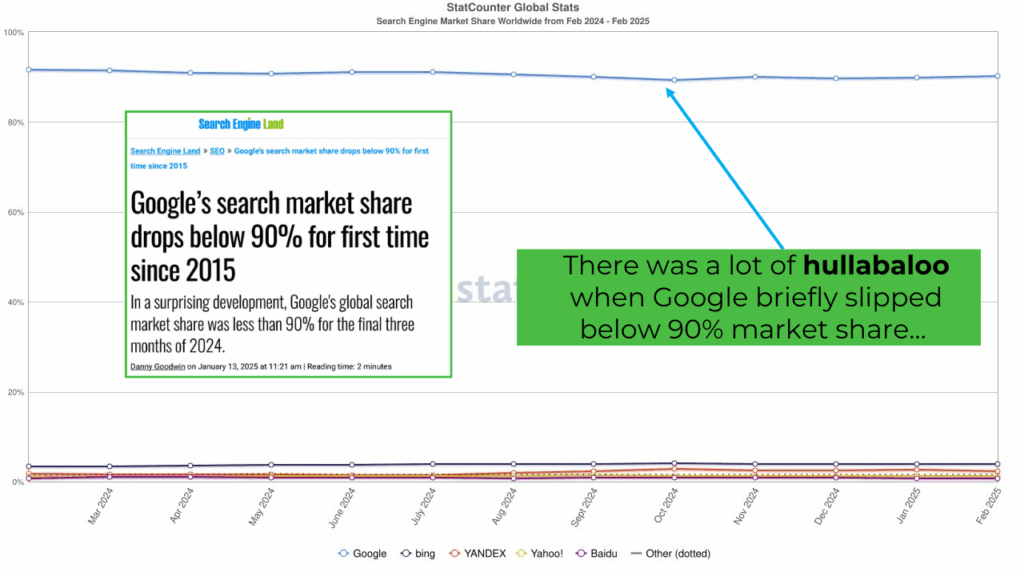
Traditional Google Searches Are Not Decreasing (Reportedly), But Their Market Share is Under Attack

While reports suggest raw search volume remains stable, this statistic can be misleading. The critical change is in user behavior. With AI Overviews and rich snippets answering queries directly on the search engine results page (SERP), click-through rates (CTR) to organic results are declining for many query types. The value of a #1 ranking is diminishing if the user gets their answer without needing to click.

SEO Week 2025 - Rand Fishkin - You Are Bigger than SEO.pdf (6)

google search market share 2026

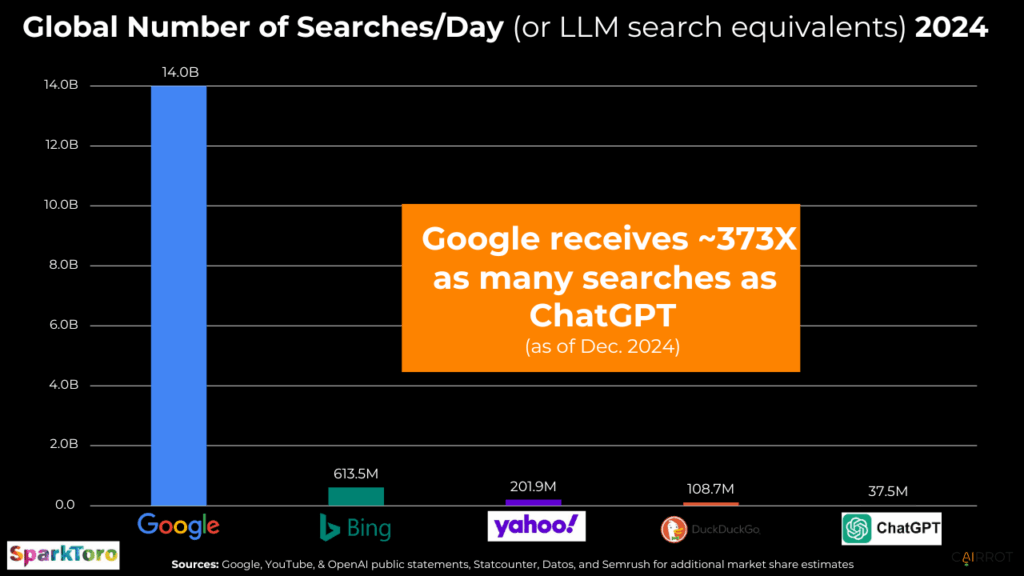
We don’t think that means Google is in trouble anytime soon. Google can lose market share and still continue to grow if more users enter the market, which they are. And their position has been so dominant, even hyper-growth alternatives like LLMs will take years to catch up, giving Google some time to solidify their positions in the developing market.

search engine vs llm search trends

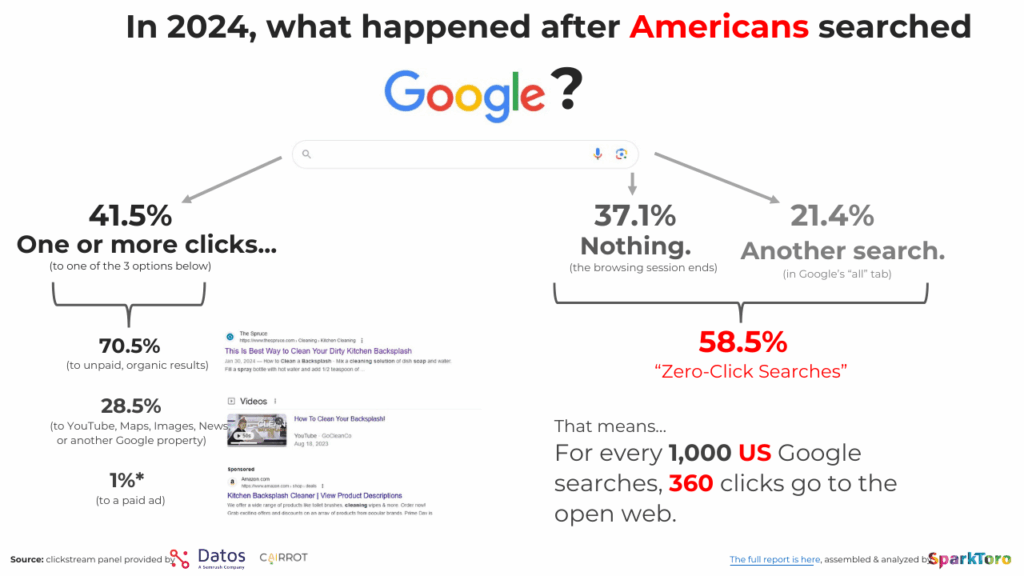
Websites Are Receiving Less Organic Traffic Ever Since Google Launched AI Overviews (Zero-Click Searches)

zero click search trends

A zero-click search happens when a user searches their query and find their answer without ever clicking into a new website. Zero-click searches, which are good for Google and bad for webmasters, are on the rise since the introduction of Google’s AI Overviews early in 2024. 

Key takeaways:

  • Webmasters report less traffic, but not always a loss in leads or revenue 
  • On the software/tools side of the market, this presents challenges to marketing analytics platforms, especially SEO rank trackers like Semrush and Ahrefs as alternatives (LLM rank trackers) emerge
  • On the marketing and sales services side, challenges arise in reporting and measurement. No LLM currently has an advertising platform (enjoy that while it lasts), and users who discover a brand in an LLM will often be attributed to traditional SEO, direct traffic, or simply go unmeasured in standard tools like Google Analytics 4. 

Typical Marketing KPIs Are Expanding To Include “AI Visibility”

Classic SEO tools built to track keyword rankings are becoming insufficient. Now marketing teams are trying to measure their influence in LLMs through channel metrics like how often they are mentioned or cited by various LLMs compared to their competitors. This suite of metrics is known as “AI Visibility” and requires tools that can track these metrics and display your data in a useful format. 

Rising demand for AI search analytics have led to a rise in AI Visibility Tools (also known as LLM Tracking or Monitoring). Top early entrants into the AI visibility space (American companies) include: 

  • Cairrot: reason 
  • AthenaHQ: reason 
  • Profound: reason
  • Evertune: reason 
  • Gumshoe AI: reason

Key Pieces Of Every AEO Strategy

A robust AEO strategy is a multi-faceted approach that integrates technical precision with high-quality content and strategic outreach. The core pillars of a successful AEO campaign are:

  1. Your Website Structure (IA) and Page Choice: How your site is organized and the pages you choose to build.
  2. Website Content: The quality, depth, and type of information you provide.
  3. Digital PR: Building authority and earning mentions across the web.
  4. Social Media and Discussions (UGC): Engaging in the platforms where real-time information is generated.
  5. Structured Data and Technical Considerations: Speaking the language of machines through code.
  6. KPI Tracking: How to measure and report on AEO success.

We explore each of these pieces in detail throughout this guide.

Website Structure (Information Architecture) and Landing Page Strategies for AEO

Your website’s Information Architecture (IA) is the bedrock of your AEO strategy. A flat, disorganized site is incomprehensible to an LLM trying to determine your expertise. To be seen as an authority, you must build a comprehensive and logical hierarchy of pages that covers your entire business landscape.

Why is a deep page structure crucial for AEO:

  • They rank for high-intent keywords: Pages dedicated to specific services, products, or solutions naturally target long-tail, high-conversion keywords.
  • These are the highest converting page types: Users looking for a “CRM for manufacturing companies” are much further down the buying funnel than those searching for “what is a CRM.” Dedicated pages capture this high-intent traffic.

You “check the box” for LLM recommendations: When an LLM processes a query like “What’s the best welding robot for automotive assembly?”, it scans its knowledge base for entities that specialize in “welding robots” AND “automotive industry.” By having dedicated pages for your products, use-cases, and the industries you serve, you provide clear, structured signals that you are a relevant and authoritative match for the query.

B2B SaaS Example

A B2B SaaS company selling project management software should move beyond a single “Features” page. A strong AEO structure would include:

  • Product/Service Pages: A main page for the software, plus dedicated pages for different pricing tiers (e.g., “Enterprise Plan,” “Business Plan”).
  • Solutions/Use-Cases: Pages targeting how people use the software, such as “Project Management for Marketing Teams,” “Software for Agile Development,” or “Task Management for Remote Work.”
  • Industries: Pages demonstrating expertise in specific verticals, like “Project Management for Construction,” “Software for Healthcare Administration,” or “Tools for Financial Services.”

International (Multilingual) Example

Dialpad boasts an excellent multilingual AEO strategy. Their success is built on a few key principles:

  • Excellent IA (Folder Structure): They use clear URL structures like /fr/ for French and /jp/ for Japanese, making it easy for search engines to understand the language and region of each page.
  • Targeted Translation: They don’t just translate their homepage. Their top-performing product and solution pages are professionally translated and localized for their key international markets.
  • Consistent Internal Linking: Pages within the French section of the site link to other French pages. This keeps users and search crawlers within a consistent language experience, reinforcing regional authority.
  • Easy Language Toggling: A user-friendly language switcher allows visitors to easily navigate to their preferred language, improving user experience.

Law Firm Example

A niche law firm like one specializing in maritime law can use site structure to dominate its vertical. An effective structure includes:

  • Optimized Homepage: The homepage clearly states their main practice area (maritime law) and top service locations (e.g., Seattle, Portland).
  • Dedicated Location Pages: A unique page for every office location and major port or area they serve.
  • Dedicated Practice Area Pages: Specific pages for every type of case they handle, such as “Jones Act Claims,” “LHWCA Claims,” and “Wrongful Death at Sea.”
  • Dedicated Client Pages: Pages that speak directly to their target clients, like “Legal Help for Offshore Workers,” “Representation for Longshoremen,” and “Claims for Commercial Fishermen.”

B2B Industrial (Manufacturers) Example

SKS Welding Systems (sks-welding.com) provides a masterclass in AEO for the industrial sector:

  • Clear Homepage Navigation: The homepage acts as a hub, immediately linking to their top products and solutions.
  • Granular Page Dedication: They have distinct pages for every type of robot they sell, the specific use-cases they address, and the industries they specialize in.
  • Detailed Schema Markup: They use structured data on their pages to explicitly tell search engines what each product is, its specifications, and its applications.
  • Robust Multilingual Strategy: All key pages are professionally translated into multiple languages, including English and German, to capture a global market.
  • Optimized Imagery: They feature numerous high-quality images of their products, complete with descriptive filenames, detailed descriptions, and optimized alt text, providing another layer of information for answer engines.

Best Content Strategies for AEO

Content for AEO must be precise, authoritative, and directly answer user questions. The goal is to create content that is so useful and well-structured that an AI engine chooses it as the definitive source. Prioritize creating content that targets users who are close to making a purchasing decision.

  • Focus on high-intent content first: Target transactional and commercial investigation keywords. These are the queries users make when they are actively evaluating solutions and are ready to buy.
  • Create high-conversion topic clusters: Across most industries, certain content formats consistently drive conversions. These include direct comparisons with your competitors, comparisons between your own products or service tiers, detailed industry pricing guides, and how-to content that solves a problem using your product.
  • Build interactive tools: Free, valuable tools are powerful assets for AEO. For example, a telecom company could offer a “Monthly Bill Calculator” that estimates costs based on call volume, number of users, and feature needs. This not only provides immense value but also captures highly qualified leads and serves as a linkable asset.

Competitor Comparisons & Reviews

This content tactic involves creating detailed, honest comparisons between your product and your competitors’ products. For example, a page titled “[Your Product] vs. [Competitor A]” or “Best [Product Category] Software: [Your Product], [Competitor A], and [Competitor B] Compared.” These pages directly capture users in the final stages of their decision-making process. To be effective, they must be balanced and genuinely helpful, not just a sales pitch. Acknowledge your competitors’ strengths while clearly articulating your unique advantages. WordPress Dynamic’s Top 10 AI Visibility Tools is a great example. 

Buyer's Guides (Price Comparisons)

Creating a detailed pricing guide for your industry is a powerful AEO strategy. Why? Because nearly every B2B and B2C buyer searches for pricing information before they engage with sales. If you are not transparent about costs, you risk letting your competitors or third-party review sites control the pricing narrative. A comprehensive guide that explains the factors that influence price (e.g., number of users, feature tiers, implementation fees) establishes you as a transparent, trustworthy authority. Even if you don’t list specific prices, explaining *how* pricing works in your industry is incredibly valuable content.

Helpful Listicles

Listicles, or articles structured as lists (e.g., “7 Ways to Improve X,” “Top 5 Tools for Y”), are highly effective for AEO because they are easy for both humans and machines to parse. Prioritize listicles that address commercial-intent topics. Instead of “5 Fun Facts About Marketing,” create “5 Marketing Automation Tools That Integrate With Salesforce.” This targets users looking for a solution. For further reading on creating effective, research-backed content, you can explore resources like SES Research.

Link Magnets and Free Tools

A “link magnet” is a piece of content or a tool so valuable that other websites naturally want to link to it. Free tools are the ultimate link magnets. They provide ongoing utility to users, generate high-quality backlinks, and position your brand as an innovative leader. A great example is iPullRank’s QFA (Questions, Facts, and Answers) tool, which helps marketers identify key entities and questions related to a topic—a perfect tool for the AEO era that also serves as a powerful promotional asset for their agency.

Glossaries

Creating a comprehensive glossary of industry terms is a foundational AEO tactic. It establishes your website as a definitive resource for your niche. Each definition can be a standalone piece of content that answers a specific “What is…” query. By internally linking from glossary terms to your relevant product or service pages, you create a powerful web of contextual relevance that helps both users and answer engines understand the full scope of your expertise. A prime example is Cairrot’s own AEO glossary, which helps define the very field it operates in.

Best Digital PR Strategies for AEO

Digital Public Relations, which includes link building, has always been a cornerstone of SEO. For AEO, its importance is magnified. Answer engines rely on signals of authority and trust from across the entire web to validate information. When reputable websites link to or mention your brand, it acts as a vote of confidence, telling LLMs that your content is credible and worthy of being featured in an answer. A strong digital PR strategy ensures that the web’s consensus about your brand aligns with the narrative you want to project.

Online Press Releases

This tactic involves the regular publication and distribution of press releases that communicate your company’s news, achievements, and desired narrative. For AEO, press releases serve as a tool to inject your brand and key messages into the news ecosystem, which is a primary source for many LLMs.

  • Strategy: Regularly release press releases that paint your desired narrative about your company, such as new product launches, partnerships, or market research findings.
  • Linking: These press releases should always link back to your website multiple times. Use varied anchor text and link to different relevant pages (e.g., link a new product name to its product page, and your company name to the homepage).
  • Frequency: Small companies should aim to publish a press release at least once every six months. Larger brands, especially in competitive spaces like B2B SaaS and Industrial, should publish one every 2-3 months to maintain a steady stream of authoritative signals.

Classic Link Building

Traditional link building tactics remain vital for AEO, as each link is a signal of authority. A diverse link profile from relevant, high-quality sites is essential.

  • Direct Outreach: Manually contacting webmasters of relevant sites to request a link to your valuable content (like a tool or a guide).
  • Broken Link Building: Finding broken outbound links on other websites and suggesting your own relevant content as a replacement.
  • Partnerships (Link Trades): Collaborating with non-competing businesses in your ecosystem to exchange links in a way that is natural and valuable to users.
  • Outsourcing: Engaging a specialized link building agency to scale your outreach efforts.
  • Social Media Profiles: Treat your social media profiles as a source of foundational links. Ensure every profile links back to your website.
  • Directory Profiles: Claim and fully optimize your company profiles on high-authority review and directory websites like G2, Capterra, and TrustRadius. These are powerful trust signals.

Repurpose Content On Multiple Websites

If you own or operate multiple web properties, you can strategically repurpose content across them to maximize your footprint. This is an advanced tactic that requires care to avoid duplicate content penalties. The key is to ensure the content on each site is substantially unique. As a rule of thumb, changing at least 50% of the wording, and especially the headers and subheadings, is often enough to be considered unique by search engines.

Example: Asbestos.com is a lead generation website operated by a network of law firms. Similar informational content about asbestos-related diseases and legal options appears on the main site as well as the individual websites of the partner firms. The content is re-written and tailored for each site. This way, if any of the associated websites win a featured placement in an AI search, the lead benefits the entire network.

Social Media & User-Generated Content (UGC) for AI Search

Answer engines, particularly real-time ones like Grok, rely heavily on public discussions and User-Generated Content (UGC) to understand current events, opinions, and sentiment. Your social media presence is no longer just for engagement; it’s a critical data source for AEO. Claim and optimize your profiles on all major platforms, ensuring they link back to your website. Your content strategy should be a mix of direct promotion (linking to your site) and valuable, non-promotional content that builds authority and community.

Optimize X (Twitter)

X is the primary source of real-time information for xAI’s Grok. Content published here can appear in AI answers within minutes. The key is to turn your expertise into conversational content. Transform blog posts, data, and insights into engaging threads (a series of connected posts that tell a story). This format is highly readable and feeds directly into Grok’s knowledge base, positioning your profile as an authority on your topics.

Get Mentioned On Reddit and Industry-Forums

Reddit is a treasure trove of authentic human conversations, questions, and product opinions, making it a prime data source for almost all LLMs. For AEO, the strategy is not to spam links, but to become a genuinely helpful member of relevant subreddits. Answer questions, provide expert advice, and subtly mention your brand or product only when it is a genuinely useful solution. Being upvoted as a helpful resource sends powerful signals of trust and relevance to answer engines monitoring these discussions.

Post On LinkedIn and Professional Platforms

LinkedIn is the definitive platform for B2B authority. For AEO, it’s about demonstrating professional expertise. Publish articles, share insightful posts about your industry, and encourage your leadership team to build their personal brands. When an LLM looks for an expert or authoritative company in a professional context, the depth and quality of your company’s and employees’ LinkedIn activity serve as strong validation signals.

Optimize YouTube for AEO/SEO

LinkedIn is the definitive platform for B2B authority. For AEO, it’s about demonstrating professional expertise. Publish articles, share insightful posts about your industry, and encourage your leadership team to build their personal brands. When an LLM looks for an expert or authoritative company in a professional context, the depth and quality of your company’s and employees’ LinkedIn activity serve as strong validation signals.

Structured Data & Technical AEO (Schema Markup and LLMS.TXT)

If content is what you say, structured data is how you say it in the language of machines. Schema markup and emerging standards like llms.txt are critical for AEO because they remove ambiguity. They allow you to explicitly tell answer engines what your content is about: this is a product, this is its price, this is an organization, this person is the author. This clarity is essential for being correctly interpreted and featured by AI.

A file like llms.txt, similar to robots.txt, is an emerging standard to give instructions to LLM crawlers. This can be managed automatically on platforms like WordPress with dedicated AEO tools such as Cairrot, simplifying technical compliance.

Schema Markup for SaaS

For a SaaS company, the goal of schema is to define your software as a solution to specific problems.

  • Homepage schema: Use Organization schema to define your company, logo, social profiles, and contact information. You can nest Product schema to highlight your main software offering.
  • What to use on product/service pages: SoftwareApplication schema is essential. Use it to specify the application category (e.g., BusinessApplication), operating system compatibility, and pricing. Use offers to detail pricing plans.
  • How important is article / author schema?: Very important. Use Article or BlogPosting schema on your blog posts, and nest Author schema with a link to an author bio page. This builds topical authority and trust, showing that your content is written by real experts.
  • Should SaaS companies make dedicated pages for their leadership team?: Yes. An “About Us” or “Leadership” page with individual bios for key team members, marked up with Person schema, adds a powerful layer of E-E-A-T (Experience, Expertise, Authoritativeness, Trust).
  • Does schema need to be on every page?: No, but it should be on every page that represents a key entity. Your homepage, product pages, blog posts, and about page are the highest priorities.

Schema Markup for Industrial Manufacturers

Reddit is a treasure trove of authentic human conversations, questions, and product opinions, making it a prime data source for almost all LLMs. For AEO, the strategy is not to spam links, but to become a genuinely helpful member of relevant subreddits. Answer questions, provide expert advice, and subtly mention your brand or product only when it is a genuinely useful solution. Being upvoted as a helpful resource sends powerful signals of trust and relevance to answer engines monitoring these discussions.

Schema Markup for Ecommerce Websites

For ecommerce, schema is non-negotiable. It directly powers rich snippets in search results and provides critical data to answer engines.

  • Homepage schema: Use Organization and/or WebSite schema to define your brand and enable features like the sitelinks search box.
  • What to use on product pages: Product schema is the most important. It must include the product name, image, description, and offers (which contains price, priceCurrency, and availability). Also, use AggregateRating to display star ratings, a massive trust signal.
  • How important is article / author schema?: Very important for the blog or content marketing section. A blog post reviewing or explaining how to use a product should be marked up with Article schema. This helps you capture informational queries related to your products.
  • Should these companies make dedicated pages for their leadership team?: It’s a good practice for brand building and trust, especially for smaller or founder-led brands. Use Person schema on an “Our Story” or “About the Founder” page.
  • Does schema need to be on every page?: Every product page MUST have Product schema. Every blog post should have Article schema. The homepage should have Organization schema. Use it wherever an important entity is being described.

KPI Tracking

Measuring the success of AEO requires a shift in mindset and tools. Traditional SEO KPIs like keyword ranking are becoming less relevant in a world of click-less answers. The new focus is on visibility and influence within the AI-generated responses themselves. This section is inspired by modern approaches to measuring AI visibility, such as those discussed in the AEO community.

To effectively track AEO, you need a combination of specialized tools and a new set of Key Performance Indicators (KPIs):

A file like llms.txt, similar to robots.txt, is an emerging standard to give instructions to LLM crawlers. This can be managed automatically on platforms like WordPress with dedicated AEO tools such as Cairrot, simplifying technical compliance.

Most Important KPIs

  • AI Visibility / Share of Answer: This is the most important AEO metric. It measures how frequently your brand, products, or content are mentioned or cited in AI-generated answers for your target queries. Specialized AEO tracking tools are required to monitor this.
  • Branded Mentions in AI Responses: Tracking the raw number of times your brand name appears in answer engine results. This is a measure of brand presence and recall.
  • Citation Clicks: When an answer engine cites your website as a source with a link, tracking the clicks on that link is a direct measure of AEO-driven traffic. This can be tracked using UTM parameters.
  • Unlinked Brand Mentions: Monitoring discussions on social media, forums, and news sites where your brand is mentioned without a link. These mentions still contribute to the AI’s understanding of your authority.
  • Keyword Visibility in AI: Instead of just tracking your rank, track whether your domain is used as a source for the AI answer for a given keyword.

Secondary/Supporting KPIs (Channel Metrics)

  • Organic Traffic to High-Intent Pages: While overall traffic might fluctuate, an increase in organic traffic to your core product, service, and solution pages is a strong positive signal.
  • Conversion Rate from Organic Traffic: Are the users who find you via search (even if influenced by an AI answer first) converting into leads or customers? This remains a critical business metric.
  • SERP Feature Ownership: Tracking how often you appear in People Also Ask boxes, featured snippets, and other SERP features, as these are often direct data sources for AI Overviews.

The right tools are essential. Look for modern AEO platforms that can actively query answer engines, parse the results, and report on your visibility within them, moving beyond the limitations of traditional rank trackers.

32 AEO Tactics That Work

You don’t have to use every tactic, but the more boxes you check off, the more lucky you can expect to get in AI search. Check out my expert guide to AEO strategies for even more tactics to consider ->

32-Point AEO Checklist (2026)
32-Point AEO (AI Engine Optimization) Checklist – January 2026
# Tactic Category Description Examples
1 Create dedicated pages for products/services Website Structure (Information Architecture) and Page Choice Build specific pages for products or services to target high-intent keywords and establish authority Main product page plus sub-pages for pricing tiers like "Enterprise Plan" or "Business Plan"
2 Develop solutions/use-case pages Website Structure (Information Architecture) and Page Choice Create pages targeting how the product is used in specific scenarios to capture high-conversion traffic "Project Management for Marketing Teams," "Software for Agile Development," "Task Management for Remote Work"
3 Build industry-specific pages Website Structure (Information Architecture) and Page Choice Demonstrate expertise in verticals with dedicated pages for industries served "Project Management for Construction," "Software for Healthcare Administration," "Tools for Financial Services"
4 Optimize for multilingual support Website Structure (Information Architecture) and Page Choice Use clear structures and translations to target international markets URL structures like /fr/ for French; professionally translate product pages; consistent internal linking within languages; easy language togglers (e.g., Dialpad's strategy)
5 Create location-specific pages Website Structure (Information Architecture) and Page Choice Dedicate unique pages for offices or service areas to optimize for local searches Pages for Seattle, Portland in a law firm context
6 Develop practice area or client-type pages Website Structure (Information Architecture) and Page Choice Specific pages for case types or client segments in niche services "Jones Act Claims," "Legal Help for Offshore Workers," "Representation for Longshoremen"
7 Ensure granular page dedication for industrial/products Website Structure (Information Architecture) and Page Choice Separate pages for each product type, use-case, and industry Distinct pages for robot types, use-cases, and industries (e.g., SKS Welding Systems)
8 Optimize imagery on pages Website Structure (Information Architecture) and Page Choice Use high-quality images with descriptive elements to provide additional information Descriptive filenames, detailed descriptions, optimized alt text (e.g., SKS Welding Systems' product images)
9 Focus on high-intent keywords and content Website Content Prioritize content for transactional and commercial investigation queries from users ready to buy Target keywords like those in the buying stage
10 Create high-conversion topic clusters Website Content Develop clusters around comparisons, pricing, and how-tos that drive conversions Competitor comparisons, product tier comparisons, industry pricing guides, how-to content using your product
11 Build interactive tools Website Content Create free tools that provide value, capture leads, and attract links "Monthly Bill Calculator" for telecom based on call volume, users, features
12 Produce competitor comparisons and reviews Website Content Create balanced, detailed comparison pages to capture decision-stage users "[Your Product] vs. [Competitor A]," "Best [Category] Software Compared"
13 Develop price guides Website Content Explain industry pricing factors to establish transparency and authority Guides on factors like number of users, feature tiers, implementation fees
14 Create helpful listicles Website Content Structure articles as lists targeting commercial-intent topics "5 Marketing Automation Tools That Integrate With Salesforce" (avoid low-intent like "5 Fun Facts About Marketing")
15 Build link magnets and free tools Website Content Develop high-utility content or tools that naturally attract links iPullRank's QFA tool for identifying entities and questions
16 Develop glossaries Website Content Create comprehensive definitions of industry terms with internal links Cairrot's AEO glossary linking to product pages
17 Publish online press releases Digital PR Regularly release and distribute press releases to inject brand messages into the news ecosystem Releases on product launches, partnerships; link multiple times with varied anchors; frequency every 6 months for small companies, 2-3 months for larger
18 Conduct link building Digital PR Acquire diverse, high-quality links to signal authority Direct outreach, broken link building, partnerships/link trades, outsourcing to agencies, optimize social and directory profiles (e.g., G2, Capterra)
19 Repurpose content on multiple websites Digital PR Strategically reuse content across owned properties, rewriting to avoid duplicates Rewrite at least 50% of wording; e.g., asbestos info across law firm network sites
20 General optimization of social media profiles Social Media and Discussions (UGC) Claim and optimize profiles on major platforms, linking back to website; mix promotional and valuable content Ensure links to website; build authority and community
21 Use X (Twitter) for SEO/AEO Social Media and Discussions (UGC) Transform content into engaging threads for real-time integration into Grok Turn blog posts, data into threads to position as authority
22 Use Reddit (and industry forums) for AEO Social Media and Discussions (UGC) Provide helpful advice in relevant subreddits without spamming Answer questions, mention brand only when useful; aim for upvotes
23 Use LinkedIn for SEO/AEO Social Media and Discussions (UGC) Publish articles and posts to demonstrate professional expertise Share industry insights; build leadership personal brands
24 Use YouTube for SEO/AEO Social Media and Discussions (UGC) Create videos answering questions with clear transcripts "How to Set Up a VPN for Small Business"; how-to guides, demos, interviews
25 Optimize Meta (Facebook, Instagram, Threads) for AEO Social Media and Discussions (UGC) Complete business pages with accurate info for brand sentiment signals Full descriptions, website links; build positive engagement
26 Implement llms.txt Structured Data and Technical Considerations Use a file to give instructions to LLM crawlers for technical compliance Manage via tools like Cairrot on WordPress
27 Apply schema markup for SaaS companies Structured Data and Technical Considerations Define software as solutions using specific schemas Homepage: Organization with nested Product; Product pages: SoftwareApplication; Articles: Article/BlogPosting with Author; Leadership pages: Person for E-E-A-T
28 Apply schema markup for B2B industrial companies Structured Data and Technical Considerations Define physical products and applications Homepage: Organization/Corporation; Product pages: Product with specs; Articles: Article/TechArticle with Author; Leadership: Person
29 Apply schema markup for ecommerce websites Structured Data and Technical Considerations Enable rich snippets with product data Homepage: Organization/WebSite; Product pages: Product with offers and AggregateRating; Articles: Article; Leadership: Person
30 Track core AEO KPIs KPI Tracking Measure visibility and influence in AI responses AI Visibility/Share of Answer, Branded Mentions, Citation Clicks, Unlinked Brand Mentions, Keyword Visibility in AI
31 Track secondary & supporting KPIs KPI Tracking Monitor leading metrics for AEO success Organic Traffic to High-Intent Pages, Conversion Rate from Organic Traffic, SERP Feature Ownership
32 Use modern AEO tools KPI Tracking Employ tools to query and report on AI visibility Platforms that parse AI results beyond traditional rank trackers

Related Resources for AEO

Enjoy a Free Trial of The Fastest Growing AEO Visibility Tool

Navigating the world of AEO can be complex, but choosing the right tool doesn’t have to be. If you’re a marketing agency or a business running on WordPress, we built Cairrot for you.

You can sign up for a free trial to explore the full platform. After that, it’s only $39 to experience a full month of powerful LLM tracking insights that will show your competence to clients (or your boss). 

Author

  • Connor Kimball ai seo expert

    Connor Kimball is an SEO and AEO expert specializing in organic growth strategies for SaaS, ecommerce, industrial, legal, and finance companies. He is the founder of Cairrot and still maintains an active roster of clients. He shares data studies, field observations, and useful guides for marketers looking to improve their visibility in AI search engines.