
Answer engine optimization (AEO) is the practice of making your content citation-ready so generative answer engines are likelier to cite and surface it. The highest-impact priority is extractability: structuring facts, evidence and definitions so an AI system can lift them cleanly into a generated answer. Before anything else, measure your current AI visibility so you know where you stand.
TL;DR:
- Structurable facts, clear labeling, and source attribution are essential for content to be cited effectively by answer engines.
- Combining structured data, schema markup, and evidence pairing significantly increases the likelihood of content appearing in AI-generated answers.
- Monitoring citation share, AI impressions, and fidelity provides measurable insights into AI visibility performance.
- Scaling AEO requires dedicated ownership for discovery, editing, and measurement, along with testing to refine tactics continuously.
- Using specialized platforms can streamline audits, tracking, and iteration, with noticeable results often within 60 days.
Table of Contents
- What AEO means and how it evolved from ranked search
- Why AEO matters now: the business case
- AEO versus traditional SEO: where they overlap and where they diverge
- Core AEO tactics that raise citation probability
- Measurement and KPIs for AI visibility
- Implementing AEO at scale: roles, testing, and iteration
- How a dedicated AEO platform supports the playbook
- What marketers consistently get wrong about AI visibility
- Turning the playbook into a running system with Cairrot
- FAQ
- Sources
What AEO means and how it evolved from ranked search
AEO covers everything that makes a piece of content easy for an AI system to find, trust and quote inside a generated answer, rather than merely easy to rank on a results page. Traditional SEO optimized for position in a ranked list; AEO optimizes for inclusion in a citation-grounded summary, where the engine synthesizes an answer from several sources and names (or links) the ones it trusts. That shift matters because retrieval and generation pipelines behave differently from classic crawlers: they pull passages, not pages, and they weigh structure and evidence density more heavily than raw keyword matching, according to feature-level research on generative citation behavior.
AEO applies wherever a query is likely to trigger a generated summary instead of, or alongside, a list of blue links. That includes:
- Definitional and “what is” queries that reward a concise, quotable answer.
- Comparison queries where the engine synthesizes pros and cons across sources.
- How-to and process queries that favor numbered, step-based structure.
- Data and statistic queries where the engine looks for a specific, attributable figure.
The scope is broad enough to touch nearly every content type a marketing team produces, from product pages to help docs to long-form guides.
Why AEO matters now: the business case
AI summaries are already changing how people interact with search results, and the shift has a direct cost attached to it. searchers. That gap is the clearest evidence yet that visibility inside the answer itself, not just below it, now determines whether your content gets seen at all.
The same Pew analysis found that AI summaries draw heavily from a small set of frequently cited outlets, including Wikipedia, YouTube and Reddit, which signals that generative engines reward sources they already trust and can verify. Separately, Gartner has forecast that traditional search engine volume may decline substantially by 2026 as chatbots and virtual agents absorb more query traffic, a trend that reinforces why citation visibility deserves its own budget line rather than living as a side effect of SEO.
For most teams, the business case breaks into three outcomes worth tracking:
- Visibility: how often your brand or content appears inside AI-generated answers for relevant queries.
- Qualified attention: whether the traffic or recognition that does arrive matches your buyer profile.
- Conversion: whether AI-referred visitors complete the action you care about, at a rate you can compare to other channels.
AEO versus traditional SEO: where they overlap and where they diverge
Traditional SEO still does the heavy lifting on crawlability, indexing and topical authority. If an engine cannot crawl your site, index your pages or associate you with a topic over time, no amount of citation-ready formatting will help. That foundation does not go away.
AEO asks for something additional: structured evidence, excerpt-friendly formatting and clear entity signals that let a generative system lift a passage with confidence. A page can rank well and still get ignored by an answer engine if its best facts are buried in dense paragraphs with no labeled structure.
The practical sequencing looks like this:
- Keep investing in crawlability, site architecture and topical depth, since those remain the entry ticket.
- Layer in extractable blocks, schema markup and entity clarity on your highest-opportunity pages first.
- Treat AEO as a refinement on top of SEO rather than a replacement for it, since feature-level optimization research finds that structural signals generalize across engines better than keyword-level tweaks alone.
Done in that order, SEO and AEO reinforce each other instead of competing for the same editorial hours.
Core AEO tactics that raise citation probability
The tactics that move the needle are mostly structural, not stylistic. Generative engines reward content that isolates facts, labels them clearly and backs them with verifiable evidence.
- Write extractable blocks. Keep a tight answer, a labeled fact or a short summary (roughly 50 to 120 words) near the top of any section that answers a direct question.
- Attach citation-ready evidence. Pair claims with inline statistics, named sources and dates, since numeric precision and source attribution both increase the odds an engine will quote rather than paraphrase.
- Mark up structured data. Use schema.org types like FAQPage, HowTo, Dataset and, where relevant, ClaimReview, so machines can parse your facts without guessing at their role on the page, per the Schema.
- Clarify entities. Use canonical names consistently, add visible author bylines, maintain an organizational “about” page and link internally to your own authoritative pages on the same topic.
- Format for machine preference. Favor lists, short numbered steps and explicitly labeled definitions over long unbroken paragraphs, since FeatGEO experiments show document-level structure outweighs token-level keyword edits in driving citation behavior.
Our internal review of agency workflows, reflected in a breakdown of AEO strategies for 2026, shows the pages that earn citations most consistently are the ones that answer a question in the first two sentences and support it with a named, dated figure.
Pro Tip: Put your single best statistic in the same sentence as its source and date, not in a separate footnote. Generative engines tend to lift the sentence that already contains its own attribution.
Measurement and KPIs for AI visibility
Measuring AEO means tracking a different set of signals than classic rank tracking. The core metrics worth building a dashboard around are:
- Citation share: the percentage of sampled queries where your content gets cited or named.
- AI impressions: how often your brand appears in a generated answer, broken out by engine.
- Engine-specific AI CTR: clickthrough rate when your citation includes a link, tracked separately for engines like ChatGPT, Gemini and Perplexity.
- Citation fidelity: how accurately the engine represents your claim, not just whether it mentions you.
- AI-assisted conversion rate: the rate at which AI-referred visitors complete a meaningful action.
Instrumentation combines a few practical habits: sample a consistent set of representative queries on a regular cadence, track LLM mentions through dedicated monitoring rather than guesswork, and layer that data against your existing Search Console and GA4 metrics so you can see where AI referral traffic overlaps with or diverges from organic search.
| Metric | What it tells you | Typical source |
|---|---|---|
| Citation share | How often you’re named in AI answers | LLM mention tracking |
| AI impressions | Frequency of brand appearance across engines | Platform monitoring logs |
| Citation fidelity | Accuracy of how your claim is represented | Manual or automated sampling |
| AI-assisted conversions | Revenue impact of AI-referred visits | GA4 combined with referral tagging |
Set a baseline in the first sampling cycle, then build alerts that flag a sudden drop in citation share the same way you would flag a ranking drop, since generative engines are known to be unstable across runs and a single bad sample can look worse than it is.
Implementing AEO at scale: roles, testing, and iteration
Scaling AEO past a handful of pages requires assigning ownership rather than treating it as a side project for whoever has time. A workable structure looks like this:
- Assign discovery ownership to whoever already runs keyword and topic research, since query sampling for AI visibility uses the same muscle.
- Assign edit ownership to content or technical SEO leads who can implement structured data, extractable blocks and entity fixes without waiting on a full redesign cycle.
- Assign measurement ownership to analytics or growth teams who can maintain the citation-share dashboard and flag anomalies.
- Run controlled tests. A twin-branch design, comparing an optimized variant against a control under the same retrieval conditions, lets you attribute a citation change to the edit itself rather than to engine noise, a method validated in multi-agent generative engine optimization research.
- Distill what works into templates. Once a pattern repeatedly improves citation fidelity, turn it into a reusable editing guideline so the next page benefits without re-running the whole experiment.
That discover, prioritize, edit, measure, distill loop is what separates a one-time AEO push from a durable practice. The same research found that teams using a reusable “skill bank” of proven edit patterns improved citation fidelity faster than teams relying on ad hoc heuristics each time.
How a dedicated AEO platform supports the playbook
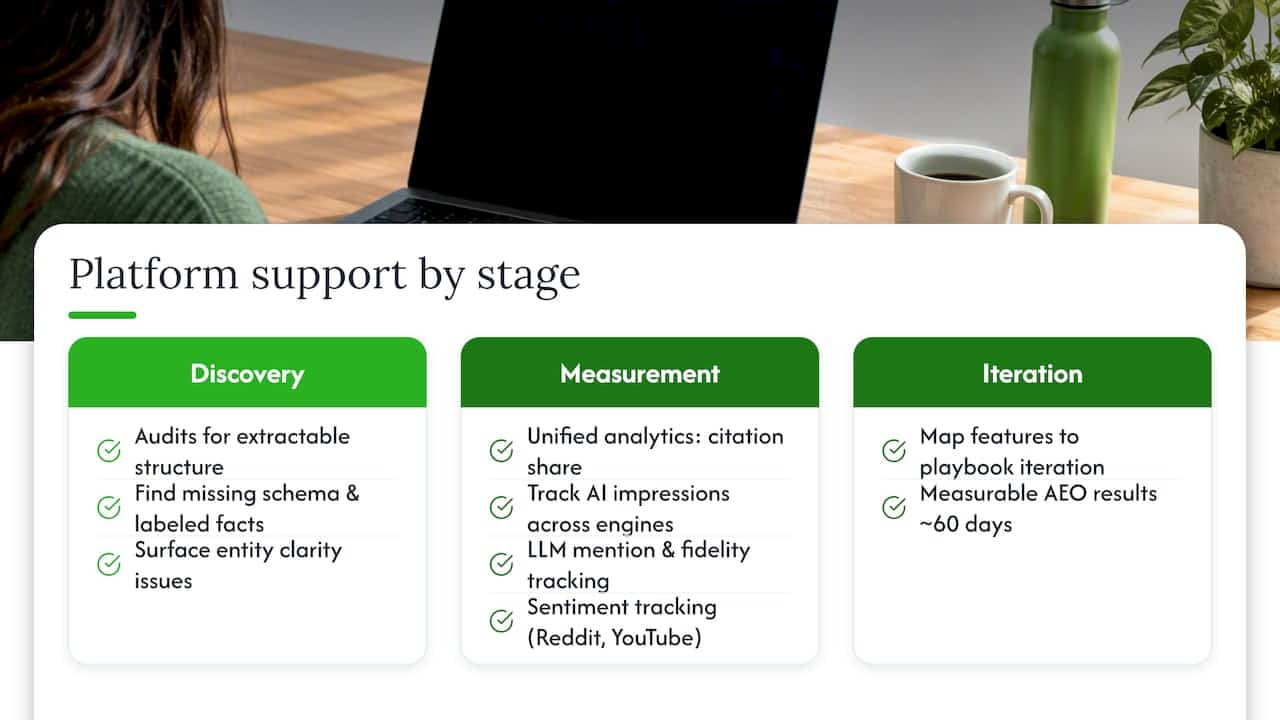
Running this playbook by hand across dozens or hundreds of pages gets unwieldy fast, which is why we built our platform around the exact steps above. Platforms handle tasks such as audits that surface which pages already have extractable structure and which are missing schema, labeled facts or entity clarity; unified analytics tracking citation share and AI impressions across major engines in one dashboard; LLM mention tracking to monitor when and how brands get cited, including fidelity to the original claim; and sentiment tracking across widely cited outlets like Reddit and YouTube. These features map directly onto the discovery, measurement, and iteration stages of the playbook, with measurable AEO results often seen within about 60 days of consistent use.
What marketers consistently get wrong about AI visibility
The biggest mistake we see is treating AEO like a keyword problem when it is really a structure and evidence problem. Teams spend hours tweaking phrasing to match expected queries, then wonder why a competitor with plainer prose gets cited instead. The competitor usually just labeled its facts better and attached a date and a source to its best number. Durable signals beat daily chasing every time.
If you do nothing else this week, run these three checks:
- Sample ten queries a real customer would ask and see which engines cite you, if any.
- Add one extractable, labeled answer block to each of your top five pages.
- Set up a recurring AI-visibility sample so you have a baseline before you start editing.
— Dr. Patrick McAvoy
Turning the playbook into a running system with Cairrot
Reading about citation share is one thing; watching it move on a dashboard every week is another. We built Cairrot so marketers and SEO teams can run the audit, monitor, and iterate loop described above without stitching together spreadsheets and manual query sampling.
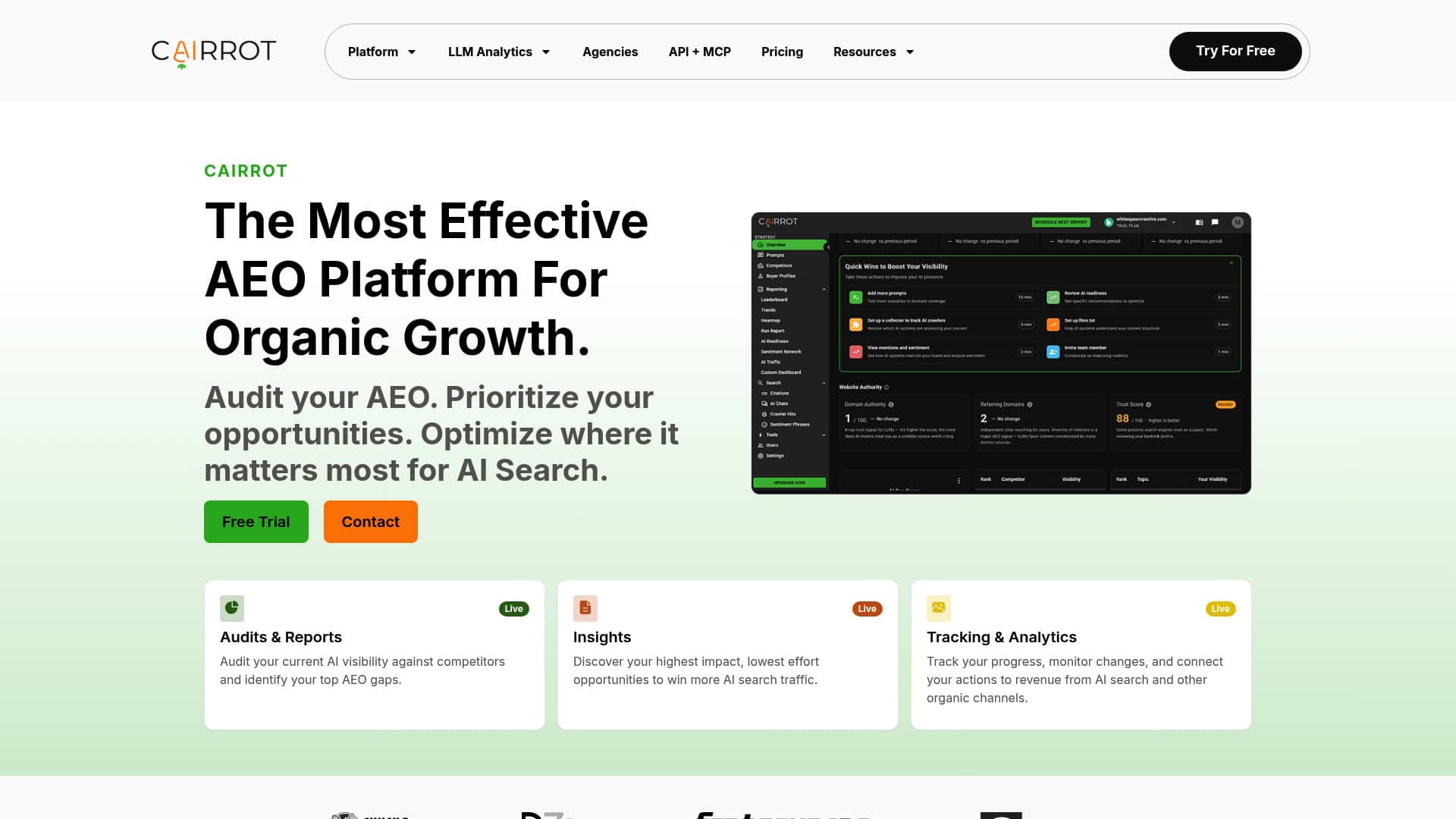
Our AEO audits and reports identify which pages lack extractable structure or schema coverage, our unified analytics track citation share and AI impressions across every major engine, and our LLM citation and mention tracking tells you exactly when and how you get quoted. From there:
- Start with an audit to see where your current citation gaps are.
- Review plans starting at $39 a month to match the audit, insights, and analytics tiers to your team size.
- Set up ongoing monitoring so citation share becomes a metric you track weekly, not something you check once a quarter.
FAQ
What is the best answer engine optimization approach for AI?
The most effective approach combines extractable content structure, schema markup and verifiable evidence with ongoing measurement of citation share across engines. Research on feature-level optimization shows structural signals consistently outperform keyword-only tweaks.
How do I optimize content for AI answers?
Start by writing a concise, labeled answer near the top of each section, then attach inline statistics with named sources and dates to back your claims. Add schema markup for FAQ, HowTo or Dataset content, and keep internal links strong so entities stay clear to both readers and machines.
Is SEO dead or evolving in 2026?
SEO is evolving rather than disappearing: crawlability, indexing and topical authority still matter, but they now sit alongside AEO practices built for citation-grounded answers. Search volume itself is shifting, with Gartner forecasting a 25% drop in traditional search engine volume by 2026 as chatbots absorb more queries.
Is there a free course on answer engine optimization?
We are not aware of a widely recognized free course dedicated specifically to answer engine optimization as of this writing. Several glossaries and guides, including background resources on generative engine optimization, cover the core concepts at no cost while a formal curriculum is still taking shape across the industry.
Sources
- Do people click on links in Google AI summaries? | Pew Research Center
- Think Before Writing: Feature-Level Multi-Objective Optimization for Generative Citation Visibility