
To optimize for Gemini, make pages citation-ready: answer first, use machine-readable signals, and ensure the page is reachable for Gemini’s grounding process. Gemini visibility comes down to being a citation-ready, well-indexed page in Google Search. The four moves that matter most: answer-first content, structured data, an open path for grounding crawlers, and a system for measuring citations once you go live.
TL;DR:
- Ensuring your pages are indexable in Google Search is critical, as Gemini can only cite sources that are already surfaced in search results.
- Use answer-first content, self-contained evidence paragraphs, and specific facts to make passages easily extractable and citation-ready for Gemini.
- Implement structured data like Article and FAQPage schemas, with accurate JSON-LD, to facilitate faster and clearer citation from Gemini.
- Regularly update high-value pages to maintain their factual relevance, and track citation velocity as a key metric for content visibility.
- Focus on building trust signals such as author credentials, primary sources, and clear dates to boost page credibility for both humans and AI grounding processes.
Table of Contents
- How does Gemini’s grounding process create citations?
- On-page tactics that make passages citation-ready
- Which schemas and markup patterns help Gemini cite your pages?
- Site operations that determine whether Gemini can ground on your pages
- How to measure Gemini citations and report AI visibility
- E-E-A-T signals and a pre-publish checklist
- Understanding Gemini’s underlying AI architecture and capabilities
- Differences between optimizing for Gemini versus other AI models
- Best practices for updating content regularly to align with evolving Gemini algorithms
- The role of user intent and engagement metrics in Gemini optimization
- Setting priorities without losing sight of risk
- Turn Gemini visibility into a repeatable process with Cairrot
- Sources
- FAQ
How does Gemini’s grounding process create citations?
Gemini’s grounding process works like a live research assistant. When a prompt calls for current or verifiable information, Gemini triggers the google_search tool, runs a real Google Search, and pulls back a set of results. From there, it builds a grounded answer and attaches groundingMetadata, a structured map connecting specific text segments to the source URLs that informed them.
That metadata is the mechanism behind every citation you see in a Gemini answer. It relies on:
- groundingChunks, which store the source URI and title Gemini pulled from.
- groundingSupports, which link exact spans of the generated answer back to those chunks.
- webSearchQueries, the underlying queries Gemini ran to find candidates.
Being indexed in Google Search is the gate, not the exception. If your page has never surfaced in a live Google Search, it cannot become a groundingChunk, no matter how well written it is. Enterprise use of the API also carries query limits worth checking against your traffic goals, but for most content teams, the practical implication is simpler: fix indexability before you worry about phrasing.
On-page tactics that make passages citation-ready
Gemini does not cite entire pages. It cites spans, the exact sentences and paragraphs that groundingSupports can map cleanly to a source. That changes how you write.
- Lead with the answer. Put the direct claim in the first sentence of a section, then support it. A grounding model looking for a clean span will grab the sentence that already reads like an answer.
- Write self-contained evidence paragraphs. Each paragraph should make sense pulled out of context, with the subject named rather than implied by a pronoun from three sentences earlier.
- Embed format and persona cues where they help the reader, such as “for small-business owners, here’s a three-step checklist,” which also happens to give a grounding model an obvious, extractable structure.
- Use specific facts. Dates, figures, and named sources are easier to cite than vague generalizations, and they are more useful to the reader too.
- Break up long blocks with headings and short paragraphs. A wall of text has no clean span for groundingSupports to isolate.
Pro Tip: Write the first sentence of every section as if it were the only sentence Gemini would ever quote.
This is the same discipline that makes content good for humans skimming on a phone. Gemini did not invent the need for clarity, it just added a machine reader that rewards it more precisely.
Which schemas and markup patterns help Gemini cite your pages?
Structured data does not force a citation, but it gives extraction systems a faster, less ambiguous path to your content, which raises the odds a groundingChunk points to you instead of a competitor.
- Use Article schema for standard editorial content, with clear author, date Published, and date Modified fields.
- Use FAQPage or QAPage markup when content is genuinely structured as questions and answers, matching the visible copy exactly.
- Use ClaimReview where you are fact-checking a specific public claim, since it gives verification systems a direct signal.
- Place JSON-LD in the page head or immediately before the closing body tag, and make sure it mirrors the visible text. Mismatched or hidden markup is a common error that undermines trust in the signal.
- Favor semantic HTML, proper heading hierarchy, and real list and table elements over div soup, since clean HTML chunks more predictably than a heavily scripted layout.
Google’s own AI optimization guidance frames this as an extension of ordinary quality work, not a separate set of tricks: markup that reflects genuinely well-organized content outperforms markup bolted on for appearances.
Site operations that determine whether Gemini can ground on your pages
Content quality means nothing if the crawler cannot reach the page or the page conflicts with itself across URLs. A few operational checks belong on every technical audit.
- Check your robots.txt for the Google-Extended control. This directive specifically governs whether Google may use content for training or grounding. Blocking it does not change your position in traditional Google Search, but it does remove the page entirely from Gemini’s candidate pool. Decide this deliberately, not by default.
- Confirm one canonical URL per piece of content. Duplicate or conflicting canonical tags create ambiguity about which version should be indexed and, by extension, grounded.
- Verify consistent indexing signals across sitemaps, canonical tags, and internal links so search systems see one clear version of the page.
- Favor server-side rendering or stable static HTML for content you want cited. Heavy client-side rendering can delay or distort what a crawler sees, which makes chunk extraction less predictable.
None of this is exotic. It is the same technical hygiene that has mattered for search ranking for years, now with a second consumer for the output.
How to measure Gemini citations and report AI visibility
Traditional rank tracking was never built to answer “did an AI engine cite us,” so treat this as a new KPI layer on top of existing SEO reporting, not a replacement for it.
- Grounding citations: the count of pages Gemini actually cites for a defined set of target prompts.
- Share of Recommendation: how often your brand or page appears among cited sources relative to competitors for the same query set.
- Organic click-through changes on queries where AI Overviews now appear, since those clicks behave differently than a standard blue-link result.
- Citation velocity: the rate at which new pages start appearing as grounding sources after publication or optimization.
| Metric | What it tells you | Typical review cadence |
|---|---|---|
| Grounding citations | Whether pages are entering Gemini’s candidate pool | Weekly |
| Share of Recommendation | Competitive position among cited sources | Monthly |
| Organic click-through | Traffic impact where AI Overviews appear | Monthly |
| Citation velocity | Speed of new pages gaining citations | Biweekly |
Instrumentation can be as light as a spreadsheet tracking prompt responses or as structured as a dedicated Gemini Rank Tracker. Set a review cadence, act when citation velocity stalls for two consecutive cycles, and treat Share of Recommendation as your primary competitive signal.
E-E-A-T signals and a pre-publish checklist
Grounding models still favor pages that read as credible to a human, which means the classic E-E-A-T signals matter as much for AI citation as they ever did for search ranking.
- Include a visible author byline with real credentials, not a generic “staff” tag.
- Link to primary sources for every factual claim rather than paraphrasing a secondary summary.
- Show an update log or last-modified date so readers and crawlers can see the content is maintained.
- Cite primary evidence, original data, official documentation, named studies, instead of vague appeals to consensus.
Pro Tip: Run every published page through a short checklist before it goes live: byline present, sources linked, date visible, claims specific.
This is also where tools built specifically for AEO earn their keep, such as those offered by Local Growth Direct for managing local presence and profile visibility. A platform like Cairrot can surface which pages are missing these signals at scale, rather than leaving it to a manual spot check across hundreds of URLs.
Understanding Gemini’s underlying AI architecture and capabilities
Gemini is built as a multimodal model, meaning it processes text, images, audio, and video within the same reasoning system rather than bolting separate models together. For search-facing use, the piece that matters most to content teams is the grounding layer described earlier: a retrieval step that lets Gemini reach outside its trained knowledge and pull live web results into an answer.
This architecture has a direct consequence for optimization. Gemini’s core training data has a cutoff, but grounded answers are not limited to it, since the google_search tool fetches current information at the moment of the query. That means a page published yesterday can appear in a grounded answer today, provided it is indexed and well structured. It also means Gemini’s answers can shift day to day for the same prompt, since the underlying search results shift.
For marketers, the practical takeaway is that Gemini is not a static knowledge base to be memorized once. It behaves more like a search engine with a language layer on top, which is why the same fundamentals that earned you visibility in classic search, indexability, clarity, and authority, still carry the most weight. The multimodal side matters mostly for image and video content: alt text, captions, and transcripts give Gemini additional material to ground on when a query involves non-text media, so pages with rich visual content benefit from describing that content in words as well as pixels.
Differences between optimizing for Gemini versus other AI models
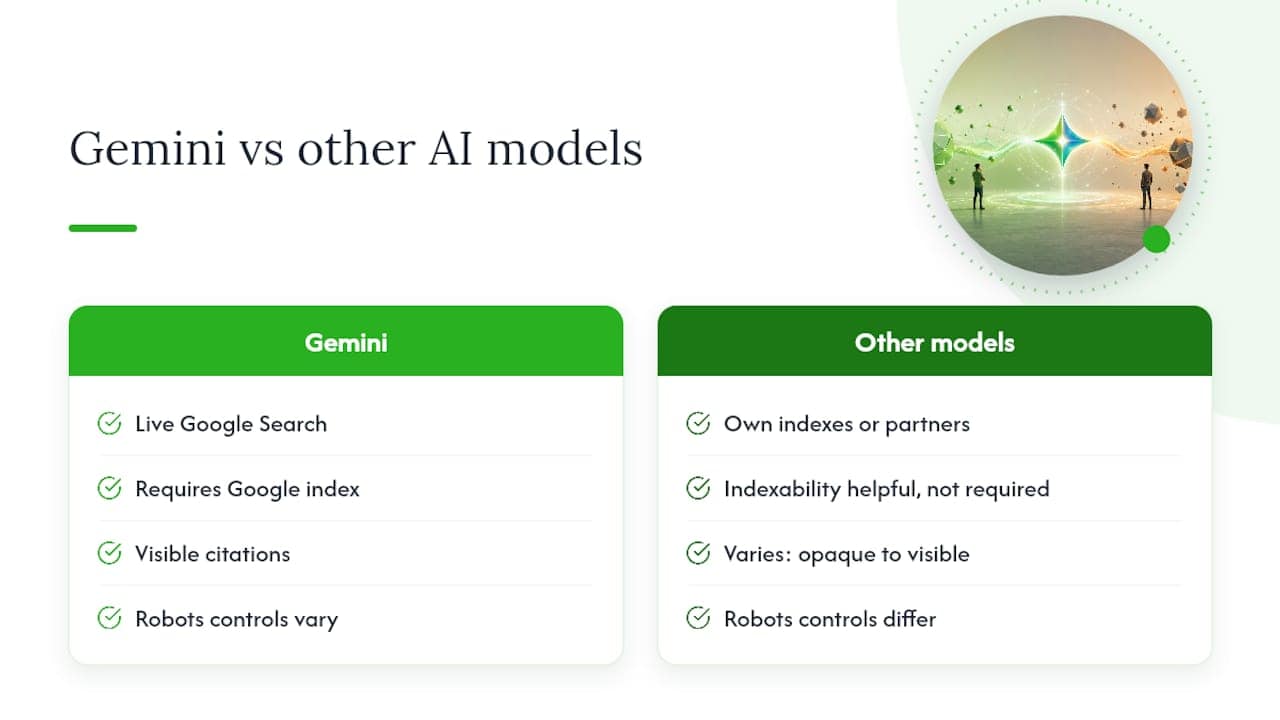
The biggest structural difference is that Gemini’s citations come from a live Google Search call, while some other AI models rely more heavily on their own indexes or a mix of licensed data partnerships. That single fact changes your priority list. For Gemini, classic Google indexability is a prerequisite, not just a nice-to-have, because a page that never appears in Google Search results has no path into a groundingChunk.
Other AI engines vary in how transparent they are about sourcing. Some show inline citations similarly to Gemini’s groundingSupports model, others summarize without clear attribution, which makes it harder to reverse-engineer what they are pulling from. Perplexity, for instance, has built its interface heavily around visible citations, which makes it more directly comparable to Gemini’s approach than a model with opaque sourcing.
Practically, this means a single optimization strategy will not transfer perfectly across engines. The content tactics in this guide, answer-first structure, self-contained paragraphs, clear schema, hold up broadly because they help any retrieval-based system extract clean spans. But the technical controls differ: robots.txt directives for training and grounding use vary by provider, and the query behavior behind each engine’s search calls is not identical. Treat Gemini optimization as your baseline for retrieval-augmented engines, then check provider-specific documentation before assuming the same controls apply elsewhere. For a broader view of how these tactics generalize, AEO and GEO fundamentals cover the overlap across engines in more depth.
Best practices for updating content regularly to align with evolving Gemini algorithms
Gemini’s grounding behavior is tied to live search results, which means your content’s citation status can change even when you have not touched the page, simply because the competitive set of search results shifted. That makes a fixed publish-and-forget approach riskier for AI visibility than it ever was for traditional SEO.
A practical cadence looks like this: review high-priority pages on a monthly basis for factual currency, refresh dates and figures whenever underlying data changes, and treat any drop in grounding citations as a trigger for a content review rather than waiting for a scheduled audit. Pages tied to fast-moving topics, pricing, statistics, product specifications, need tighter review cycles than evergreen explainer content.
Keep a visible update log. Beyond the trust signal it sends to readers, a dated revision history gives you your own internal record of what changed and when, which is useful when you are trying to correlate a citation gain or loss with a specific edit. Avoid the trap of updating for the sake of updating. Google’s own AI optimization guidance treats this work as an extension of standard content quality practice, not a special algorithm to chase, so the goal of each update should be a genuine improvement in accuracy or clarity, not a cosmetic timestamp change meant to signal freshness to a crawler.
The role of user intent and engagement metrics in Gemini optimization
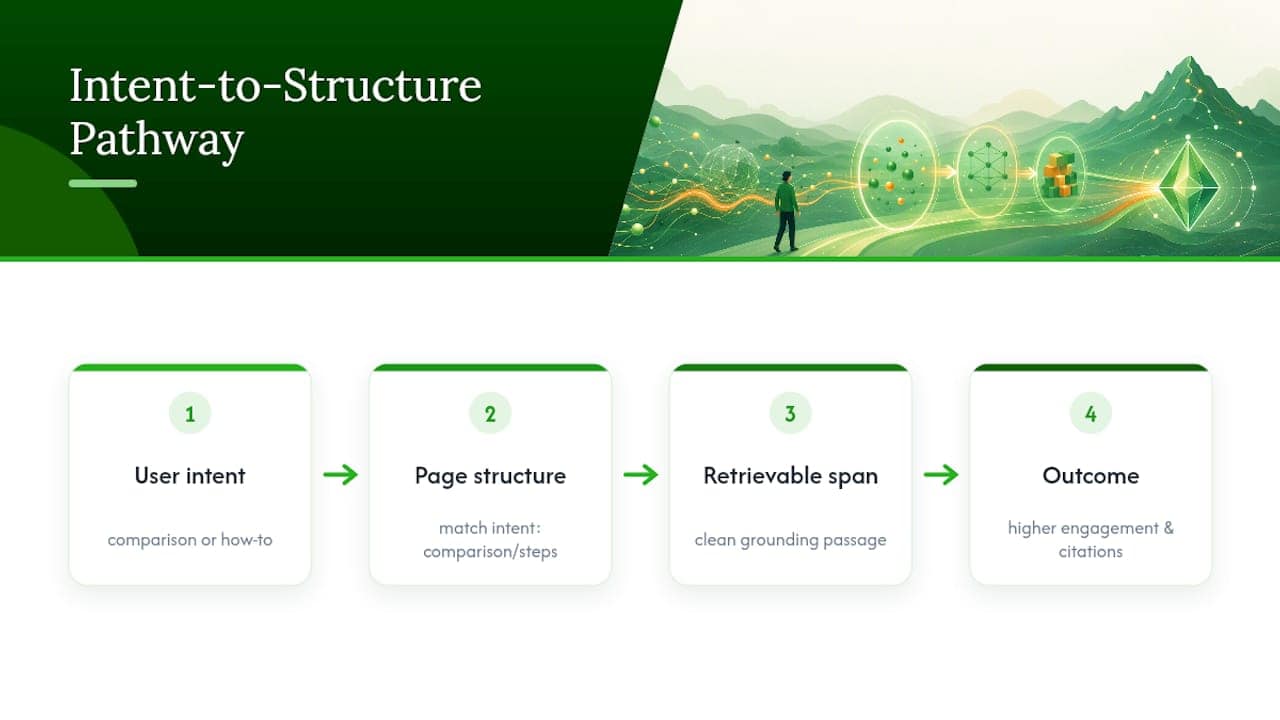
Grounding solves the retrieval half of the problem, matching a prompt to candidate sources, but engagement metrics still shape which of those candidates perform well over time. A page that gets grounded once but produces low engagement when users do click through sends a weaker long-term signal than one that holds attention.
Matching content structure to intent matters more here than in traditional search, because Gemini is often synthesizing an answer rather than sending a user to browse. If your page answers a comparison question, structure it as a comparison. If it answers a how-to question, structure it as sequential steps. A mismatch between what the query implies and how the page is organized makes it harder for groundingSupports to find a clean span, and harder for a human reader to trust the result if they do click through.
Traditional engagement metrics, time on page, bounce rate, scroll depth, still matter as proxies for whether a page actually satisfies the intent behind the query it gets cited for. Search Console remains one of the more direct ways to see which queries are already driving impressions and clicks, and that data can point you toward which pages are strong grounding candidates worth reinforcing with clearer structure and more current facts.
Setting priorities without losing sight of risk
Start with your highest-value pages, the ones tied to revenue or brand authority, and make those citation-ready first. Measure grounding citations before expanding the approach site-wide.
At the same time, AI Overviews measurably reduce clicks on source links, which is a real business risk, not a hypothetical one. That is why brand investment and direct channels, email, owned communities, direct traffic, deserve renewed attention as a hedge. Industry analysis on AI Overviews also points toward licensing and direct platform relationships as a longer-term strategy worth monitoring.
Keep experiments small, watch grounding citations as your primary signal, and iterate rather than betting the whole content calendar on one theory at once.
— Dr. Patrick McAvoy
Turn Gemini visibility into a repeatable process with Cairrot
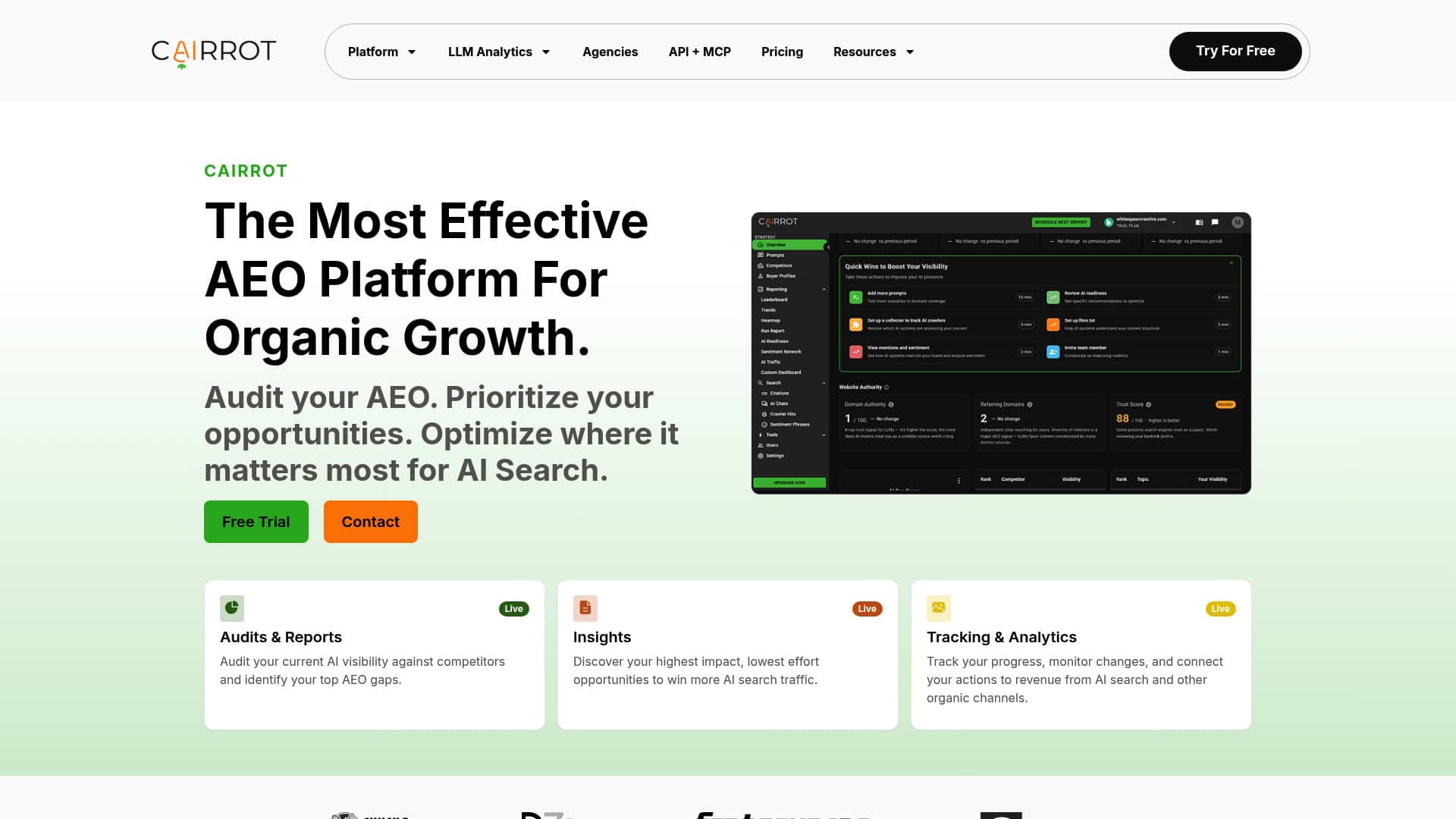
Everything in this guide becomes far easier to manage with a platform built to track it. Certain platforms run AEO audits and reports, surface high-impact fixes, and offer unified analytics across Gemini, ChatGPT, Claude, Perplexity, Grok, and DeepSeek, helping you track citation status without manually integrating data.
A typical audit includes:
- A page-by-page review of citation readiness and structural gaps.
- Competitor benchmarking to calculate your Share of Recommendation.
- Sentiment tracking across platforms like Reddit and YouTube that feed AI answers.
Plans start at $39 a month with Starter, scaling to Pro and Enterprise for larger teams. Explore AEO Audits & Reports and Unified AEO Analytics to see where your pages stand today.
Sources
- Grounding with Google Search – Interactions API | Google AI for Developers
- AI optimization guidance — Google Developers
- Robots.txt Google-Extended control – Google Search Central
- Pew Research Demonstrates Sharp Impact of AI Overviews on Publisher Search Traffic – VideoWeek
- AI Overviews impact and how publishers should adapt — Search Engine Journal
FAQ
Is Google Optimize still available?
Google Optimize, the website testing tool, was retired by Google and is not related to optimizing content for Gemini or AI search. Any “Gemini optimization” work today refers to citation readiness, structured data, and grounding access, covered throughout this guide, not the discontinued A/B testing product.
How do I make Gemini give better answers to my prompts?
Better Gemini outputs generally come from specific, well-scoped prompts that state the desired format, audience, and level of detail up front. This is a separate skill from optimizing your website content to be cited by Gemini’s grounding process, which depends on indexability and clear on-page structure rather than prompt phrasing.
How can I get the most out of Gemini as a content tool?
Gemini works best as a content tool when you give it a clear persona, a defined output format, and specific source material to reason over rather than an open-ended request. For website optimization specifically, the more relevant skill is writing citation-ready pages that Gemini’s grounding process can find and quote, as detailed in the grounding documentation.
What is the fastest way to see if my content is cited by Gemini?
Run a defined set of target prompts related to your content and check whether your domain appears among the cited sources, then repeat on a regular cadence to track citation velocity. Dedicated tools such as a Gemini Rank Tracker automate this instead of manual prompt checking.
