
Purpose-built AEO platforms are the right category to evaluate for AI citation tracking, ahead of legacy SEO suites or DIY prompt testing, because they cover multiple engines and separate mentions from citations. Cairrot is the strongest enterprise fit for agencies managing several client accounts. Start with a 50 to 100 prompt sample test or a live demo, and measure citation share and mention volume as two distinct numbers, tracked as a delta over time rather than a fixed count.
TL;DR:
- AI citation tracking requires monitoring multiple large language models to accurately measure when your content is referenced or linked in generating AI answers.
- Proper tools distinguish between mere content retrieval and actual brand mentions, with purpose-built AEO platforms offering the most comprehensive multi-engine coverage.
- Valid sampling methods include API prompts, scraping, and synthetic testing, but none provide an exact “ground truth” — only directional benchmarking.
- Tracking should focus on citation share, mention rates, and ghost citation percentages over time, not just raw citation counts, which can be misleading.
- Agencies managing multiple clients benefit most from scalable, integrated platforms with dashboard reporting, while solo marketers may start with manual prompt testing.
Table of Contents
- What Is AI Citation Tracking and How Does It Differ From SEO?
- Which Category of Tool Fits Your Team?
- How Do Vendor Feature Claims Compare in Practice?
- How Do You Choose the Right AI Citation Tracking Tool?
- How Do You Measure AI Citations Yourself?
- What Does a Real AEO Platform Implementation Look Like?
- What the Data Actually Tells Us About Citation Tracking
- Ready to See Your Own Citation Gaps?
- Sources
- FAQ
What Is AI Citation Tracking and How Does It Differ From SEO?
AI citation tracking measures how often large language models like ChatGPT, Perplexity, Gemini, and Claude reference or link to your content when answering a question. Traditional rank tracking checks where a URL sits on a results page. Citation tracking checks whether an AI answer engine actually pulled from your content, and whether it named your brand when it did.
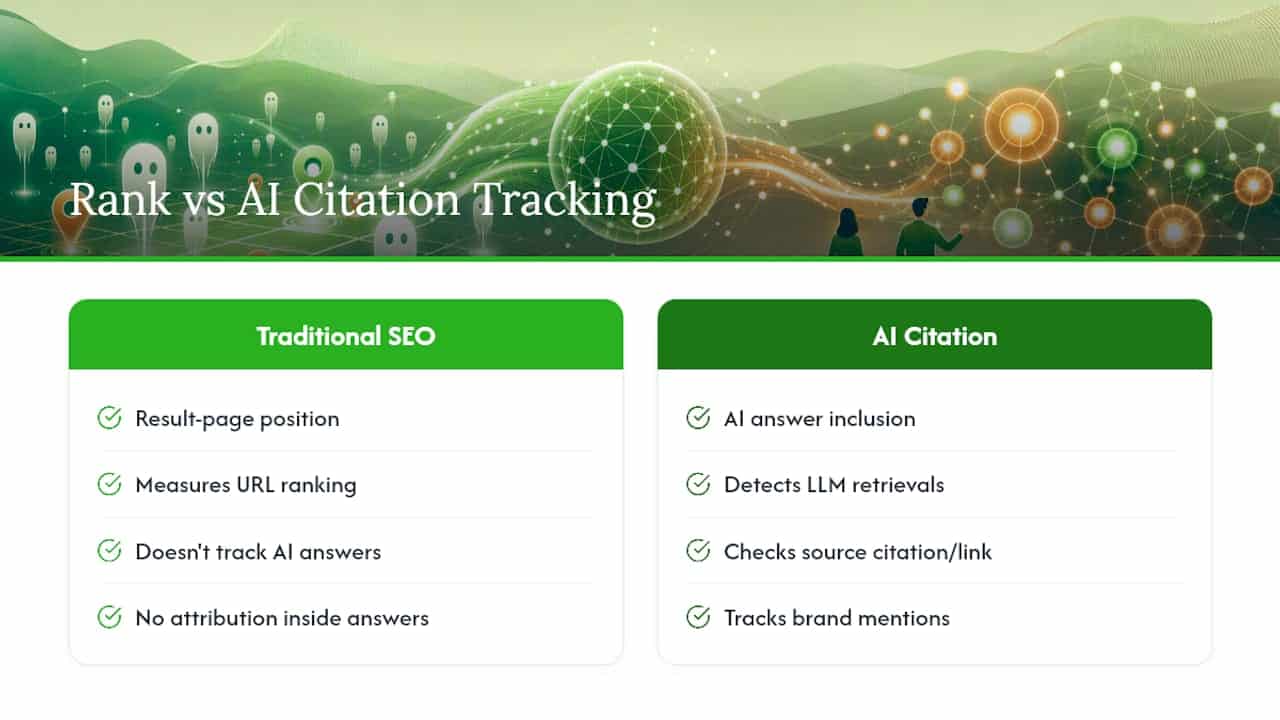
That distinction matters more than most teams realize. Search engine journal’s analysis of AI visibility measurement found that visibility scores can mask the gap between mentions and citations, meaning a brand can show up in an AI answer without ever getting attributed credit for it. Reddit content gets retrieved by ChatGPT at a high rate, but only a small share of those retrievals turn into an actual citation. Retrieval is not citation. That gap is exactly why generic rank trackers built for Google’s ten blue links miss what’s actually happening inside an AI answer.
The category everyone now calls AEO, or AI Engine Optimization, exists because of this gap. It’s the discipline of getting cited and named inside generative answers, not just ranked in a results page. Once you understand that AEO and traditional SEO measure fundamentally different outcomes, the tool landscape starts making a lot more sense.
Which Category of Tool Fits Your Team?
Four broad categories compete for your AEO budget right now, and they are not interchangeable. Picking the wrong one wastes months of reporting cycles before anyone notices the data doesn’t hold up.
- Purpose-built AEO platforms are engineered specifically to track citations and mentions across multiple LLMs, with dashboards designed around AI visibility metrics rather than retrofitted rank data.
- Legacy SEO suites have bolted AI-tracking modules onto existing keyword-rank platforms, useful if you already live in that toolset for traditional SEO.
- Analytics-based monitoring tools lean on referral data and Search Console signals to infer AI-driven traffic rather than sampling prompts directly.
- DIY prompt stacks are spreadsheets and scripts a team builds in-house to manually query engines and log results by hand.
Purpose-built AEO platforms fit agencies and enterprise brand teams who need repeatable, multi-engine coverage and client-ready reporting. Legacy SEO suites make sense for teams that want AI visibility folded into a dashboard they already pay for and already trust, even if the engine coverage is narrower. Analytics-based monitoring suits teams mainly interested in referral traffic and conversion signals rather than raw citation counts. DIY prompt stacks work for a solo marketer or a small team validating whether AEO matters at all before committing budget.
Here’s how the four stack up on coverage and cost:
| Category | Typical engine coverage | Sampling method | Reporting depth | Cost shape |
|---|---|---|---|---|
| Purpose-built AEO platforms | Broad (ChatGPT, Gemini, Perplexity, Claude, DeepSeek) | API and synthetic prompts | Client dashboards, exports | Monthly subscription |
| Legacy SEO suites | Moderate, often 2 to 3 engines | Mostly scraping | Bolt-on module inside existing suite | Add-on to existing plan |
| Analytics-based monitoring | Indirect, inferred from referrals | Analytics signals, not direct prompting | Strong on traffic, weak on citation detail | Often bundled free or low cost |
| DIY prompt stacks | As wide as your team’s patience allows | Manual synthetic prompts | Spreadsheet, no dashboard | Labor cost only |
The trade-off is consistent across every category: broader engine coverage tends to cost more and demand more setup time, while narrower tools are cheaper but leave engines unmonitored. A team that only checks ChatGPT will miss shifts happening on Perplexity or Gemini entirely.
Pro Tip: Before comparing vendors, run the same five commercial queries manually across ChatGPT, Perplexity, and Gemini. If the results already vary wildly by engine, that’s your proof you need multi-engine coverage, not a single-engine tool.
How Do Vendor Feature Claims Compare in Practice?
Every AEO vendor claims to track citations. Far fewer explain how, and the “how” is where trust either gets earned or lost. Evaluate any tool, named or unnamed, against seven feature categories before you sign a contract.
- Citation detection: does it confirm the content was actually quoted or linked, not just retrieved?
- Mention classification: does it separate a named brand mention from an unnamed “ghost citation”?
- Engine coverage: which specific LLMs does it query, and how often does that list expand?
- Sampling method: API access, scraping, or synthetic prompts, each with different reliability?
- Alerting: does it flag when a citation disappears, not just when one appears?
- Integrations: does it connect to GA4, Search Console, Looker Studio, or export cleanly?
- Reporting and export: can an agency turn this into a client-ready deliverable without manual rework?
Sampling method deserves special scrutiny because it determines whether the numbers you report are defensible. API-based sampling queries the model directly and tends to produce the most consistent results, but not every engine offers a public API for this purpose. Scraping simulates a browser session against a live chat interface, which captures real-world conditions but breaks easily when an interface changes. Synthetic prompt testing runs a fixed battery of queries on a schedule, which is repeatable and comparable over time but only as good as the prompt list behind it.
None of these methods produces a perfect ground-truth count. Industry analysis on generative-influence measurement makes the point directly: AI citation data functions as benchmarking, not ground truth, the same way share-of-voice numbers in traditional media never claimed to be exact. A vendor that promises precise, guaranteed citation counts is overselling what any current method can deliver.
| Feature area | Why it matters for agency reporting |
|---|---|
| Citation detection | Confirms actual attribution, not just retrieval, before you bill a client on visibility gains |
| Mention classification | Separates ghost citations from named mentions, which affects how you frame brand-lift results |
| Multi-client dashboards | Determines whether you can report on 5 accounts or 50 without manual exports |
| GA4/GSC integration | Lets you tie citation events to actual referral sessions, not just visibility scores |
For agencies specifically, dashboard structure often matters as much as raw coverage. A platform built around bulk client management and white label reporting saves hours every reporting cycle that a single-account tool simply was not designed to save.
How Do You Choose the Right AI Citation Tracking Tool?
Run through this checklist in order before signing anything, whether you’re evaluating one vendor or five.
- Confirm the engine list. Ask exactly which LLMs it queries today, not which ones are “on the roadmap.” ChatGPT and Perplexity coverage is table stakes; Gemini and DeepSeek coverage is where most tools start to thin out.
- Ask how sampling actually works. “How do you sample prompts, and how often?” A vendor who answers with a specific cadence and method (API-based, weekly synthetic batch of X prompts) is telling you the truth. A vendor who answers with “our proprietary AI” is not.
- Check integration depth. Confirm native connections to GA4, Search Console, and Looker Studio, or at minimum a clean CSV export you can pipe into your own AEO reporting stack.
- Test reporting scale. If you manage multiple clients, ask to see a multi-account dashboard before you commit, not after.
- Verify the SLA on data refresh. Weekly refresh is a reasonable floor; monthly-only refresh will leave you reporting stale numbers to clients who expect current data.
Red flags to walk away from: any vendor claiming an exact, guaranteed “ground truth” citation count across every engine; a methodology page that stays vague no matter how many times you ask; no export or integration options at all; and pricing that hides engine coverage behind an enterprise sales call with no public detail.
Pro Tip: Ask a vendor directly: “What happens when an engine changes its interface overnight?” A team with a real scraping fallback and API redundancy will have an answer ready. A team that goes quiet is running a fragile setup.
How Do You Measure AI Citations Yourself?
You don’t need to wait on a vendor contract to start measuring. A workable, repeatable loop looks like this:
- Identify 20 to 50 priority commercial queries your buyers actually type into ChatGPT, Perplexity, or Gemini when researching your category.
- Run those prompts on a fixed cadence across at least four engines: ChatGPT, Perplexity, Gemini, and Claude, adding Copilot or DeepSeek if your audience uses them.
- Log every source cited per prompt, noting whether your brand was named outright or just linked without attribution.
- Ship a structural or content change based on what you find, whether that’s clearer schema, updated FAQ content, or a new comparison page.
- Re-run the same prompt set and measure the delta, not the absolute count, in citation share before and after.
That five-step loop mirrors what a repeatable measurement framework actually requires: fixed queries, fixed cadence, documented sources, a real change, then a re-measurement.
Four metrics matter more than any others in this process: citation count (how many times you’re referenced), mention count (how many times your brand is named, with or without a link), citation share (your citations as a percentage of all sources cited across the sample), and ghost-citation rate, the share of citations where your content gets used but your brand never gets named. That last metric matters because roughly 40% of AI citations leave the source brand unnamed, a rate that climbed as high as 52% for Perplexity in one analysis. If you only track raw citation count, you’ll miss that nearly half your “wins” may never register with the person reading the answer.
Pair every prompt test with analytics. Set up GA4 events to catch referral traffic from AI platforms, watch for referral parameters in your traffic sources, and check how Search Console’s AI-related reports are trending month over month. A monthly review cadence is a reasonable baseline for this whole process, though teams competing in fast-moving categories often check weekly to catch a citation drop before a client asks about it.
The number that should worry you isn’t your citation count. It’s your ghost-citation rate. Getting cited without getting named is a visibility win that never becomes a brand-recognition win, and most teams aren’t tracking the difference yet.
What Does a Real AEO Platform Implementation Look Like?
Cairrot is built around the exact measurement loop described above, run at agency and enterprise scale instead of by hand. The platform tracks LLM citations and mentions across the major answer engines, with dedicated rank trackers for Gemini and DeepSeek, which is exactly the kind of engine-specific coverage that generic SEO suites tend to skip.
- Sentiment tracking across Reddit and YouTube, catching brand perception where AI models increasingly source their answers from.
- Native integrations with GA4, Search Console, Bing, Databox, Cloudflare, and CloudFront, so citation data doesn’t live in a silo separate from your existing reporting stack.
- Bulk client management and white label reporting built for agencies running multiple accounts at once, not retrofitted onto a single-account tool.
- API access included in base plans, plus a WordPress plugin for teams managing content directly on that platform.
Many clients report measurable AEO results within about 60 days of implementation, a timeline that lines up with the sampling cadence described earlier: enough time to run a baseline test, ship changes, and measure a real delta. Treat that 60-day window as a starting point for your own validation, not a guarantee, and run your own before-and-after prompt sample to confirm the movement for your specific queries.
If you’re preparing for a demo, bring your priority query list and two or three pages you suspect are underperforming in AI answers. That’s usually enough for a team to show you exactly where the gaps sit inside your current visibility.
What the Data Actually Tells Us About Citation Tracking
The conventional advice treats AI citation tracking like a scoreboard: bigger number, better performance. That framing is backwards, and the research on ghost citations proves it. A brand can rack up hundreds of citations and still lose the war for recognition if 40% or more of those citations never name it. The number worth watching isn’t total citations. It’s the ratio between citations and named mentions, tracked over time as you make changes.
The second place conventional wisdom fails is precision. Vendors love to sell “ground truth” citation counts, and buyers love to believe them because a precise number feels more defensible in a client report. Neither instinct survives contact with how these engines actually work. Retrieval, sampling limitations, and engine-side changes mean every count is directional. Treat vendor dashboards the way a media buyer treats reach estimates: useful for trend and comparison, dangerous when presented as exact.
What should a reader prioritize first? Build the measurement habit before you build the tool stack. A team that runs a disciplined 50-prompt test monthly, by hand if necessary, will understand its AI visibility better than a team that buys an expensive dashboard and never questions the number it spits out.
— Dr. Patrick McAvoy
Ready to See Your Own Citation Gaps?
Agencies juggling several client accounts and enterprise teams running a full AEO program get the most out of Cairrot, mainly because the reporting layer is built for scale from the start rather than added later. If you’re a solo marketer just testing whether AEO is worth the investment, a lighter DIY prompt test might be the smarter first move. But once you’re managing more than one brand’s AI visibility, manual tracking stops scaling fast.
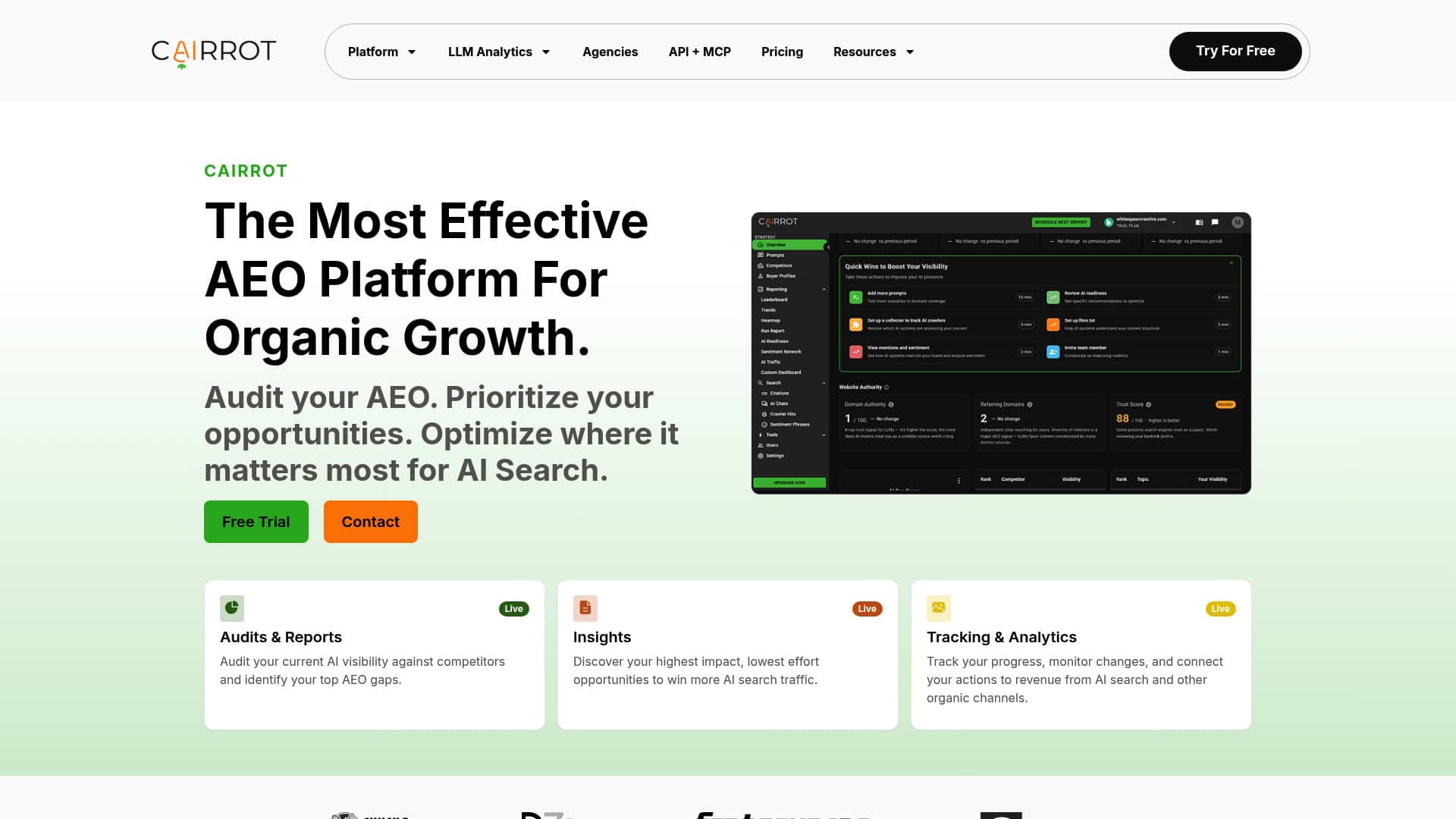
A demo takes less time than most teams expect, and it works best when you come prepared with two things: your list of priority commercial queries and two or three pages you suspect are underperforming in AI answers. In that session, you’ll see your actual citation and mention counts across ChatGPT, Gemini, Perplexity, and DeepSeek, plus how ghost citations are affecting your brand recognition specifically. From there, you can decide whether the full AEO platform fits your reporting needs or whether the agency-focused dashboard built for multi-client billing is the better starting point. Either way, request a demo and bring your query list.
FAQ
How Do You Track AI Citations?
Run a fixed set of commercial queries across ChatGPT, Perplexity, Gemini, and Claude on a regular cadence, log which sources get cited, and compare that against a dedicated AEO platform’s dashboard for a second data point. Combine both with GA4 and Search Console signals to catch referral traffic tied to those citations.
Which AI Tool Is Good for Finding Citations?
Purpose-built AEO platforms like Cairrot are designed specifically to detect and classify citations across multiple engines, which makes them a stronger fit than legacy SEO suites for this task. The right choice depends on whether you need single-account monitoring or agency-scale, multi-client reporting.
Can I Use AI to Do My Citation Tracking?
Yes. Synthetic prompt testing, where you or a tool run a fixed battery of AI-generated queries on a schedule, is one of the three main sampling methods vendors use, alongside API access and scraping. You can run this manually with a spreadsheet or automate it through a dedicated platform.
How Can I Track My Citations Over Time?
Measure citation count, mention count, citation share, and ghost-citation rate as four separate numbers, then track the delta between test cycles instead of any single snapshot. A monthly cadence is a reasonable minimum, with weekly checks recommended for fast-moving categories.