
AI search reporting is the practice of measuring how often, where and how accurately your brand shows up in AI-generated answers, then tying that visibility to traffic and business results. No single tool covers it. Google’s Search Console now reports impressions in AI Overviews and AI Mode, GA4 isolates AI referral traffic, and a tracking platform fills the rest: citations, share of voice and sentiment across ChatGPT, Gemini, Claude, Perplexity and others. This guide shows what each source gives you, which AEO metrics deserve a place on the dashboard, and how to package it all into a report a client or executive will actually read.
TL;DR
- Google’s Generative AI report gives you impressions by page, country, device and date, but no queries, clicks or conversions, so it can’t be your only source.
- Report on four layers of visibility: presence, prominence, portrayal and persuasion.
- Pull AI referral traffic from GA4, citations from Bing’s AI reporting, and cross-engine mentions and sentiment from a dedicated AEO platform.
- Keep your AI scoreboard and your classic SEO scoreboard separate. Averaging them hides what each one is telling you.
- Agencies should build one template, brand it per client, and run it on a fixed cadence.
Table of Contents
- What AI search reporting actually measures
- What Google Search Console shows (and what it leaves out)
- Tracking AI referral traffic in GA4
- Bing’s AI citation data
- The metrics worth putting on an AEO dashboard
- Which AI engines to include
- Our perspective: report on what you can change
- How agencies can structure white-label AEO reporting
- A simple reporting cadence
- What you can’t measure yet
- Putting it to work with Cairrot
- FAQ
- Sources
What AI search reporting actually measures
Traditional SEO reporting asks where a page ranks for a keyword and how many clicks it earned. AI search reporting asks a different question: did an AI engine mention or cite you when it assembled an answer, and what did it say?
The difference comes from how the engines work. Google explains that AI Overviews and AI Mode build responses with supporting links and may run query fan-out, meaning several related searches across subtopics and data sources, while traditional Search presents links directly. A single user prompt can trigger many sub-queries, so one “keyword” no longer maps to one result page.
That is why rank tracking alone fails here. A brand can hold position three for a term and never be named in the generated answer, or be cited without ranking at all. Good AI search reporting treats visibility inside the answer as its own channel with its own metrics.
What Google Search Console shows (and what it leaves out)
Google now offers a dedicated report. According to Google’s own help page, the generative AI performance report covers impressions from AI Overviews and AI Mode, and Google says it expects to update that list over time. The data can be grouped by page, country, device and date, and Search Console traffic from these features also sits inside the Performance report under the Web search type, per Search Central.
The limits matter just as much. Search Engine Journal’s walkthrough notes that the report does not include queries, clicks, click-through rate, average position, citation placement, the supporting passage, conversions or revenue. It also warns that AI impressions are not interchangeable with traditional search impressions.
In practice that means:
- Use the report to show which pages Google surfaces in AI features and how that moves over time.
- Never put AI impressions into the same chart as classic impressions and call it “total search visibility.”
- Don’t claim attribution from it. Impressions without clicks or conversions can’t prove revenue.
Tracking AI referral traffic in GA4
Traffic is where visibility turns into something a CFO recognizes. Google Analytics now has a built-in AI Assistant channel: as of May 13, 2026, the Default Channel Group includes it and assigns the medium ai-assistant to recognized AI assistant traffic.
If you need more granularity than one bucket, you can configure custom channel groups with regular expressions that match specific platforms such as ChatGPT, Gemini and Claude. A clean setup takes about an hour:
- Open your property’s channel group settings and copy the default group.
- Add a channel for each assistant you want to isolate, matching on source with a regular expression.
- Place those channels above the generic referral channel so traffic is not swallowed by it.
- Build one exploration that shows sessions, engaged sessions and key events per AI source.
Expect small numbers. AI referrals are usually a sliver of total sessions, but they often convert differently from other channels, which is the interesting part of the story.
Bing’s AI citation data
Microsoft is the other engine giving publishers first-party numbers. A CXL guide to Bing’s AI Performance report explains that Bing Webmaster Tools introduced AI Performance in February 2026, showing which pages Copilot and Bing’s AI answers cite, along with the grounding queries behind those citations. It doesn’t directly attribute clicks or conversions, so like Google’s report, it feeds the visibility half of your story.
Pairing Bing citation data with Google impressions gives you two first-party views. Neither tells you what ChatGPT, Perplexity, Claude, Gemini or Grok say about you, which is where a cross-engine tracker comes in.
The metrics worth putting on an AEO dashboard
A dashboard stuffed with twenty numbers gets ignored. Start from a framework. The Interactive Advertising Bureau released Measuring Visibility in the AI Era on August 3, 2026, to standardize how brands and publishers track visibility in AI discovery platforms. It defines four layers, the 4 P’s, which map neatly onto a report:
| Layer | Question it answers | Example metrics |
|---|---|---|
| Presence | Does the brand appear? | Mention rate, citation share per engine, prompt coverage |
| Prominence | Where and how prominently? | Position in the answer, first-mention rate, share of voice vs. competitors |
| Portrayal | In what context and how accurately? | Sentiment, factual accuracy, hallucination rate |
| Persuasion | Does visibility drive action? | AI referral sessions, engaged sessions, key events |
Two definitions help keep teams honest. Citation share is the percentage of tracked prompts where your domain appears in the answer’s cited sources, and it should be measured per engine and per prompt. Prompt coverage is the share of your tracked prompt set for which your domain has a citable answer, which makes it a useful weekly production target for content teams.
Portrayal deserves more attention than most teams give it. The IAB framework’s executive summary points out that portrayal metrics such as hallucination rate and factual inaccuracy rate let teams treat AI-generated errors as a measurable brand-safety problem. If an engine tells buyers the wrong price or the wrong product category, that belongs in the report with an owner and a fix.
Directional versus decision-grade data
Not every number deserves the same trust. The IAB separates directional measurement, which shows patterns for competitive awareness, from decision-grade measurement, which meets the rigor and reproducibility needed for budget decisions. It also notes that more than 20 companies sell AI visibility tools using different methodologies, and sets criteria such as query volume, sample size and reproducibility.
Label your charts accordingly. A one-week sample of 30 prompts is directional. A stable prompt set, run on a schedule across engines with enough volume to smooth out answer variation, can support a budget conversation.
Which AI engines to include
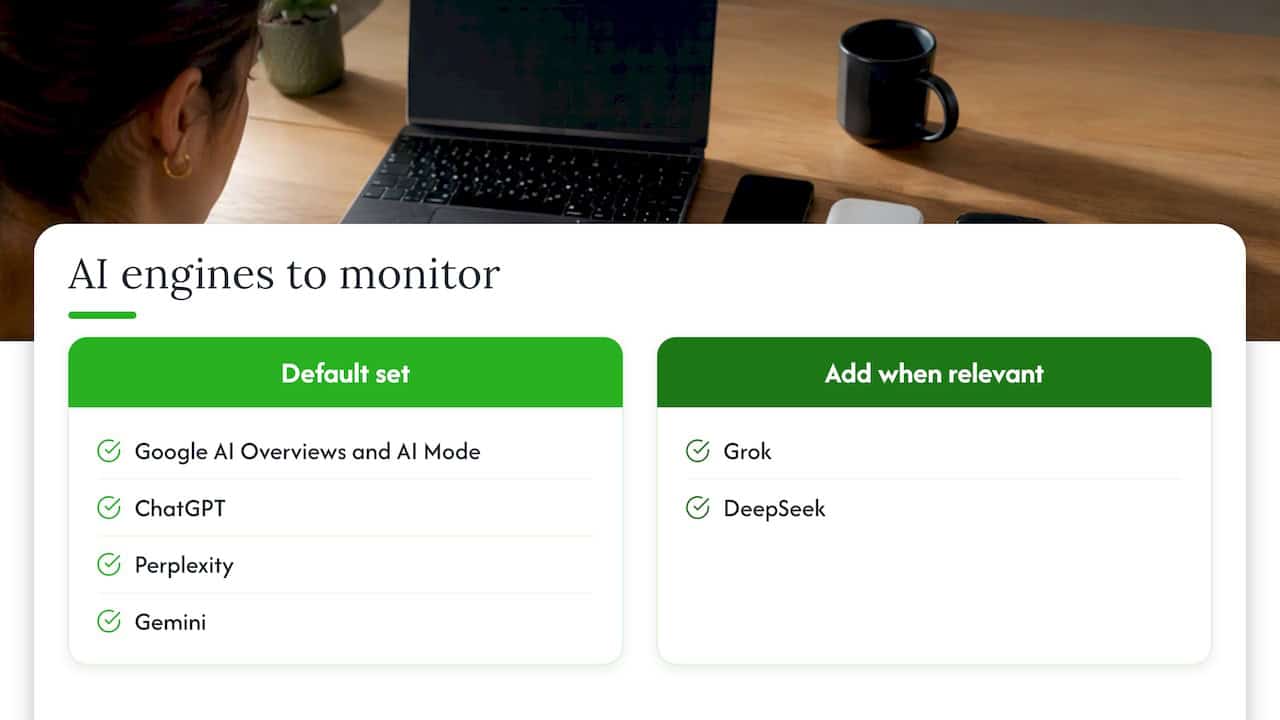
Monitor the engines your buyers actually use, and be explicit about why each is in or out. A sensible default for a US-focused plan covers Google’s AI Overviews and AI Mode, ChatGPT, Perplexity, Gemini, Claude and Microsoft Copilot, with Grok and DeepSeek added where your audience or industry makes them relevant.
One caution for the Google side: Google says there are no extra technical requirements for AI Overviews beyond standard Search eligibility, and no page is guaranteed to appear. Your report should never promise placement. It should show movement and explain it.
Sentiment sources matter too. AI engines often lean on community and video content when they assemble answers, so tracking how your brand is discussed on Reddit and YouTube gives you early warning about what the engines may repeat. That is a core part of how we built Cairrot’s unified AEO analytics.
Our perspective: report on what you can change
We talk with agencies, in-house content teams and developers every week, and the same mistake shows up in almost every first AI report: it describes, but it doesn’t direct. A chart showing that your share of voice is 14% is trivia until it sits next to the gap analysis that explains it.
So we build reporting around three habits.
Keep the scoreboards separate. Search rankings and AI citation share measure different phenomena, and blending them into one composite score hides the signal. Report both, side by side, with their own definitions.
Pair every metric with an action. Low prompt coverage means a content brief. A negative sentiment cluster on Reddit means a community or product response. An inaccurate answer means fixing the source pages the engines pull from.
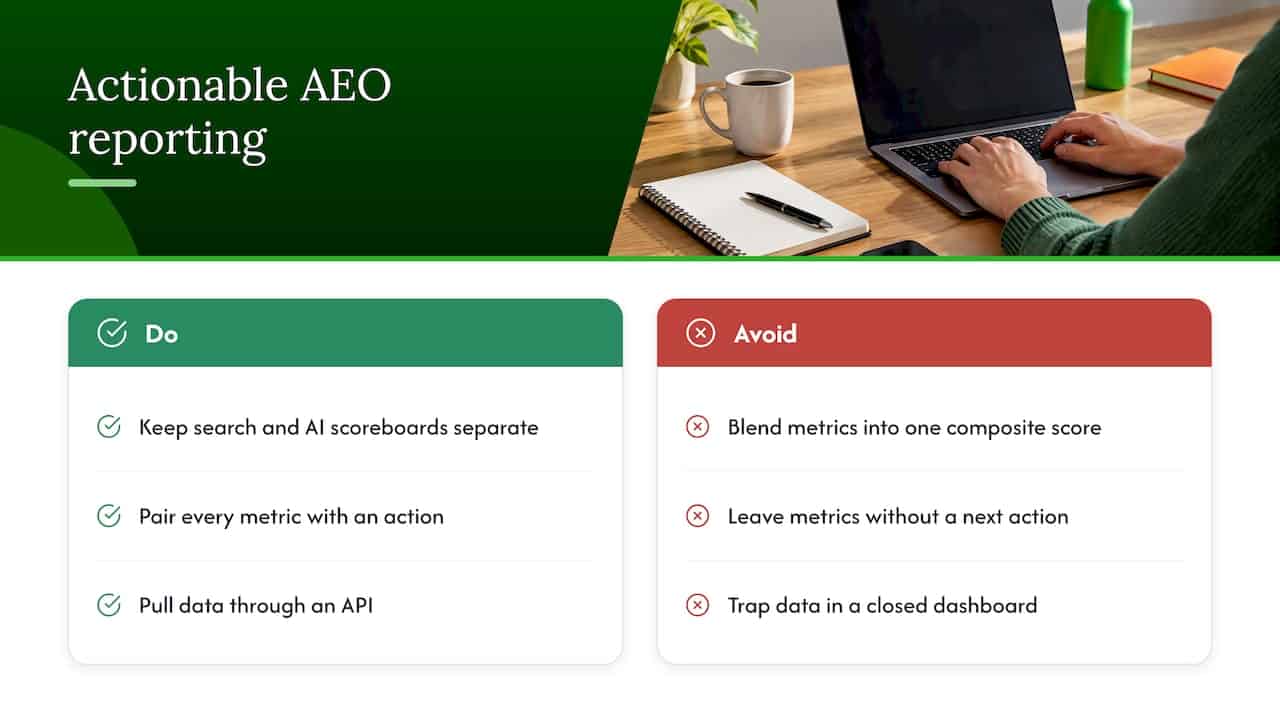
Open data beats walled gardens. Teams should be able to pull their numbers into GA4, Search Console, Databox or their own warehouse through an API, not be trapped in a closed dashboard. Control over the data is control over the story you tell.
Many teams that run this loop consistently see measurable AEO movement within as little as 60 days. The reports are what keep the loop honest.
— Dr. Patrick McAvoy
How agencies can structure white-label AEO reporting
Agencies carry a particular burden: ten or fifty clients, each with different engines, prompts and competitors, and each expecting a polished deliverable. The fix is one template with modular blocks, branded per client.
A structure that works:
- Executive summary (one page). Three headline numbers, one risk, one win, one recommended action.
- Presence and prominence. Citation share and share of voice by engine, with a competitor benchmark.
- Portrayal. Sentiment trend, notable Reddit and YouTube threads, and any factual errors found in answers.
- Traffic and outcomes. AI referral sessions and key events from GA4, plus Google and Bing first-party data.
- What we’re doing next. Prioritized opportunities with owners and dates.
- Method notes. Prompt set size, engines, run frequency and a plain label for directional versus decision-grade data.
Three practices keep this scalable. First, freeze the prompt set per client each quarter so trends are comparable, and add new prompts in a separate block. Second, report monthly for executives and review weekly internally, since weekly prompt coverage is the number content teams can move. Third, automate the pulls so analysts spend time on the recommendations, not on copying screenshots.
This is the workflow our AEO reporting tool supports, with bulk client management, customizable white-label dashboards and integrations with GA4, Search Console, Bing, Databox, Cloudflare and CloudFront. Our AEO Insights layer turns the gaps it finds into a ranked to-do list for each account.
For a deeper primer on the visibility concept itself, our guide to AI search visibility covers the fundamentals, and this walkthrough on measuring AI search visibility is a good companion when you are setting targets.
A simple reporting cadence
Reporting fails when it is irregular. A rhythm most teams can sustain:
- Weekly (internal, 30 minutes): prompt coverage, new citations gained or lost, sentiment flags, errors to fix.
- Monthly (client or executive): the full template above, with a comparison to the previous month and the same month’s goals.
- Quarterly: refresh the prompt set, revisit which engines matter, and decide which metrics graduate from directional to decision-grade.
Keep changes in methodology in writing. If you add an engine or rewrite prompts, annotate the chart so nobody mistakes a methodology shift for a performance shift.
What you can’t measure yet
Be straightforward with stakeholders about the gaps. Google’s report does not give clicks, queries or conversions for AI features. Bing does not attribute clicks or conversions either. Answers vary from run to run, which is why sample size and reproducibility matter, and referral data under-counts people who read an answer and later search for you by name.
The honest framing is that AI search reporting shows exposure, perception and a partial view of outcomes. Combine it with branded search trends, direct traffic and sales conversations, and let the business decide how much weight each deserves.
Putting it to work with Cairrot
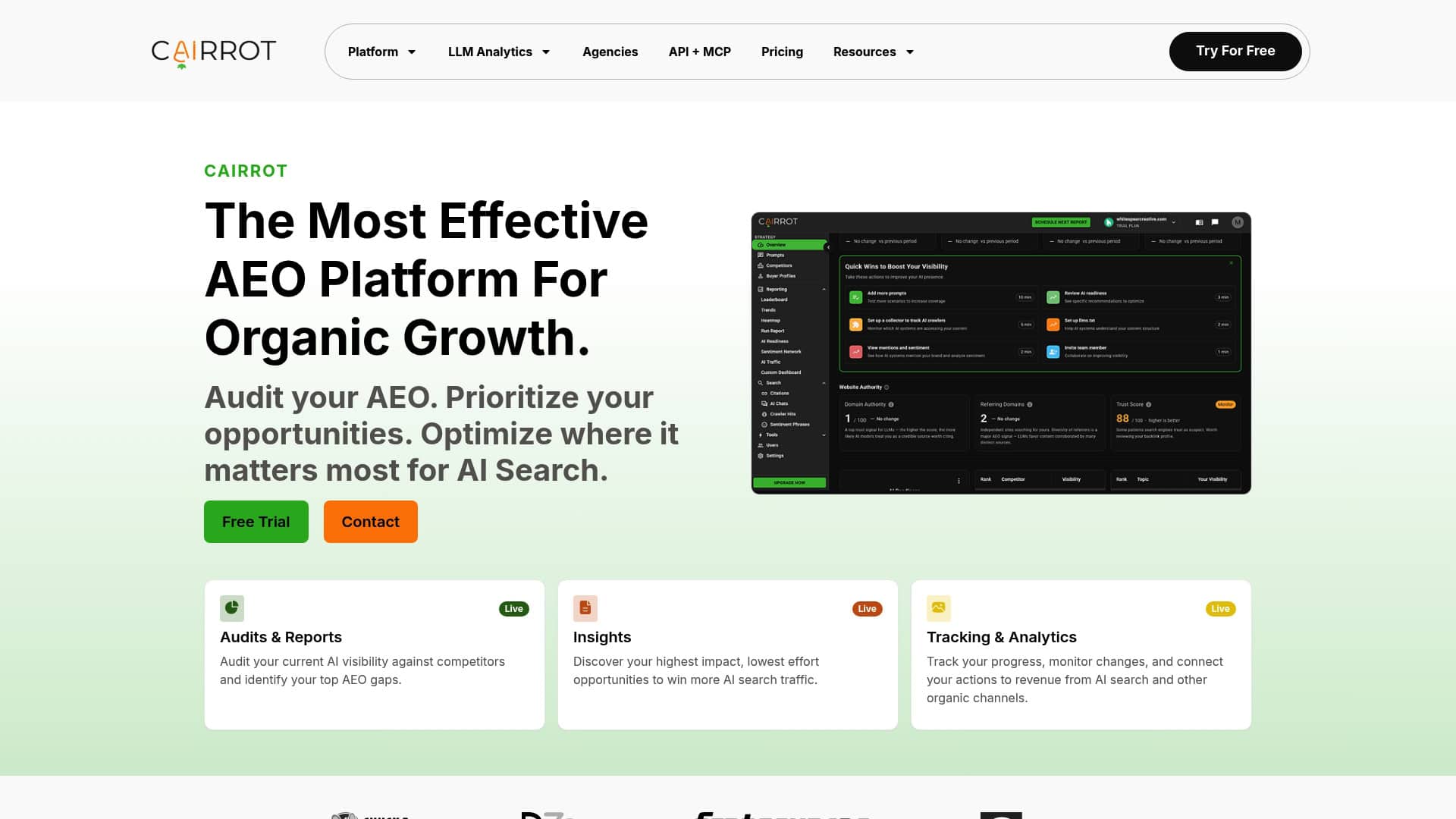
If you need cross-engine tracking, sentiment and client-ready reporting in one place, Cairrot is built for exactly this. Our platform runs audits, competitor benchmarking and sentiment tracking across ChatGPT, Gemini, Claude, Perplexity, Grok and DeepSeek, plus Reddit and YouTube, and feeds a unified view alongside your GA4 and Search Console data. API access is included in base plans, and there is a WordPress plugin for publishers.
Plans on our pricing page start at $39 per month for Starter, $99 per month for Pro and $299 per month for Enterprise, with Grok monitoring and analytics available from $25 per month. Agencies and large organizations can also see how AEO audits and reports fit their setup, or look at our enterprise solutions for custom pricing at scale.
Start with a free trial or demo from cairrot.com and build your first report on real data.
FAQ
What is the difference between AEO reporting and AI search reporting?
In practice the terms overlap. AEO reporting usually refers to the full cycle of auditing, optimizing and reporting for answer engines, while AI search reporting describes the measurement piece: visibility, citations, sentiment and traffic. Most teams use one report to cover both.
Can AI searches be traced?
Partly. Google’s Search Console reports impressions for pages in AI Overviews and AI Mode, GA4 can isolate AI assistant referral traffic, and Bing shows cited pages. Individual conversations inside ChatGPT or other assistants are not visible to you, so cross-engine tracking relies on running a fixed set of prompts and recording the answers.
Which metrics should I report first?
Start with citation share per engine, prompt coverage, sentiment and AI referral sessions. Those map to presence, portrayal and persuasion in the IAB framework, and they are practical to collect in a first month.
Should I combine AI and SEO metrics into one score?
No. Rankings and citation shares measure different things, so a blended score blurs both. Show them side by side on the same page and explain each on its own terms.
How often should an AEO dashboard update?
Run prompts weekly for internal use and report to clients monthly. Answers fluctuate, so weekly runs give you enough data points to separate real movement from noise.
Sources
- AI Features and Your Website, Google Search Central
- Generative AI performance report, Search Console Help
- Google Now Reports AI Search Impressions, Search Engine Journal
- What’s new in Google Analytics, Analytics Help
- Custom channel groups, Analytics Help
- Tracking AI visibility with Bing Webmaster AI Performance, CXL
- IAB: Measuring Visibility in the AI Era
- IAB Measuring Visibility in the AI Era, executive summary (PDF)
- AI Visibility Metrics That Actually Mean Something, Momentence
- AI Search Visibility, AmmarAI