
ChatGPT SEO means AEO, or AI Engine Optimization: making your content discoverable, extractable, and citable by ChatGPT and other AI assistants rather than ranking it for blue links; learn more about why optimize for ChatGPT. The single highest-leverage move available right now is verifying that AI crawlers can actually reach your pages, then adding a tight 40 to 60 word answer block above the fold. Get the technical piece right and you can see citation movement in your target prompts within two to four weeks.
TL;DR:
- Ensuring AI crawlers can access your site often results in citation increases within two to four weeks if issues like blocked bots or outdated robots.txt files are fixed.
- Structuring content with concise direct answers and self-contained answer blocks near the top of pages improves extractability and citation likelihood for AI answers.
- Building third-party mentions and corroborating signals through guest posts, forums, and partner pages takes two to six months, significantly influencing citation trust.
- Technical fixes such as schema deployment and crawler access are quick wins, while off-site authority-building requires a longer, more deliberate effort.
- Continuous measurement with a defined set of buyer questions and tracking citation and mention rates helps evaluate progress and guide optimization efforts.
Table of Contents
- What Is ChatGPT SEO (AEO) and Why It Matters
- How Do You Verify AI Crawler Access?
- How Should You Structure Content for AI Extraction?
- Where Do You Earn the Corroboration AI Engines Trust?
- How Do You Measure Whether Your ChatGPT SEO Is Working?
- What Does a 90-Day AEO Roadmap Look Like?
- What Are the Ethical Risks of ChatGPT SEO?
- What Are the Limits of AI-Generated Content for AEO?
- How Does ChatGPT SEO Fit With Your Existing SEO Stack?
- What Does ChatGPT SEO Look Like in Practice?
- How Do You Write Prompts for SEO Content Creation?
- Does ChatGPT SEO Improve User Experience and Engagement?
- What Actually Slows Down an AEO Rollout?
- How Cairrot Fits Every Phase of Your AEO Program
- Sources
- FAQ
What Is ChatGPT SEO (AEO) and Why It Matters
ChatGPT SEO has nothing to do with prompting ChatGPT to draft your meta descriptions. It’s the discipline of engineering your content and site infrastructure so ChatGPT, Perplexity, Gemini, and Copilot can find your pages, pull a clean passage from them, and attach your brand name to the answer. Two separate mechanics are at work here, and mixing them up wastes budget.
Retrieval is whether an assistant can crawl and index your page at all. Selection is whether, once retrieved, your passage gets chosen over a competitor’s for the actual answer. You can win retrieval and still lose selection if your content reads like a wall of marketing copy instead of a self-contained answer.
- Retrieval depends on crawler access, rendering, and technical health.
- Selection depends on extractable structure, corroboration, and topical authority.
- Platforms weight these differently: Perplexity leans heavily on freshness, while ChatGPT’s browsing mode blends its own retrieval index with real-time search.
For agencies and enterprise teams, this distinction is the difference between a client who shows up in AI shortlists and one who is invisible no matter how good their traditional rankings look.
How Do You Verify AI Crawler Access?
Before touching content, confirm the machines can even see it. An audit cited by Authoricy found that Many B2B websites inadvertently block major AI crawlers, usually by accident through a default WAF rule or an outdated robots.txt file inherited from a redesign. That single misconfiguration can zero out your visibility in ChatGPT regardless of how strong your content is.
Work through this checklist in order:
- Pull your CDN and server edge logs and confirm GPTBot, OAI-SearchBot, PerplexityBot, ClaudeBot, and Google-Extended are returning HTTP 200, not 403 or 429.
- Check your robots.txt for blanket disallow rules that were meant for scraper bots but accidentally caught AI crawlers too.
- Review CDN and WAF dashboards (Cloudflare, Akamai, Imperva) for bot-management rules silently blocking these agents.
- Confirm your core content renders in static HTML or via server-side rendering, since many AI crawlers do not execute JavaScript.
- Fix any lingering 4XX or 5XX errors on priority pages and check Core Web Vitals, since slow or broken pages get skipped in re-crawls.
- Publish a content-signals policy if your legal or comms team wants explicit terms around AI use of your content.
Pro Tip: Don’t trust your robots.txt file alone. Cross-reference it against your actual server logs. It’s common to find a crawler technically allowed on paper but silently blocked at the CDN layer.
Technical fixes are binary and fast. Most teams see measurable citation movement within a few weeks once crawler access is restored, well before any authority-building work pays off.
How Should You Structure Content for AI Extraction?
Assistants do not read your page like a person scrolling top to bottom. They pull discrete passages, so every section needs to function as a standalone answer. Google’s own guidance for AI search recommends leading with direct answers and building self-contained answer blocks rather than burying the point three paragraphs deep.
Apply these formatting rules to any page you want cited:
- Open with a concise direct answer near the top of the page, stating the core claim with no throat-clearing.
- Build each H2 or H3 section as a 75 to 150 word answer block that could be lifted whole into a chat response and still make sense.
- Write headings as the actual questions buyers type into ChatGPT, not generic labels like “Overview” or “Benefits.”
- Add Article schema (with author, datePublished, and dateModified), FAQPage schema, and a visible Author schema tied to a real byline.
- Use semantic HTML and descriptive alt text so non-text elements don’t create extraction dead ends.
Reformatting flat paragraphs into lists and tables can improve extraction accuracy by around 43%, according to HubSpot’s structural optimization research. That single change often costs less than a day of editorial time per page.
Where Do You Earn the Corroboration AI Engines Trust?
Assistants rarely cite a single source in isolation. They tend to trust claims that show up in more than one place: your site, plus a Reddit thread, a YouTube review, or trade press coverage saying the same thing. Third-party mentions frequently make up the majority of what gets cited alongside or instead of brand-owned pages, which means owned content alone will not carry an AEO program.
Two things need to happen in parallel. First, align your entity signals on-site: Organization, Product, and Person JSON-LD, with sameAs links pointing to your Wikidata entry and verified LinkedIn or Crunchbase profiles. Second, go earn mentions where the models are already listening.
- Pitch guest posts and podcast appearances on outlets your buyers already trust.
- Seed genuinely useful answers in relevant Reddit and forum threads, since assistants increasingly cite sentiment from those platforms.
- Build partner and integration pages that create natural, linkable corroboration between your brand and adjacent tools.
- Contribute to community Q&A sites and niche newsletters where your category gets discussed.
Authority work moves slower than technical fixes. Expect two to six months before corroboration efforts show up consistently in citation tests.
How Do You Measure Whether Your ChatGPT SEO Is Working?
Guessing is expensive here. Build a fixed prompt set of 30 to 60 real buyer questions, spanning informational, comparison, and vendor-intent phrasing, and run it consistently across ChatGPT with browsing enabled, Perplexity, Gemini, and Copilot.
- Run the baseline prompt set before making any changes and log which domains get cited and which brands get mentioned by name.
- Make one change at a time, whether it’s a schema addition or a BLUF rewrite, and hold everything else constant during the washout window.
- Re-run the identical prompt set and calculate citation rate (was your domain cited) separately from mention rate (was your brand named anywhere in the answer).
- Compare the lift between your test group and a control group of untouched pages to isolate what actually moved the needle.
Separating retrieval-stage and selection-stage signals is the part most teams skip, and it’s why so many AEO experiments produce confusing results. Selection-stage wins (structure, schema) often show up in 14 to 60 days; retrieval-stage wins (crawler access, indexing) can take 30 days or longer to fully register.
Pro Tip: Track mention rate even when citation rate stays flat. A brand that gets named without a link is still winning share of voice, and it often precedes a citation a few weeks later.
What Does a 90-Day AEO Roadmap Look Like?
A staged sequence beats a scattershot one. AEO programs that follow accessibility, then structure, then authority, in that order, tend to show measurable citation improvement within 90 days, while teams that jump straight to link-building often stall on a crawler block they never diagnosed.
- Days 1 to 14: Unblock AI crawlers, verify server-side rendering, deploy Article and FAQPage schema, and add BLUF blocks to your top 10 highest-traffic pages.
- Days 15 to 45: Restructure those pages into extractable answer blocks, expand FAQs, update last-modified timestamps, and run your first prompt-set test.
- Days 46 to 90: Launch off-site corroboration through guest posts and interviews, refine the prompt set based on early results, and set a recurring quarterly content refresh.
| Phase | Primary owner | Success metric |
|---|---|---|
| Days 1 to 14 | Engineering | Crawler access confirmed, zero AI-agent 403s |
| Days 15 to 45 | Content team | Citation rate lift on the tested prompt set |
| Days 46 to 90 | Communications/PR | Mention rate growth across third-party sources |
Assign the roadmap to named owners immediately. AEO work dies in committee when engineering assumes content owns schema and content assumes engineering owns crawler access.
What Are the Ethical Risks of ChatGPT SEO?
The biggest risk isn’t malicious, it’s careless: publishing AI-assisted content that states something confidently and wrong, then watching an assistant cite it as fact to thousands of users. Because AI answers compress your page into a short passage, factual errors travel further and faster than they would in a normal blog post buried on page four of Google.
There’s also a manipulation temptation worth naming directly. Some teams try to game selection by stuffing keyword-matched questions into FAQ schema that don’t reflect real user intent, or by fabricating statistics to make content look more citable. Both tactics tend to backfire, because assistants increasingly cross-check claims against corroborating sources, and a claim nobody else repeats is a claim less likely to survive selection.
Transparency matters more here than in traditional SEO, not less. If your content signals policy says one thing and your robots.txt does another, that inconsistency erodes trust with the platforms and, eventually, with your own audience. Disclose AI involvement in content production where it’s material, keep a human editor accountable for factual claims, and resist the urge to publish volume over accuracy just because AI content is cheap to produce. An answer engine that cites you once and gets burned by a factual error is an answer engine that stops citing you.
What Are the Limits of AI-Generated Content for AEO?
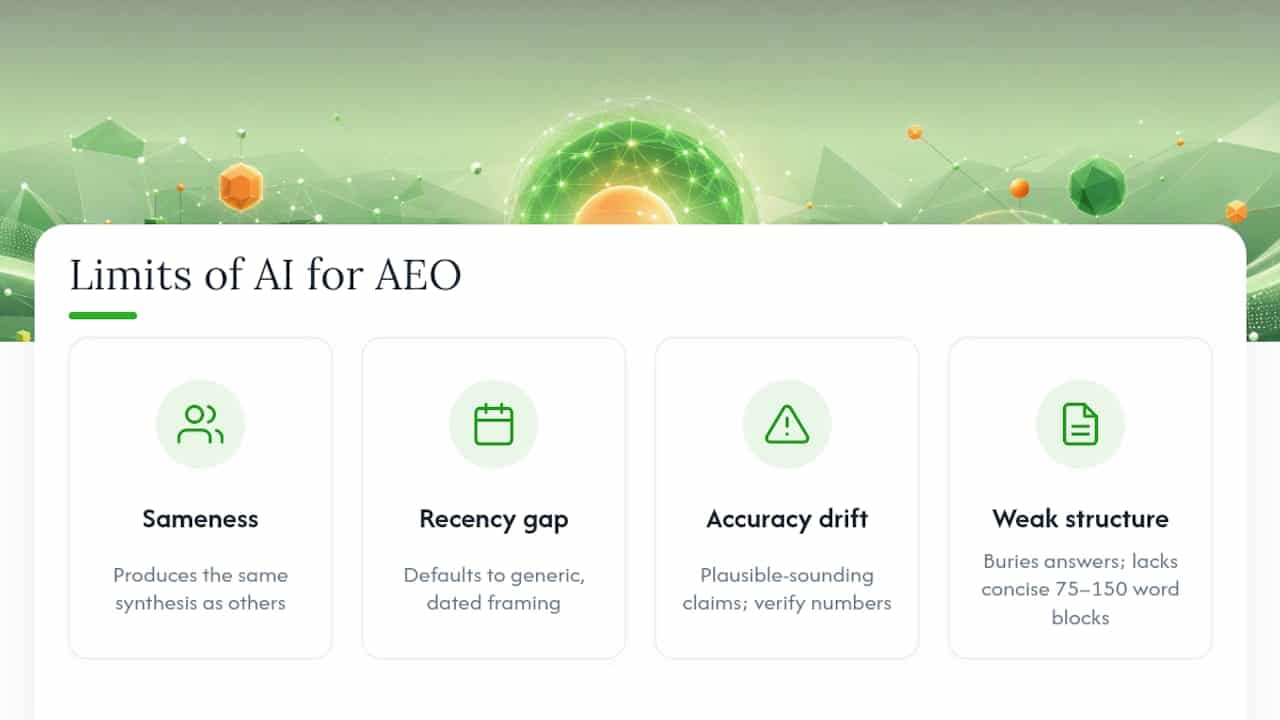
AI-drafted content has a structural weakness for AEO specifically: it tends to produce the same synthesis everyone else’s AI-drafted content produces. Assistants favor original data, proprietary case studies, and genuine synthesis over commodity summaries, according to Google’s own AI search guidance. A page that reads like a competent restatement of five other pages has nothing distinct to be cited for.
There’s also a recency and specificity gap. Generative tools often default to generic, dated framing unless a human editor injects fresh figures, named tools, and a defensible point of view. Content that leans entirely on model output without added reporting tends to read as safe and forgettable, precisely the opposite of what selection algorithms reward.
Accuracy drift is the third limitation. Models can produce plausible-sounding statistics or misattributed claims, and if those slip into published pages, they create the exact kind of unverifiable content that damages long-term citation trust. Every number in AI-assisted drafts needs a human check against a primary source before it goes live.
Finally, AI-generated prose often lacks the structural discipline AEO demands: it buries the answer, pads with transitions, and rarely self-contains a passage the way a 75 to 150 word answer block needs to. Treat AI drafting as a starting point for research and structure, not a substitute for editorial judgment on what actually gets cited.
How Does ChatGPT SEO Fit With Your Existing SEO Stack?
AEO doesn’t replace your existing SEO tooling, it sits alongside it and pulls from the same technical foundation. Your crawl-error monitoring, Core Web Vitals dashboard, and Search Console data are still relevant, since a page that’s broken for Googlebot is usually broken for GPTBot too.
Where the stack needs to expand is citation and mention tracking, which most traditional rank trackers weren’t built to measure. A ChatGPT rank tracker fills that gap by monitoring whether your brand shows up in AI-generated answers, something keyword-position tools simply don’t capture. Layer that on top of GA4 and Search Console so you can correlate AI citation spikes with actual traffic and conversion changes.
Integration also means process, not just tools. Your content brief template needs a BLUF and schema checklist alongside the usual keyword targets. Your technical SEO audits need an AI-crawler-access line item next to the standard robots.txt review. And your reporting cadence needs a citation-rate column next to organic sessions, so stakeholders see AEO progress in the same dashboard as everything else. Treating AEO as a bolt-on side project, tracked in a separate spreadsheet nobody checks, is the fastest way to let it quietly die after the initial audit.
What Does ChatGPT SEO Look Like in Practice?
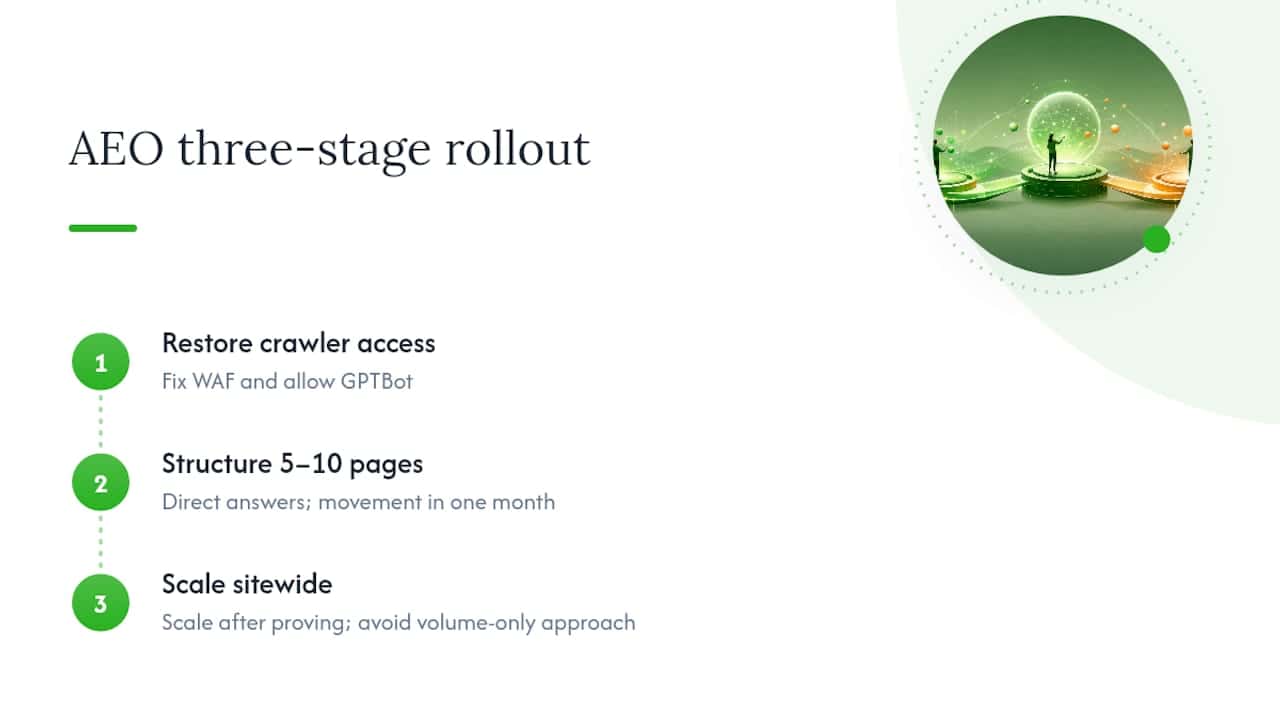
Picture an enterprise SaaS content team that ran a baseline prompt set of 40 buyer questions across ChatGPT and Perplexity and found their domain cited in exactly zero answers, despite ranking on page one of Google for the same terms. Their audit found GPTBot was returning a 403 from a WAF rule set eighteen months earlier for an unrelated bot-mitigation project. Restoring access and adding BLUF blocks to their ten highest-traffic comparison pages was the entire first intervention.
A separate pattern shows up constantly in agency work: pages that rank well but read as pure narrative, with the actual answer to “what does this cost” or “how does this work” scattered across four paragraphs instead of stated plainly near the top. Rewriting those into a direct answer followed by supporting detail is often the single highest-return edit available, because it addresses the selection-stage problem directly without touching a single backlink.
The pattern that shows up in Cairrot’s best AEO strategies research is consistent: teams that fix accessibility first and structure second see selection-stage movement inside a month, while teams that start with content volume, publishing more pages without fixing the underlying technical or structural issues, often see no citation change at all, because volume was never the constraint. Start with a small set of five to ten high-traffic pages, prove the model works there, and only then scale it across the site.
How Do You Write Prompts for SEO Content Creation?
Prompt engineering for AEO content differs from general-purpose prompting because the output has to survive an editorial and structural checklist, not just read well. A prompt that says “write a blog post about X” produces generic prose. A prompt that specifies the BLUF length, the target question for each H2, and the schema requirements produces something closer to publishable.
Structure your content prompts around these constraints:
- Specify the exact word count for the opening answer (40 to 60 words) and require it to state the core claim without introductory framing.
- Feed the model your actual target prompt set, the real questions buyers type into ChatGPT, and ask it to draft headings as direct answers to those questions.
- Require every section to stay within a 75 to 150 word range so passages remain extractable on their own.
- Ask explicitly for named tools, standards, or figures rather than generic claims, since vague output produces vague citations.
- Instruct the model to flag any statistic it generates as unverified, so your editor knows exactly what needs a source check before publication.
The output still needs a human pass for accuracy and voice. Prompt engineering narrows the gap between AI draft and publishable AEO content, but it doesn’t close it. Treat well-engineered prompts as a faster first draft, not a finished, citation-ready page.
Does ChatGPT SEO Improve User Experience and Engagement?
The formatting AEO demands, BLUF openings, question-led headings, self-contained answer blocks, happens to be the same formatting that improves comprehension for human readers scanning on mobile. That’s not a coincidence; both assistants and impatient readers want the answer before the explanation.
The engagement effects show up unevenly, though. Pages optimized for extraction sometimes see a shift in on-page behavior: readers who get their answer from an AI citation may never click through at all, which can show up as flat or declining organic sessions on a page that’s actually gaining AI visibility. Track citation and mention rate alongside traffic, not as a replacement for it, or you’ll misread a winning AEO page as an underperforming one.
Where the two metrics align cleanly is dwell time and bounce rate on pages that do earn the click. A tightly structured answer block with clear subheadings tends to keep readers oriented and reduces the “wrong page” bounce that happens when someone lands expecting a direct answer and finds three paragraphs of preamble instead. The freshness signals that help with AI citation rates also tend to correlate with better engagement, since updated, accurate content simply serves readers better regardless of which engine sent them there.
What Actually Slows Down an AEO Rollout?
Most AEO programs stall on coordination, not strategy. Engineering owns crawler access, content owns page structure, and comms owns off-site mentions, and if nobody governs how those teams hand off work, pages sit half-fixed for months. Set up a lightweight landing-page governance process before you start: one owner per page, one shared tracker, one definition of “done” for each phase.
Expect asymmetric timelines. Structural fixes, BLUF blocks, schema, crawler access, tend to show movement in your prompt-set tests within weeks. Authority work is slower and noisier, often taking months before third-party mentions compound into consistent citations. Teams that expect authority-building to move as fast as a robots.txt fix usually abandon it too early.
— Dr. Patrick McAvoy
How Cairrot Fits Every Phase of Your AEO Program
Running this playbook by hand across dozens of client pages is where most agencies lose momentum, especially the measurement step, since manually querying four different AI engines with sixty prompts every month isn’t a sustainable workflow. Cairrot is built specifically for that gap: it audits your current AEO standing, flags crawler-access and schema issues before they cost you citations, and tracks how your pages perform across ChatGPT and Gemini rank tracking, plus sentiment monitoring on Reddit and YouTube where a meaningful share of AI corroboration actually originates.
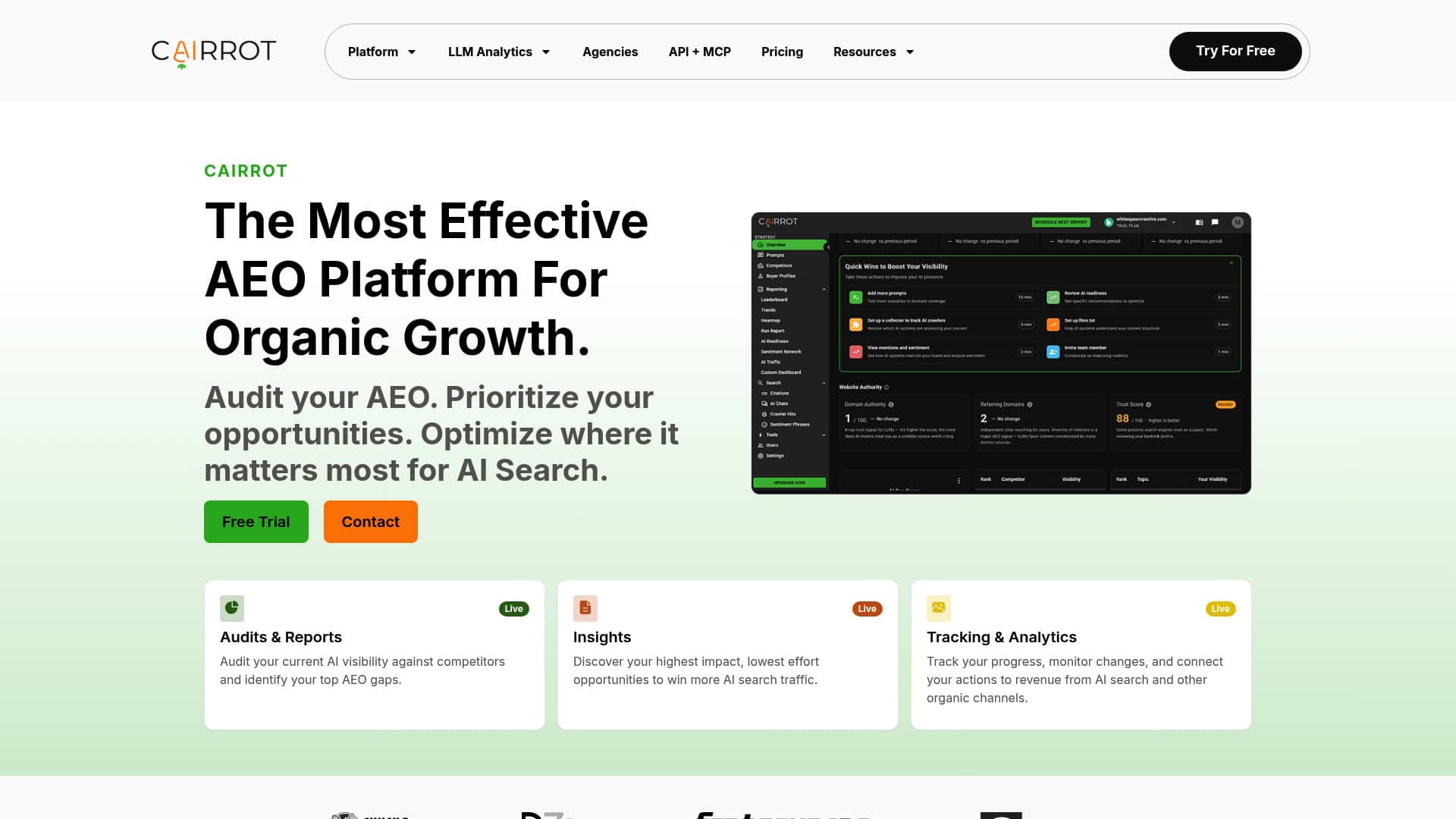
The platform maps directly onto the 90 day roadmap above. Run the initial audit during your Days 1 to 14 technical phase to catch crawler blocks fast, use citation and mention tracking through the Days 15 to 45 structural work to see which pages respond, then lean on sentiment tracking during the Days 46 to 90 authority push to see whether your off-site mentions are actually landing. Agencies managing multiple client accounts get bulk reporting and customizable dashboards instead of stitching together spreadsheets by hand. If you’re ready to see where your own pages stand right now, start with an AEO audit on Cairrot and get a baseline before you change a single line of code.
Sources
- Succeeding in AI search (Google Developers blog)
- AI content optimization: How to get found in Google and AI search in 2026 (HubSpot)
- The technical signals AI search uses that most SEOs still aren’t optimizing (Search Engine Journal)
- AI Search Ranking Factors 2026 | Authoricy
- Geodocs
FAQ
Is ChatGPT SEO the Same as Traditional SEO?
No. Traditional SEO targets ranking positions in search results, while ChatGPT SEO (AEO) targets whether your content gets retrieved and cited inside an AI-generated answer, which relies on crawler access and extractable structure rather than backlinks alone.
How Long Does It Take to See AEO Results?
Technical fixes like crawler access typically show citation movement within a few weeks, while structural changes take 14 to 60 days and authority-building through third-party mentions takes two to six months.
Do I Need FAQPage Schema for Every Page?
Not every page, but any page meant to answer a discrete buyer question benefits, since pages with FAQPage schema show measurably higher extractability in AI Overviews and similar features.
Can I Track My Brand’s Visibility Inside ChatGPT?
Yes. Tools like Cairrot’s ChatGPT rank tracker monitor citation and mention rates across prompt sets, which standard keyword-rank trackers don’t capture.
What’s the Single Fastest AEO Fix to Make Today?
Verify your robots.txt and CDN settings aren’t blocking GPTBot, PerplexityBot, or ClaudeBot, then add a 40 to 60 word direct-answer block to your highest-traffic page.