
AEO does not replace SEO. It complements it. SEO engineers pages to rank and earn clicks; AEO engineers content to be extracted, quoted, and cited directly inside an AI answer. If your priority is informational, high-volume question traffic, optimize for extractability and citations first. If it’s transactional or local intent, keep SEO in the lead seat.
TL;DR:
- AEO focuses on content extractability and citation, emphasizing short, structured answers, schema markup, and entity consistency over long-form ranking content.
- Technical SEO fundamentals like crawlability, server-side rendering, and schema are crucial, as many AI crawlers rely on raw HTML and can’t see content rendered by JavaScript.
- Measuring AEO success involves tracking citation share, mention counts, and attribution accuracy rather than traditional ranking metrics like position or click-through rate.
- Prioritize technical fixes before content creation, ensuring your pages are accessible and parseable by AI systems to improve citation and visibility.
- AEO best applies to informational, high-volume questions, while traditional SEO remains more effective for transactional, local, or consideration-stage pages.
Table of Contents
- AEO vs SEO: How the Two Disciplines Actually Differ
- What Signals, Formats, and Metrics Actually Diverge
- Technical Foundations That Determine AI Visibility
- How Do You Measure AEO Success vs SEO Success?
- When Should You Prioritize AEO Over SEO?
- An 8-Step Checklist to Make a Page AEO-Ready
- Why This Guide Reflects How AEO Actually Gets Implemented
- What This Guide Gets Right That Most AEO Advice Doesn’t
- Get Your Baseline AEO Score With Cairrot
- Sources
- FAQ
AEO vs SEO: How the Two Disciplines Actually Differ
Search Engine Optimization gets your page indexed, ranked, and clicked. Answer Engine Optimization gets your content lifted, quoted, and attributed inside an AI-generated response, whether that’s a Google AI Overview, a ChatGPT answer, or a Perplexity summary. The distinction sounds subtle until you watch how differently each discipline treats the same piece of content.
SEO is defined by ranking mechanics: keyword targeting, backlink authority, page experience signals, and click-through rate optimization across a search results page. Success looks like position 1 through 3 and a healthy organic session count.
AEO is defined by retrieval mechanics: whether a language model’s retrieval layer can find your content, parse it cleanly, and lift a self-contained passage into its response with attribution intact. Success looks like a citation, a brand mention, or a linked source inside an AI-generated answer.
Take a query like “how long does invoice matching take.” An SEO-first approach builds a 2,000 word pillar page with internal links, targets the keyword in an H1, and builds authority through backlinks over months. An AEO-first approach opens with a direct, two-sentence answer, formats it as a discrete passage a model can lift whole, and backs it with schema that makes the claim’s source unambiguous.
- SEO: long-form authority content built to rank and convert over time
- AEO: short, self-contained, extractable answers built to be cited in a single retrieval pass
- Both: technical hygiene, quality writing, and a real reason to be the definitive source
Neither discipline is optional anymore. Google’s own guidance on optimizing for generative AI features is explicit that foundational SEO practices remain the base layer AI systems build on. AEO is not a separate universe. It’s a more demanding extension of the same fundamentals.
What Signals, Formats, and Metrics Actually Diverge
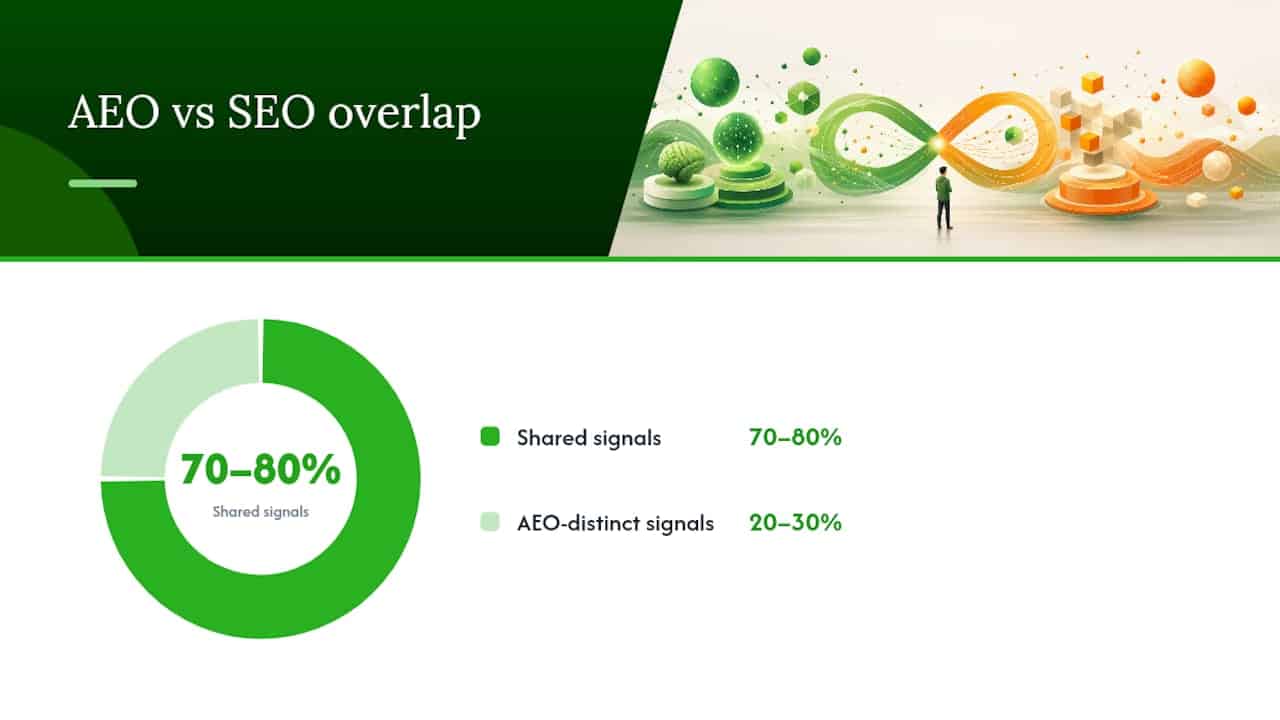
SEO and AEO overlap far more than most marketers assume. Industry analysis puts the overlap at roughly 70 to 80 percent, with AEO’s distinct mechanics accounting for the remaining share. That remaining 20 to 30 percent is where teams get tripped up, because it requires different signals, different formats, and different measurement entirely.
Signals that matter for each:
- SEO leans on backlink authority, keyword relevance, domain trust, and page experience scores.
- AEO leans on extractable passage structure, schema density, and entity disambiguation, meaning the model can confidently tell your brand apart from a similarly named competitor.
- Both still depend on genuine expertise and a page that actually answers the query it targets.
Format differences that show up immediately:
- SEO favors long-form content, topic clusters, and internal linking architecture that builds topical depth over dozens of pages.
- AEO favors short direct-answer blocks, FAQ schema, HowTo structured steps, and passages written to stand alone outside their page context.
- A page can do both: lead with a direct answer, then expand into the long-form depth that ranking still rewards.
Measurement diverges sharply here. SEO tracks rankings, organic traffic, and click-through rate from a search results page. AEO tracks citation share (the percentage of relevant test prompts where your brand gets cited), AI mention count across engines, and pass/fail outcomes from repeatable prompt tests. You cannot measure AEO with a rank tracker. There is no position 4 in a ChatGPT answer. You either got cited or you didn’t.
That binary nature matters more than it sounds. Pew Research found users are less likely to click on links when an AI summary appears in results, which means the zero-click outcome you used to worry about killing your traffic is now something you can actually win, if you’re the source the AI summary cites. Traffic isn’t the only prize anymore. Attribution is.
The real overlap dividend shows up in technical work. Fix crawlability, rendering, and structured data once, and you improve both ranking eligibility and citation eligibility at the same time. That’s the highest-leverage investment on this whole list.
Technical Foundations That Determine AI Visibility
Here’s the part most AEO advice skips entirely: none of your content strategy matters if an AI crawler can’t reach, render, or parse your page. Technical SEO fundamentals, including crawlability, JavaScript rendering, and server-side structured data, remain the most common blockers to AI citation, and they fail silently. Your page can look perfect in a browser and still be invisible to a model’s retrieval layer.

Crawlability. Check your robots.txt for accidental blocks on AI user agents like GPTBot, ClaudeBot, or PerplexityBot. A firewall rule meant to stop scraper abuse can just as easily block the exact crawlers you want indexing your content. Verify access with a direct user-agent fetch, not a guess.
Rendering. If your direct answer, your schema, or your key claim only appears after a client-side JavaScript render, many AI crawlers will never see it. They typically read the initial HTML response, not the rendered DOM. Server-side rendering (SSR) or static site generation (SSG) for anything you need cited is not optional infrastructure, it’s the baseline.
Structured data. FAQPage, HowTo, Article, Organization, and Product schema all help a model parse your content’s meaning faster. Google’s own developer guidance confirms structured data helps but isn’t strictly required for generative features, so treat it as an accelerant, not a magic switch, and always inject it server-side. Schema added via JavaScript after page load carries the same rendering risk as any other client-side content.
Entity consistency. Inconsistent brand naming, mismatched schema across templates, or a different “sameAs” profile on every CMS instance fragments your identity in a model’s eyes. That fragmentation is a documented failure pattern at scale, and the fix is enforcing one canonical entity schema with consistent sameAs links across every property you control.
A four-step validation checklist covers most of this:
- Fetch your key pages as the relevant AI user agents and confirm the direct answer and schema appear in the raw HTML.
- Run the page through the Schema Markup Validator to confirm structured data parses cleanly.
- Check server logs for AI crawler visits and response codes, not just Googlebot activity.
- Run the same 3 to 5 prompts against your target topic weekly and log whether your brand gets cited.
Pro Tip: Don’t chase a special “AEO file” or hidden markup trick. Google has explicitly warned against llms.txt and similar hacks as a shortcut. The fix is almost always boring: fix the render, fix the schema, fix the entity name.
How Do You Measure AEO Success vs SEO Success?
You cannot run an SEO dashboard and call it AEO reporting. The KPIs are structurally different, and conflating them is how teams end up unable to prove AEO is working even when it is.
Citation metrics replace ranking metrics. Track citation share (what percentage of your test prompts result in your brand being cited), raw AI mention count across engines, and a qualitative accuracy or sentiment score for how the model characterizes your brand when it does cite you. None of these map cleanly onto rank position or CTR, so don’t force them into the same report.
Build a genuine test set. A workable approach is to build an AI citation test set of 20 to 50 high-value prompts covering your core topics, then run them weekly across ChatGPT, Gemini, Perplexity, and Google AI Overviews. Log which pages get cited, which don’t, and which citations are wrong or outdated.
- Google Search Console: still your source of truth for impressions, clicks, and query-level ranking data.
- Server logs: your only reliable signal for actual AI crawler visits and whether they’re getting served the right content.
- AI monitoring/citation tools: your only way to see whether all that technical work translated into an actual mention.
Each source answers a different question, and none of them substitutes for the others. GSC won’t tell you if ChatGPT cited you. Server logs won’t tell you if the citation was accurate. A citation tracker won’t tell you if your rankings dropped in the process.
Cadence matters here. Citation outcomes shift month to month, sometimes week to week, as engines update retrieval behavior. Enterprise guidance recommends monitoring first, optimizing second, governing third, which means your reporting rhythm should be weekly for citation tracking and monthly for the broader SEO/AEO blend, with a decision trigger to revisit any page that’s gone three cycles without a citation despite technical fixes being in place.
When Should You Prioritize AEO Over SEO?
Not every page deserves the same treatment, and trying to AEO-optimize a bottom-funnel demo request page is usually wasted effort. A simple heuristic handles most cases: AEO first for informational, high-volume question queries. SEO first for transactional, local, and consideration-stage pages.
If someone is asking “what is invoice matching” or “how does answer engine optimization differ from SEO,” they’re in information-gathering mode, exactly the kind of query an AI Overview or ChatGPT answer intercepts before a click ever happens. That’s AEO territory. If someone is searching “invoice automation software pricing” or “SEO agency near me,” they’re closer to a decision, and a strong ranking with compelling on-page conversion elements still does more work than a citation ever will.
For many B2B SaaS and ecommerce sites, a reasonable default effort split lands around 80% SEO, 20% AEO, shifting toward more AEO investment when:
- Your category has heavy top-of-funnel question volume (comparison and definitional queries).
- Competitors are already earning citations you’re losing share to.
- Your product touches a topic AI Overviews already surface heavily in search results.
Governance matters as much as the ratio. AEO work touches engineering (rendering, schema), content (answer formatting), and SEO (technical hygiene) simultaneously, so it needs a named cross-functional owner, not three teams assuming someone else has it. Set a content quality bar that rejects thin, keyword-stuffed “answers” written purely to game extractability, because AI engines increasingly favor original, attributable claims over reformatted boilerplate. Review the split quarterly, not annually. Google’s continued rollout of AI Mode and agentic search features, teased at Google I/O 2026, means this ratio won’t stay static for long.
An 8-Step Checklist to Make a Page AEO-Ready
Run this against one high-value page this week. It’s designed to be testable within a single sprint.
- Write a direct answer. Draft 1 to 2 sentences that fully answer the page’s core query, labeled clearly (a bolded “Direct Answer:” lede works fine) so it’s unmistakable as a self-contained passage.
- Confirm server-side rendering. Load the page with JavaScript disabled or fetch the raw HTML response. If the direct answer isn’t there, it doesn’t exist for most AI crawlers.
- Add schema server-side. FAQPage, HowTo, or Article schema, whichever fits, injected into the HTML response itself, not appended by a client-side script after load.
- Link entities with sameAs. Tie your organization schema to consistent sameAs profiles (LinkedIn, Wikipedia, Crunchbase, whatever’s authoritative for your brand) so identity resolution is unambiguous.
- Standardize naming everywhere. Audit how your brand name appears across your site, schema, and off-site profiles. Fragmented naming is a documented cause of failed citation resolution.
- Verify crawler access. Fetch the page as GPTBot, ClaudeBot, and PerplexityBot user agents, and check server logs to confirm those crawlers are actually visiting and getting a 200 response.
- Run baseline prompt tests. Ask 3 to 4 AI engines (ChatGPT, Gemini, Perplexity, Google AI Overviews are a solid starting set) the exact query this page targets. Record whether you’re cited, and if so, how accurately.
- Set a review cadence. Log the baseline citation result, then revisit in 60 days. Iterate on any page cited inaccurately or not cited at all, starting with the technical checks above before you touch the content itself.
Pro Tip: Resist the urge to rewrite the whole page on day one. Fix rendering and schema first, run the prompt test again a week later, and see if the citation appears before you touch a single sentence of copy. Half the time, the content was fine. The render wasn’t.
The single hardest step to automate manually is step 7, running the same prompts consistently across multiple engines and remembering to log results without them drifting into inconsistent formats. That’s the exact workflow a tool like Cairrot’s platform is built to run on autopilot instead of a spreadsheet nobody updates past week two.
Why This Guide Reflects How AEO Actually Gets Implemented
Cairrot builds AEO audits, citation tracking, and sentiment monitoring across AI engines including ChatGPT, Gemini, Claude, Perplexity, and Grok, plus sentiment tracking on platforms like Reddit and YouTube where brand perception often forms before it ever reaches a search query. That vantage point, watching what actually gets cited versus what merely gets optimized, shapes the operational bias in this guide toward technical fixes over content volume.
This piece is written by Patrick, whose work centers on translating AEO mechanics into engineering and content tasks teams can actually execute without a six-month roadmap. Detailed case studies and a fuller author background are available on request as Cairrot continues expanding its published proof points.
Teams using structured AEO monitoring commonly report measurable citation improvements within roughly 60 days of fixing the technical blockers outlined above, provided the underlying content already answers the query well. That timeline tracks with how quickly AI engines re-crawl and re-evaluate sources once rendering and schema issues are resolved.
What This Guide Gets Right That Most AEO Advice Doesn’t
Most AEO content treats it as a content trick: write shorter paragraphs, add an FAQ block, done. That’s incomplete advice, and it’s why so many teams add schema and see nothing change. The research is consistent on this point: the failures are usually technical, not editorial. A page can have a perfect direct answer and still be invisible if it’s rendered client-side or fragmented across inconsistent entity names.
The conventional advice also overstates how separate AEO is from SEO. It isn’t a new department. It’s the same technical and content discipline held to a stricter, more binary standard, cited or not, with less room for the slow compounding wins that define traditional ranking work.
If you take one thing from this guide, prioritize the crawl and render audit before you write a single new FAQ block. Content quality matters, but it’s wasted effort behind a technical wall the model can’t see past. Fix visibility first. Optimize the words second.
— Patrick
Get Your Baseline AEO Score With Cairrot
Every step in the checklist above, from prompt testing across engines to catching entity fragmentation before it tanks your citation rate, is exactly what Cairrot’s platform is built to run continuously instead of manually.
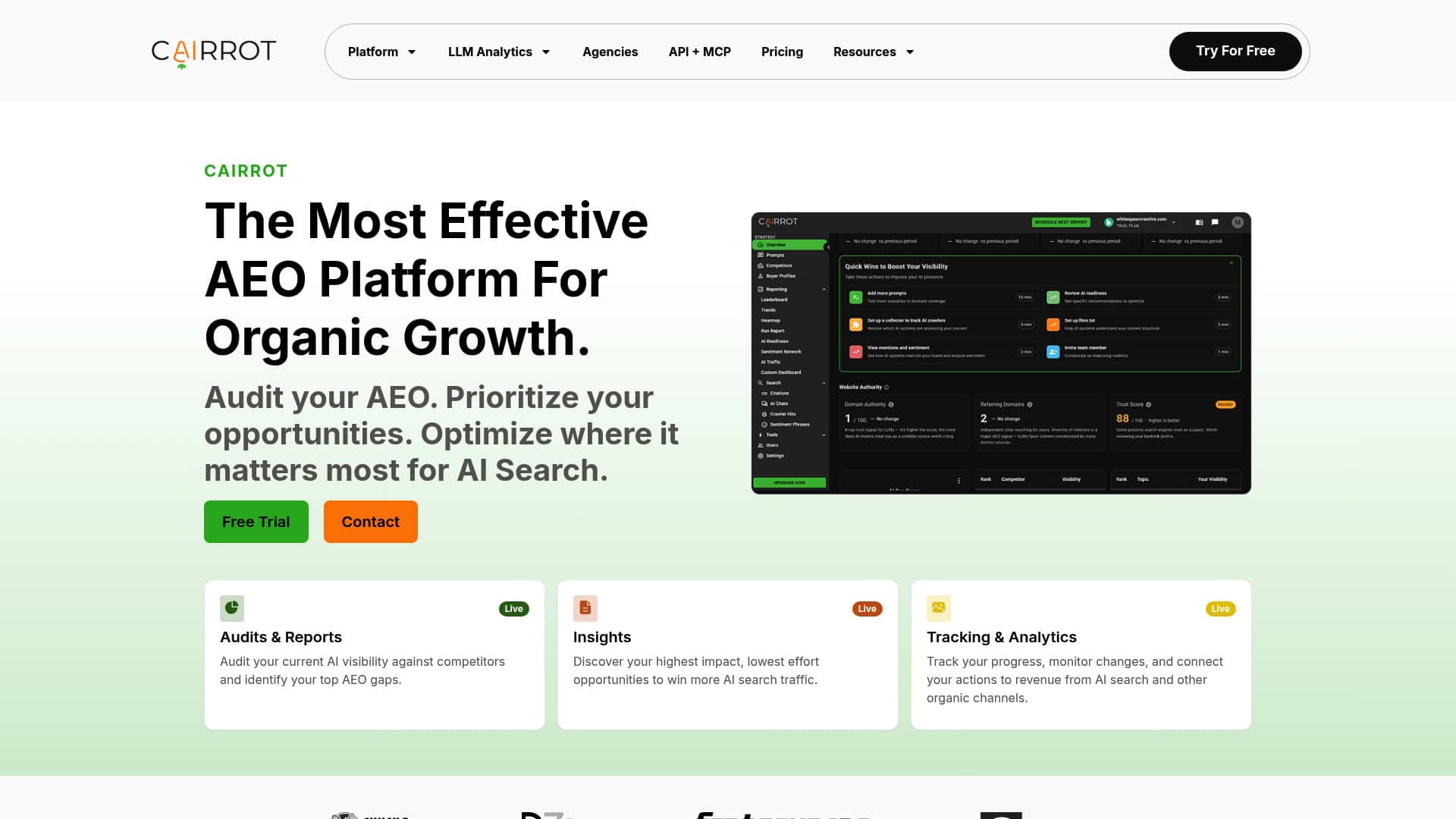
Cairrot’s audits flag the exact crawlability, rendering, and schema gaps covered in the technical foundations section, then its citation and mention tracking turns your weekly prompt tests into an actual dashboard instead of a spreadsheet you forget to update. Add sentiment tracking across Reddit and YouTube, and you get visibility into how AI engines characterize your brand before a citation even happens, not just whether one occurred. Agencies and enterprise teams managing multiple clients get bulk reporting and GA4, Search Console, and Cloudflare integrations built in, so citation share sits next to your existing SEO KPIs instead of living in a separate tool nobody checks.
Run a baseline audit on your highest-value page and see where your current citation share actually stands. Start with the AEO reporting platform and get your first gap report before your next content sprint.
Sources
- Google Search Central: Guide to optimizing for generative AI features
- What is Answer Engine Optimization, and Why Should Enterprise Marketers Care? (Siteimprove)
- AI Engine Optimization Explained: Full Workflow (Citera)
FAQ
Is AEO Part of SEO?
AEO is best understood as an operational layer built on top of SEO’s technical foundation, not a separate discipline. The two overlap roughly 70 to 80 percent in the fundamentals they share, including crawlability, quality content, and site structure, with AEO adding citation-specific mechanics like extractable answer formatting and entity disambiguation on top.
Is SEO Dead or Just Evolving?
SEO isn’t dead. It’s adapting to a search landscape where AI summaries increasingly sit above traditional results, and users click through less when an AI summary appears. Rankings and organic traffic still matter for transactional and consideration-stage queries; they’re simply no longer the only outcome worth measuring.
Does AEO Replace Traditional SEO Rankings?
No. AEO and SEO measure different outcomes, citation share versus rank position, and both remain necessary. A page can rank well and never get cited, or get cited frequently even if it isn’t among the top ranked results.
What’s the Fastest Way to Test If AEO Is Working?
Build a small set of 20 to 50 prompts covering your core topics, run them across ChatGPT, Gemini, and Perplexity, and log whether your brand gets cited and how accurately. Repeat weekly and treat the citation rate as your primary early signal, the same approach Cairrot’s citation tracking automates for ongoing monitoring.
Do I Need Special Files Like llms.txt for AEO?
No. Google has explicitly advised against chasing special AEO hacks like llms.txt, and structured data, while helpful, isn’t strictly required for generative features either. The reliable path is fixing crawlability, server-side rendering, and structured data delivery, not adding a novel file format.