
AI search visibility measures whether your brand gets cited, named, or recommended inside answers from ChatGPT, Gemini, Perplexity, and Google AI Overviews, not whether you rank on a results page. The single most useful first move is running a baseline audit across the prompts your buyers actually type, because your citation rate then becomes the metric that tells you if your strategy is working or wasting budget.
TL;DR:
- Running a baseline audit of customer prompts helps you identify whether your brand is cited or recommended, which directly impacts AI trust and early discovery.
- Tracking citation rate and recommendation rate across multiple AI engines reveals if your content is not only visible but also actively favored in generative answers.
- Technical SEO must include bot accessibility, schema markup, and server log checks, as AI models cannot cite or recommend content that isn’t indexable or accessible.
- Creating answer-first, entity-consistent content around key prompts and leveraging high-authority platforms increases the likelihood of AI citations and recommendations.
- Regular measurement, including monthly prompts testing and trend analysis via dedicated tools, is necessary to understand and improve AI search visibility over time.
Table of Contents
- What Is AI Search Visibility, and Why Does It Matter for Brands?
- How Do AI Visibility Tools and Trackers Work?
- What Metrics Should You Track for AI Search Visibility?
- What’s the Technical Checklist for AI Discoverability?
- What Content and Entity Tactics Win AI Citations?
- How Should You Measure and Report AI Visibility Progress?
- What Do Quick Wins in AI Visibility Actually Look Like?
- What Are the Limits of Measuring AI Search Visibility?
- Where Is AI Search Visibility Measurement Headed?
- How Does AI Search Visibility Fit Into Your Broader SEO Strategy?
- An Editorial Take on What Actually Moves the Needle
- Turn Measurement Into a Repeatable AEO Program
- Sources
What Is AI Search Visibility, and Why Does It Matter for Brands?
Traditional SEO measures rank. AI search visibility measures whether a generative engine chooses to mention your brand, quote your content, or recommend your product when someone asks a question in ChatGPT, Perplexity, Gemini, or a Google AI Overview. Those are fundamentally different jobs. A page can rank third for a competitive term and still never get pulled into an AI answer, because the model is selecting sources based on retrievability and perceived authority, not position.
This distinction matters because AI citations behave like a trust shortcut. When a generative engine names your brand as the answer, the searcher skips the comparison-shopping phase almost entirely. Ahrefs’ AI visibility guide frames this as a new discovery layer sitting on top of classic search, one where being mentioned carries more weight than being ranked.
The business outcomes tied to this shift are concrete:
- Brand discovery happens earlier, often before a prospect visits any website directly.
- Recommendation-style answers function like a trusted referral, not a listing.
- Referral traffic from AI platforms tends to arrive further along in the buying decision, since the user already got a recommendation before clicking through.
Ignore this layer and you’re invisible at the exact moment a buyer asks, “What’s the best tool for X?”
How Do AI Visibility Tools and Trackers Work?
AI visibility tools work by asking AI engines the same questions your customers ask, repeatedly and at scale, then logging whether and how your brand appears in the response. This is prompt sampling: a defined set of queries run against multiple engines on a schedule, with each response parsed for brand mentions, competitor mentions, and the sources the model cites.
Engine coverage is the first thing to check when evaluating a tool. ChatGPT, Gemini, Claude, Perplexity, Grok, and DeepSeek each pull from different training data, different retrieval systems, and different real-time web access. A brand that dominates Perplexity citations can be entirely absent from Gemini’s answers, so a tracker that only covers one or two engines gives you a distorted picture.

Pro Tip: Run the same 20 to 30 prompts manually across four or five engines before you buy any tool. It costs nothing but time, and it shows you exactly where the gaps are before you scale up measurement.
Most trackers output a similar core set of data:
- A visibility score, usually a composite of mention frequency and prominence.
- A list of specific mentions, with the exact prompt and engine that triggered them.
- Source coverage, showing which domains the AI engine cited alongside or instead of you.
- Prompt previews, so you can see the actual generated text, not just a score.
The limitation worth knowing upfront: AI answers are non-deterministic. Ask the same prompt twice and you can get a different answer, which is exactly why Ahrefs recommends starting with manual prompt checks before investing in paid tooling. Manual sampling is free and reveals platform-by-platform gaps fast; automated tracking adds the sample size and consistency manual checks can’t scale to.
What Metrics Should You Track for AI Search Visibility?
Citation rate is the metric that matters most, and it’s simple to calculate: the number of tracked prompts where your brand appears, divided by total prompts tested, across a given engine. Track it weekly at first, then monthly once your baseline stabilizes.
Recommendation rate is a narrower cut of that same data. It only counts instances where the AI engine actively suggests your brand as a solution, not just mentions it in a list. That distinction changes how you read the number: a high citation rate with a low recommendation rate usually means you’re present but not preferred.
AI share of voice compares your citation volume against named competitors across the same prompt set, similar in concept to traditional share of voice but measured inside generative answers instead of search results or ad auctions. Sentiment adds another layer entirely: a mention paired with cautionary language (“some users report”) carries different value than an unqualified endorsement, and it’s worth logging separately.
| Metric | What it tells you | How to calculate |
|---|---|---|
| Citation rate | How often you appear at all | Mentions ÷ total prompts tested |
| Recommendation rate | How often you’re the suggested choice | Active recommendations ÷ total prompts |
| AI share of voice | Your standing versus named competitors | Your mentions ÷ total category mentions |
| Sentiment score | Tone attached to your mentions | Positive minus negative mentions, as a ratio |
| Bot access rate | Whether crawlers can reach your content | Successful bot hits ÷ total bot requests in logs |
That last row, bot access, is a technical metric marketers often skip. If GPTBot or PerplexityBot is getting blocked at the server level, none of your content strategy matters, because the engine can’t retrieve the page in the first place.
What’s the Technical Checklist for AI Discoverability?
Content strategy is worthless if the crawler can’t get in the door. Work through this checklist in order, because each step depends on the one before it.
- Check server logs for AI bot activity. Search for GPTBot, ClaudeBot, PerplexityBot, and Google-Extended, and flag any 403 or 401 responses. Google’s own optimization guide recommends this as a first step, since blocked crawlers are one of the most common and most fixable causes of invisibility.
- Audit your robots.txt file. Confirm you’re not accidentally disallowing the AI crawlers you want indexing your content, and add an llms.txt file if your platform supports it to give engines a clean map of what to prioritize.
- Test renderability without JavaScript. Many AI crawlers don’t execute JavaScript the way a browser does. If your key content loads behind client-side rendering or a paywall, it’s effectively invisible to the model.
- Add schema markup for the content types that matter. Use Schema FAQPage, Article, and Product types where relevant, since structured data helps AI systems map entities and relationships faster than plain text alone.
- Confirm indexability in Search Console. Generative features on Google Search depend on core indexing; a page that isn’t indexed can’t be eligible for AI Overviews no matter how well-written it is.
Pro Tip: Cross-reference your server logs against your highest-value pages specifically. A blanket crawl audit tells you bots are visiting; checking your logs against your money pages tells you whether the pages you actually care about are getting through.
What Content and Entity Tactics Win AI Citations?
Answer-first writing is the single biggest lever available to you, and it costs nothing but editorial discipline. Lead every important page with a 40 to 60 word summary that directly answers the question the page targets, before any context, history, or setup. ICODA’s AI SEO playbook frames this as making your content “extractable,” meaning a generative engine can lift the answer cleanly without having to interpret a wall of prose first.
Entity consistency matters almost as much. Refer to your product, your company, and your key concepts the same way every time, across every page. When an AI system builds its internal map of who does what, inconsistent naming (calling the same feature three different things across your site) makes that mapping harder and less confident, which lowers your odds of being the source it pulls from.
Search Engine Land’s five-factor framework identifies entity mapping as one of the core drivers of AI citation likelihood, alongside content retrievability, content alignment, competitive differentiation, and authority signals. Build internal links between related pages using consistent anchor text, so the entity relationships are obvious to both readers and crawlers.
The formats that earn citations most often aren’t accidental:
- Best-of and comparison lists, because they answer a specific decision question directly.
- Original data studies, since AI engines favor sources that offer information not already repeated everywhere else.
- Structured FAQ sections, which map almost one-to-one with how people phrase prompts.
Third-party proof rounds this out. Authority for AI citation purposes is broader than backlinks. Search Engine Land’s research notes that presence on high-citation forums, review platforms, and YouTube frequently increases how often a brand gets cited, because generative engines treat those platforms as independent validation rather than brand-controlled marketing.
How Should You Measure and Report AI Visibility Progress?
Start with a fixed prompt set, built around actual buyer intent rather than guesswork. Pull ten to twenty real questions from sales call transcripts, support tickets, or Reddit threads in your category, and keep that list stable so you’re comparing consistent data month over month, not chasing a moving target.
Run that prompt set on a monthly cadence at minimum, logging results by engine, by prompt, and by whether the mention was a citation, a recommendation, or a passive reference. ICODA’s operational playbook recommends this monthly rhythm specifically because AI models update frequently enough that quarterly checks miss meaningful shifts.
Google Search Console now includes a Generative AI performance report, filterable to show impressions and clicks tied specifically to AI Overview appearances. Google’s guidance on this feature is clear that indexing eligibility drives AIO eligibility, so this report doubles as a health check on your core technical setup, not just a vanity metric.
For reporting up the chain, three things belong on every dashboard:
- Citation rate trend by engine, month over month.
- Share of voice against your two or three closest named competitors.
- A short log of specific prompt wins and losses, so leadership sees real examples, not just a score.
A tool like Cairrot’s LLM analytics can automate this logging, but the framework works even if you’re tracking it manually in a spreadsheet at first.
What Do Quick Wins in AI Visibility Actually Look Like?
Technical fixes move fastest. Unblocking a bot in your robots.txt file can change crawler access within days, while content and authority work typically compounds over six to twelve weeks before you see citation movement, according to ICODA’s operational timeline.
- Week one: fix bot access issues, add missing schema, rewrite your top five pages with answer-first summaries.
- Weeks two through six: rewrite FAQ sections around real buyer prompts, pursue PR or guest placements on domains that already get cited frequently in your category.
- Months two through three: track citation rate changes and expect traffic changes to lag behind citation changes, since being mentioned and being clicked are separate outcomes.
What Are the Limits of Measuring AI Search Visibility?
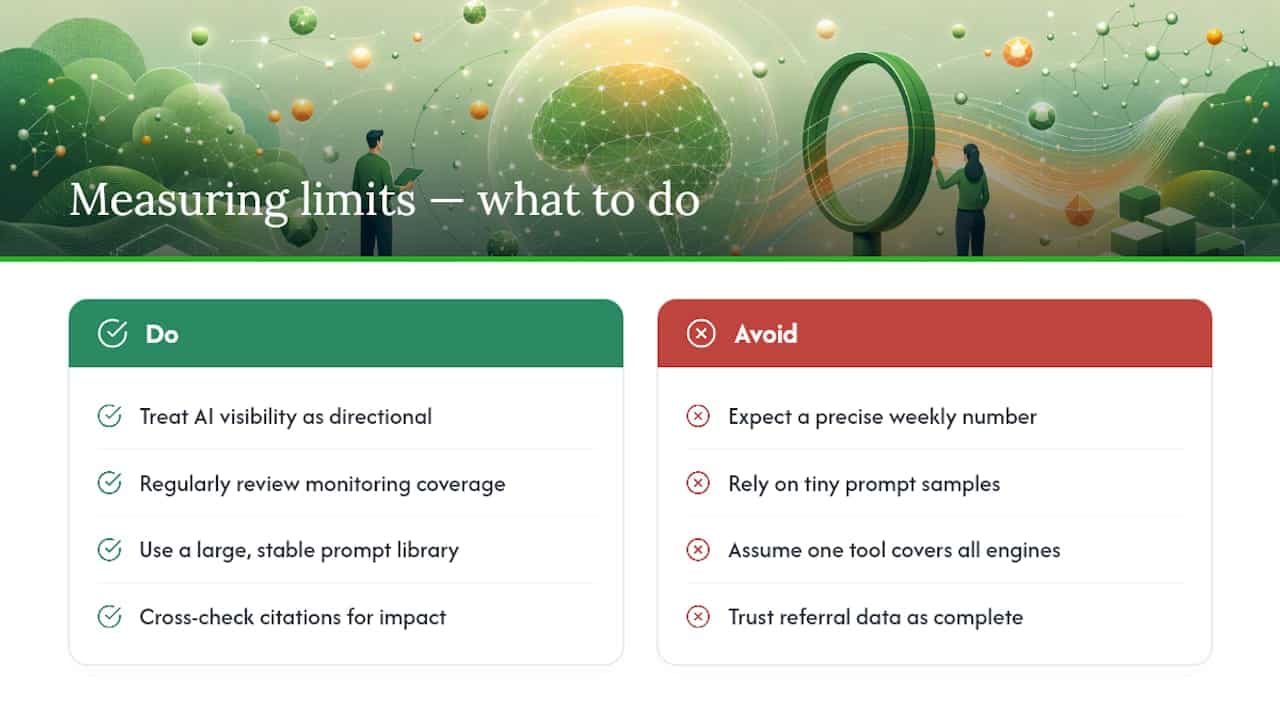
AI answers are inherently inconsistent, and that’s the hardest limitation to explain to a stakeholder expecting a clean weekly number. The same prompt run twice on the same engine can produce different mentions, different phrasing, and even a different set of cited sources, because generative models don’t return deterministic results the way a search index does.
Coverage gaps compound the problem. No single tool monitors every engine with equal depth, and new AI search surfaces launch often enough that your tracking setup needs regular review just to stay current. A tool built primarily for ChatGPT and Perplexity coverage might treat Grok or DeepSeek as an afterthought, leaving you blind to a platform your buyers actually use.
Attribution is murkier too. When a customer arrives after seeing your brand recommended in an AI answer, that referral often shows up as direct traffic or isn’t tracked at all, since most AI platforms don’t pass referral data the way a search engine link does. You end up inferring impact from a rising citation rate rather than measuring a clean conversion path.
Sample size matters more than most marketers expect. A prompt set of ten questions gives you anecdotes, not a trend. You need a large enough, stable enough prompt library, tested consistently, before month-to-month changes mean anything more than random variation in how the model answered that day.
None of this makes the discipline pointless. It means you should treat every AI visibility number as a directional signal with real noise around it, not a precise conversion metric, and report it that way to anyone above you who’s expecting SEO-style certainty.
Where Is AI Search Visibility Measurement Headed?
Generative engines are moving toward real-time retrieval more than static training data, which means the content you publish this week has a faster shot at influencing an answer than it did even a year ago. That shift rewards brands that update content frequently and penalizes stale pages that used to coast on domain authority alone.
Multi-engine fragmentation is likely to deepen before it consolidates. ChatGPT, Gemini, Perplexity, Claude, Grok, and DeepSeek are pulling from different data sources and weighting authority signals differently, and there’s no indication any single engine is about to dominate the way Google once did for classic search. That means brand teams need visibility across a spread of platforms, not a bet on just one.
Google’s own generative features are tightening their dependency on core Search fundamentals rather than loosening them. Google’s guidance is explicit that indexing and crawlability remain prerequisites for AI Overview eligibility, which suggests the technical basics won’t become less important as these features mature, only more tightly enforced.
Expect third-party platforms to matter more, not less. Industry analysis of AI search patterns points to Reddit and YouTube as recurring citation sources across AI Overviews and chat-based engines, a trend that reflects how these models are trained to trust community-validated content over brand-authored copy. Building a durable presence there now is a hedge against whatever the algorithms look like in a year.
How Does AI Search Visibility Fit Into Your Broader SEO Strategy?
AI search visibility isn’t a separate discipline that replaces SEO. It’s an added layer that runs on the same technical foundation, indexability, crawlability, structured data, and adds a new measurement target on top. Treating it as a bolt-on side project, disconnected from your core content and technical SEO work, is the fastest way to waste budget on both fronts.
The overlap is bigger than most teams realize. Pages that already rank well tend to have an easier path to AI citation, because retrievability and authority signals largely double as ranking factors. But the reverse isn’t automatically true: a page can rank fine and still never get pulled into a generative answer if it isn’t structured to be quoted.
Budget allocation should reflect this integration rather than fighting it. Technical SEO audits should now include a bot access and schema check as standard practice, not an add-on. Content briefs should require an answer-first summary as a baseline requirement, not a nice-to-have. Reporting should sit citation rate next to organic rank in the same dashboard, so leadership sees one unified picture of discoverability instead of two competing narratives fighting for credit.
The teams that treat this as one integrated system, rather than SEO plus a separate AI tracking project, are the ones who’ll adapt fastest as engines keep shifting how they select and cite sources.
An Editorial Take on What Actually Moves the Needle
Most AEO programs fail not from bad tactics but from bad expectations. At 30 days, expect technical fixes and a stable baseline, nothing more. At 60 days, content and authority work should start showing early citation movement. At 90 days, you should have a defensible trend line, and this is usually where teams either commit further or abandon the effort just as it starts compounding.
The mistake I see most often is chasing raw mention counts instead of citation quality. Ten passive mentions buried in a comparison list matter less than two direct recommendations from an engine your buyers actually use. Leadership wants a big number; the right number is usually smaller and more specific than they’d like.
— Patrick
Turn Measurement Into a Repeatable AEO Program
Everything in this guide, the prompt sampling, the citation tracking, the bot audits, becomes a lot less manual with a platform built specifically for it. Cairrot maps directly onto the audit-to-measurement workflow covered here: the Deepseek Rank Tracker and Gemini tracking cover the multi-engine sampling this guide recommends, while the Unified Visibility Index rolls citation rate, share of voice, and sentiment into one score instead of five spreadsheets.
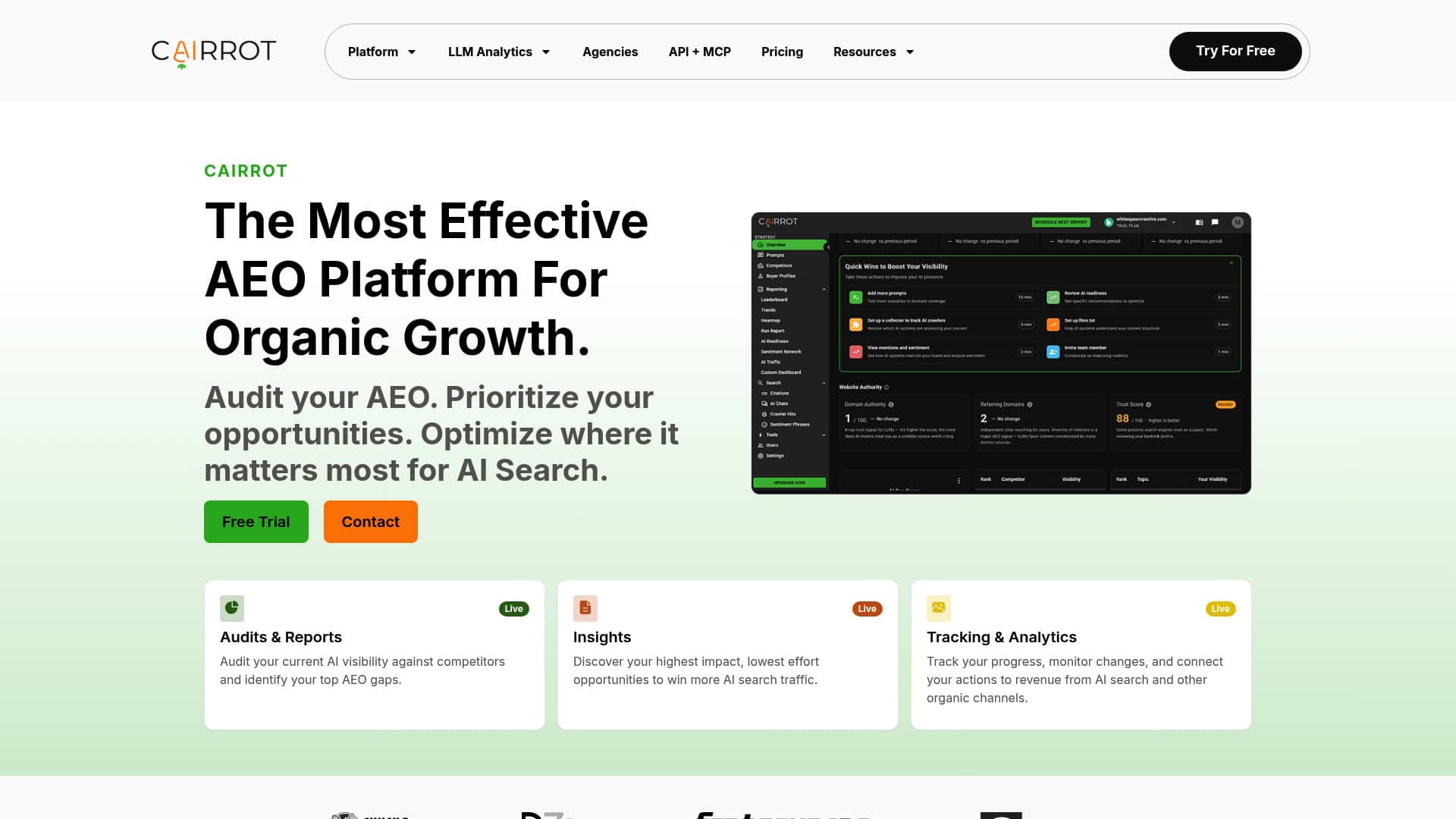
Where Cairrot goes further than manual tracking is third-party signal coverage. Its Reddit monitoring and YouTube tracking surface exactly the kind of forum and video presence that generative engines lean on for independent validation, the piece most marketing teams have no visibility into at all today.
The recommended sequence: run a baseline audit in Cairrot to see where you stand across engines right now, fix the technical quick wins this guide outlined, then move to monthly measurement using the same platform so your trend data stays consistent. Clients typically see measurable AEO movement within 60 days of that cycle. Start with a platform demo to see your current citation baseline before you write another page of content.
Sources
- Google’s Guide to Optimizing for Generative AI Features on Google Search
- How to boost your AI search visibility: 5 key factors
- SEO Strategy for AI Search 2026: The Complete Playbook | SEOScaleUp
Recommended
- AEO Platform: Monitor Brand Mentions in AI Search & Rank in LLMs like ChatGPT – Cairrot
- AEO/GEO Metrics: New SEO KPIs and Methods for Reporting AI Visibility – Cairrot
- AI Visibility – Cairrot
- Universal Visibility Index (UVI) | Local to Global AI Visibility Data, Statistics, and Rankings – Cairrot
Made with BabyLoveGrowth to get found on Google
