
Enterprise AEO (answer engine optimization) is the discipline of making sure AI engines such as ChatGPT, Gemini, Perplexity and Claude find, cite and accurately describe your brand across hundreds of pages, several business units and multiple buyer audiences. It builds on SEO rather than replacing it. What changes at enterprise scale is governance: who owns which entities, how you measure citations, and how you prove a fix worked. This guide covers that operating model, step by step.
TL;DR
- Enterprise AEO is an extension of SEO. Topical authority, content quality and technical health still do most of the work; the new layer is structuring content so AI engines can extract and cite it.
- Scale needs a governance model: crawl access, entity-rich structured data, and authority signals from trusted third-party sites, owned by named teams.
- Measure citations and sentiment on a large, stable prompt set. Sentiment swings far more than mentions, so small samples mislead.
- Expect early citation signals in roughly 30 to 60 days and meaningful scale over 4 to 6 months.
- A unified platform with API access, white-label reporting and multi-brand management keeps the program auditable. Plans start at $39 per month, with Enterprise at $299 per month.
Table of Contents
- What makes enterprise AEO different
- AEO is SEO plus a last mile
- The governance model that scales
- Build a control loop, not a one-off project
- Measurement: avoid the sentiment noise trap
- Timelines and expectations
- Our perspective: open, unified and accountable
- What to look for in an enterprise AEO platform
- Where Cairrot fits
- A practical first 60 days
- FAQ
- Sources
What makes enterprise AEO different
Standard AEO optimizes one site with one content owner. An enterprise program spans hundreds of pages, product lines, regions and stakeholders, and every one of them can be described differently by an AI engine. That is a coordination problem as much as a content problem.
Three things make it harder at scale:
- Fragmented ownership. Product marketing, SEO, web engineering, PR and support all shape what AI engines read about you. Without a shared prompt portfolio and entity list, each team fixes its own corner.
- Brand stature effects. In one 2025 benchmark of B2B AI answers, global household names appeared in 73% of relevant answers on first runs, mid-market brands in 44% and niche brands in 11%. Your starting point depends on how established you are, so baselines matter more than absolute targets.
- Readiness gaps. The same study found only 11% of B2B firms say most of their content is ready for AI discovery. Most enterprises have a large backlog of pages that need restructuring, not rewriting.
If you are choosing where to start, our AEO platform overview shows how we organize monitoring, audits and reporting around these questions.
AEO is SEO plus a last mile
Before you fund a separate program, settle the relationship with SEO. Practitioners increasingly argue that AEO is an extension, not a replacement. As quoted at Digital Content Next, a Consumer Reports leader put it as SEO equals GEO, and GEO transcends SEO. Topical authority, strong content and technical health still carry most of the weight. The divergence is the last mile: shaping content so it can be extracted and cited inside a synthesized answer.
That has a practical consequence. Do not tear up a working SEO program. Layer AEO onto it, and keep foundations such as local listings, reviews and citations healthy, because they feed the same signals. Specialists in AI-focused local SEO cover how those basics connect to AI visibility, which is useful reading if your enterprise runs many location pages.
| SEO | AEO / GEO | |
|---|---|---|
| Primary win | Rankings and clicks | Citations and accurate representation in AI answers |
| Unit of measurement | Position, traffic | Mention rate, citation rate, sentiment, share of answer |
| Where it happens | Results pages | Inside synthesized responses across multiple engines |
| Shared foundation | Content quality, authority, technical health | Same, plus extraction-ready structure |
The governance model that scales
Treat AEO as an architectural evolution, not a content task. The Google structured data guidelines are a good anchor here: Google’s developers note there is no special schema for AI, while high-quality structured data that matches your real entities remains a best practice for search eligibility. So the goal is not a new markup trick. It is consistency at scale.
A tiered model works well in practice:
Tier 1: Crawl access
Confirm that the bots you care about can actually reach your content. Audit robots rules, rendering, CDN and firewall settings, and gated or script-dependent pages. Enterprises often block crawlers by accident through security layers. Our integrations with Cloudflare and CloudFront exist for this reason: the edge is where access problems tend to hide.
Tier 2: Entity-rich structured data
Define your core entities: the company, products, executives, locations and key concepts. Then implement JSON-LD consistently and keep it aligned with visible page content. Pages that earn citations often share these technical foundations, including JSON-LD and IndexNow for faster crawling.
Tier 3: Authority signals
AI engines cross-reference trusted third-party sources. That means review sites, industry publications, community discussions and reference sources. Entity records such as Wikidata and Wikipedia presence can influence how engines understand a brand, but only when you meet notability standards, so audit eligibility before investing.
Assign each tier a named owner, a review cadence and a change log. That is what turns AEO from a campaign into an operation.
Build a control loop, not a one-off project
The most useful framing we have seen is a control loop. Gradial’s AI search operations guide describes a 10-point operation that runs from defining the decision space and prompt portfolio through to validating live results. Its sharpest point is that measurement alone does not change the answer. It reveals where a brand is absent, misrepresented or outranked, and then someone has to act.
Here is a version you can run:
- Define the decision space. List the questions buyers ask at each stage, by product line and region.
- Build the prompt portfolio. Turn those questions into a fixed prompt set per engine.
- Baseline. Record mention rate, citation rate, cited sources and sentiment for each engine.
- Diagnose gaps. Separate absence, misrepresentation and outranking by competitors.
- Fix. Restructure content, repair markup, fill authority gaps.
- Validate. Re-run prompts and confirm the engine now cites you.
- Report and repeat. Feed results back into the portfolio.
Step 6 is where programs fail. Many teams ship a fix and assume it worked. Track how long it takes from a fix to the engine re-citing your brand; the Gradial guide treats mean time to re-citation as a key health metric.
Measurement: avoid the sentiment noise trap
Sentiment tracking matters for enterprises because AI answers shape reputation, not just traffic. But it is easy to misread. Researchers in a 2026 arXiv study found that whether an AI frames a brand positively or negatively flips 6.7 times more often than whether the brand is mentioned at all. Their guidance is to use at least 10 prompts per platform before drawing conclusions about sentiment trends.
Put that into your reporting rules:
- Never report sentiment from a handful of prompts.
- Show mention rate and sentiment side by side, with sample sizes.
- Treat a one-week swing as noise until it repeats.
- Track where sentiment comes from. Reddit and YouTube are frequently cited sources, so conversations there can move answers.
This is one reason we built sentiment tracking across platforms like Reddit and YouTube into Cairrot, alongside monitoring of ChatGPT, Gemini, Claude, Perplexity, Grok and DeepSeek. For a deeper look at what to report, see our guide to AEO and GEO metrics.
The KPIs executives will actually read
- Mention rate across the prompt portfolio, by engine.
- Citation rate and the domains cited, yours and third-party.
- Share of answer against named competitors.
- Sentiment, with prompt counts attached.
- Mean time to re-citation after a fix.
- Downstream impact in GA4 and Search Console, such as referral traffic and branded search.
Timelines and expectations
Be honest with leadership about pace. Enterprise programs typically see early citation signals within 30 to 60 days, with meaningful visibility scaling over 4 to 6 months, according to the benchmarks cited with the 10Fold study. The same research found 35% of surveyed marketing executives name GEO performance as their primary success measure, so the pressure for early proof is real.
That is why we structure the first phase around a 60-day window: audit, prioritize, fix, validate. Our 60-day enterprise plan lays out the citation KPIs we use for it.
Our perspective: open, unified and accountable
We see the same pattern in enterprise conversations. The teams that stall do not lack ideas. They lack a single view. SEO has one dashboard, brand has another, agencies send their own PDFs, and nobody can say whether the answer an engine gives today is better than last month’s.
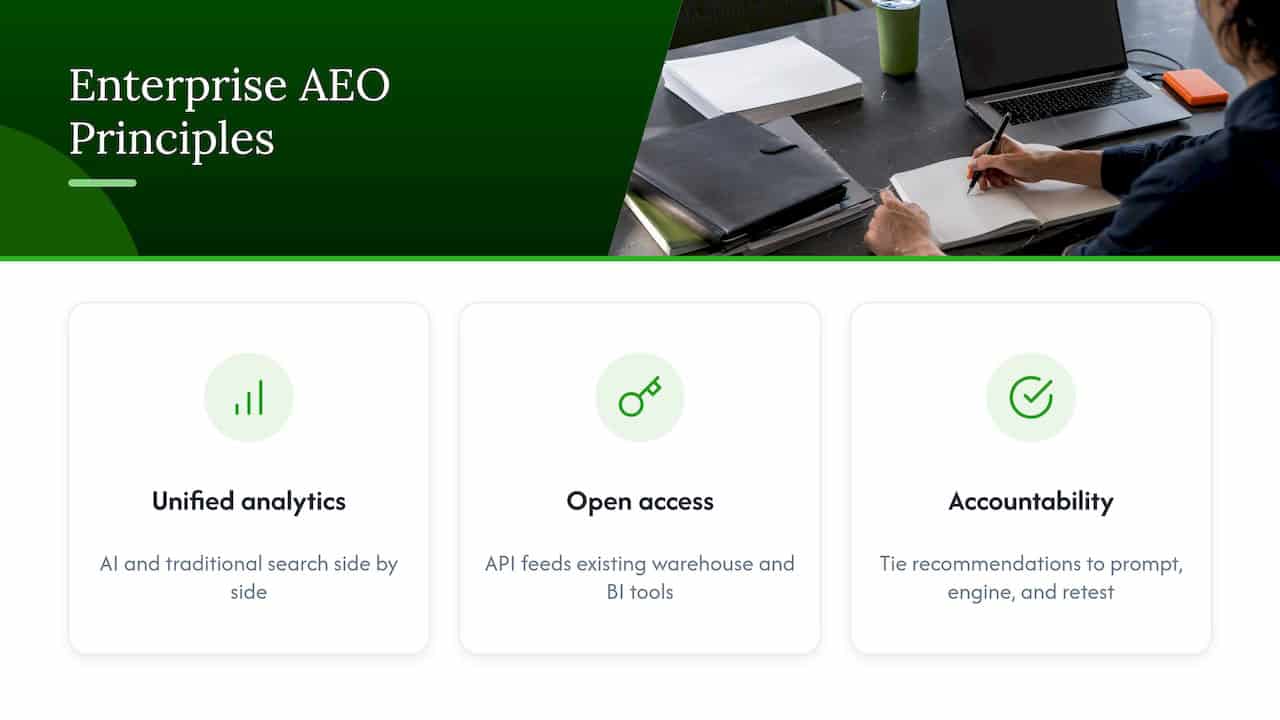
Our view is that enterprise AEO needs three things. First, unified analytics that put AI and traditional search side by side, so you can see AEO as part of organic growth instead of a separate experiment. Second, open access: an API that lets your data team pull results into the warehouse and BI tools you already run, rather than a walled garden you visit once a quarter. Third, accountability, meaning every recommendation is tied to a prompt, an engine and a re-test.
We also think sentiment deserves more respect than it gets. A mention is not an endorsement, and an AI engine that cites a hostile forum thread is telling you something about your authority footprint. That is why we track the platforms those answers draw from.
Start small, instrument everything, and let the data pick your next fix.
— Dr. Patrick McAvoy
What to look for in an enterprise AEO platform
Whether you build a stack or buy one, judge it on criteria that survive procurement:
| Criterion | Why it matters at scale |
|---|---|
| Engine coverage | Buyers use more than one engine; you need ChatGPT, Gemini, Claude, Perplexity, Grok and DeepSeek in one view |
| Prompt volume and stability | Sentiment needs large prompt sets to be trustworthy |
| Unified analytics | AI and traditional search results in the same reports |
| API access | Lets data teams own the numbers and automate reporting |
| Multi-brand and bulk management | Business units, regions and agencies need separate workspaces |
| White-label reporting | Agencies and internal teams can brand outputs for stakeholders |
| Integrations | GA4, Search Console, Bing, Databox, Cloudflare and CloudFront connect AEO to the rest of the stack |
| Pricing transparency | Published tiers make budgeting simple |
Alternatives fall into a few types: enterprise suites bundled into broader content platforms, point tools that only monitor mentions, and agency retainers. Suites can be heavy, point tools rarely connect measurement to action, and retainers keep the data outside your walls. Cairrot is built to sit between them: audits, insights and unified analytics in one place, with the API in your hands. An independent review of Cairrot highlights the unlimited API on every plan and the WordPress integration for teams that manage many sites.
Where Cairrot fits
Cairrot is an AEO platform for agencies, content teams, developers and enterprise organizations. You can run website audits, benchmark against competitors, get prioritized optimization insights, and track local and global analytics, then report through customizable dashboards.
Published pricing:
- Starter: $39 per month
- Pro: $99 per month
- Enterprise: $299 per month
- Grok monitoring and analytics: from $25 per month
Large-scale and enterprise needs can be scoped with custom pricing. See the pricing page for what each plan includes, explore AEO audits, insights and unified analytics, or start at cairrot.com with a trial or demo.
A practical first 60 days
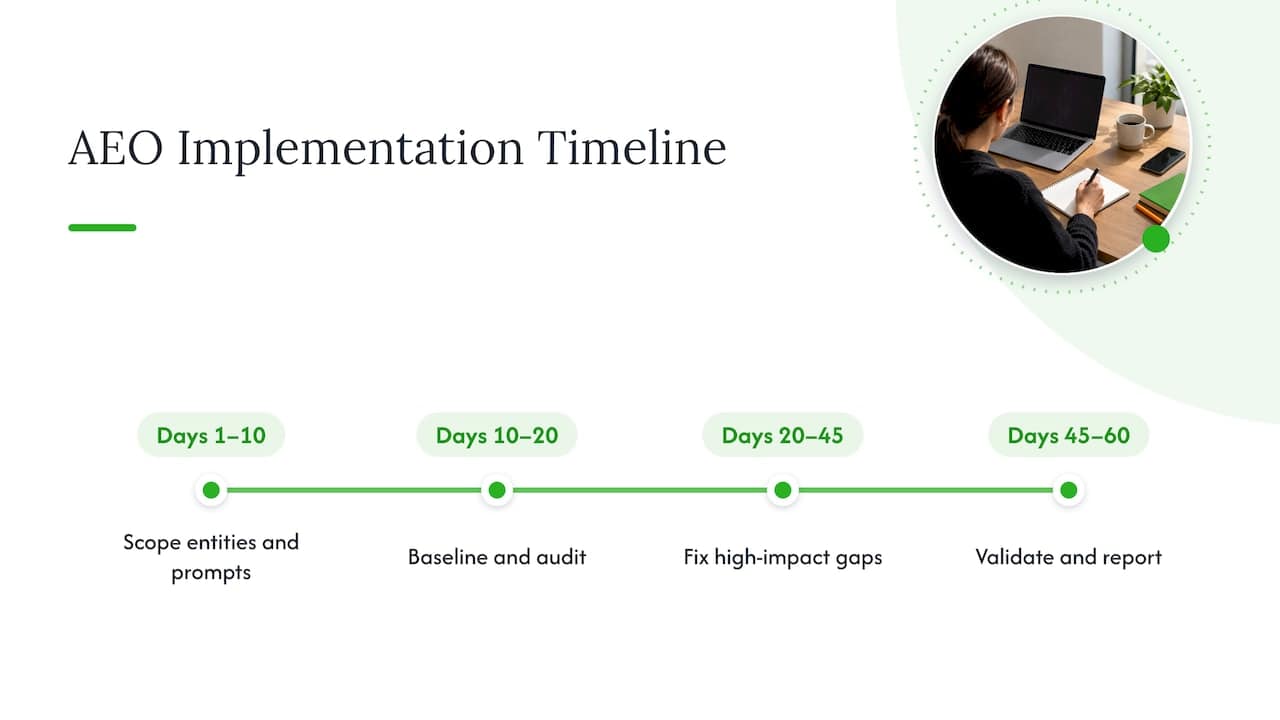
Days 1 to 10: Scope. Pick one or two business units. Define entities, buyer questions and a prompt set of at least 10 prompts per platform.
Days 10 to 20: Baseline and audit. Capture mention, citation and sentiment baselines. Run a technical audit of crawl access and structured data.
Days 20 to 45: Fix the highest-impact gaps. Start with pages that already rank well in SEO but are not cited, since they need structure rather than new authority. Fill obvious third-party gaps.
Days 45 to 60: Validate and report. Re-run prompts, record time to re-citation, and present results with sample sizes. Decide which units to add next.
For more tactics, our best AEO strategies article goes deeper on what the data supports.
FAQ
What is AEO for an enterprise?
It is the practice of optimizing content, technical structure and brand signals so AI answer engines surface, cite and accurately represent a large organization. At enterprise scale it adds governance across teams, products and regions. It is measured in citations, mention rate and sentiment rather than rankings alone.
Is AEO different from SEO?
It is an extension. Content quality, topical authority and technical health still drive most results. AEO adds structuring for extraction and measuring whether AI engines cite and describe you correctly.
How long does enterprise AEO take to show results?
Benchmarks point to early citation signals in 30 to 60 days and meaningful visibility over 4 to 6 months. Brand stature changes the starting point. Cairrot customers can see measurable results within as little as 60 days.
Do we need special schema for AI search?
No. Google’s developers state there is no special schema for AI, but accurate, entity-aligned structured data remains a best practice. Focus on consistent JSON-LD that matches visible content.
Sources
- 2025 Study Reveals AI Search Surpasses SEO in How B2B Buyers Find Content (Business Wire)
- How media leaders are rethinking SEO in the age of AI (Digital Content Next)
- General structured data guidelines (Google Search Central)
- AI Search Operations Guide for Enterprise Teams (Gradial)
- Sentiment noise study (arXiv)
- Cairrot Review 2026 (Prompt Insider)