
In this guide, “bing webmaster tools ai” refers to AEO measurement: tracking whether ChatGPT, Perplexity, Gemini, Copilot, Claude, and Google AI Overviews mention and cite your site, not Microsoft’s own Bing product. The recommended first move is simple. Run a frozen prompt set across those six surfaces and track citation rate, not mention rate, as your primary KPI. Platforms built for this workflow typically see measurable movement within 60 days.
TL;DR:
- Citation rate is the most reliable indicator of AI visibility because it reflects the AI’s trust in your source, not just casual mention.
- Monitoring six distinct AI surfaces separately is essential, as each pulls data from different sources and updates on different schedules, affecting measurement accuracy.
- Running multiple daily or weekly scans with a fixed prompt set and averaging the results provides a true trend, avoiding misleading single-run fluctuations.
- Fixes should be prioritized based on potential traffic impact, fix difficulty, and the size of citation gaps, especially on surfaces relying on third-party mentions like Perplexity and Claude.
- Automated platforms like Cairrot streamline multi-engine scraping and tracking, enabling agencies to see measurable citation movement within approximately 60 days.
Table of Contents
- Mention Rate vs. Citation Rate: The Metric That Actually Predicts AI Visibility
- Which AI Surfaces Should You Monitor, and How Often?
- Building a Repeatable AEO Measurement Pipeline
- Turning Citation Gaps Into a Prioritized Fix List
- Your 60-Day AEO Measurement Roadmap
- What Bing Webmaster Tools AI Features Cover in an AEO Program
- Setting Up Your AI Visibility Tracking Stack
- Reading AI-Generated Data Without Getting Misled by It
- Where AEO Measurement Fits Into Day-to-Day SEO Work
- Limitations to Plan Around Before You Trust the Numbers
- How Bing-Linked AI Signals Compare to Full Multi-Engine AEO Tracking
- What Agencies Get Wrong About Running This as a Service
- Why Cairrot Is Built for This Exact Measurement Problem
- Sources
- FAQ
Mention Rate vs. Citation Rate: The Metric That Actually Predicts AI Visibility
A mention is when an AI assistant says your brand name in its answer. A citation is when that assistant links directly to your URL as a source. The gap between the two is enormous, and it’s the gap that matters most.
Say your brand appears frequently in relevant prompts across ChatGPT and Perplexity, which is your mention rate. Now check how often the assistant actually links to your page instead of just naming you in passing text. That’s your citation rate, which is always smaller. Citation rate is rarer than mention rate precisely because it requires the model to treat your page as a verifiable source worth surfacing, not just a name it recalls from training data.
That rarity is what makes citation rate the stronger signal. A mention tells you the model knows you exist. A citation tells you the model trusts your page enough to point a user there.
Three supporting metrics round out a real dashboard:
- Share of voice: your mention or citation count relative to competitors across the same prompt set.
- First-mention rate: how often you’re named first, which correlates with how the model weighs source authority.
- Sentiment: whether the surrounding language is favorable, neutral, or critical.
Pro Tip: Never trust a citation blindly. Run manual accuracy sampling on a rotating batch of answers each cycle. An assistant can cite your page while still misquoting your pricing or misstating a feature, and automated scoring alone won’t catch that.
Which AI Surfaces Should You Monitor, and How Often?
Six surfaces cover the vast majority of AI-driven discovery today, and each behaves differently enough that treating them as one blob will wreck your data. Monitor:
- ChatGPT — often leans on Bing indexing and Microsoft’s search partnership for live retrieval.
- Perplexity — built around real-time web citations, making it the most citation-transparent surface to audit.
- Gemini — pulls heavily from Google’s index and rewards structured data and entity clarity.
- Copilot — inherits much of Bing’s crawl and ranking signals directly.
- Google AI Overviews / AI Mode — tied to traditional Search Console visibility, so Google’s own generative AI performance reporting is worth cross-checking against your citation data.
- Claude — leans more on training-data consensus and durable third-party mentions than live crawling.
Different surfaces pull from different data sources and update on different rhythms, so a fix that moves Perplexity might do nothing for Claude.
Cadence matters as much as coverage. Sample regularly, with weekly checks as a practical minimum. If you’re in a high-velocity category like SaaS pricing or breaking news, more frequent checks may be needed. Slower-moving B2B verticals might require less frequent monitoring once a baseline is established. Whatever cadence you pick, run every prompt from a fresh or incognito session, and keep your market IP consistent, since location signals can shift which sources an engine pulls.
Building a Repeatable AEO Measurement Pipeline
A one-off check tells you almost nothing. AI answers are non-deterministic, meaning the same prompt can return different sources on different runs, so the only credible approach is a reproducible pipeline you can run on a schedule.
Start with a frozen prompt set. Pull these from real buyer language, not your own marketing copy: comparison queries (“best AEO platform for agencies”), problem queries (“how to track AI citations”), and direct brand queries. Freeze the wording so every run is comparable.
Next, run that prompt set through a multi-engine scraper that queries all six surfaces in one pass. A practical multi-engine pipeline can return raw answers alongside each engine’s cited sources as structured JSON, which is the detail that makes this scalable instead of a manual copy-paste exercise every week.
From that JSON export, compute:
- Mention rate and citation rate per prompt, per surface.
- First-mention rate across competitor sets.
- Share of voice, aggregated weekly.
Pro Tip: Watch for renamed JSON keys when an engine updates its API. A scraper that silently fails on a schema change will report a false zero, and a false zero looks identical to a real visibility collapse until someone checks the raw output.
Schedule repeated runs and average them. A single run can mislead you because of normal answer variance. Averaging multiple runs smooths that noise into a trend you can actually act on, and it’s the difference between a dashboard that’s directionally useful and one that just generates weekly panic.
Turning Citation Gaps Into a Prioritized Fix List
Not every gap deserves the same urgency. Rank fixes by impact times feasibility times surface gap: how much traffic or revenue that prompt represents, how hard the fix actually is, and how wide the citation gap is on that specific surface.
The remediation pattern changes by surface:
- ChatGPT gaps often trace back to Bing indexing issues or missing structured data, since ChatGPT frequently leans on Microsoft’s index for live retrieval.
- Perplexity gaps usually mean you’re missing from the third-party pages it already trusts, comparison sites, review aggregators, niche forums, rather than a problem with your own site.
- Gemini gaps typically point to weak schema markup or unclear entity definitions on your pages.
- Claude gaps are the hardest to move quickly, since Claude leans on durable third-party mentions baked into training data rather than live crawls.
That third pattern deserves its own line item: an off-page playbook. Dedicated citation-tracking tools help teams capture which URLs and domains AI systems actually cite, which lets you build a target list of the review sites, comparison pages, and Reddit threads the engines are already pulling from. Get cited there first, then re-measure your own citation rate on the next cycle.
This is where a platform like Cairrot’s LLM citation and mention tracking earns its subscription cost. Running audits, cross-surface tracking, and sentiment monitoring on Reddit and YouTube by hand across six engines and dozens of prompts is a full-time job. A dashboard that separates mention from citation automatically, and flags sentiment drops before a client asks about them, is the difference between reactive reporting and a real operating rhythm.
Your 60-Day AEO Measurement Roadmap
Sixty days is enough time to establish a baseline, ship fixes, and see real citation movement, provided you don’t skip the boring parts.
- Days 1 to 14: Run baseline measurements across all six surfaces. Manually accuracy-sample a batch of citations to confirm they’re not misrepresenting your brand. Rank your top prompt and page pairs by opportunity size.
- Weeks 3 to 6: Ship the highest-impact fixes first, whether that’s schema cleanup, Bing indexing repairs, or outreach to secure third-party corroboration. Keep running weekly checks so you catch movement as it happens, not a month later.
- Days 45 to 60: Measure citation movement against your baseline. Document which fixes actually moved the needle and which didn’t. Scale the winning patterns to adjacent queries in the same category.
Pro Tip: Define success before you start, not after. A realistic 60-day target is a citation rate lift on your top 10 to 15 target prompts, not a vague “improve AI visibility” goal that nobody can score.
What Bing Webmaster Tools AI Features Cover in an AEO Program
Inside an AEO measurement program, “Bing webmaster tools AI” functions as a data layer, not a standalone destination. Because Bing’s crawl and index feed both Copilot and, indirectly, a portion of ChatGPT’s live retrieval, indexing status and structured data health on Bing directly influence citation rates on two of your six monitored surfaces.
The practical features that matter here are crawl and index status (confirming your key pages are actually indexed by Bing, not just Google), structured data validation, and site health signals like crawl errors or slow response times that can quietly suppress a page from being surfaced as a source. None of this replaces multi-engine citation tracking. It’s a diagnostic input that feeds into it. If a page isn’t cited by Copilot, checking its Bing index status is often the fastest way to find out whether the problem is technical (not indexed, blocked by robots.txt) or editorial (indexed fine, but the content itself isn’t citation-worthy).
Treat this layer as one data source among six. A team that only watches Bing-side signals will miss the Perplexity and Claude gaps entirely, since those surfaces don’t depend on Bing’s crawl the same way.
Setting Up Your AI Visibility Tracking Stack
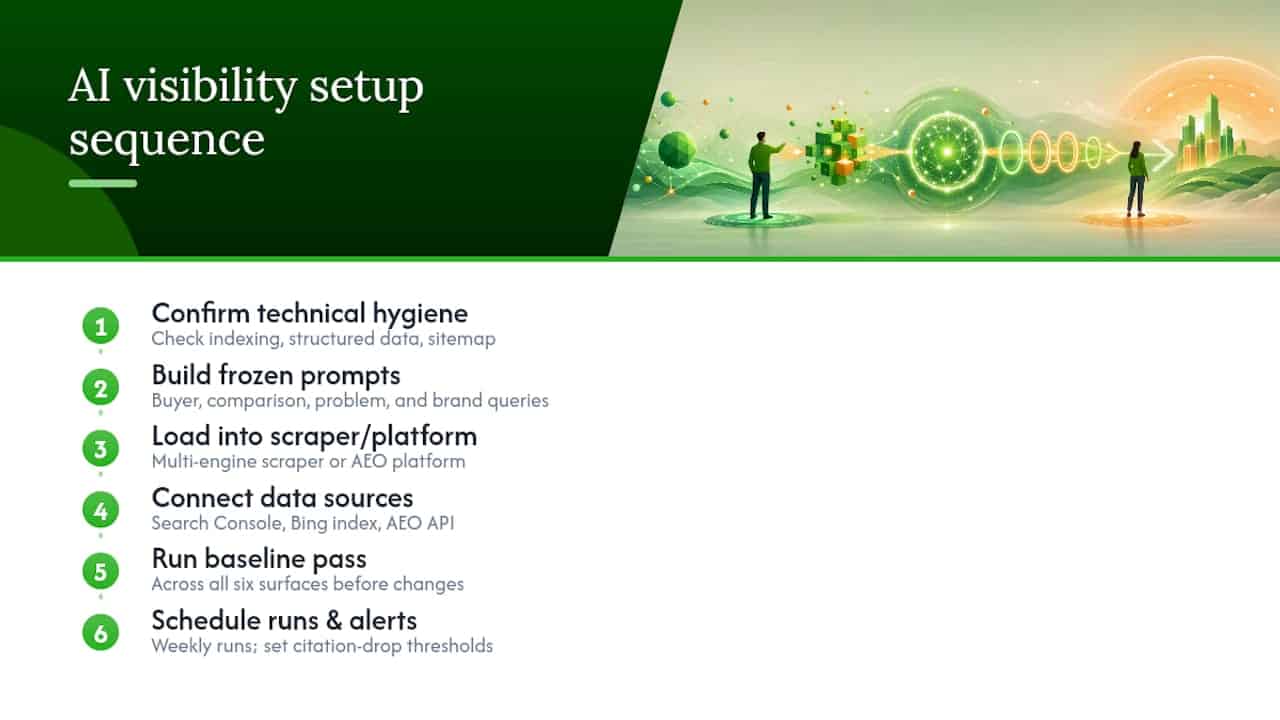
Getting this running takes less setup time than most teams expect, but the order of operations matters. Start by confirming basic technical hygiene: your pages are indexed, structured data validates cleanly, and your sitemap is current. Skipping this step means you’ll misdiagnose a technical gap as a content problem later.
Next, build your frozen prompt set using real buyer language, comparison queries, problem queries, and direct brand queries, and load it into your multi-engine scraper or platform. Connect your data sources: Search Console, Bing’s indexing data, and your AEO platform’s own API, so citation and mention data can be cross-referenced against organic traffic and indexing status in one place.
Run your first baseline pass across all six surfaces before making any changes. This baseline is what every future comparison depends on, so resist the urge to fix things first and measure second. Fix the process, not just the pages: schedule the recurring runs (weekly minimum) before you start optimizing content, so you have a clean before-and-after for every change you ship.
Finally, set alert thresholds. A citation rate drop of more than a few points on a high-value prompt should trigger a flag, not wait for someone to notice it during a monthly review.
Reading AI-Generated Data Without Getting Misled by It
Raw citation counts look impressive until you interrogate what’s actually inside them. A spike in mentions with a flat citation rate usually means the model recognizes your brand name from training data but doesn’t trust your pages enough to link out, a branding win with no traffic behind it.
Sentiment data needs the same skepticism. A high mention count paired with neutral-to-negative sentiment is often worse than a low mention count with strongly positive sentiment, because the former means you’re visible for the wrong reasons. Cross-reference sentiment shifts against specific content changes or competitor moves rather than treating the number in isolation.
The single most important interpretive rule: never take a citation at face value without checking what the assistant actually said about you. Manual accuracy sampling exists because AI answers can misrepresent a brand even while technically citing it, a pricing figure could be outdated, a feature could be misattributed, or a comparison could favor a competitor despite citing your page as the source. Automated dashboards count citations. They don’t verify accuracy. That verification step still needs a human reading the actual answer text, at least on a rotating sample each cycle.
Where AEO Measurement Fits Into Day-to-Day SEO Work
The most common practical use of this measurement layer is competitive gap analysis: running the same prompt set for your brand and two or three competitors, then finding exactly which prompts they’re cited on and you’re not. That gap list becomes your content and outreach priority queue.
A second common use case is pre-launch validation. Before publishing a new comparison page or product update, teams run it through the prompt set to see whether the existing content already gets cited for adjacent queries, then structure the new page to fill the gap rather than duplicate what’s already working.
Client reporting is the third major application, particularly for agencies. Instead of reporting rankings that clients increasingly view as a secondary metric, agencies now package citation rate, sentiment, and share-of-voice trends into a recurring dashboard that ties directly to AI-driven discovery, the channel clients actually ask about now.
Finally, this layer feeds crisis detection. A sudden sentiment drop or citation loss on a brand-name prompt often signals something worth investigating immediately, a negative review that got picked up by a comparison site, or a competitor’s aggressive PR push into the same third-party pages your citations depend on.
Limitations to Plan Around Before You Trust the Numbers
AI answers are inherently non-deterministic. The same prompt run twice can return different sources, different phrasing, and even different sentiment, which means a single snapshot is close to meaningless. Averaging across multiple runs per cycle is not optional if you want defensible numbers.
Engine transparency varies sharply. Perplexity shows its sources plainly, making citation tracking straightforward. Claude and some ChatGPT responses are far less transparent about sourcing, which means your citation data on those surfaces will always carry more uncertainty than on Perplexity or Gemini.
Google itself warns against chasing unsupported AEO “hacks” and recommends its own Generative AI performance report as a legitimate measurement layer rather than relying purely on third-party scraping. That’s a useful check on expectations: no tool, including a multi-engine scraper, replaces first-party data where a platform actually provides it.
The best practice that ties all of this together is treating automated metrics as a triage layer, not a verdict. Mention rate and citation rate tell you where to look. Manual accuracy sampling tells you whether what you found is actually good news.
How Bing-Linked AI Signals Compare to Full Multi-Engine AEO Tracking
Bing-side indexing and structured data checks tell you about two surfaces at best, Copilot and a portion of ChatGPT’s live retrieval. They say nothing about Perplexity’s third-party citation patterns, Gemini’s entity-clarity requirements, or Claude’s reliance on durable training-data mentions.
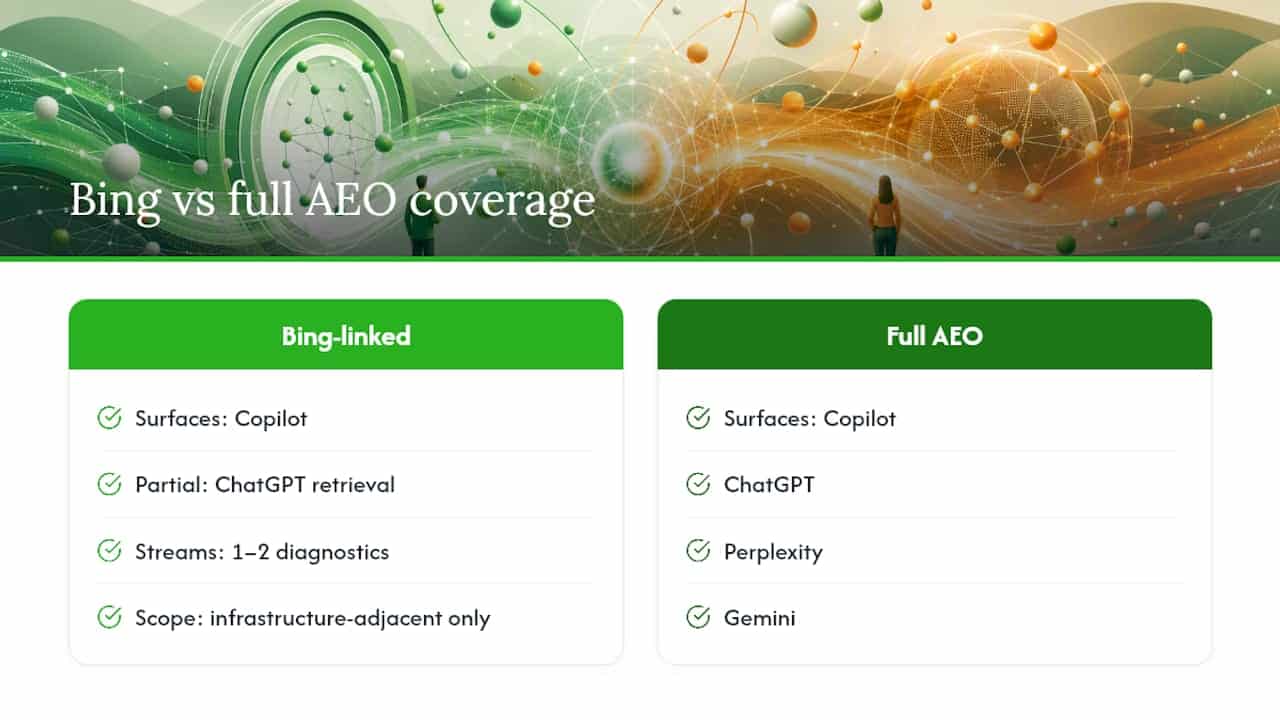
A full AEO measurement approach, by contrast, treats the six surfaces as six separate diagnostic streams feeding one prioritized action list. The comparison isn’t which single tool wins. It’s whether your measurement approach covers the surfaces where your buyers are actually asking questions, versus the one or two surfaces that happen to share infrastructure with a search engine you’re already familiar with.
For agencies managing multiple clients, this distinction determines whether reporting is credible. A client asking “are we visible in ChatGPT” deserves an answer built from real ChatGPT-side data, not an inference drawn from Bing indexing status alone. That’s the practical case for a dedicated cross-surface platform over piecing together signals from tools built for a different purpose.
What Agencies Get Wrong About Running This as a Service
Most agencies treat AEO measurement like a rankings report: check it monthly, screenshot it, move on. That approach misses the entire point. Citation rate moves on a weekly cycle in competitive categories, and a monthly cadence means you’re always explaining last month’s problem instead of catching this week’s.
The teams getting real results split the work across four roles instead of dumping it on one SEO generalist. A prompt designer owns the frozen prompt set and keeps it aligned to actual buyer language. A data operator runs the pipeline, checks for broken exports, and averages runs correctly. A content owner turns citation gaps into shipped fixes. A client-facing analyst translates raw mention and citation numbers into a story a client’s leadership team cares about.
Package this as three layers: a monthly dashboard for strategic reporting, weekly alerts for anything that moves fast enough to need immediate attention, and a quarterly strategy review where you scale what worked to adjacent prompt categories. Skip the weekly layer and you’ll find out about a citation collapse from the client before you find it yourself.
— Dr. Patrick McAvoy
Why Cairrot Is Built for This Exact Measurement Problem
Running six-surface citation tracking by hand, on top of client work, is where most agencies quietly give up and fall back to vanity mention counts. Cairrot’s platform exists specifically to close that gap: audits, cross-surface LLM citation and mention tracking, sentiment monitoring across Reddit and YouTube, and the Universal Visibility Index for benchmarking your position against competitors, all in one subscription instead of a stack of scripts someone has to babysit.
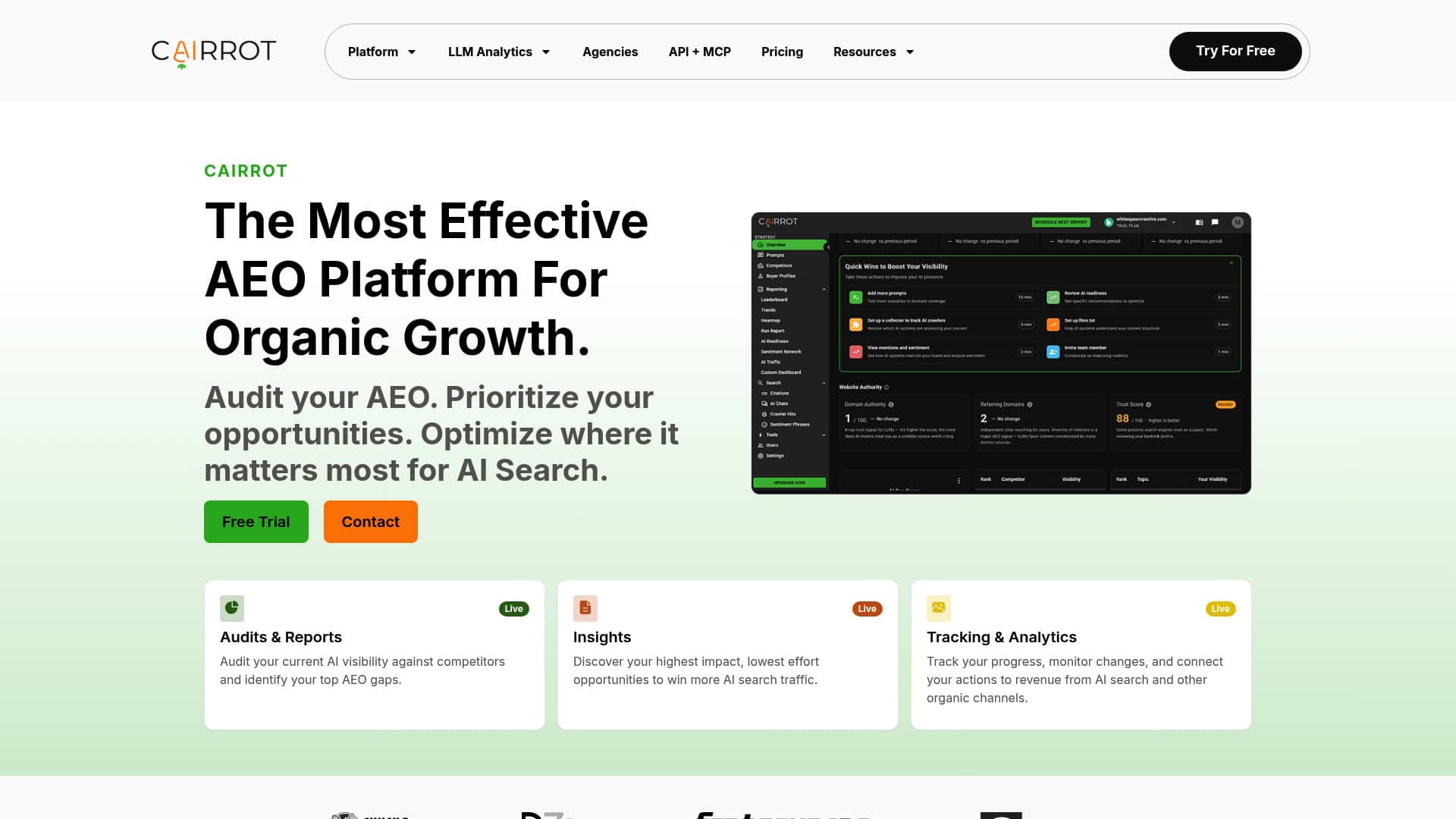
Getting started is a short process. Start a trial or demo, import your frozen prompt set, and run your baseline across all six engines in one pass. From there, some agencies see measurable citation movement on target prompts within roughly 60 days, the same window covered in the roadmap above. If you want the reporting layer without building your own scorecard from scratch, the AEO reporting tools page walks through how the dashboard, alerts, and UVI benchmarking fit together for agencies managing multiple client accounts.
Sources
- AI optimization guide — Google Developers
- AI answer visibility tracking: tools, metrics, protocols · CrawlSense Blog
- How to Track AI Search Visibility Across ChatGPT, Perplexity, Gemini, and Claude in 2026
FAQ
What Does “Bing Webmaster Tools AI” Mean in an AEO Context?
Here it refers to AEO measurement, tracking your citation and mention rates across ChatGPT, Perplexity, Gemini, Copilot, Google AI Overviews, and Claude, not Microsoft’s own Bing product.
What’s the Difference Between Mention Rate and Citation Rate?
A mention is when an AI assistant names your brand in its answer text; a citation is when it links directly to your page as a source, and citation rate is the rarer, stronger signal of the two.
How Often Should I Run AEO Measurement Checks?
Sample weekly at minimum, and daily for high-velocity categories like SaaS pricing or breaking news, since engine output is non-deterministic and needs averaging across runs.
How Long Before I See Measurable AEO Results?
A practical window is 60 days: two weeks for baseline measurement, four weeks for shipping fixes, and a final two weeks to confirm citation movement, which is the timeline agencies using Cairrot typically report.
Can a Platform Automate This Entire Measurement Pipeline?
Yes. Tools like Cairrot’s LLM citation and mention tracking automate the multi-engine scraping, JSON scoring, and per-surface breakdown, though manual accuracy sampling still requires a human review step.
Recommended
- Best AEO Software for Agencies: Track & Optimize LLM Visibility for Clients
- AEO Reporting Guide for Marketing Agencies: Best Ways to Report AI Visibility to Clients
- Best AEO Strategies 2026 (Based on Data and Anecdotes)
