
Every marketing agency I talk to is dealing with some version of the same problem right now.
Clients have been asking about AI Search. They’ve seen the headlines, they’ve noticed ChatGPT traffic showing up in their GA4 reports. and they want to know what the marketing plan is.
Most agencies don’t have a good answer yet. They’re still sending ranking reports built for a search landscape that doesn’t exist anymore. Positions 1 through 10 on a Google SERP. Clean, linear, comfortable, so of course marketers don’t want it to change.
Here’s the thing: that model was already breaking down in Google before AI Search entered the picture. AEO reporting isn’t some radical departure from good SEO reporting. It’s the logical next step. The metrics that actually matter (visibility, traffic, revenue) haven’t changed. The surfaces have.
If you’re running an agency and you can’t report on AI visibility yet, this guide is for you. We’re covering what to track, how to report it, what tools to use, and the cadence that actually works for agencies managing multiple clients.
SEO Rank Tracking Is Dead (And It Started Dying Years Ago)
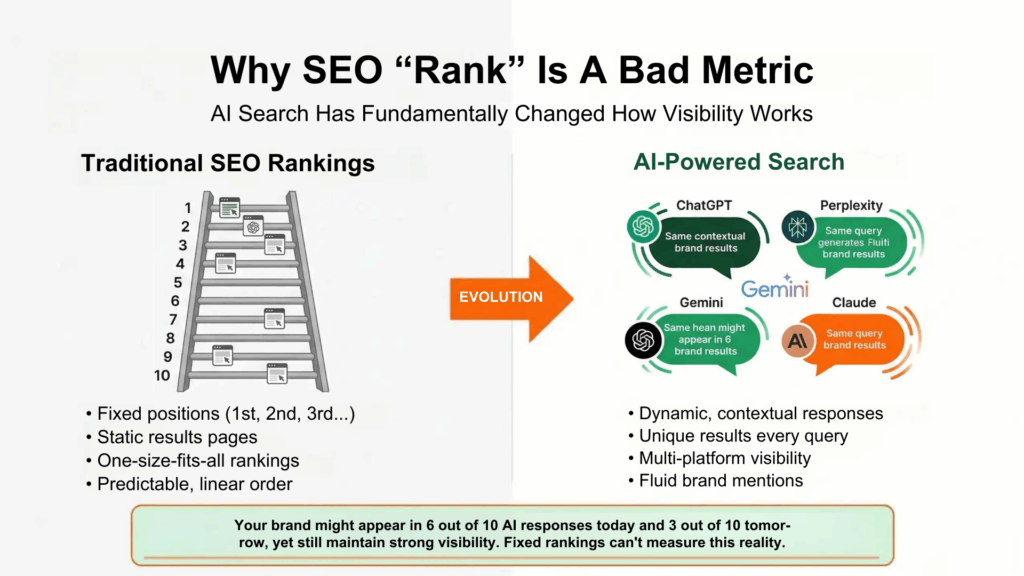
I need to say something that might ruffle some feathers: rank/position has been a dead metric for a long time.
Advanced SEOs have known this for years. I started reporting on “visibility” as an SEO metric (as a leading indicator, not a KPI) over five years ago because Google was already behaving this way. AEO is just fast-forwarding a larger share of businesses to what was already true.
Here’s what I mean. Pull up Google Search Console for any active site and look at your query data. You’ll find examples like this all the time:
- A query doubles in impressions but drops half a position in average ranking
- A query loses impressions but climbs two spots in average ranking
Both of those scenarios? I’m happy with them.
In the first case, Google is “testing us out” twice as often, even if we appear slightly lower on average. That’s more visibility. More chances to earn a click. In the second case, we’re moving up for a more specific audience, which often means better conversion rates even with fewer total impressions.
If you’ve been deep in the SEO weeds for years, you’ve probably called this “impression share” or “share of voice.” It’s not a new concept. AEO tools are just fast-forwarding a larger share of the market to these more modern metrics.
And AI Search makes it impossible to ignore. There are no fixed positions in ChatGPT. No SERP with 10 blue links. Every time someone asks a question, the model generates a fresh response. Your brand might appear in 6 out of 10 answers today, 3 out of 10 tomorrow, and 8 out of 10 next week.
The right metric has always included “visibility” and now it’s the primary leading metric you’ll need to know for AEO reports.
For agencies offering an AEO service, this matters: If ranking reports are still the centerpiece of your client deliverables, you’re reporting on a metric that hasn’t been reliable for years. AEO just makes that undeniable.
The Metrics That Actually Matter for AEO Reporting
So if rankings are out, what’s in?
Good news: the lagging indicators (the ones your clients actually care about) are the same as they’ve always been. Traffic. Conversions. New customers. New revenue. Those don’t change just because the search channel does.
What changes are the leading indicators you use to predict and influence those outcomes. Here’s what should be in every AEO report:
AI Visibility Across LLMs
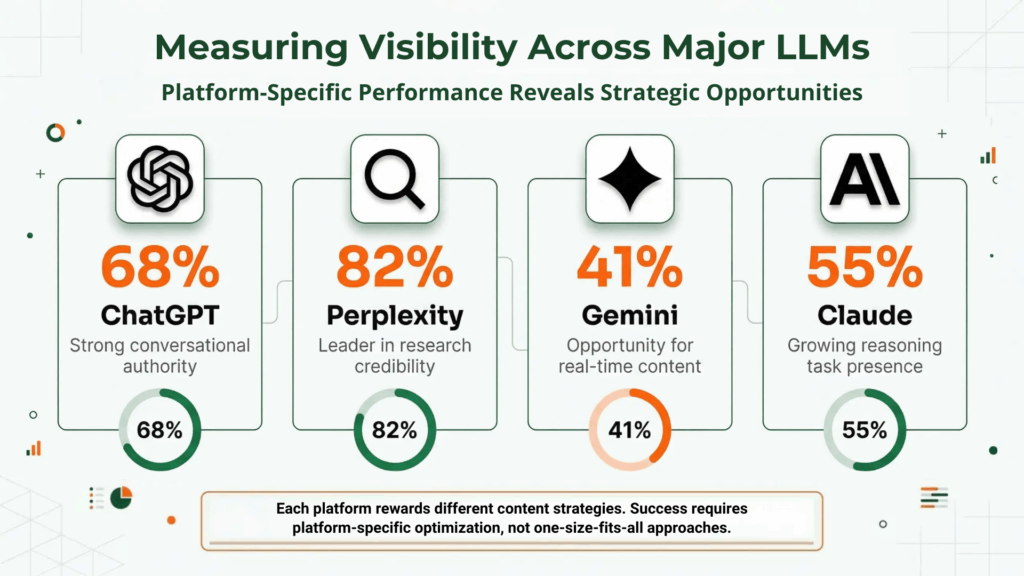
Are you showing up when people ask ChatGPT, Perplexity, Gemini, or Claude about your category? This is your new “impression share.” It’s the single most important leading indicator in AEO, and it needs to be tracked by platform because each LLM behaves differently.
Track Prompt Topics Over Keywords
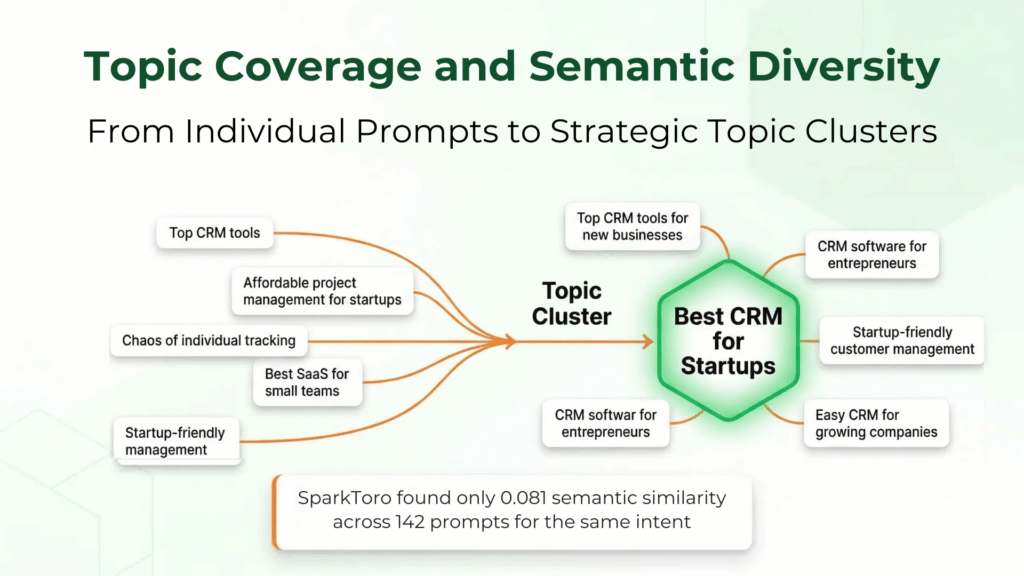
Marketers need to track prompt “Topics” the same way SEOs track keyword “Clusters.” A Topic is a group of related prompts that map to a single intent or subject area. The more prompts you include within a Topic, the more trustworthy the Visibility metric becomes.
This matters more in AEO than it ever did in SEO. SparkToro found a semantic similarity of just 0.081 across 142 people writing prompts for the same intent. People phrase things wildly differently in AI Search. Tracking a single prompt is meaningless. Tracking a Topic of 10-20 related prompts gives you data you can actually act on.
Visibility by LLM
Each model has different biases and grounding sources. Your brand might dominate on Perplexity but be invisible on Gemini. Reporting needs to reflect this. A flat “AI visibility” number without a per-model breakdown is hiding more than it’s revealing.
LLM Referral Traffic and Conversions (GA4 + GSC Correlation)
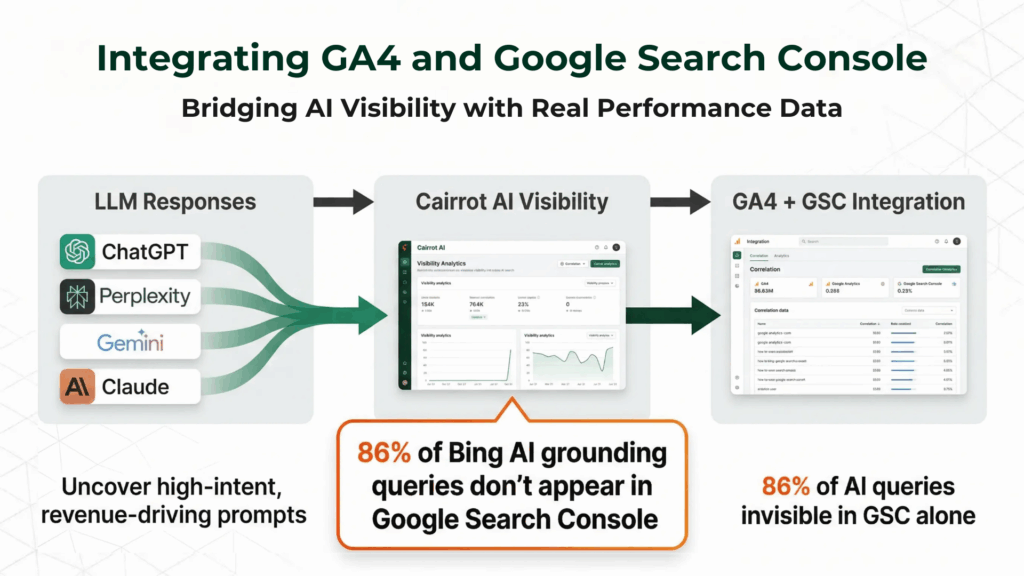
This is the bridge metric that connects AEO to the rest of your reporting. Cairrot’s GA4 and Google Search Console integration lets agencies cross-reference what users are tracking in LLMs with what searchers are entering into Google.
Why does this matter? Our data shows that roughly 86% of Bing AI grounding queries don’t even appear in Google Search Console. If you’re only looking at GSC, you’re missing most of the AI search picture. The GA4 + GSC integration also helps generate an ever-growing list of highly specific prompts you can add to Cairrot for more detailed tracking over time.
Manual Tracking vs. AEO Analytics Tools
There are two ways to do AEO reporting: manually or automatically. One of them scales well for agencies, one does not.
The Manual Approach
Every agency marketer knows the drill. Open GA4. Pull traffic numbers. Cross-reference with the client’s CRM. Manually enter everything into a spreadsheet. Color-code the rows. Add a chart. Hope the formulas don’t break.
For traditional SEO and marketing KPIs, this works fine when you have one or two clients. I’ve done it. I still maintain manual tracking spreadsheets for some of my clients because sometimes a clean, customized spreadsheet is exactly what the client needs.
But for AI visibility? Manual tracking means you’d also need to open ChatGPT, Perplexity, Gemini, and Claude, run a set of prompts yourself, check if the brand was mentioned, log the results, and repeat that process across every client, every month.
That doesn’t survive five clients. The time cost kills margins, and the data is stale by the time you’ve formatted the deck.
Features That Agencies Actually Need in an AEO Tool
This is why purpose-built AEO tools exist. When you’re evaluating options, here’s the checklist that matters for agencies:
- Multi-client / multi-brand management. You need one dashboard that handles all your accounts, not separate logins per client.
- Whitelabel reports and dashboards. If you’re sending a report with another company’s branding, it undermines trust.
- API access for deeper customization. Some clients want data piped into their own BI tools. A free, advanced API is non-negotiable.
- MCP integration for agentic workflows. This is still emerging, but agencies that automate early will win.
- Affordable pricing that scales across clients. Pay-per-client models beat fixed-license packages for agencies every time.
- Visibility metrics broken out by LLM. Not just a blended score. Per-model data.
- GA4 and Google Search Console integration. AEO data in isolation is interesting. AEO data correlated with real search behavior is actionable.
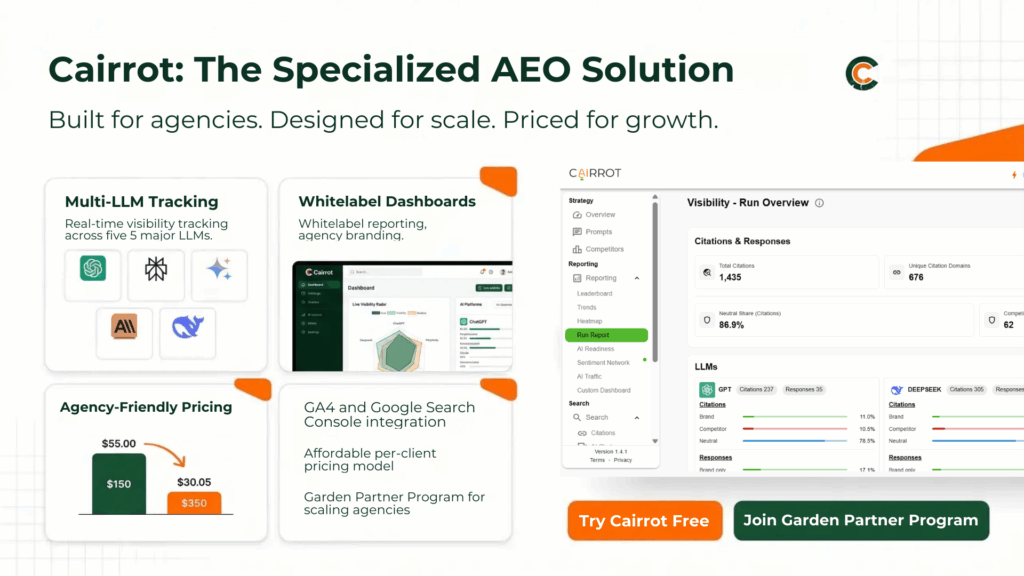
Cairrot was built specifically with this checklist in mind. It’s not the only tool on the market, but it’s the only one that checks every box on this list at a price that makes sense for agencies managing 5, 10, or 50 clients. Full comparison of LLM tracking tools here ->
What an AEO Reports Look Like (Examples)
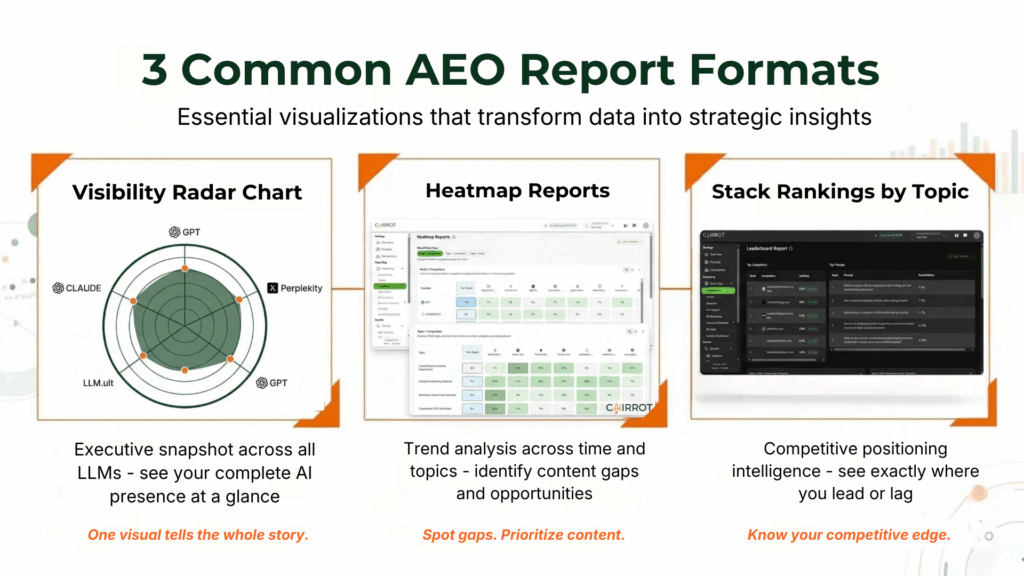
Let’s get specific. These are the three report types that make up a strong AEO report, and how agencies are using them with clients.
The Visibility Radar Chart
Think of this as your executive summary in a single visual.
The radar chart shows your brand’s visibility across multiple LLMs on a single multi-axis view. Each axis represents a platform (ChatGPT, Perplexity, Gemini, Claude, etc.). The shape of the radar instantly communicates where you’re strong and where you have gaps.
Agencies love this one because it’s the fastest way to show a client the state of their AI visibility. No explanation needed. The shape tells the story. If one axis is collapsed, that platform needs work. If the shape is large and balanced, you’re winning.
This is your opening slide in every client report.
Heatmap Reports
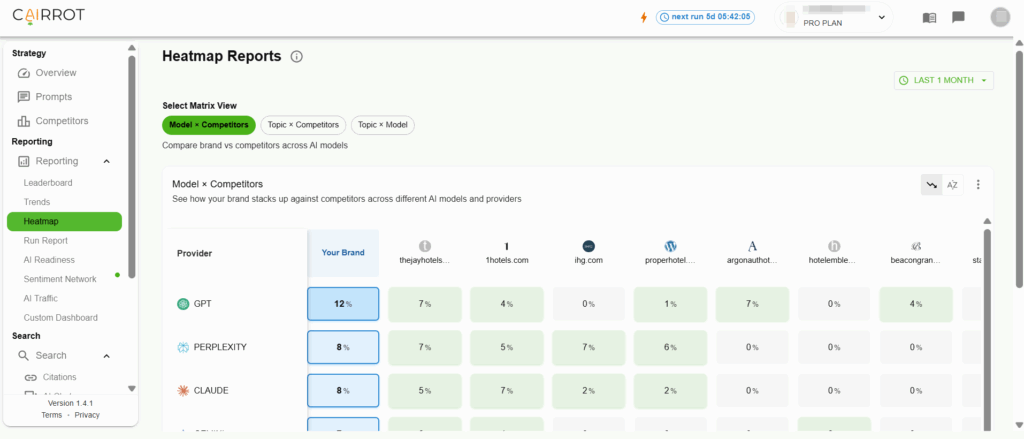
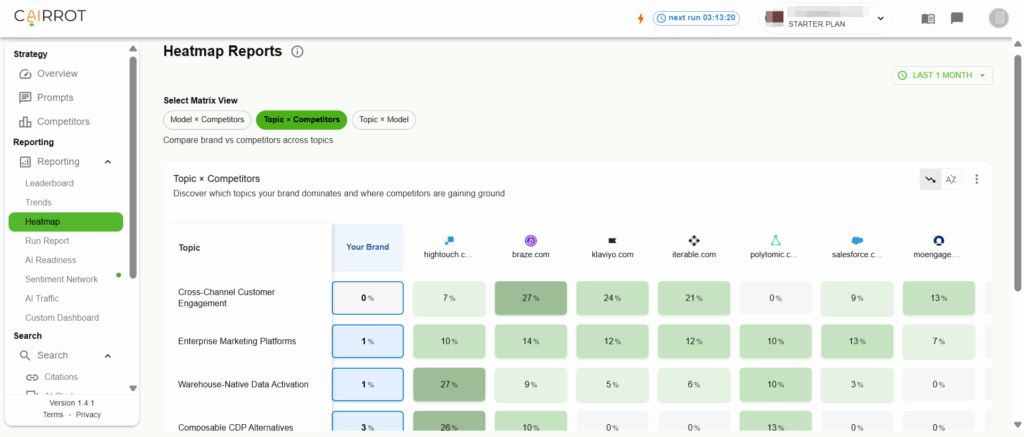
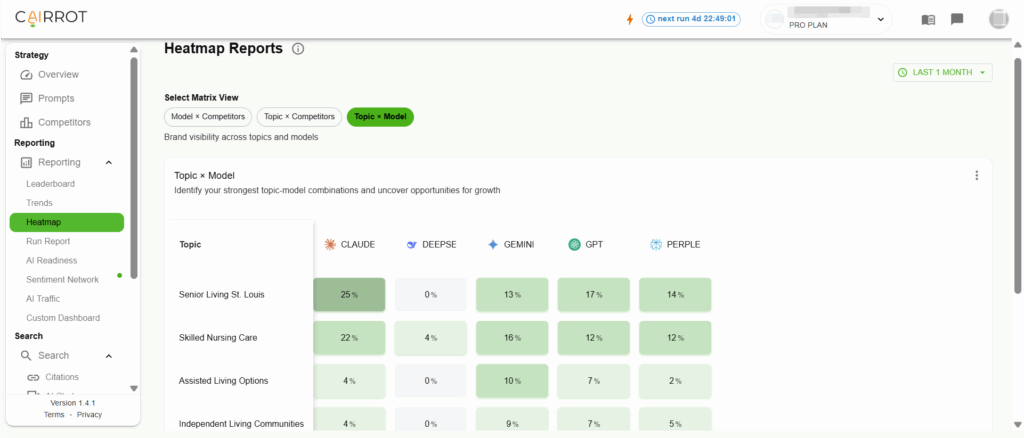
The heatmap shows visibility intensity across prompt topics over time.
Hot spots indicate strong, consistent mentions. Cold spots flag areas where the brand is losing ground or never had visibility in the first place. It’s a trend analysis tool that helps agencies prioritize which topics to optimize for next, and it gives clients a visual that maps directly to their content strategy.
When a client asks “what should we write about next?” you point at the cold spots.
Stack Rankings by Topic
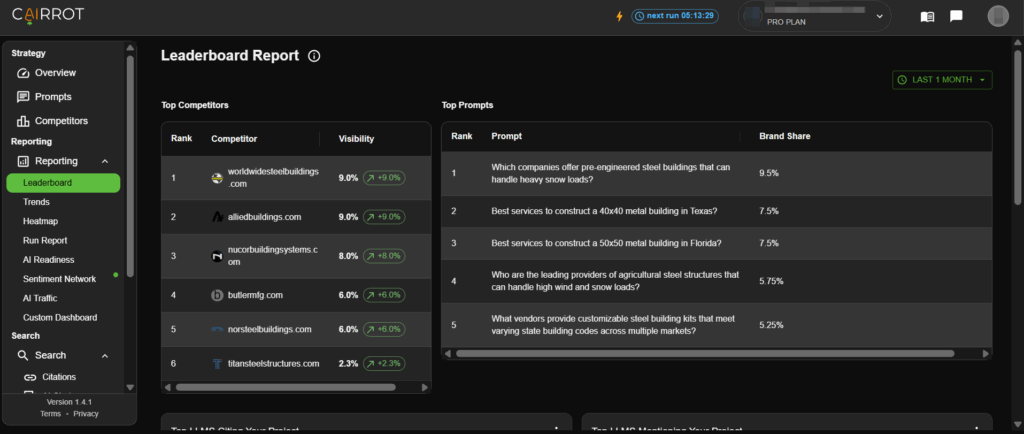
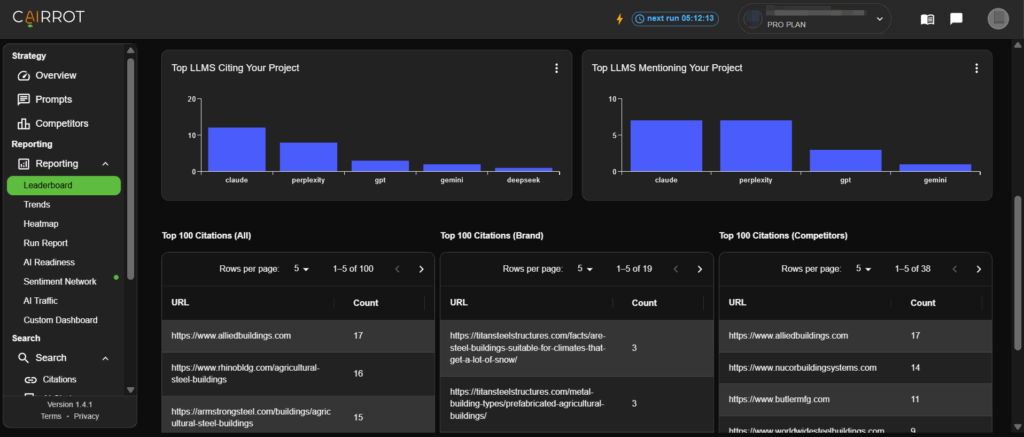
For any given prompt topic, how does the client’s brand stack up against competitors in AI responses? Think “share of voice, per topic, per LLM.”
This is your competitive positioning slide. When a client asks “how do we compare to [competitor]?”, this is the answer. It’s concrete, visual, and impossible to argue with.
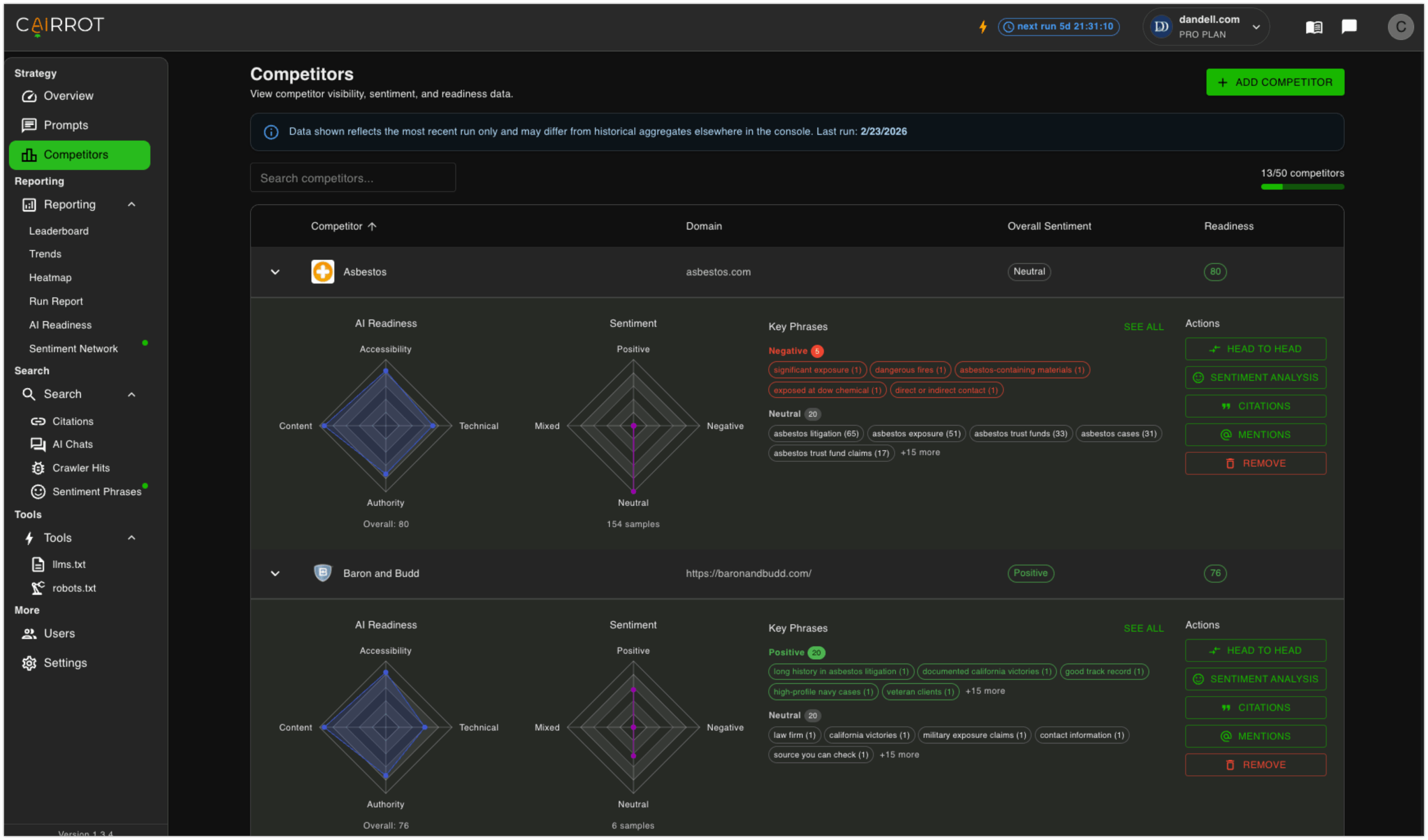
Competitor Comparison View
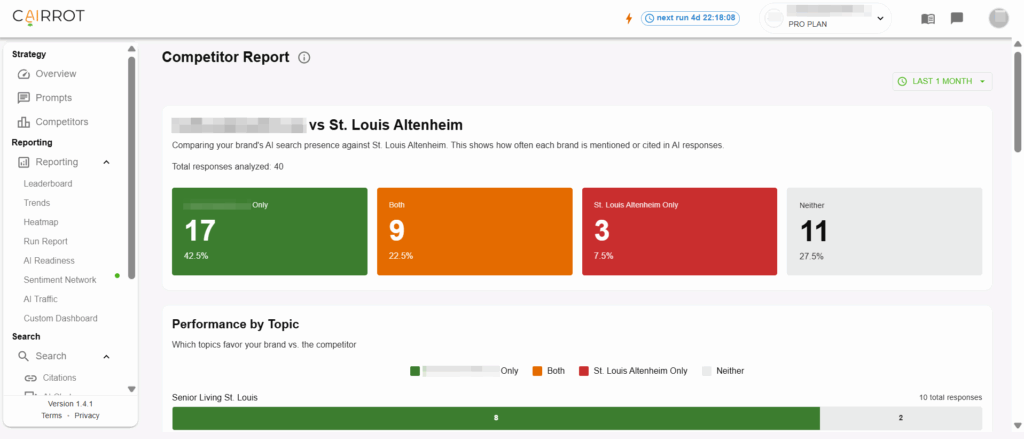
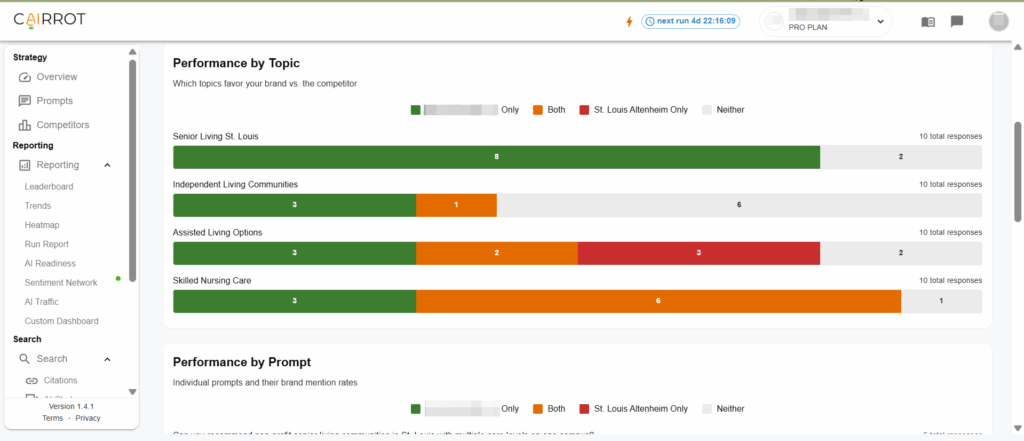
Every client wants to know how their visibility compares to their competitors. No agency’s AEO report is complete if you don’t include a competitive analysis report.
LLM/AI Traffic Reports (GA4 Integration)
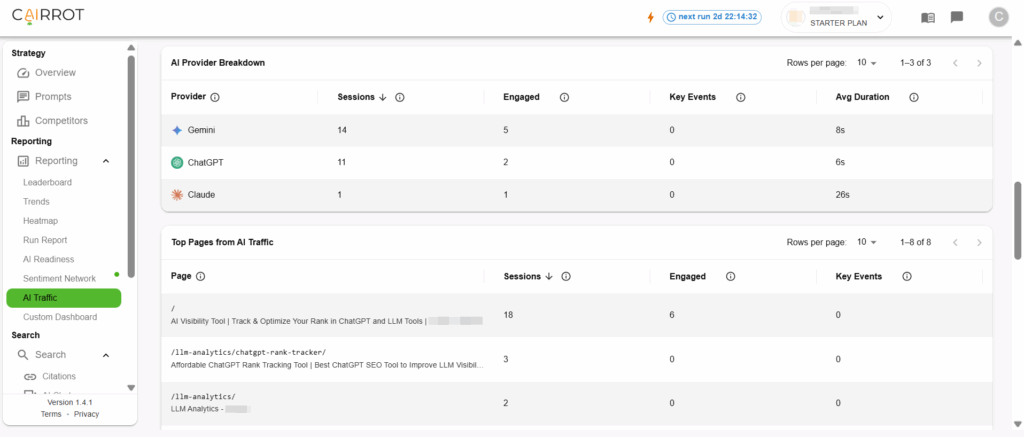
How can an agency report on AI visibility if they don’t include actual traffic metrics? In order to make this easy, we set up a two-click GA4 and GSC integration so your client’s AEO reports don’t just track leading metrics, they measure KPIs from discovery to close.
Putting It All Together
These three report types aren’t standalone charts, they’re layers of a story you are telling.
The radar chart gives the executive summary. The heatmap shows trends over time. The stack ranking delivers competitive intel. A strong AEO report combines all three into a narrative: here’s where you stand, here’s how it’s trending, and here’s how you compare.
Cairrot also supports persona-based tracking and includes a prompt generator that expands your coverage as the tool discovers new opportunities in your data. The more you use it, the smarter your reports get.
How Often Should Agencies Report AEO Metrics to Clients?
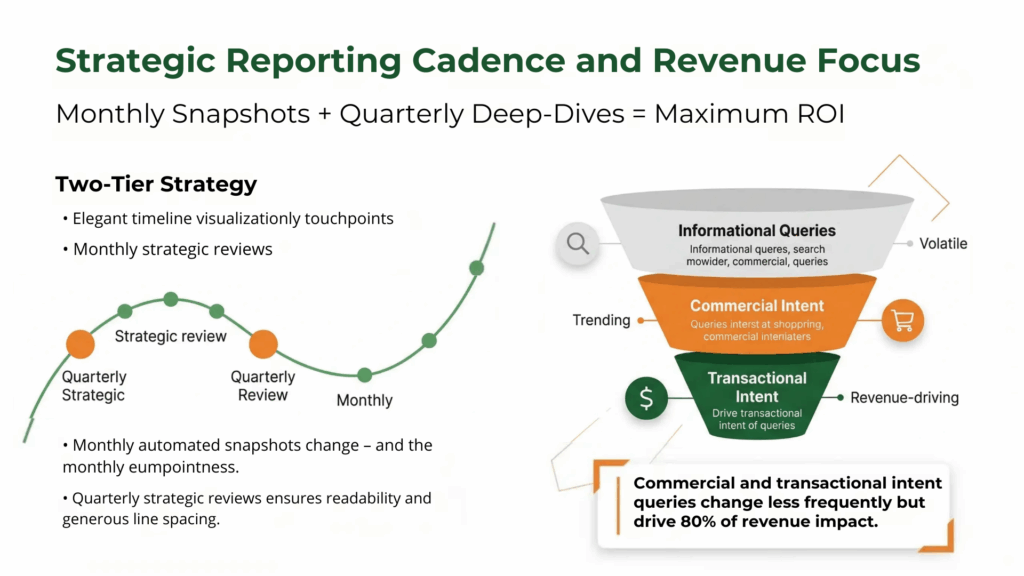
In our experience working with agencies through the Garden Partner Program, the cadence that works best is straightforward:
- Monthly: Send an automated visibility report. Keep it simple. Radar chart, top-level metrics, a brief narrative of what moved. This keeps clients informed without eating agency hours. Most of this can be automated or templated in Cairrot.
- Quarterly: Deliver a deep-dive analysis. This is where you pull in heatmaps, stack rankings, GA4 correlation data, and strategic recommendations. It’s the “what’s working, what’s not, and here’s what we’re doing next” conversation.
- Why this cadence works: AI search results for high-intent, bottom-funnel queries (the ones that actually drive revenue) don’t change as frequently as broad informational queries. Monthly is enough to catch meaningful movement. Quarterly is where you build strategy.
One trap to avoid: don’t over-report on top-funnel informational queries. These fluctuate constantly in LLMs, and reporting on every swing creates noise that distracts from the metrics that matter. Focus reporting on the prompts and topics that correlate closest with revenue. In SEO tool language, that means commercial and transactional intent queries.
Start Offering AEO Reports Before Your Competitors Do
AEO reporting isn’t some futuristic concept. Agencies are doing it right now. The ones that build it into their stack today will own the conversation with clients before their competitors figure out what’s happening.
The shift is simple: from rankings to visibility. From individual keywords to prompt topics. From single-platform reporting to multi-LLM analytics. The underlying KPIs (traffic, conversions, revenue) haven’t changed. The measurement layer has.
If you’re running an agency and want to start offering AEO reporting at scale, Cairrot’s Garden Partner Program was built for exactly this. Multi-client management. White label dashboards. An API you can actually use. And pricing that doesn’t destroy your margins.