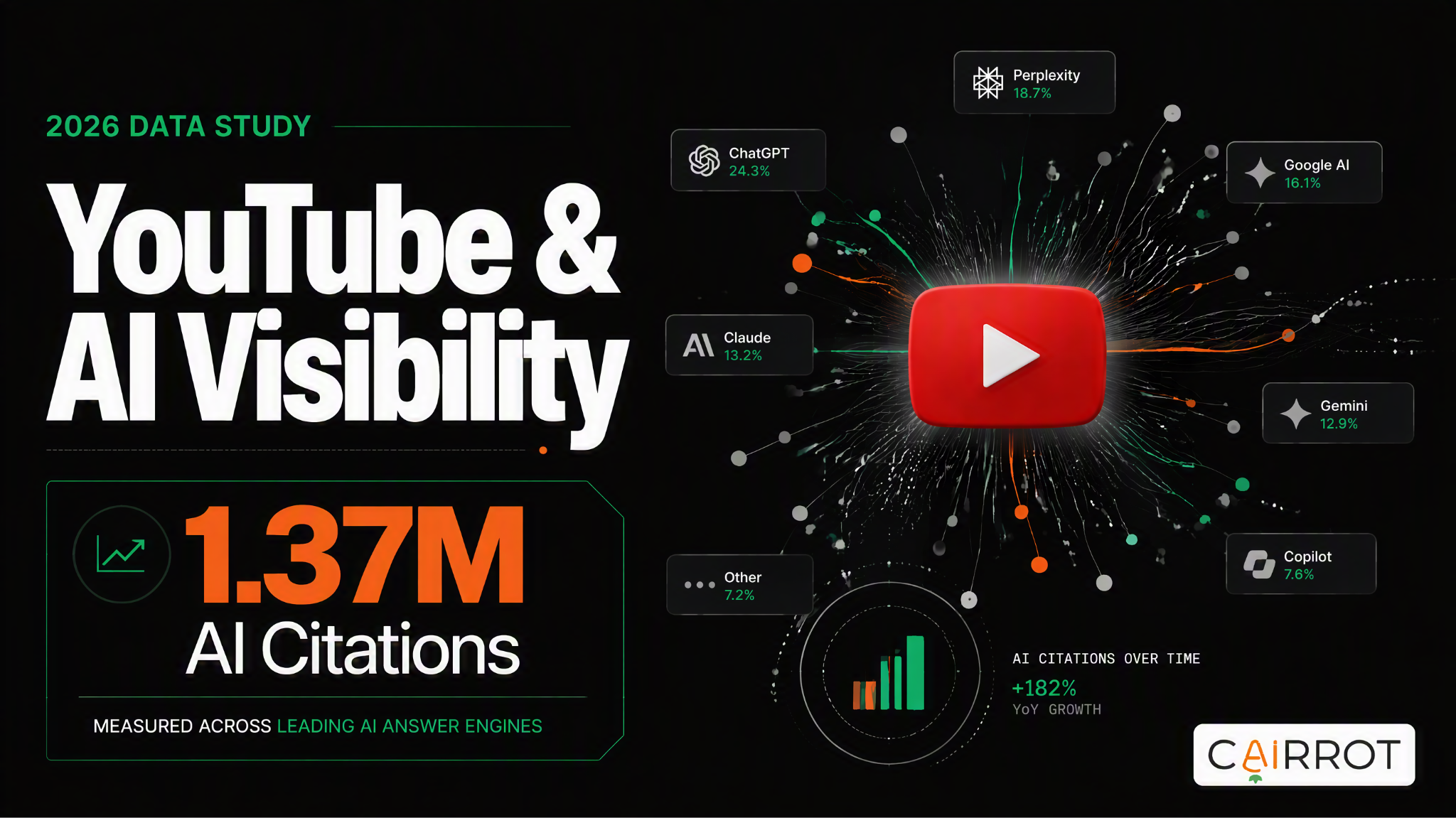
YouTube is the most-cited domain by LLMs in our dataset
Across the trailing three months, ChatGPT, Gemini, Perplexity, Claude, DeepSeek and Google AI Overviews produced 1,527,194 citations across 5,294 unique prompts in Cairrot’s LLM Citation Landscape. No domain was cited more often than youtube.com.
That reads like a mandate to invest in video. It isn’t, or at least not universally. The #1 ranking is a blended average across six engines that behave nothing alike, and the blend hides the decision a marketing team actually has to make. Three surfaces treat YouTube as a primary source. Three barely acknowledge it. Which ones your buyers use determines whether video is your best AEO investment or close to your worst.
The global picture
| Domain | Citations (3 mo) | Share of all citations |
| youtube.com | 26,209 | 1.72% |
| reddit.com | 22,828 | 1.49% |
| nih.gov | 18,308 | 1.20% |
| wikipedia.org | 14,520 | 0.95% |
| google.com | 14,507 | 0.95% |
Note how flat the top of that list is. The most-cited domain in the dataset holds under 2% of citation volume, and the gap between first and fifth is less than a point. Citations spread across 114,606 unique domains. There is no domain that owns AI answers. Instead, you are competing for inclusion in a set of sources, not for a #1 position.
For how video compares to the other channels worth optimizing, see our breakdown of the best digital marketing channels for AEO.
YouTube citations by engine: the split that actually matters
| Provider | Total citations | YouTube citations | YouTube’s share of that engine |
| Google AI Overviews | 40,897 | 2,137 | 5.22% |
| Gemini | 374,889 | 14,497 | 3.87% |
| Perplexity | 469,466 | 9,321 | 1.99% |
| Claude | 185,391 | 125 | 0.07% |
| ChatGPT | 274,614 | 82 | 0.03% |
| DeepSeek | 181,937 | 47 | 0.03% |
Google’s two surfaces together account for 16,634 YouTube citations — 63% of the total — with Perplexity supplying another 36%. ChatGPT, Claude and DeepSeek, which between them represent 42% of all citation volume we tracked, contributed 254 YouTube citations. That’s a difference of roughly two orders of magnitude between engines answering the same prompts in the same window.
The practical read: YouTube AEO is a Google-and-Perplexity strategy. If your category’s buyers research in ChatGPT or Claude, video is not the lever to pull. If they use Google’s AI surfaces, it may be the single most efficient asset you can build.
Why the split exists
We can measure the gap confidently. Explaining it takes more care, so we’ll label our hypotheses rather than assert a motive we can’t observe.
- Ownership. YouTube is a Google property, and Google’s AI surfaces have structured access to transcripts, chapter metadata and segment-level timestamps. It would be surprising if that access didn’t produce a citation advantage, and the fact that AI Overviews, not Gemini, posts the highest YouTube share is consistent with the surface that leans hardest on live web retrieval also leaning hardest on video.
- Extractability. A less conspiratorial reading: citing a video usefully requires parsing what’s said and where. Engines without transcript and chapter infrastructure may prefer text they can quote precisely. This is not because video is disfavored, but because it’s harder to cite well.
Both are plausible and not mutually exclusive. What we’d caution against is the conference-stage version, that OpenAI and Anthropic deliberately suppress Google properties. Our data can’t support that. ChatGPT does cite YouTube; it just does so rarely and never enough to enter its top 10 domains.
Does adding a city change how often YouTube gets cited?
Yes, and it’s the sharpest behavioral split in the dataset after the engine gap itself.
| Prompt type | Unique prompts | Total citations | YouTube citations | YouTube share of citations | Prompts surfacing any YouTube result |
| No location in the prompt | 4,504 | 1,308,538 | 25,056 | 1.92% | 60.8% (2,739 of 4,504) |
| City-level location added | 733 | 191,259 | 1,033 | 0.54% | 33.0% (242 of 733) |
| “Near me” phrasing | 73 | 28,824 | 125 | 0.43% | 43.8% (32 of 73) |
Naming a city cuts YouTube’s citation share by a factor of 3.5, from 1.92% to 0.54%. Measured a different way — how often a prompt surfaces at least one YouTube result at all — coverage falls from 61% of prompts to 33%.
The “near me” row is a useful check on that result. It’s a completely separate way of expressing local intent, drawn from a different set of prompts, and it lands in the same place: 0.43%. Two independent markers of local intent, same direction, similar magnitude. This isn’t an artifact of how we defined “local.”
What replaces YouTube in local answers is directories. In the city-level and “near me” cuts, the top-cited domains shift decisively toward Yelp, Psychology Today, A Place for Mom, Tripadvisor and category-specific listing sites. Engines answering “best X in Chicago” reach for a curated list of local providers, not a video explaining what X is.
This is the mirror image of what we found in our Reddit AI citation study, where adding a city nearly doubled Reddit’s citation share in Perplexity. Community discussion and directory listings gain ground on local queries. Video loses it.
What this means if you operate in multiple locations
The instinct for multi-location brands is to produce location-specific video — a walkthrough per branch, a testimonial per market. Our data suggests that’s the wrong sequencing for AI visibility. Once a query carries a place name, engines are looking for a provider record, not an explainer.
The higher-return path is to treat video as an upper-funnel category asset — the “how does this work,” “what should this cost,” “how do I choose” questions that get asked before a location is attached — and to invest in directory presence, review profiles and structured local data for the queries where a city is named. Those are two different budgets solving two different problems, and our data indicates they don’t substitute for each other.
Does YouTube’s role change by industry?
More than it changes by anything else we measured.
| Prompt category | Total citations | YouTube citations | YouTube share | vs. 1.72% baseline |
| Marketing agency selection | 6,477 | 298 | 4.60% | 2.7x |
| Senior care / assisted living | 38,098 | 495 | 1.30% | 0.8x |
| Mesothelioma / asbestos legal | 88,172 | 1,000 | 1.13% | 0.7x |
| Therapist / mental health | 10,314 | 56 | 0.54% | 0.3x |
This pattern tracks the shape of the buying question rather than the industry label — and it points the same way the location data does.
Categories where the query is evaluative and informational: how does this work, how do I choose a vendor, what should I expect. Categories that resolve into “find me a specific local provider” pull directories. Therapist queries sit at the bottom at 0.54%, which is almost exactly the city-level figure, and that’s not a coincidence: those prompts are overwhelmingly location-bound.
Why YouTube matters for AEO/GEO
Marketers think of YouTube as a search and audience-development channel. In the engines that cite it, it also functions as a source layer for AI-generated answers.
- AI engines surface videos as evidence for recommendations, tutorials, comparisons and explanations. A cited video shapes the answer even when nobody clicks through.
- None of the metrics YouTube reports to you indicate whether a video is being cited. A 400-view video can be a citation workhorse while your best-performing upload is invisible to every engine.
- The asset is unusually addressable. Unlike being cited by a publisher or a review site, you control the video. If structure drives citation, structure is something you can ship this quarter.
What gets a Youtube video cited?
The instinct is to assume AI citation tracks YouTube’s own metrics. It doesn’t. The largest independent study on this question — Otterly’s analysis of 100M+ AI citations — found near-zero correlation between citation frequency and views (r = -0.03), likes (r = -0.02) or subscribers (r = -0.03). Over 40% of cited videos had fewer than 1,000 views; roughly a third of cited channels had under 10,000 subscribers.
What did correlate, weakly but consistently, was structure: description length (r = 0.31) and clear topical signals. And 94% of citations went to long-form video rather than Shorts.
AI citation behaves like reference selection, not recommendation. The engine isn’t asking what’s popular. Instead, it’s asking what answers this precisely, and whether it can point at the exact moment where it does.
What to do about it
- Build around one specific question. “How much does commercial HVAC replacement cost in 2026” is citable. “Everything you need to know about HVAC” is not.
- Put the answer in the title. It’s the strongest signal an engine has that the video matches the query.
- State the answer in the first 30 seconds, then elaborate. Burying the conclusion at 8:40 works against extractability.
- Format chapters to YouTube’s spec: first timestamp at 00:00, at least three, ascending, each 10 seconds or longer. Since Google’s surfaces cite at segment level, this is the highest-leverage change most channels can make.
- Treat the description as machine-readable metadata: plain-language summary, key entities and terms, relevant links, chapter list.
- Target the pre-location question. Our city-level data says video loses once a place name enters the prompt, so build for the research that happens before the buyer narrows to a market.
- Don’t fund location-specific video for AI visibility. Put that budget into directory and review presence instead.
- Measure citations per video separately from views. Different funnels, different winners.
Track YouTube citations with Cairrot
[INSERT SCREENSHOT: LLM Citation Landscape filtered to youtube.com, showing the per-provider breakdown. Square or tall format.]
YouTube is among the highest-leverage content channels for AEO/GEO in the engines that cite it — which is why we track it at domain and page level rather than lumping it into “social.” Cairrot lets you:
- Identify which YouTube videos are cited for your tracked prompts, by engine.
- Compare citation behavior across ChatGPT, Gemini, Perplexity, Claude, DeepSeek and Google AI Overviews.
- Segment by prompt type — including location-bearing vs. non-location prompts — so you can see where video wins and where directories do.
- Surface competitor videos shaping AI answers in your category.
- Monitor citation gains and losses as you publish, restructure or update videos.
If you’re building the reporting layer, our AEO reporting tool covers tying citation data back to pipeline rather than leaving it as a vanity metric.
Request the study
This article covers initial findings from Cairrot’s YouTube citation data. The complete study adds unique-video counts, deeper industry breakdowns, international comparisons and a longer trend window.
Get early access to our universal visibility analysis for more AEO insights
Request early access to our AI visibility data studies derived from the Universal Visibility Index (UVI), including AEO insights for optimizing your brand on Reddit, YouTube, and other channels AI prefers to cite.