
Seven forces define AI in 2026: agentic systems taking on real workflow ownership, multimodal inputs becoming the default interface, efficiency-first compute replacing brute-force scaling, answer-led AI search engines eclipsing blue links, tighter safety guardrails around autonomous agents, faster AI-accelerated research, and automated infrastructure management. If you act on one thing first, make it this: build topical depth and corroborated third-party citations now, because answer engines reward evidence density, not keyword density. Microsoft’s own research on 2026 AI trends backs several of these shifts, and NIST’s safety work confirms agents are the year’s biggest governance question.
TL;DR:
- Agentic systems will shift from pilot projects to full deployment, automating multi-step workflows and requiring security measures for agent-to-agent communication.
- Multimodal inputs like images, voice, and video will become standard, making content optimized for extraction and verification crucial for visibility.
- Efficiency-focused compute approaches will favor smaller, well-tuned models rather than brute-force scaling, amidst ongoing hardware supply chain constraints.
- AI safety efforts will emphasize defenses against agent hijacking, requiring detailed security reviews and logging of decision chains for any autonomous agent.
- Answer-led search replacing traditional results will demand content structurization, cross-source corroboration, and continuous citation monitoring to maintain visibility.
Table of Contents
- The Top AI Trends Shaping 2026
- How Will Compute and Infrastructure Change in 2026?
- Why Are Agentic Systems the Defining Technical Trend?
- What Should Enterprises Change About AI Governance in 2026?
- How Is AI Search Changing Discovery, and What Should You Do About It?
- Where Does This Analysis Come From?
- What Does a Practical AEO Workflow Look Like?
- What Does AI Search Mean for Privacy and Data Security?
- What Regulatory and Ethical Questions Are Emerging Around AI Search?
- How Is AI Search Changing User Behavior?
- How Will AI Search Connect With AR, VR, and IoT in 2026?
- What Are the Biggest Limitations Facing AI Search in 2026?
- A Practitioner’s Take on What to Actually Prioritize
- Sources
- FAQ
The Top AI Trends Shaping 2026
You don’t need to track fifty signals this year. You need to track the ones that change how your product, content, or team operates. Here are the eight that matter most, ranked by how directly they’ll hit your workflow.
-
Agentic systems move from demo to deployment. AI agents that plan, execute, and hand off tasks across tools are showing up inside real operations, not just pilot decks. Microsoft frames this as agents “joining the workforce,” and the implication is immediate: any process built around a single chatbot interaction now needs a review for multi-step automation potential.
-
Multimodal input becomes the norm, not the novelty. Search and assistant tools increasingly accept images, voice, and video alongside text, and users are adjusting their query habits accordingly. Teams that only optimize text content are leaving an entire discovery channel unaddressed.
-
Compute efficiency overtakes raw scale. Model developers are chasing smarter architectures and better data curation instead of just adding parameters, a shift Microsoft Research counts among its seven defining trends for the year. The implication: smaller, cheaper models will handle tasks that used to require the largest available system.
-
AI-accelerated research compresses discovery cycles. Scientific and engineering teams are using AI to generate and test hypotheses faster, a pattern Microsoft’s trend report also highlights. Product teams should expect competitors to ship faster, which shortens your own window for differentiation.
-
Answer-led AI search reshapes discovery. ChatGPT, Perplexity, Gemini, and similar tools increasingly deliver a synthesized answer instead of a results page, drawing from corroborated sources rather than a single ranked link. Brands that haven’t structured content for extraction will simply not appear in the answer.
-
Agent safety and hijacking defenses tighten. NIST has prioritized technical evaluation work specifically on agent hijacking, where a malicious actor manipulates an agent’s instructions or context to act against its owner’s intent. Any team deploying agents with tool access or payment authority needs a hijacking-specific test plan, not just a general model safety review.
-
Interoperability standards for model-to-data connectivity mature. TechCrunch reported that major AI labs are converging on shared standards for connecting models to external data sources, which affects how search systems and agents pull structured information. Structured, machine-readable content will have an easier path into these pipelines than unstructured pages.
-
Infrastructure management automates itself. Cloud providers are pushing more AI-driven optimization into the infrastructure layer, from workload placement to cost management, reducing the manual tuning teams used to need. This lowers the barrier for smaller teams to run production-grade AI workloads without a dedicated infrastructure specialist.
How Will Compute and Infrastructure Change in 2026?
Efficiency, not brute force, decides who ships. Model teams that spent 2024 and 2025 chasing parameter counts are now optimizing architecture and data quality instead, because the cost curve of scaling further has gotten steep enough to change the math. That shift affects your model-selection decisions directly: a well-tuned mid-size model frequently outperforms a larger, less-curated one on the tasks that matter for search and content applications, at a fraction of the inference cost.
Supply chains are the constraint nobody planned for. Reuters reporting documents a supply-chain crisis driven by AI demand, with chip and hardware availability creating real bottlenecks for companies trying to scale infrastructure. That has a direct downstream effect on experiment cadence: teams should budget longer lead times for new hardware-dependent deployments and prioritize workloads that run efficiently on existing capacity.
Pro Tip: Before requesting new compute, audit whether a smaller, better-tuned model can hit the same accuracy target. Efficiency gains are often cheaper to capture than capacity is to acquire right now.
A few practical adjustments follow from this environment:
- Favor cloud platforms, such as Azure’s AI infrastructure offerings, that let you scale usage incrementally rather than committing to fixed hardware.
- Build cost monitoring into any agentic workflow before launch, since agent chains can multiply inference calls quickly.
- Treat quantum computing as a research horizon, not a 2026 deployment option. Nothing in current industry reporting suggests quantum hardware will handle production AI workloads this year; the practical move is watching the space, not budgeting for it.
Why Are Agentic Systems the Defining Technical Trend?
Agentic systems are AI setups that don’t just answer a question. They plan a sequence of steps, call tools, check their own output, and hand tasks to other agents when needed. In 2026, that architecture is showing up in document automation, customer workflows, and what Microsoft describes as AI acting like a workplace teammate rather than a single-turn assistant.
The interesting part isn’t one agent doing one job. It’s agent-to-agent communication, where a coordinating “super agent” delegates subtasks to specialized agents and assembles the results. Research from Carnegie Mellon University on multi-agent coordination explores exactly this kind of structure, where a company-like hierarchy of agents handles different parts of a task. It’s promising for complex workflows, and it’s also where risk concentrates fastest, because a failure or manipulation at one node can cascade through the whole chain.
That’s precisely why NIST has prioritized agent-specific safety testing. Their technical work on agent hijacking evaluations treats hijacking, where an attacker injects instructions that redirect an agent’s behavior, as a distinct threat category requiring its own test suite, separate from standard model output evaluation. If your agent has access to a calendar, a payment system, or customer data, that distinction should shape your security review, not just your model choice.
Practical implications for teams building or buying agentic tools this year:
- Map every tool and data source an agent can touch before deployment, since that surface is what hijacking attacks target.
- Require a human checkpoint on any agent action with financial, legal, or customer-facing consequences.
- Test agents against adversarial prompts specifically designed to redirect their task, not just prompts designed to produce bad content.
- Log agent decision chains, not just final outputs, so you can audit where a failure originated.
None of this means agentic AI is too risky to deploy. It means the safety conversation has moved from “is the output accurate” to “can this system’s autonomy be exploited,” and that’s a genuinely different engineering problem.
What Should Enterprises Change About AI Governance in 2026?
The organizations pulling ahead have stopped treating AI as a pilot program and started treating it as production infrastructure, sometimes called an AI factory model, where output, uptime, and cost per task get tracked the same way any manufacturing line would. MIT Sloan’s analysis of 2026 trends points to this operational maturity as one of the clearest differentiators between companies that capture real value from AI and those still stuck running disconnected experiments.
Governance in that production environment looks different from governance during a pilot. Provenance tracking, citation verification, and repeatable safety testing become permanent line items, not one-time checklist items before launch.
- Require source provenance on any AI-generated content or recommendation that reaches a customer or decision-maker.
- Build citation verification into your content pipeline so AI-generated claims get checked against real sources before publishing.
- Run safety testing on a recurring schedule, not just at initial deployment, since model behavior shifts as underlying systems update.
- Instrument new measurement categories: AI answer share (how often your brand appears in AI-generated answers), citation frequency across AI platforms, and sentiment alignment between how your brand describes itself and how AI systems describe you.
That last point deserves emphasis. Traditional metrics like organic traffic and keyword rank tell you almost nothing about whether ChatGPT or Perplexity is citing your brand accurately, or citing you at all. Instrumenting those newer metrics is the governance shift that separates teams reacting to AI search from teams managing it.
How Is AI Search Changing Discovery, and What Should You Do About It?
Traditional search rewarded the page that matched a keyword and earned enough links to rank. AI search rewards the source that gets cited inside a generated answer, and that answer draws from multiple corroborated sources rather than a single winning page. Queries are also getting longer and more conversational, and a growing share arrive as images or voice rather than typed keywords. Background analysis of this shift consistently points to the same conclusion: answer engines prioritize corroborated evidence and entity depth over any single ranking signal.
That changes what “visibility” means. Here’s a prioritized checklist for adapting:
- Build topical depth, not just page count. Cover a subject from multiple angles across multiple pieces of content so an AI system finds consistent, reinforcing information rather than one thin page.
- Structure content as extractable answer units. Short, direct, well-labeled answers to specific questions get pulled into AI-generated responses more reliably than long unstructured paragraphs.
- Earn cross-source corroboration. If your claim about your own product only exists on your own site, an answer engine has no second source to confirm it with. Get mentioned, reviewed, or cited on other credible sites.
- Produce multimodal assets deliberately. Images, video transcripts, and structured data all feed the multimodal query behavior that’s becoming standard.
- Track your citation frequency across AI platforms, not just your search rank. A content strategy built for 2026 increasingly treats this as the primary visibility metric.
- Run small experiments before committing budget. Publish one structured answer unit on a high-intent question, then check within a few weeks whether it surfaces in ChatGPT, Perplexity, or Gemini responses.
Pro Tip: Pick one high-value question your audience asks constantly, write a direct 40 to 60 word answer to it, publish it in its own clearly labeled section, and check three AI search tools two weeks later. That single test tells you more about your AI visibility than a month of traffic reports.
Partner analysis of this shift reaches a similar conclusion: the move from keyword matching toward topical authority and answer-focused optimization is now the central strategic question in digital visibility, not a side experiment. Success here isn’t a one-time fix. Treat it as a repeating measurement cycle, since AI platforms update their citation behavior frequently enough that a strategy validated in January can drift by summer.
Where Does This Analysis Come From?
The trends above draw from three kinds of evidence: primary technical guidance from bodies like NIST, whose agent hijacking evaluation work shapes the agent-safety section; industry research from Microsoft and MIT Sloan on where enterprise AI investment is heading; and reporting from outlets like Reuters and TechCrunch on the supply-chain and interoperability shifts affecting deployment timelines.
- Technical safety guidance carries the most weight on anything agent-related, since it comes from testing infrastructure rather than forecasting.
- Enterprise research from MIT Sloan and Microsoft informs the governance and adoption sections, where organizational behavior matters more than raw technical specifics.
- Reporting from Reuters and TechCrunch grounds the infrastructure and interoperability claims in verifiable, dated events rather than speculation.
Some items deserve more caution than others. Quantum computing’s practical role in AI remains speculative for 2026, and any regulatory framework specific to agentic AI is still forming rather than settled. Treat those two areas as watch items, and revisit your assumptions on a quarterly cadence rather than locking in a full-year plan around them.
What Does a Practical AEO Workflow Look Like?
Auditing for AI visibility gaps isn’t guesswork if you approach it the way you’d approach any measurement problem: find where you’re not showing up, fix the highest-impact gaps first, then measure again. Cairrot builds AEO audits around that exact loop, tracking where a brand is or isn’t cited across ChatGPT, Gemini, Claude, Perplexity, Grok, and DeepSeek, and adding sentiment tracking across Reddit and YouTube, two platforms that heavily influence how AI models characterize a brand’s reputation.
A sample workflow looks like this:
- Audit current AI answer share and citation frequency across major AI search engines to establish a baseline.
- Prioritize fixes based on which content gaps are actually suppressing citations, rather than fixing everything at once.
- Corroborate claims by identifying where third-party mentions are missing and closing those gaps.
- Measure answer share again on a repeating schedule, since AI citation behavior shifts often enough that a single snapshot misleads.
Teams running this cycle with an AEO platform typically see measurable results within about 60 days, which lines up with how quickly AI platforms tend to update their citation patterns once corroborating sources appear.
What Does AI Search Mean for Privacy and Data Security?
Answer-led search engines pull from more sources per query than a traditional search result page does, which means more of your data trail feeds into a single generated response. When an AI system synthesizes an answer about you, your company, or your product, it’s drawing on a wider net of scraped, indexed, and cross-referenced content than a ranked list ever needed.
That has two practical consequences. First, brands and individuals have less visibility into which sources an AI system used to build a given answer, since most platforms don’t fully disclose their retrieval process. Second, agentic systems with access to personal or business data, calendars, files, payment tools, introduce a new attack surface that didn’t exist with simple chatbots. This is part of why NIST’s agent hijacking evaluation work treats data-access agents as a distinct risk category.
For professionals managing brand or customer data, the practical response is auditing what’s publicly indexable and connected to your systems, since anything scrapable is potentially answer-engine fodder. For agent deployments specifically, that means restricting data access scope per task rather than granting broad standing permissions, and logging what an agent accessed and why. Privacy policy language written for the search-engine era, which assumed a human clicking a link, often doesn’t address a system generating a summary from data it never asked permission to reveal in that form.

What Regulatory and Ethical Questions Are Emerging Around AI Search?
Regulation hasn’t caught up to answer-led search, and that gap is where the sharpest ethical questions sit right now. When an AI system synthesizes a response instead of linking to a source, who’s accountable if that response is wrong, defamatory, or based on outdated information? Traditional search never had to answer that question, because the search engine wasn’t the one making the claim.
Attribution is the practical flashpoint. If a brand’s product claim gets pulled into an AI answer without a working link back to the source, the brand loses both the traffic and the ability to correct the record if the AI system misrepresents it. Expect continued pressure, from publishers, regulators, and platforms alike, on how AI systems disclose and attribute their sources.
Agent autonomy raises a second, distinct set of questions. When an agent takes an action, a purchase, a scheduling change, a data-sharing decision, on a person’s behalf, existing consumer protection frameworks weren’t built with that kind of intermediary in mind. NIST’s prioritization of hijacking-specific safety evaluations is itself a signal that regulators and standards bodies see agent autonomy as a distinct risk category needing its own rules, not just an extension of existing model safety guidance.
The practical move for professionals: don’t wait for finalized regulation to build good habits. Document how your AI systems attribute sources, restrict what any deployed agent can do without human sign-off, and treat transparency about AI involvement in a decision as a baseline expectation, not a future compliance requirement.
How Is AI Search Changing User Behavior?
People are asking longer, more specific questions instead of typing short keyword fragments, because they’ve learned answer engines can actually parse a full sentence. A query that used to be “best running shoes” is increasingly phrased as “what running shoes work best for a wide foot with plantar fasciitis,” because the user knows the system will give a direct answer instead of a list of links to sort through themselves.
That shift changes what “success” looks like for a search session. Users increasingly expect a synthesized answer on the first attempt and treat clicking through to a source page as an optional verification step rather than the default next action. That’s a meaningful behavioral change from the click-heavy habits traditional search trained for over two decades.
Multimodal habits are compounding this. Voice queries and image-based searches, snapping a photo of a plant to ask what’s wrong with it, are becoming routine rather than novel, and users expect the same conversational follow-up capability across modalities. A person asking a question by voice increasingly expects to ask a clarifying follow-up the same way, without restarting the search from scratch.
For brands and content teams, this means the old assumption, that a user reads a results page and picks the best option, applies less often. Increasingly, the AI system picks for them, based on which sources it trusts enough to cite. That puts more pressure on being the corroborated, citable source rather than simply the top-ranked one, and it rewards content written to directly answer a specific question rather than content written to rank for a keyword phrase.
How Will AI Search Connect With AR, VR, and IoT in 2026?
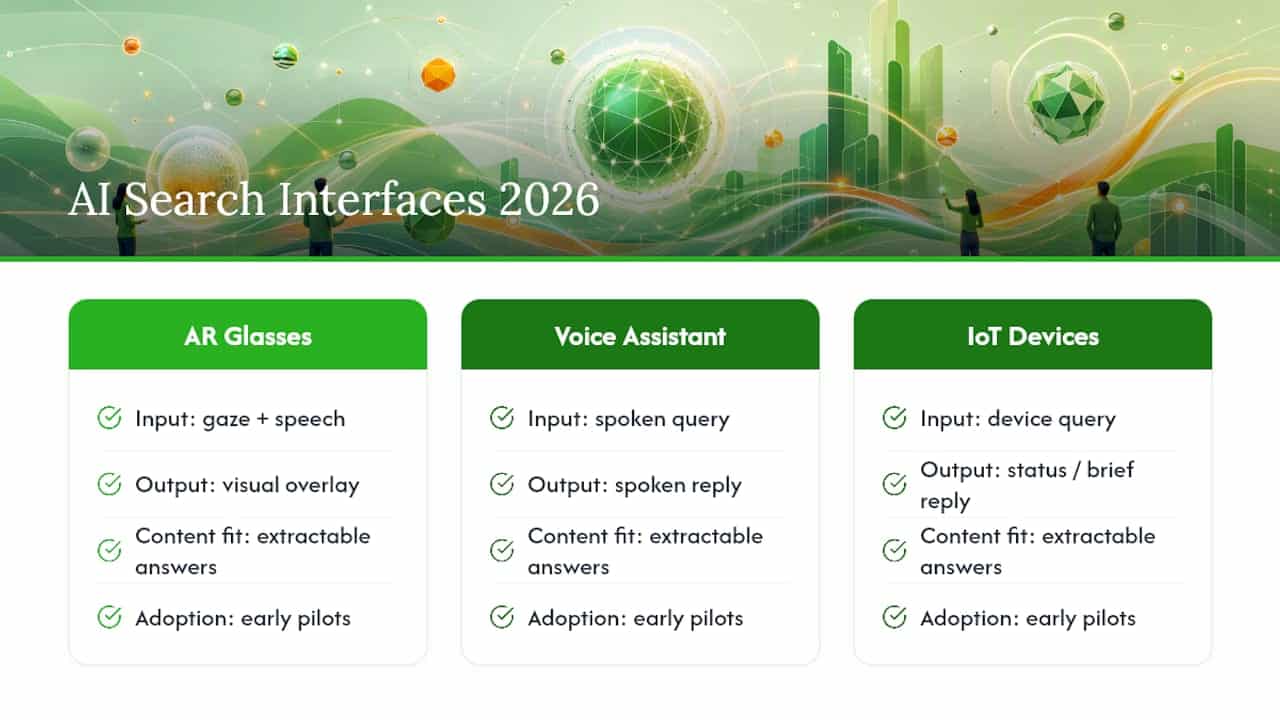
Search is starting to happen through devices other than a phone or laptop screen, and that shift is accelerating as smart glasses, voice assistants, and connected home devices mature. A user wearing AR glasses who looks at a product and asks a question aloud is running an AI search query through a completely different interface than a typed box, and the answer needs to work as a spoken or visually overlaid response, not a list of blue links.
IoT devices add a second layer to this. A smart appliance or wearable that can query an AI system directly, “why is this error code showing,” “what’s a safe temperature for this,” turns everyday hardware into a search entry point, often without the user consciously thinking of it as a search at all.
For content and product teams, the practical implication is that structured, direct-answer content isn’t just useful for chat interfaces anymore. It’s the format most likely to work across a voice assistant, an AR overlay, and a connected device query alike, since none of those interfaces can display a traditional results page. Content built as clear, extractable answer units, rather than long-form pages designed for scrolling and reading, is better positioned for this shift regardless of which device ends up delivering it.
This integration is still early, and most of it in 2026 remains at the pilot and early-adopter stage rather than mainstream behavior. The practical move for professionals isn’t rebuilding your content strategy around AR and IoT queries today. It’s making sure your most important answers are structured cleanly enough that they’ll work no matter what interface eventually delivers them.
What Are the Biggest Limitations Facing AI Search in 2026?
Accuracy and hallucination remain the most persistent limitation, even as answer-led systems improve. An AI system pulling from multiple sources to synthesize a response can still misrepresent, oversimplify, or blend conflicting information in ways a single linked source never would, and that risk scales as more queries route through a single generated answer instead of a list a user can independently evaluate.
Attribution gaps compound this. When an AI system doesn’t clearly show which sources informed a given answer, users lose the ability to verify a claim themselves, and brands lose the ability to correct misrepresentation quickly. That’s a structural limitation of the answer-led format itself, not just a rough edge that better models will smooth out.
Infrastructure constraints are shaping the pace of improvement too. The supply-chain pressures Reuters has documented mean that even well-funded AI search providers face real limits on how fast they can scale the compute-heavy retrieval and synthesis processes answer engines depend on.
Volatility is the limitation professionals underestimate most. AI search visibility isn’t a fixed state you achieve once. Citation patterns shift as models update, as new corroborating sources appear, and as platforms adjust their retrieval logic, which means a brand cited reliably in one quarter can quietly lose that citation by the next without any obvious trigger. Teams that treat AEO as a one-time project rather than a continuously monitored metric will find their visibility erodes without warning.
A Practitioner’s Take on What to Actually Prioritize
Most 2026 trend coverage buries the one action that matters most under a pile of equally-weighted predictions. Here’s my disagreement with that approach: agentic safety and AI search visibility deserve more attention than compute efficiency or multimodal input this year, because those two carry the sharpest near-term consequences if ignored, one to your security posture, the other to your discoverability.
If you do nothing else, run this: instrument citation tracking across at least three AI platforms, then build three structured answer units around your highest-intent customer questions. Check citation frequency again in 30 to 60 days. Success looks like appearing in at least one AI-generated answer you weren’t cited in before. Failure tells you exactly where your corroboration gaps sit.
For deeper tactical steps, Cairrot’s AI search resources and AEO strategy guide are good next stops.
— Dr. Patrick McAvoy
Sources
- What’s next in AI: 7 trends to watch in 2026 – Microsoft Source
- NIST technical blog: strengthening AI agent hijacking evaluations
- Five Trends in AI and Data Science for 2026 – MIT Sloan
- OpenAI adopts rival standard for connecting AI models to data – TechCrunch
FAQ
What Is the Single Biggest AI Trend for 2026?
Agentic AI systems that plan, execute, and coordinate tasks across tools are the defining trend, according to Microsoft Research’s 2026 trend analysis, because they shift AI from single-turn assistance to workflow ownership.
How Is AI Search Different From Traditional Search in 2026?
AI search delivers a synthesized answer drawn from multiple corroborated sources instead of a ranked list of links, and it increasingly handles longer, conversational, and multimodal queries rather than short keyword phrases.
What Is Agent Hijacking, and Why Does It Matter?
Agent hijacking is when an attacker manipulates an AI agent’s instructions or context to redirect its behavior against its owner’s intent. NIST has made evaluating this risk a technical priority as agents gain more autonomous access to tools and data.
How Quickly Can a Brand Improve Its AI Search Visibility?
Teams running structured audits, citation tracking, and corroboration fixes through platforms like Cairrot typically see measurable AEO results within about 60 days, though visibility should be monitored continuously rather than checked once.
Is Quantum Computing Relevant to AI Search in 2026?
Not practically. Quantum computing remains a research horizon rather than a deployment option for production AI search or search infrastructure this year, and professionals should treat it as a watch item, not a planning input.
