
DeepSeek SEO means optimizing your content so DeepSeek’s synthesized answers cite your page instead of a competitor’s. The fastest practical step: publish short, answer-first snippets with explicit, crawlable source lines and schema-friendly structure, then test them. Expect iterative gains, with measurable shifts commonly showing up around 60 days into a consistent testing cadence.
TL;DR:
- Lead with a 50 to 150 word standalone answer, place a descriptive source URL beneath it, and keep the answer visible without JavaScript.
- Log baseline citations and opened pages, change one element per test, then compare results across cache windows before drawing conclusions from 4 to 12 weeks.
- Track citation totals, domain share, page engagement, and GA4 or server log attribution; measurable gains often appear around 60 days with consistent testing.
- Monitor Reddit, YouTube, and other indexed discussions for recurring complaints or competing sources, then publish clearer, sourced answers that address those questions directly.
Table of Contents
- How DeepSeek executes searches and what its answer JSON contains
- AEO content and markup checklist you can implement today
- Testing and measurement: verifying citations and accounting for caching
- How Cairrot accelerates AEO work and what to expect from an audit
- Understanding the role of sentiment analysis in DeepSeek SEO
- Integrating cross-platform data for comprehensive DeepSeek optimization
- Advanced strategies for closing DeepSeek-specific visibility gaps
- Customizing AEO dashboards around DeepSeek’s own metrics
- The discipline that actually moves DeepSeek citations
- Try Cairrot for DeepSeek audits and ongoing tracking
- FAQ
- Sources
How DeepSeek executes searches and what its answer JSON contains
DeepSeek doesn’t just retrieve a page and summarize it. When a tool call triggers a web search, it forces a real search on every invocation and returns a synthesized answer with inline citations, not a loose paraphrase, according to the pi-deepseek-web-search package. That distinction matters for testing: you’re optimizing for citation inside a structured response, not for a generic ranking position.
The deepseek-search CLI exposes the actual shape of that response, and knowing the fields helps you instrument tests instead of guessing at outcomes:
- answer: the synthesized text the reader actually sees.
- citations: the sources DeepSeek chose to attribute, the field you’re trying to win.
- warnings: flags on data quality or search limitations worth logging.
- usage: token and request accounting, useful for cost tracking during test runs.
- model: which DeepSeek model handled the request, since behavior varies by version.
- request_id: a unique identifier for tracing a specific test back to its exact output.
- stop_reason: why generation ended, which can hint at truncation issues in longer answers.
Beyond the answer itself, DeepSeek-backed tools log the executed search actions, meaning you can see which pages were opened and searched during answer construction, not just which ones got cited in the final text. That’s a meaningfully stronger verification signal than most AI answer engines expose.
Caching complicates testing. Results are cached per working directory, base URL, model, and query, with a time-to-live window controlled by a cacheTtlMs setting, per the pi-deepseek-web-search configuration. Other configuration keys worth knowing include baseUrl, model, reasoningEffort, maxOutputTokens, and timeoutMs, along with allowed and blocked domain lists that can filter which sources DeepSeek will even consider. If you publish a change and query immediately, you might be reading a cached answer from before your edit went live. Build that lag into your test design rather than treating an unchanged early result as a failure.
AEO content and markup checklist you can implement today
Winning a DeepSeek citation comes down to making your answer easy to find, easy to extract, and easy to trust. Here’s the sequence we recommend running on any page you want DeepSeek to cite:
- Write an answer-first lead. Open with 50 to 150 words that directly answer the likely query, using the same phrasing a person would type or ask aloud.
- Add explicit source lines immediately after the answer. Stable URLs with descriptive anchor text, placed right under the claim, make attribution unambiguous for both readers and crawlers.
- Use simple JSON-LD for FAQ or Q&A sections. Structured markup gives DeepSeek a clean, machine-readable version of your answer alongside the human-readable one.
- Avoid JS-only rendering for the answer block. If the core answer only appears after client-side JavaScript executes, a crawler that doesn’t run your scripts never sees it.
- Separate the extractable snippet from supporting context. A short, quotable answer followed by deeper explanation performs better than one long undifferentiated block.
- Add a visible updated timestamp. Freshness signals matter more for a model trying to confirm an answer still holds true.
- Confirm your pages are crawlable. Check robots.txt and server logs for anything blocking the bots DeepSeek-backed tools rely on, and review any allowed or blocked domain lists in your testing setup before concluding a page was ignored rather than excluded.
Pro Tip: Keep your answer-first lead under 150 words and test it in isolation before changing anything else on the page, so you know exactly which edit moved the needle.
For teams that want a deeper library of tactics once this checklist is running, our AEO strategy guide walks through additional patterns drawn from live testing.
Testing and measurement: verifying citations and accounting for caching
A citation win only counts if you can prove it happened and repeat it on purpose. Start by checking the citations field and the executed search actions DeepSeek-backed tools log, which together confirm whether your specific page was opened and attributed, per the pi-deepseek-web-search documentation.
Run a disciplined cadence rather than a single test:
- Establish a baseline set of queries and log the current citation pattern before changing anything.
- Make one targeted content or markup change per test.
- Re-check results across multiple TTL windows, since a single early check can hit a stale cache.
- Aggregate outcomes over 4 to 12 weeks before drawing conclusions.
Track a small set of KPIs: total citations earned, your share of answers citing your domain versus others, engagement on the pages that get cited, and attribution confirmed through GA4 or server logs. Teams following an iterative audit and optimization workflow commonly see measurable AEO improvements within roughly 60 days. That timeline assumes consistent testing, not a one-time publish.
How Cairrot accelerates AEO work and what to expect from an audit
We built our AEO Audits & Reports to shorten the distance between “we think this page should get cited” and “here’s proof it is.” An audit identifies which of your pages already contain extractable, answer-shaped content and flags the gaps where a competitor is more likely to win the citation instead.
Our Unified AEO Analytics track citation changes across DeepSeek alongside other AI engines, so you’re not running separate spreadsheets for every model you care about. We also apply sentiment tracking across platforms like Reddit and YouTube, which surfaces how people are already talking about your brand in the exact places language models pull framing cues from.
That combination, audit plus tracking plus sentiment, is built around the same short test cycles this guide recommends: baseline, change, measure, repeat. Clients running this workflow consistently typically see measurable shifts within roughly 60 days, which lines up with the testing cadence we outlined above rather than replacing it.
Understanding the role of sentiment analysis in DeepSeek SEO
Sentiment isn’t a vanity metric here. When DeepSeek synthesizes an answer, it draws on language that reflects how a brand, product, or topic is generally discussed, and consistently negative framing in widely indexed discussions can color how an answer characterizes you even when your own page is technically accurate.
Monitoring sentiment across forums, review sites, and video platforms gives you an early warning system. If a wave of negative discussion is building around a product category you cover, you can address it in your own content before it shapes the synthesized answer: clarify a misunderstanding, update outdated claims, or add context that a thin negative post never included.
Positive sentiment signals tend to reinforce the citations you already have rather than create new ones out of nothing. The practical move is to treat sentiment monitoring as an input to your content calendar: when you see a recurring complaint or question with a negative tone, write the answer-first page that resolves it directly, using the same structure from the checklist above. That page becomes both a citation candidate and a sentiment correction at once.
Integrating cross-platform data for comprehensive DeepSeek optimization
DeepSeek’s citations don’t live in a vacuum separate from the rest of the web’s conversation. Reddit threads, YouTube video descriptions and comments, and other high-traffic community content frequently rank well enough to get indexed and referenced in AI-synthesized answers, which means your AEO strategy can’t stop at your own domain.
Pulling signals from these platforms into your workflow does two things. First, it shows you which questions people are actually asking in their own words, often phrased differently than your internal keyword list, which sharpens the answer-first leads you write. Second, it flags where a non-owned source, a popular Reddit thread or a widely watched video, is already winning the citation you want, giving you a concrete competitor to outperform with a clearer, better-sourced page structured for AI search.
Treat cross-platform monitoring as ongoing rather than a one-time scan. Community sentiment shifts, new threads outrank old ones, and a video that answers a question well today can be replaced by a better one next quarter. Building a habit of checking these sources alongside your own citation tracking keeps your content calendar aligned with where the conversation, and the citations, actually are.
Advanced strategies for closing DeepSeek-specific visibility gaps
Standard SEO tactics, keyword targeting, backlinks, page speed, still matter, but they don’t fully explain why one page gets cited by DeepSeek and a seemingly similar page doesn’t. Closing that gap takes a few DeepSeek-specific moves beyond the basics.
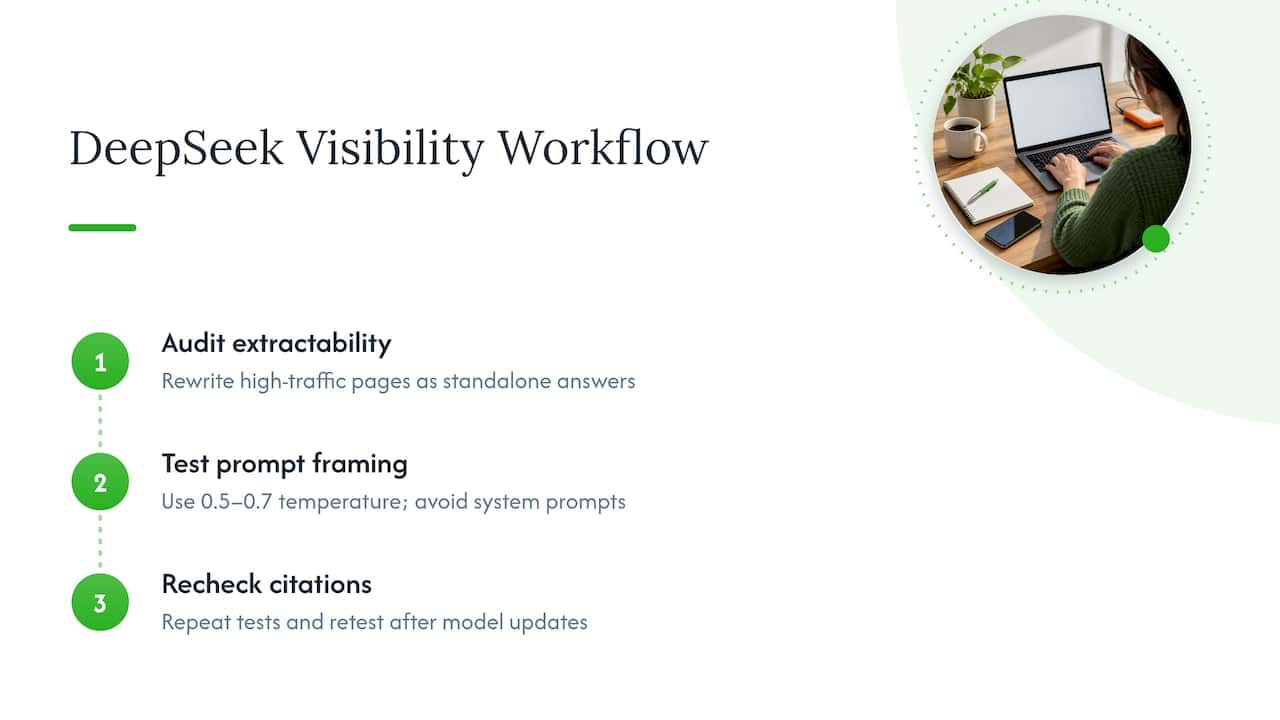
Start by auditing your existing content for extractability rather than just rankability. A page can rank well in traditional search and still fail to produce a clean, quotable answer that a synthesis model wants to lift. Rewrite the first paragraph of your highest-traffic pages as a standalone answer, then check whether it reads correctly with no surrounding context.
Next, test prompt framing on your own side before assuming your content is the problem. DeepSeek-R1 guidance recommends a temperature range of 0.5 to 0.7, avoiding system prompts, and using the documented prompt templates for web search, according to the DeepSeek-R1 repository. Running your test queries with those recommended settings gives you a more representative read than an ad hoc prompt.
Finally, account for model inconsistency. A public GitHub issue thread on DeepSeek-R1’s training cutoff documents community reports of inconsistent outputs and open questions about what the model actually knows and when. That’s a reason to verify citations repeatedly rather than treating one favorable result as permanent, and to re-test after major model updates.
Customizing AEO dashboards around DeepSeek’s own metrics
Generic SEO dashboards weren’t built with fields like executed search actions, citation share, or TTL-aware cache windows in mind, which means most teams end up bolting DeepSeek tracking onto tools that weren’t designed for it. A dashboard built around DeepSeek’s actual output structure, the answer, the citations list, the model and request metadata, gives you a far more direct read on whether your AEO work is landing.
Our Unified AEO Analytics let you build views around exactly those fields: citation counts by domain, share of voice against competitors inside DeepSeek’s answers, and sentiment trends layered on top so you can see whether a dip in citations lines up with a dip in how your brand is discussed elsewhere. Our Deepseek Rank Tracker adds a focused view on how often and how consistently your pages show up across repeated queries.
Customization matters because every team’s priority metric differs. An agency managing multiple clients needs citation share broken out per client; an in-house content team may care more about which specific pages are winning versus losing citations month over month. Building the dashboard around your own test cadence, not a generic template, keeps the reporting tied to the actual changes you’re making.
The discipline that actually moves DeepSeek citations
Most teams chasing AI visibility focus on writing more content, when the sharper lever is writing shorter, more testable answers and measuring every change against the fields DeepSeek actually returns. A single well-structured 100 word answer with a clean source line will often outperform a 2,000 word article that never isolates a quotable claim.
The teams who win citations consistently are the ones who treat every content update as an experiment: one change, one baseline, repeated checks across cache windows, then a decision based on data rather than instinct.
— Dr. Patrick McAvoy
Try Cairrot for DeepSeek audits and ongoing tracking
Running the checklist above by hand across dozens of pages gets tedious fast. Our AEO Audits & Reports find your extractable-snippet gaps automatically, and our Unified AEO Analytics track DeepSeek citation shifts alongside sentiment, so you’re testing with data instead of guesswork.
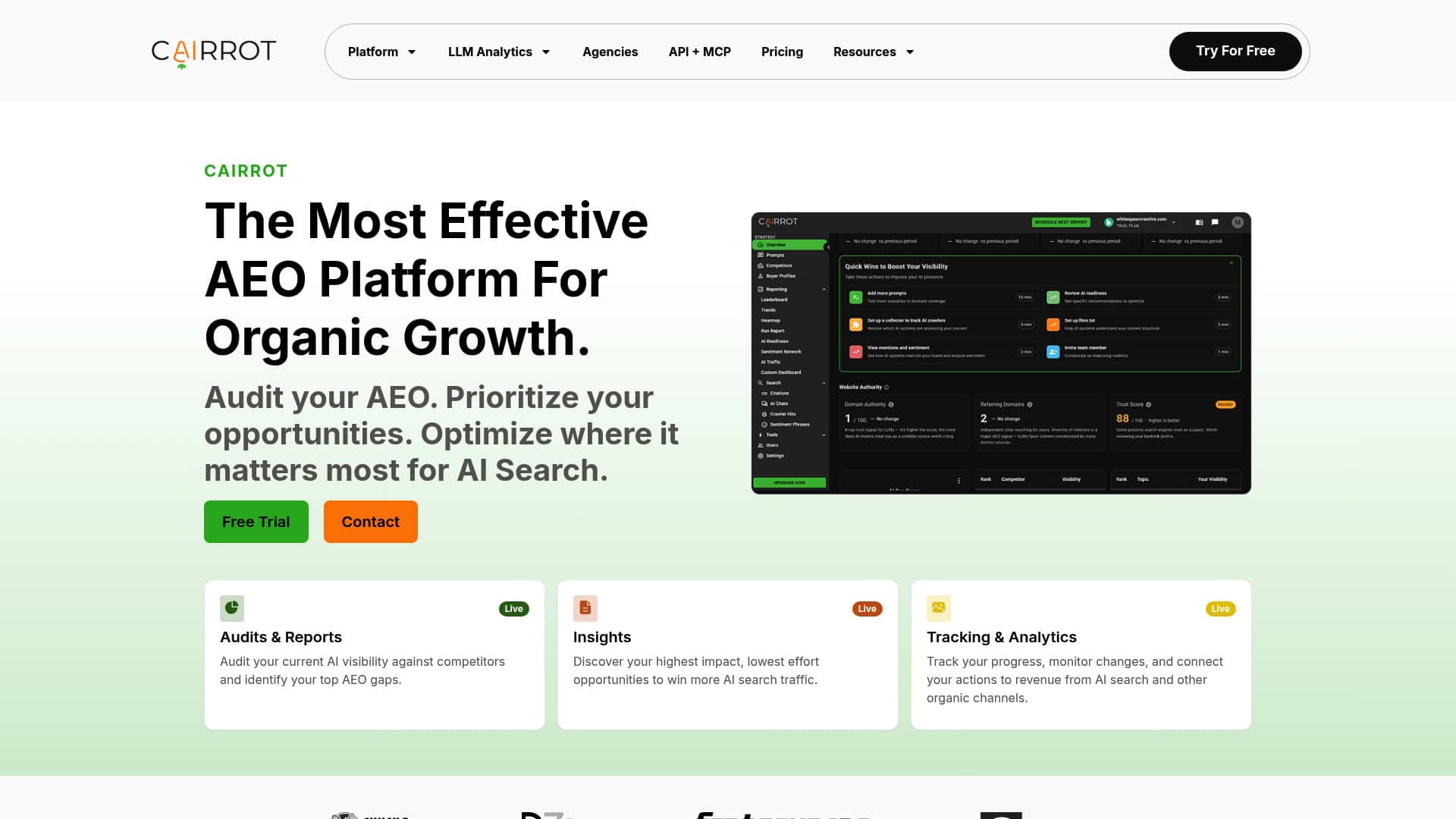
Plans start with Starter at $39 a month, with Pro at $99 and Enterprise at $299 for larger teams running multiple clients. Visit our pricing page to start a guided audit today.
FAQ
What does “DeepSeek SEO” actually mean?
It means optimizing your content so DeepSeek’s AI-generated answers cite your page as a source, rather than optimizing for a traditional search ranking position. The core tactic is publishing short, answer-first content with explicit, crawlable source lines.
How long does it take to see results from DeepSeek optimization?
Results depend on your testing cadence and DeepSeek’s cache windows, but teams running consistent audit and optimization workflows commonly see measurable shifts within roughly 60 days. Expect to run repeated checks across several TTL windows before trusting any single result.
How can I confirm DeepSeek actually used my page?
Check the citations field and the executed search actions that DeepSeek-backed tools log, which show which pages were opened during answer construction, per the pi-deepseek-web-search documentation. This gives a stronger confirmation than citation text alone.
Does sentiment on sites like Reddit affect DeepSeek’s answers?
Sentiment on widely indexed community content can influence how an AI-synthesized answer frames a topic, since the model draws on language already circulating about it. Monitoring sentiment on platforms like Reddit and YouTube helps you catch and correct negative framing before it shapes an answer.
What’s a quick first step for a team new to DeepSeek optimization?
Rewrite your highest-traffic page’s opening paragraph into a standalone 50 to 150 word answer with a clear source line beneath it, then test it against your baseline. That single change is often enough to start showing up in citation checks within a few test cycles.
Sources
Recommended
- Earn AI Citations in 60 Days: 8 Step AEO vs SEO Checklist for SEOs
- Best AEO Strategies 2026 (Based on Data and Anecdotes)
- Agencies: Turn Bing Webmaster Tools AI Into a 60 Day AEO Playbook
- Fix the 5 AI SEO Failures Blocking Citations for SEO Teams in 60 Days
