
Yes, schema for AI belongs on every technical SEO roadmap, but it will not single-handedly earn you citations in ChatGPT, Perplexity, or Google’s AI Overviews. Your first move: deploy Article, Organization, and Person schema with stable @id values and sameAs links, then confirm every field matches what a visitor actually sees on the page. Everything after that is measurement and editorial improvement.
TL;DR:
- Schema markup provides AI systems with entity disambiguation but cannot create credibility or increase citations without existing site authority and high-quality content.
- The most effective schema types for AI visibility are Article, Organization, and Person, especially when paired with stable
@idvalues andsameAslinks to external authoritative IDs.- Proper implementation requires server-side JSON-LD injection, validation, and consistent, verified data matching the visible page content to avoid misinformation and technical errors.
- Schema’s influence on AI citations remains unpredictable, with data showing no clear overall benefit unless combined with strong editorial and trust signals.
- The future of schema for AI emphasizes interconnected entity graphs, persistent identifiers, and structured data for datasets and relationships, alongside dedicated measurement tools.
Table of Contents
- What Schema for AI Actually Does (Role and Limits)
- Key Schema Types That Matter for AI Visibility
- How AI Engines Consume Schema
- Practical Implementation Checklist for AI Schema
- What the Evidence Actually Shows About Schema and AI Citations
- Advanced Tactics: Entity Graphs and Dataset Publishing
- How Schema Shapes AI-Generated Summaries
- Do Google and Bing Treat Schema the Same Way?
- Common Schema Mistakes That Hurt AI Visibility
- Where Is Schema for AI Standards Heading Next?
- Practitioner Perspective: Schema Verifies, It Doesn’t Persuade
- Turn Your Schema Work Into Measurable AI Visibility
- Sources
- FAQ
What Schema for AI Actually Does (Role and Limits)
Schema markup gives AI engines a shortcut for entity disambiguation. It tells a crawler that “Patrick McAvoy” the author is the same “Patrick McAvoy” referenced elsewhere, that your organization is distinct from a similarly named competitor, and that a given block of text is a discrete, extractable answer unit rather than a fragment of surrounding prose. That’s the mechanism, and it’s a real one.
The limit is just as real. AI engines rely heavily on index enrichment and editorial trust signals, not a live read of your JSON-LD every time a query comes in. Search Engine Land’s own analysis of how schema markup fits into AI search makes the point plainly: if your page lacks topical authority to begin with, schema cannot manufacture it. Think of schema as a floor, not a ceiling. It removes ambiguity for a machine that already has some reason to consider you credible. It does not create that credibility from nothing.
The practical implication for anyone allocating a quarterly SEO budget: technical markup earns its keep fastest when paired with primary-source content, named expertise, and consistent facts across the web. Skip that pairing and you’re polishing a floor nobody walks on.
Key Schema Types That Matter for AI Visibility
Not every schema type carries equal weight for AI-driven surfaces. Match the type to the content format, not the other way around.
- Article, Organization, and Person form the non-negotiable baseline for any editorial page. Multiple industry sources point to this trio as the mandatory floor for AI visibility, with Person schema plus
sameAslinks doing the heaviest lifting for author verification. - FAQPage and HowTo map directly onto the conversational, step-based queries AI assistants field constantly. If your content already answers a question in prose, structuring it this way makes the answer easier to lift cleanly.
- Product schema serves commerce pages where price, availability, and reviews need to be machine-readable for shopping-adjacent AI queries.
- Dataset schema matters more than most SEOs assume. Pages publishing original datasets with proper Dataset markup and machine-readable downloads get cited at a notably higher rate on data-focused engines like Perplexity, according to recent schema stack benchmarks.
- Speakable and VideoObject round out the set for voice assistants and video-heavy AI summaries, flagging which sections are built for audio delivery or timestamped video retrieval.
Pick two or three that match your actual content mix. Deploying all seven types across a blog that publishes neither data nor video wastes engineering time.
How AI Engines Consume Schema
Here’s the part most teams get wrong: AI engines generally don’t parse your JSON-LD in real time the moment a user asks a question. They consume pre-built, index-enriched knowledge graphs assembled well before that query ever happens. Your schema feeds that enrichment process on a crawl and indexing cycle, not on demand.
That changes how you should think about @id and sameAs. An @id value acts as a stable, unique anchor for an entity across every page where it appears. Reuse the same @id for your organization on every page rather than letting an emulating system generate a new one per URL. Pair it with sameAs links to your Wikipedia page, Wikidata entry, and verified social profiles, since entity linking to global knowledge bases is what actually helps disambiguation, not the mere presence of a script tag.
One more mechanical detail that trips up a surprising number of otherwise sharp technical teams: many AI crawlers do not execute JavaScript. If your JSON-LD gets injected client-side after page load, a non-JS agent may never see it. Server-side rendering of your structured data isn’t a nice-to-have here. It’s the difference between a crawler reading your entity data and skipping it entirely.
Practical Implementation Checklist for AI Schema
Treat this as a build order, not a wish list. Each step depends on the one before it.
- Select schema types by content format, not by what a competitor happens to use. An FAQ page gets FAQPage; a recipe gets HowTo; a research page gets Dataset.
- Write JSON-LD and inject it server-side. Avoid tag-manager based client-side injection for anything you need AI crawlers to reliably see.
- Mirror every schema field in the visible page content. If your markup claims an author, a price, or a rating that a human visitor can’t find on the page, you risk a policy violation and you’re feeding AI extractors information a reader can’t verify.
- Assign stable
@idvalues and linksameAsto authoritative external IDs like Wikidata, official social profiles, or a Wikipedia entry. - Validate before you ship. Run every template through Validator and Google’s Rich Results Test, checking required fields and syntax.
- Start with one page, one template. Validate it fully, confirm it renders correctly, then scale the pattern site-wide. Search Engine Journal’s guidance on becoming a trusted source is blunt about this: a single scaled error propagates across thousands of pages faster than you can catch it manually.
- Add CI checks and quarterly parity audits so a CMS update or template change doesn’t silently break your markup six months from now.
Pro Tip: Build a staging environment schema validation step into your deploy pipeline. Catching a broken @id reference before launch costs five minutes; catching it after Google has indexed 10,000 pages with it costs a full re-crawl cycle.
What the Evidence Actually Shows About Schema and AI Citations
The research here genuinely conflicts, and pretending otherwise does you no favors. Ahrefs ran a matched test across 1,885 pages comparing pages with and without JSON-LD structured data. The result: no measurable increase in AI citations overall, and a slight decline in some AI Overviews datasets. Meanwhile, other industry benchmarks claim measurable lifts, particularly for Dataset schema on data-heavy queries.
Both can be true at once. Study design, existing site authority, and query type all shift the outcome, and a page that already ranks well tends to show smaller marginal gains from adding markup than a page starting from zero. The same CMSWire analysis found that editorial signals like named expert quotes and branded mentions correlated more strongly with AI visibility than schema alone.
Measure your own results instead of trusting either camp blindly:
- Run engine-specific probes across ChatGPT, Perplexity, and Google AI Overviews for your target queries before and after implementation.
- Hold out control pages without new markup to isolate the schema variable.
- Combine GA4, Search Console, and crawler log data to see whether AI-referral traffic shifts alongside your rollout.
Advanced Tactics: Entity Graphs and Dataset Publishing
Once the baseline is live, the next tier of leverage comes from thinking in graphs, not isolated tags. Use @graph to connect every entity on a page, your organization, its authors, its products, into one interlinked structure rather than dropping disconnected JSON-LD blocks that never reference each other. This is the core technical value schema provides for AI search: relationship mapping, not decoration.
Add knowsAbout properties tied to Wikidata IDs to explicitly assert topical coverage. If your organization genuinely has depth in a subject, this property gives that claim a structured, verifiable form rather than leaving it to inference from your content alone.
If you produce original research, publish it with Dataset schema and a genuine machine-readable download, CSV or JSON, not just a PDF wrapped in a schema tag. That combination measurably increases citation odds on data-oriented engines, since machine-readable formats with license metadata are exactly what those systems are built to ingest.
None of this survives sloppy governance at scale. Run CI checks on every template change, validate in staging before production, and schedule periodic parity audits comparing your schema output against what actually renders on the live page. Scaling errors compound; a mistake in your organization template touches every page that inherits it.
How Schema Shapes AI-Generated Summaries
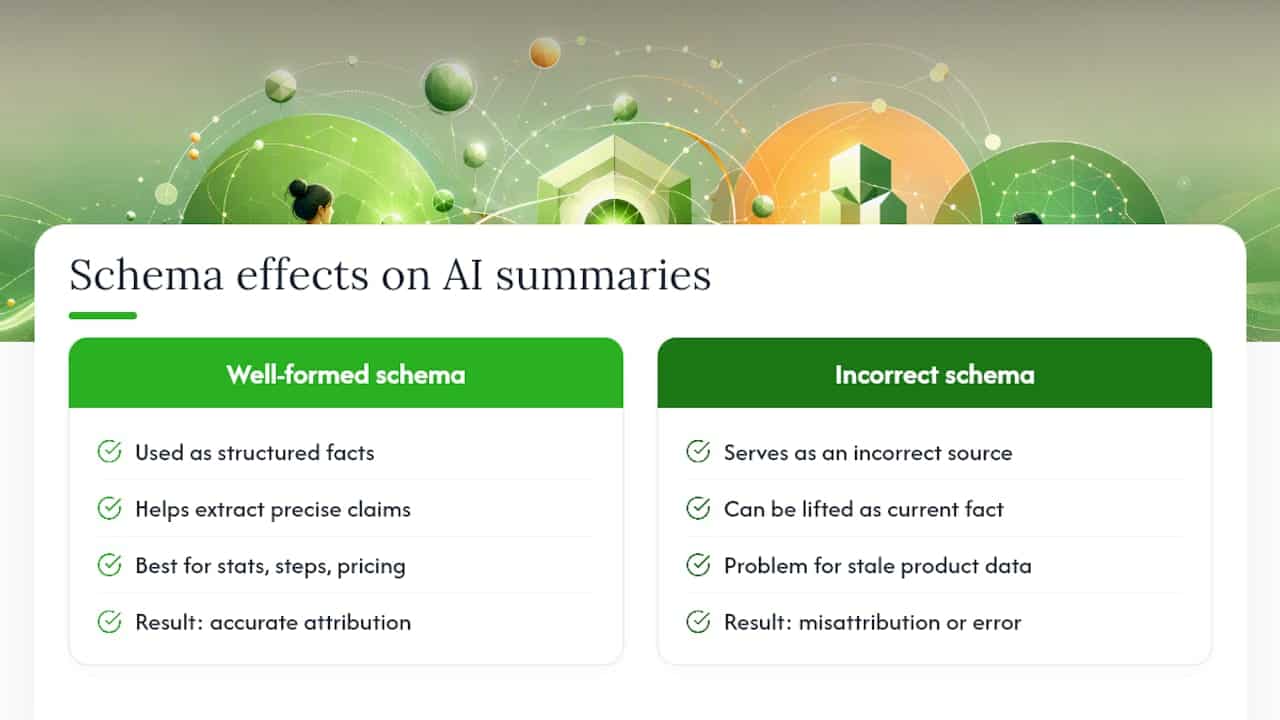
When an AI system generates a summary or answer, it’s frequently pulling from pre-processed, structured representations of your content rather than reading raw HTML on the fly. Well-formed schema increases the odds that the specific fact, statistic, or definition you intended to be extracted is the one that actually gets pulled, rather than a paraphrased or subtly wrong version assembled from surrounding text.
This matters most for content with precise, quotable claims: statistics, step counts in a process, pricing, or named credentials. An Article schema with a clearly marked headline, datePublished, and author gives a summarization system less room to misattribute your content or strip context that changes its meaning. FAQPage markup does something similar for question-and-answer content, making individual Q&A pairs easy to lift as standalone units instead of forcing an engine to guess where one answer ends and the next question begins.
The flip side deserves equal attention. Treating schema as an API for AI extractors, in the sense that correctly implemented structured data removes guesswork, also means incorrect or stale schema actively misleads those same extractors. A Product schema showing a price you changed six months ago doesn’t just confuse a human visitor who notices the discrepancy. It can get surfaced by an AI summary as current fact, creating a credibility problem you didn’t know existed until a customer complains. Parity between markup and visible content isn’t a compliance checkbox; it’s what keeps AI-generated summaries of your content accurate.
Do Google and Bing Treat Schema the Same Way?
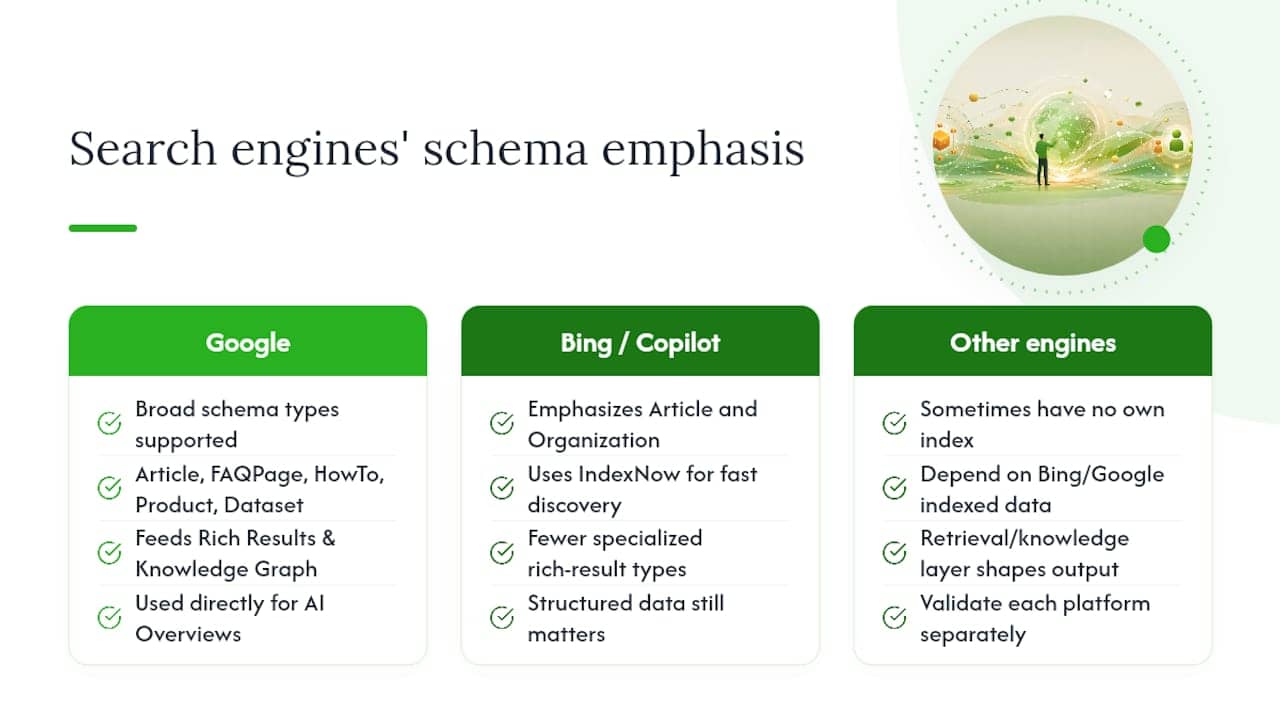
Not quite, though the differences are more about emphasis than fundamentally different rules. Google has spent over a decade building Rich Results and its Knowledge Graph around Schema.org vocabulary, and that infrastructure now feeds AI Overviews directly. Google’s systems tend to reward the full range of schema types, Article, FAQPage, HowTo, Product, Dataset, because each maps to a specific rich result or Overview format Google has already built tooling around.
Bing, which powers Copilot’s underlying search layer, has historically leaned more heavily on straightforward Article and Organization markup plus its own IndexNow protocol for fast content discovery. Structured data still matters there, but the ecosystem of specialized rich result types is thinner than Google’s.
Engines without their own search index, like ChatGPT when it isn’t invoking a live browsing tool, depend even more on whatever knowledge graph or retrieval layer sits behind them, which may itself be built from Bing or Google’s indexed data. That’s an important nuance for AEO planning: optimizing your schema for Google’s Rich Results Test doesn’t automatically optimize you for every AI surface built on top of a different underlying index. Treat each major platform, Google, Bing and its Copilot integration, and any engine with its own crawler, as needing its own validation pass rather than assuming one clean implementation covers all of them equally.
Common Schema Mistakes That Hurt AI Visibility
The most frequent failure isn’t a syntax error. It’s a mismatch between what the schema claims and what the page actually shows, an author name in the markup that doesn’t appear anywhere in the visible byline, a rating that doesn’t match the review widget, a price that’s stale. That mismatch doesn’t just risk a manual action; it undermines the entire premise of using schema as a verification layer for AI systems.
Duplicate or unstable @id values are the second most common problem, usually introduced when a CMS auto-generates a new identifier every time a page template updates. That breaks the entity continuity that makes @id useful in the first place.
Client-side-only JSON-LD injection remains widespread, particularly on sites built with heavier JavaScript frameworks, and it silently excludes any AI crawler that doesn’t render JavaScript. Missing or incomplete required fields, a Person schema with no sameAs, an Article with no datePublished, quietly reduce how useful the markup is even when it validates without errors.
And then there’s scale without governance: one broken field in a global template multiplied across ten thousand pages. Run Validator and Google’s Rich Results Test on every template before it ships, not just once at launch, and build a recurring audit into your workflow rather than treating validation as a one-time task.
Where Is Schema for AI Standards Heading Next?
Schema.org vocabulary itself continues to expand, with new and refined types appearing regularly to cover AI-specific use cases that didn’t exist when the vocabulary was first drafted for traditional search. Expect continued growth in types that support dataset provenance, licensing metadata, and claim verification, since AI engines increasingly need machine-readable signals about where a fact originated and whether it can be trusted.
The bigger shift is architectural. As more AI systems build their answers from pre-enriched knowledge graphs rather than live page parsing, the value of consistent, sitewide entity linking, the same @id, the same sameAs targets, repeated correctly across every page, will likely keep growing relative to the value of any single page’s markup in isolation. Organizations that treat their entity graph as an evolving asset, not a one-time implementation project, are better positioned as this shift continues.
Expect measurement standards to mature too. Right now, teams largely improvise their own tracking for AI citation impact because no universal analytics standard exists yet for it. Tools built specifically for AI visibility tracking, rather than repurposed traditional SEO tools, are likely to become the norm as AI-referred traffic becomes too significant for marketing teams to measure with guesswork.
Practitioner Perspective: Schema Verifies, It Doesn’t Persuade
Schema is necessary. It is not sufficient. Editorial signals, named experts, primary-source data, mentions earned rather than engineered, still decide which candidates an AI engine trusts enough to cite. Schema just makes your candidacy legible once you’ve earned it.
The practical move is to instrument everything: track citations, measure downstream conversion, iterate on what the data shows rather than what feels intuitive. Platforms built for monitoring AI citation and mention data exist precisely because guessing at AI visibility no longer scales for teams managing more than a handful of pages.
— Dr. Patrick McAvoy
Turn Your Schema Work Into Measurable AI Visibility
Getting Article, Organization, and Person schema validated and live is table stakes. Knowing whether it moved the needle in ChatGPT, Perplexity, or Google’s AI Overviews is a different problem entirely, and it’s the one most teams can’t solve with a validator alone. Cairrot was built for exactly this gap: audit your current AEO performance, benchmark against competitors, and track sentiment across AI platforms and channels like Reddit and YouTube in one place. Users typically see measurable results within a few months of implementation. If you’re ready to stop guessing whether your schema investment is paying off, explore Cairrot’s AEO platform and see what your current AI visibility actually looks like.
Sources
- Does Structured Data Actually Improve Answer-Engine Citations? – CMSWire
- How schema markup fits into AI search — without the hype – Search Engine Land
- Schema for AI citations: How to become a trusted source – Search Engine Journal
- Schema.org validator
FAQ
What Is the 30% Rule for AI?
There’s no universal, standardized “30% rule” in AI or schema implementation; the phrase shows up informally in different contexts with different meanings, so treat any specific version you encounter with caution unless it’s tied to a named, sourced study.
What Are the Four Types of Schema?
In database and data modeling contexts, the four commonly referenced schema types are conceptual, logical, physical, and external schema, but for web content, the relevant categories are markup types like Article, Organization, Person, and FAQPage, each serving a different content format.
What Are the Seven Branches of AI?
AI is commonly broken into branches including machine learning, natural language processing, computer vision, robotics, expert systems, fuzzy logic, and neural networks, though different sources group and count these branches differently.
What Is an Example of a Schema?
A simple example is Article schema on a blog post: JSON-LD markup specifying the headline, author, datePublished, and publisher, giving search engines and AI systems a structured, unambiguous version of information already visible on the page.
Does Adding Schema Guarantee More AI Citations?
No. Ahrefs’ matched test of 1,885 pages found no measurable citation increase from JSON-LD alone, meaning schema works best as a verification layer alongside strong editorial content, not as a standalone citation tactic.
Recommended
- AI Search
- Best AEO Strategies 2026 (Based on Data and Anecdotes)
- Answer Engine Optimization and Generative Engine Optimization
