
The single most important move in AI SEO is doubling down on fundamentals: crawlable technical infrastructure, unique expert content, and short answer passages AI engines can lift cleanly. Google’s own guidance backs this, as does the shift toward measurable citation tracking. Skip the chunking tricks and synthetic-mention chasing. They waste budget that fundamentals would spend better.
TL;DR:
- Ensuring AI crawlers can access your content and structuring answer-first passages are the top priorities for improving AI visibility and citation potential.
- Building content around verified expertise, proprietary data, and clear author attribution enhances the likelihood of AI engines citing your pages.
- Implementing server-rendered schema, especially FAQ and HowTo markup, is crucial, as client-side schema remains invisible to most AI crawlers.
- Regularly monitoring AI references through server logs, citation tracking tools, and share of voice metrics enables effective measurement and quick adjustments within a 60-day window.
- Avoid reliance on low-value hacks like content chunking or artificial mentions and focus instead on technical fixes, quality content, and ethical optimization practices.
Table of Contents
- AI SEO Best Practices Ranked by Impact
- What Technical Checks Actually Block AI Crawlers
- Writing Content AI Engines Actually Want to Cite
- Getting Schema Right for AI Extraction
- How to Measure AI and LLM Visibility
- Which AI Engines Reward Which Signals
- How Cairrot Fits Into This Workflow
- Using AI Content Tools Without Triggering Quality Penalties
- Avoiding AI Content Manipulation and Staying Ethical
- Keeping Content Current as AI Algorithms Shift
- Where AI SEO and Voice Search Overlap
- Using AI Tools for Keyword Research and Content Gaps
- What I’d Tell a Team Starting From Zero
- Turn This Checklist Into Measurable AEO Results
- Sources
- FAQ
AI SEO Best Practices Ranked by Impact
Not every tactic deserves equal attention, and treating them that way is how teams burn a quarter on low-value experiments. Here’s the order we recommend, based on where AI visibility actually breaks down first.
- Fix crawlability and write answer-first passages. Before anything else, confirm AI crawlers can reach your content and that your H2s answer the implied question in the first sentence beneath them. This is the highest-leverage fix because it’s binary: either the bot can read it or it can’t.
- Build content around E-E-A-T signals. Add a real byline, a credential line, and evidence no competitor can copy. Case studies and proprietary data beat generic explainer paragraphs every time an AI model chooses what to cite.
- Add schema and server-render it. JSON-LD that only loads after JavaScript execution is invisible to most AI crawlers. Move it into the initial HTML response.
- Stand up measurement before you scale. Track share of voice, watch server logs, and add GA4 custom dimensions for AI-referred traffic. Set a 0 to 12 week cadence: weeks 0 to 2 for crawl fixes, weeks 2 to 6 for schema and answer blocks, weeks 6 to 12 for measuring what moved.
- Deprioritize the hacks. Content chunking for chunk-retrieval gaming and manufacturing “mentions” through low-quality link networks are not worth the engineering hours. Google’s guidance explicitly discourages relying on AI-only tricks instead of content quality.
The prioritized checklist approach works better than scattered experimentation because it sequences topical authority before formatting, and formatting before distribution. Skipping steps just means redoing them later once you’ve already spent the budget.
What Technical Checks Actually Block AI Crawlers
Most AI visibility problems trace back to three technical issues, and none of them require a rebuild to fix.
- Robots.txt gaps. Confirm you’re not blocking GPTBot, ClaudeBot, PerplexityBot, or Google-Extended unless you have a specific reason to exclude one. Check server logs weekly to see which agents are actually hitting your pages.
- Client-side rendering. Many AI crawlers don’t execute JavaScript reliably, so content that only appears after a script runs might as well not exist to them. Server-side rendering or static generation is the safer default for anything you want cited.
- Sitemap and canonicalization hygiene. Duplicate URLs and inconsistent canonical tags confuse retrieval systems trying to identify the authoritative source.
- Raw HTML inspection. View source, not the rendered DOM, to see what a crawler actually receives.
Pro Tip: Fetch your top pages as GPTBot, ClaudeBot, and Google-Extended user agents and check whether the answer sentence and schema appear in the raw HTML response. If they don’t show up there, no AI engine can extract them, no matter how good the visible page looks.
Writing Content AI Engines Actually Want to Cite
AI engines prefer content that answers a question in one sentence and then proves it. Bury the answer under three paragraphs of preamble and most retrieval systems move to a competitor’s page instead.
Structure every section as a question-shaped heading, followed by a direct answer sentence, then three to five sentences of evidence with an explicit source. That format lets each section stand alone as a quotable unit, which is exactly how extraction works in practice.
- Lead with the answer, not the setup.
- Back it with firsthand examples, proprietary data, or a named case study, not recycled explainer text.
- Add a visible author byline, credentials, and a review date to signal expertise.
- Break long topics into independently quotable question-shaped H2s instead of one sprawling section.
Commodity content, the kind that reads like ten other articles on the same query, rarely gets cited even when it ranks. Distinctiveness is what earns the pull quote.
Getting Schema Right for AI Extraction
Schema only helps if the AI engine can see it, which means it belongs in the server-rendered HTML, not a client-side injection.
- Use
Article,FAQPage,HowTo, andOrganizationJSON-LD depending on content type, and confirm each renders in the initial page load. - Format answer passages as short, standalone blocks directly beneath question-shaped headings so schema and visible text reinforce each other.
- Apply FAQ schema to conversational queries readers actually type into AI chat interfaces, and HowTo schema for step-based tasks.
- Validate with the Schema Markup Validator, then confirm with a fetch-as-bot test to see what a crawler receives.
How to Measure AI and LLM Visibility
You can’t optimize what you can’t see, and most teams are flying blind on AI citations right now.
- Track share of voice for your prioritized queries across the AI engines your audience actually uses.
- Monitor server logs for GPTBot, ClaudeBot, and PerplexityBot hits, and layer in GA4 custom dimensions for AI-referral traffic.
- Watch branded homepage searches in Search Console as a proxy signal. A spike often correlates with a citation surge somewhere upstream.
No single tool captures every AI citation on its own. Layering server logs, dedicated AI-visibility tracking, and GA4 gives you triangulated confidence instead of a partial picture from one source. Run this on the same 0 to 12 week cadence as your technical fixes: baseline in weeks 0 to 2, implement in weeks 2 to 6, measure and adjust from week 6 onward.
Which AI Engines Reward Which Signals
Not every AI surface weighs the same factors, so a single tactic rarely wins everywhere at once.
- ChatGPT and Bing favor short, extractable answers paired with citations from high-authority sources.
- Perplexity leans toward freshness and dense source lists. Recent news and Reddit threads carry real weight here.
- Google AI Overviews still run on traditional ranking signals plus schema and author credibility. This is the least novel surface of the five.
- Claude and Grok tend to favor primary-source content, clean HTML structure, and, where relevant, social posts that add firsthand commentary.
Building primary-source authority through digital PR and third-party mentions on outlets AI models already trust, like Wikipedia and reputable publications, pays off across all five engines simultaneously.
How Cairrot Fits Into This Workflow
Most of what’s above requires visibility into what’s currently broken, and that’s the part teams underestimate. You can’t fix crawlability gaps or missing answer passages you haven’t found yet.
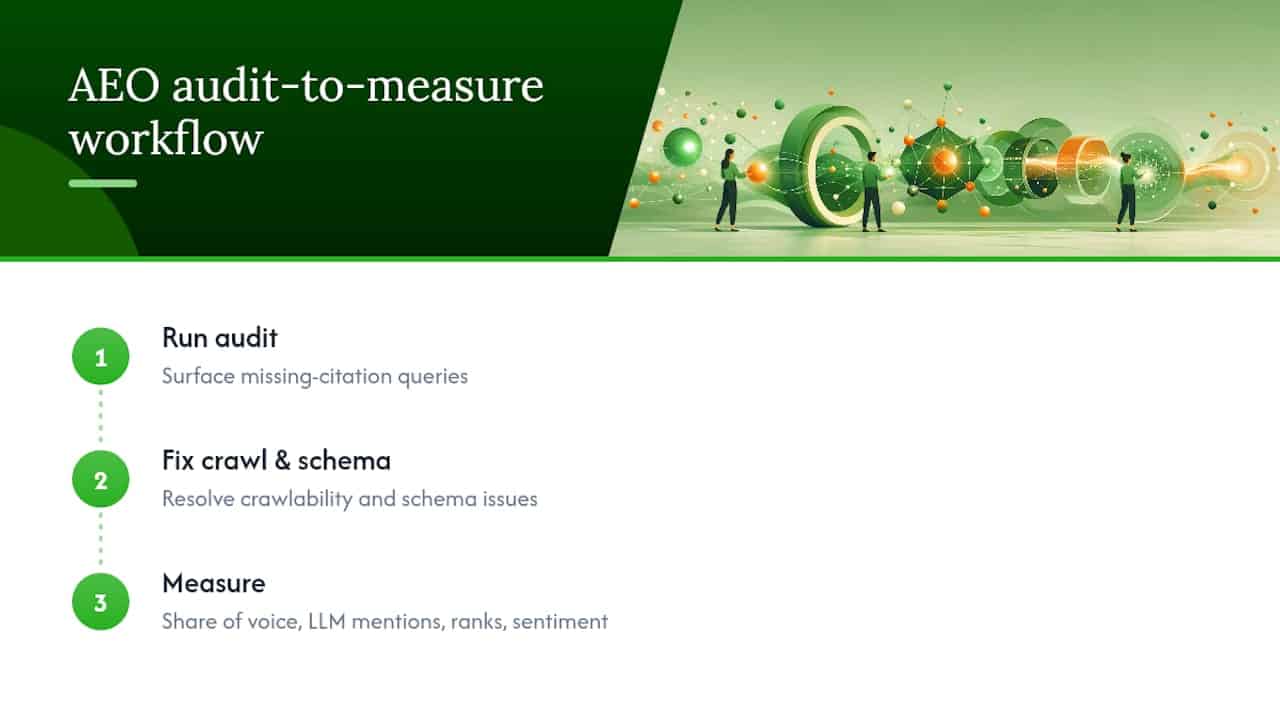
The practical workflow looks like this: run an audit to surface missing-citation queries, fix the crawl and schema issues those queries expose, then measure whether share of voice actually moved. Cairrot’s LLM citation and mention tracking covers the measurement half directly, alongside rank tracking across engines like DeepSeek and sentiment monitoring on Reddit, where a lot of AI-trusted mentions originate.
Pro Tip: Run your audit before you touch a single content brief. Fixing schema on pages nobody’s citing wastes the same hours you’d spend fixing the five pages actually blocking your visibility.
Teams using this audit-first sequence typically see measurable AEO movement within 60 days, which lines up with the 12-week fix-and-measure cadence outlined above.
Using AI Content Tools Without Triggering Quality Penalties
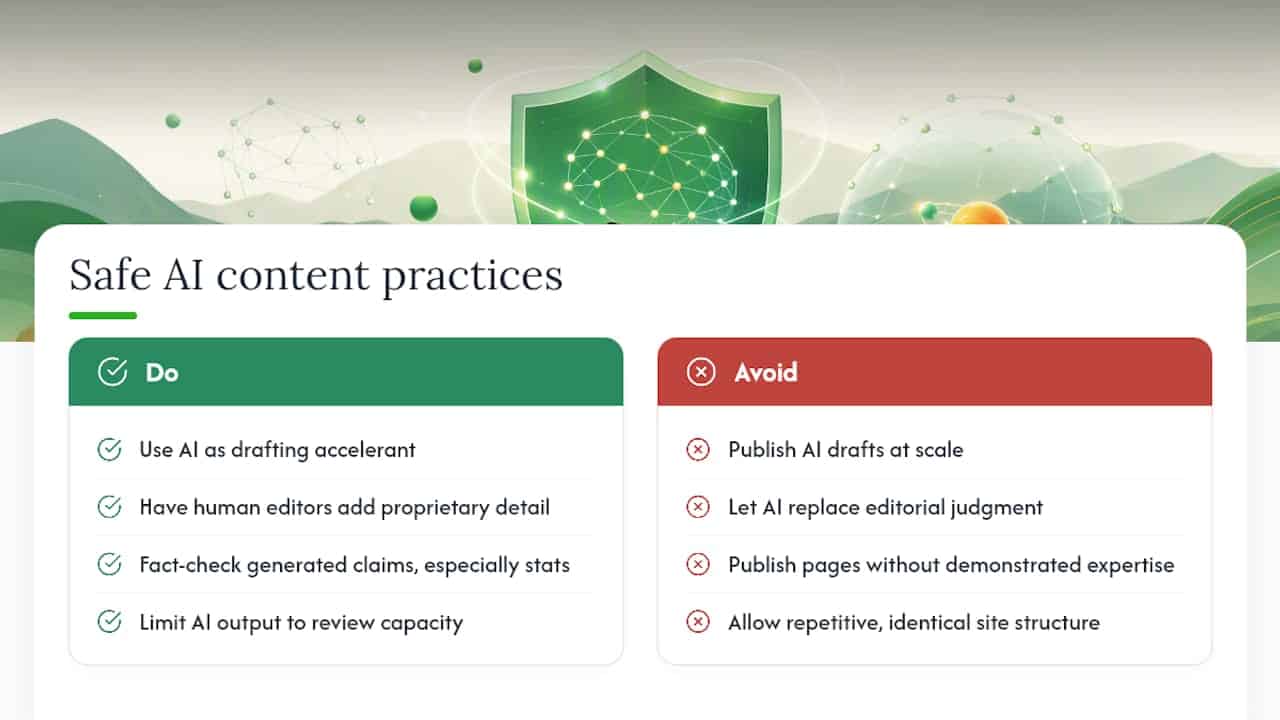
AI-assisted drafting is now standard in most content operations, but the line between “AI-assisted” and “AI-generated slop” is where penalties live. Google doesn’t penalize AI-assisted content outright. It penalizes content that’s unoriginal, unhelpful, or produced at scale purely to manipulate rankings.
The safest approach treats AI tools as a drafting accelerant, not a replacement for editorial judgment. Have a human editor add the proprietary detail, the firsthand example, or the contrarian take that an AI model can’t invent on its own. Fact-check every generated claim before publishing, especially statistics, since language models fabricate numbers with total confidence.
Avoid publishing AI drafts at a volume that outpaces your ability to review them. A hundred thin AI-written pages will get flagged faster than ten well-edited ones. If your content team can’t explain what expertise a page demonstrates, that page probably shouldn’t go live yet.
Watch for repetitive phrasing patterns across your site, too. AI models trained on similar prompts tend to produce structurally identical output, and search engines increasingly recognize that fingerprint across a domain. Vary structure deliberately, and don’t let every article follow the exact same section shape.
Avoiding AI Content Manipulation and Staying Ethical
There’s a meaningful difference between optimizing for extraction and manipulating AI systems into citing content that doesn’t deserve it. The industry needs to hold that line, because the backlash from crossing it lands on everyone.
Fabricating statistics, inventing expert quotes, or manufacturing fake “Reddit consensus” to game sentiment signals isn’t a growth hack. It’s misinformation with a marketing budget behind it, and AI engines are getting better at cross-referencing claims against primary sources to catch exactly this.
The same applies to buying mentions on forums or review sites purely to inflate perceived authority. AI models increasingly weigh source diversity and mention authenticity, so synthetic buzz tends to get discounted rather than rewarded once detected.
The more durable path is straightforward: publish claims you can actually back, disclose AI assistance where it’s material to trust (medical, financial, or legal content especially), and never let a model generate a statistic you haven’t verified against a real source. Readers and AI systems both eventually catch inflated claims, and once a domain loses credibility with a model’s training or retrieval process, it’s slow to earn back.
Keeping Content Current as AI Algorithms Shift
AI search ranking signals move faster than traditional SEO ever did, and content that was extractable six months ago can quietly lose citations without any change on your end.
Build a review cadence into your content calendar rather than treating updates as an afterthought. Quarterly reviews of your highest-traffic and highest-citation pages catch drift before it compounds. Check whether the answer passage still matches current best practice, whether the schema still validates, and whether competitors have published something more citable on the same query.
Watch AI engine documentation directly. Google publishes evolving guidance on what its AI features prioritize, and providers like OpenAI and Anthropic periodically update how their crawlers behave. A robots.txt rule that worked in January can silently stop working after a crawler update.
Prioritize updates on pages showing citation decline over pages that never had traction, since a page losing visibility signals an active problem more urgent than one that simply hasn’t hit yet. Tie the update cadence to your measurement dashboard: if share-of-voice tracking shows a query cluster fading, that cluster jumps the queue for a content refresh regardless of your original publishing schedule.
Where AI SEO and Voice Search Overlap
Voice search and AI SEO converge on the same underlying requirement: content structured to answer a specific spoken question in a sentence or two. That overlap makes most of the work here dual-purpose.
Conversational queries, the kind people speak into a phone or ask a smart speaker, tend to mirror the exact phrasing AI chat interfaces use. Optimizing answer passages for one format serves the other automatically. A page structured with question-shaped H2s and one-sentence direct answers underneath is already voice-search ready, because that’s precisely the format assistants extract from.
FAQ schema does double duty here as well. It’s the same markup that helps AI engines identify conversational answer pairs, and it’s the format voice assistants have historically pulled from for spoken responses. There’s no separate voice-search checklist to run. The fundamentals in this article cover both surfaces at once, which is one reason the “prioritize fundamentals” approach outperforms chasing platform-specific hacks.
Using AI Tools for Keyword Research and Content Gaps
AI tools have made content gap analysis faster, but they’re best used to surface questions, not to replace judgment about which ones matter.
Feed a large language model your competitor’s top pages and ask it to list questions those pages don’t answer clearly. It’s a fast way to surface content gaps that a manual audit might miss, especially across large sites. Cross-reference that output against real search demand rather than trusting the model’s phrasing at face value. AI models sometimes invent plausible-sounding queries nobody actually searches.
Pair that with actual query data from Search Console, showing what people already type when they land on your site, and layer in the conversational phrasing patterns showing up in AI chat referral traffic where you can capture it. The gap between those two datasets, questions people ask AI models versus questions your content currently answers, is usually where the highest-leverage new content lives.
Treat AI-generated keyword lists as a starting hypothesis, not a finished brief. Validate volume and intent before committing writing time, the same discipline good keyword research always required.
What I’d Tell a Team Starting From Zero
Start with crawlability, not content volume. Pick one topic cluster, confirm AI crawlers can actually reach and parse it, then rebuild the answer passages before you write a single new page. Everything else compounds from that fix.
Review monthly, not quarterly, for the first two cycles. AI visibility moves faster than traditional rankings, and waiting three months to check your work means missing the window to course-correct cheaply.
— Dr. Patrick McAvoy
Turn This Checklist Into Measurable AEO Results
Cairrot exists so you’re not running this audit-and-measure workflow by hand across spreadsheets and disconnected log files. Instead of stitching together server logs, a rank tracker, and a sentiment tool separately, you get citation tracking, LLM rank monitoring, and Reddit and YouTube sentiment in one dashboard built for exactly the 0 to 12 week cadence outlined above.
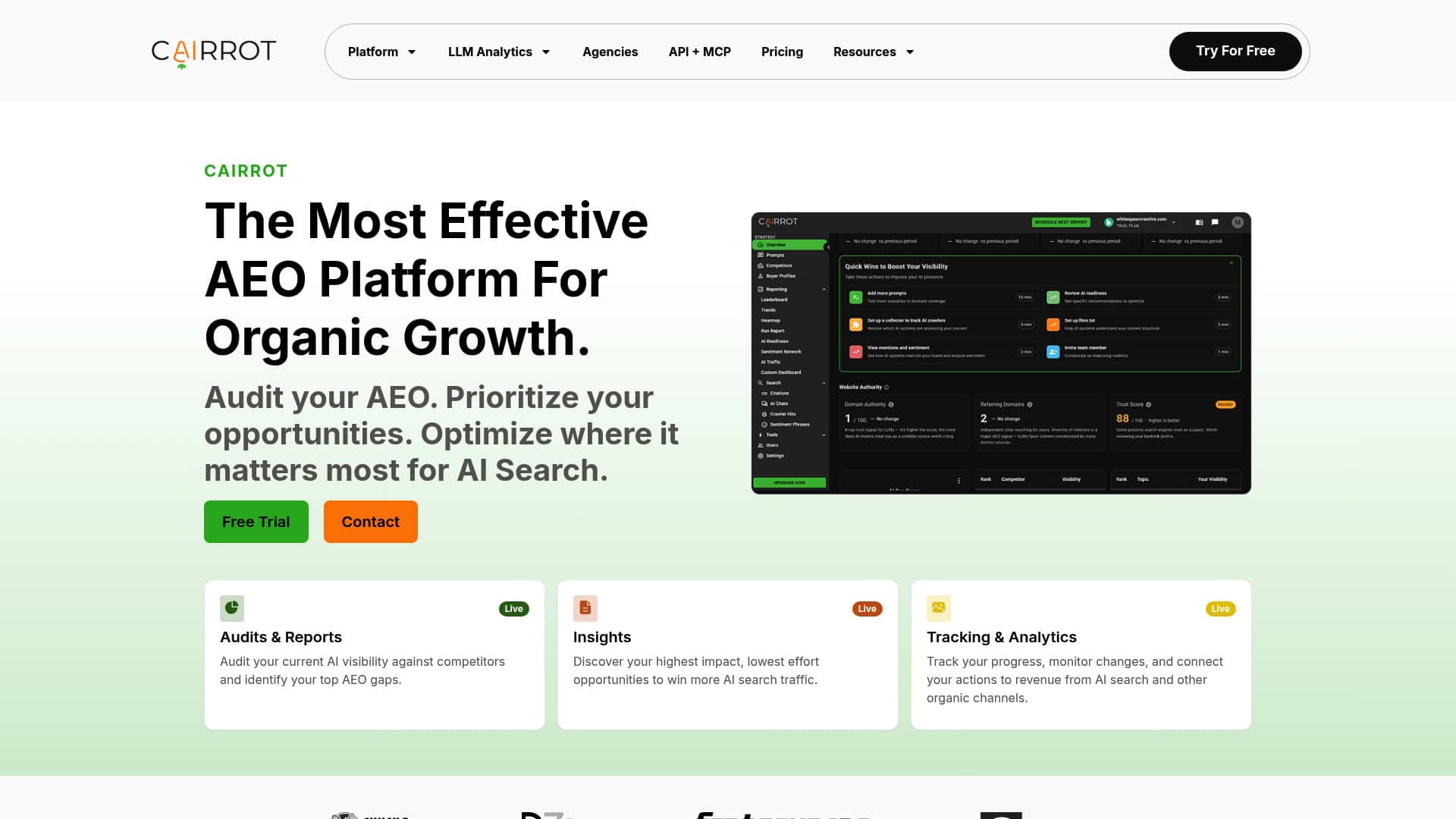
Agencies managing this across dozens of client sites benefit most from Cairrot’s agency-focused platform, which handles bulk reporting and client management without forcing your team to rebuild the same audit process for every account. If you’re running this solo for a single domain, the core platform covers the audit, prioritization, and measurement loop from day one.
Start with a free trial, run the audit on your highest-priority topic cluster, and see where your crawlability and schema gaps actually are before you spend another hour writing new content.
Sources
- Top ways to ensure your content performs well in Google’s AI experiences on Search
- Technical SEO for AI search: 4 fundamentals that matter
- AI SEO Checklist for 2026: 75+ Prioritized Tasks + Template
- SEO Strategy for AI Search 2026: The Complete Playbook | SEOScaleUp
FAQ
What Is the Single Highest-Priority AI SEO Fix?
Crawlability and answer-first content structure come first. If AI crawlers can’t parse your page or can’t find a direct answer sentence, nothing else on the checklist matters yet.
Do AI Crawlers Execute JavaScript?
Most AI crawlers, including GPTBot and ClaudeBot, don’t reliably execute JavaScript, so critical content and schema need to appear in the server-rendered HTML.
How Long Does It Take to See AI Visibility Results?
Following an audit-fix-measure cadence over 12 weeks, many teams see measurable share-of-voice movement within 60 days, consistent with typical AEO implementation timelines.
Should I Use AI Tools to Write My Content?
AI tools work well for drafting and gap analysis, but every generated claim needs human fact-checking, and published content needs a genuine expert layer AI alone can’t produce.
How Do I Track Citations Across Different AI Engines?
Layer server-log monitoring for crawler hits, GA4 custom dimensions for AI referral traffic, and a dedicated tool like Cairrot’s citation tracking, since no single method captures every citation on its own.
Does Schema Markup Actually Help With AI Citations?
Yes, when it’s server-rendered. FAQPage and HowTo schema in particular help AI engines identify conversational answer pairs and step-based content worth extracting.
Recommended
- Answer Engine Optimization and Generative Engine Optimization
- Best AEO Strategies 2026 (Based on Data and Anecdotes)
- Best AI SEO (AEO) Speakers and Influencers in 2026
- SEO Week 2026 Review: Best Speakers and Key Takeaways from NYC’s Top AI Search Conference
