Brand sentiment tracking is the continuous measurement of whether mentions of your company across the web skew positive, negative, or neutral. The immediate action for any marketing team without a program in place: turn on always-on monitoring today and define one primary sentiment KPI before adding more sources or dashboards. Cairrot is one platform built specifically to help teams do this, including inside AI outputs.
TL;DR:
- Layer two to three data sources, such as social platforms, review sites, and owned feedback, to gain a comprehensive and actionable view of brand sentiment.
- Regularly validate sentiment classification accuracy through human sampling and retrain models to prevent drift as language and context evolve.
- Prioritize real-time, always-on tracking with clear thresholds and escalation protocols to respond to negative sentiment spikes before they escalate.
- Consider sentiment measurement approaches that include mention-level polarity and aspect-based analysis to answer specific questions about brand perception.
- Focus on integrating sentiment data into broader marketing analytics to improve attribution and avoid misinterpreting isolated sentiment fluctuations.
Table of Contents
- What Brand Sentiment Is and Why It Matters as a KPI
- Where to Find Brand Sentiment Data
- How Do You Actually Measure Sentiment?
- What Should You Require From Sentiment Tracking Tools?
- How Do You Build an Always-On Tracking Program?
- Turning Sentiment Data Into Real Decisions
- Where Sentiment Analysis Gets It Wrong
- How Cairrot Approaches Sentiment Tracking
- Comparing Popular Sentiment Tracking Approaches
- Connecting Sentiment Data to Your Broader Analytics Stack
- What Are the Legal and Ethical Limits on Sentiment Data?
- A Practitioner’s Take on Where to Invest First
- Get Sentiment Tracking That Points Back to the Source
- Sources
What Brand Sentiment Is and Why It Matters as a KPI
Brand sentiment measures the emotional tone behind mentions of your company, not just how many mentions exist. That distinction separates it from share of voice, which counts volume regardless of tone, and from Net Promoter Score, which surveys intent to recommend rather than reading organic language people actually use. A brand can dominate share of voice during a product recall while sentiment collapses, and NPS surveys sent quarterly will miss that collapse entirely.
Sentiment functions as both a performance metric and an early warning system. Real-time monitoring lets teams detect negative spikes and react before issues escalate, which matters because reputational damage compounds fast once it starts trending. A single mishandled customer service exchange, screenshotted and shared, can move sentiment before your team even knows there’s a fire.
Three business outcomes tie directly to sentiment tracking:
- Reputation risk detection catches negative narratives forming in forums or review sites before they reach mainstream press.
- Churn signal correlation shows whether declining sentiment among existing customers precedes cancellation spikes.
- Campaign diagnostics reveal whether a new ad, product launch, or executive statement moved public opinion in the intended direction.
Periodic brand health surveys still have a place, but they’re retrospective. Sentiment tracking is diagnostic in real time, which is why marketing teams increasingly treat it as a standing KPI rather than an annual research line item.
Where to Find Brand Sentiment Data
Sentiment lives in a lot of places, and no single source gives you the full picture. Each channel comes with its own access rules, noise level, and blind spots.
- Social platforms (X, Instagram, TikTok, LinkedIn) offer volume and speed but limit historical data access and API rate limits, so plan for gaps rather than full archives.
- Review and retail platforms like Google Business Profile, Amazon, and Yelp deliver product-level sentiment tied to a purchase decision, which makes it more actionable than general chatter.
- News, blogs, podcasts, and forums, including Reddit, capture longer-form opinion and community consensus that social posts rarely show. Reddit tracking has become particularly valuable because Reddit threads now surface directly in Google results and get cited heavily by AI search engines.
- LLM outputs and video transcripts are the newest frontier. When someone asks ChatGPT or Perplexity to compare your brand to a competitor, the answer reflects a sentiment judgment, and YouTube tracking captures spoken opinion in reviews and unboxing videos that text scrapers miss entirely.
- Owned sources, including post-purchase surveys, NPS responses, and customer service transcripts, give you sentiment data you actually control and can segment by customer tier.
The practical move is layering two or three of these rather than chasing full coverage on day one. A partner guide on channel selection makes a similar case: breadth without prioritization just produces noise.
How Do You Actually Measure Sentiment?
Three measurement approaches dominate the market, and most serious tools blend them rather than picking one.
- Rule-based systems score text using predefined word lists and grammar patterns. They’re fast and transparent but struggle with sarcasm and slang.
- Machine learning classifiers trained on labeled examples generalize better across contexts but need retraining as language and slang evolve.
- Hybrid human-in-the-loop models route ambiguous cases to human reviewers, which is where most enterprise-grade accuracy actually comes from. Domain adaptation and language coverage remain necessary for reliable results across different sentiment-analysis approaches, whether rule-based, phrase-level, or deep learning.
Beyond picking an approach, decide whether you need mention-level polarity (is this post positive or negative?) or aspect-based sentiment (is this post positive about shipping speed but negative about price?). Aspect-based analysis costs more to build or buy but answers the “what specifically” question that mention-level scoring can’t.
Pro Tip: Don’t chase emotion detection (joy, anger, frustration) until your basic positive/negative/neutral classification is validated and stable. Adding granularity to an unreliable baseline just multiplies the noise.
Four metrics belong on every sentiment dashboard:
- Net sentiment score: positive mentions minus negative mentions, divided by total mentions.
- Sentiment ratio: the proportion of positive to negative mentions, useful for trend comparison over time.
- Sentiment velocity: the rate of change, which flags a brewing crisis faster than a static score does.
- Anomaly detection thresholds: automated flags when sentiment or volume deviates from a rolling baseline.
Enterprise platforms that combine behavioral panels with NLP claim high accuracy for their sentiment models, a reminder that model quality varies significantly by vendor and that you should ask for accuracy benchmarks before committing budget.
Validate accuracy on a recurring basis. Pull a random sample of classified mentions each month, have a human reviewer score them independently, and compare against the model’s output. Continuous retraining maintains accuracy as language and context shift, and a program that skips this step will quietly drift out of alignment with how people actually talk about your brand. Set your reporting cadence to weekly for operational teams and monthly for leadership, with alert thresholds tight enough to catch a real spike but loose enough that you’re not chasing false alarms daily.
What Should You Require From Sentiment Tracking Tools?
Not every sentiment tool covers the same ground, and the gaps usually show up after you’ve already signed a contract. Build your evaluation around five categories.
- Coverage: does the tool track social, reviews, news, and forums, plus LLM outputs and video transcripts? Historical depth matters too. A tool with only 90 days of backfill can’t show you a year-over-year trend.
- Accuracy features: custom lexicons for your industry’s jargon, sarcasm and emotion detection, and multilingual support if you operate across markets.
- Operational features: real-time alerts, anomaly detection, customizable dashboards, and API exports so your data doesn’t stay trapped in a vendor’s interface.
- Integrations: connections to ticketing systems, Slack or Teams for alert routing, BI tools for cross-functional reporting, and analytics platforms like GA4 and Search Console.
- Privacy and governance: clear PII handling policies and defined data retention periods, especially if you’re pulling from owned customer feedback channels.
Pro Tip: Ask any vendor for a live demo using your own brand name, not a generic sample dataset. How a tool handles your specific product jargon and known controversies tells you more than any feature list.
Cairrot builds coverage of LLM outputs, Reddit, and YouTube directly into its dashboards, which matters increasingly as AI search engines become a channel where brand mentions in AI responses shape public perception before a customer ever visits your website.

How Do You Build an Always-On Tracking Program?
Standing up a sentiment program isn’t a weekend project, but it doesn’t need to take a quarter either. Follow this sequence.
- Set objectives and thresholds. Define your primary KPI (usually net sentiment) and the specific threshold that triggers escalation.
- Choose sources and map gaps. Decide which channels matter most for your industry, then identify where you have no visibility at all.
- Build a taxonomy. Create tagging rules for themes, product lines, and known issue categories so mentions route correctly.
- Build the pipeline. Ingest data, normalize formats across sources, classify sentiment, and store results in a queryable format.
- Set dashboards and alerts. Configure real-time views for operational teams and summary views for leadership.
- Validate continuously. Run human review samples on a schedule and retrain models as needed.
- Write escalation playbooks. Document who gets notified, at what threshold, and what the first response step is.
Practitioners emphasize that sentiment tracking must be always-on and correlated with specific brand events like product launches or PR moments, rather than run as a periodic check-in. A ninety-day rollout gives you enough runway to calibrate without losing momentum.
Turning Sentiment Data Into Real Decisions
A sentiment dashboard with no attribution is just a number on a screen. The real work starts when you tie a spike or dip to a specific cause.
- Attribution first. Match the timing of a sentiment shift against your campaign calendar, PR activity, and any known incidents before assuming what caused it.
- Triage by urgency. A sudden negative spike tied to a service outage needs an immediate public response; a slow negative drift about pricing perception needs a longer-term product or comms fix.
- Route insights to the right team. PR handles reputational spikes, product teams handle recurring complaint themes, and campaign managers use sentiment shifts to judge whether creative resonated.
- Report to leadership with narrative, not just charts. A sentiment graph means little without the “why” attached. Pair the visualization with a short explanation of cause and recommended action.
Enterprise teams that skip attribution tend to over-react to noise and under-react to genuine trends, which wastes both budget and credibility with leadership.
Where Sentiment Analysis Gets It Wrong
Sentiment tools fail in predictable ways, and knowing the failure modes ahead of time saves you from trusting a bad signal.
- Sarcasm and irony routinely confuse rule-based and even some ML models, since “great, another delay” reads as positive without context.
- Domain-specific terms can flip meaning entirely. “Sick” is negative in a support ticket and positive in a product review.
- Platform sampling bias means API rate limits and access restrictions can skew your data toward whichever platforms are easiest to pull from, not necessarily where your customers are loudest.
- Language and cultural nuance get lost when models trained primarily on American English are applied to other markets without adaptation.
Pro Tip: Run a monthly spot-check where you manually read twenty mentions your tool classified as neutral. Neutral is where sarcasm and mixed sentiment tend to hide, and it’s the category most tools get wrong most often.
Mitigation comes down to the same practices covered earlier: human validation on a schedule, custom lexicons built for your industry, and ongoing model evaluation rather than a one-time setup and walk-away approach.
How Cairrot Approaches Sentiment Tracking
Cairrot treats sentiment tracking as core infrastructure for AI Engine Optimization, not a bolt-on feature. The platform tracks LLM citation and mention tracking across engines like ChatGPT, Gemini, Claude, and Perplexity, alongside dedicated Reddit and YouTube coverage that most general-purpose sentiment tools treat as an afterthought.
- Every sentiment score links back to its source mention, so a marketing team can see exactly which Reddit thread or YouTube review moved a number, not just that it moved.
- Real-time alerts flag anomalies as they happen rather than surfacing them in a weekly digest.
- Dashboards are built for AI-native visibility, tracking how models describe your brand relative to competitors.
Cairrot users typically see measurable AEO results within 60 days, a timeline that reflects how quickly always-on tracking surfaces actionable patterns once it’s properly configured. That traceability matters most during escalation: when a sentiment dip triggers a PR or product response, being able to point to the exact mentions behind the number is what turns a dashboard alert into a defensible decision.
Comparing Popular Sentiment Tracking Approaches
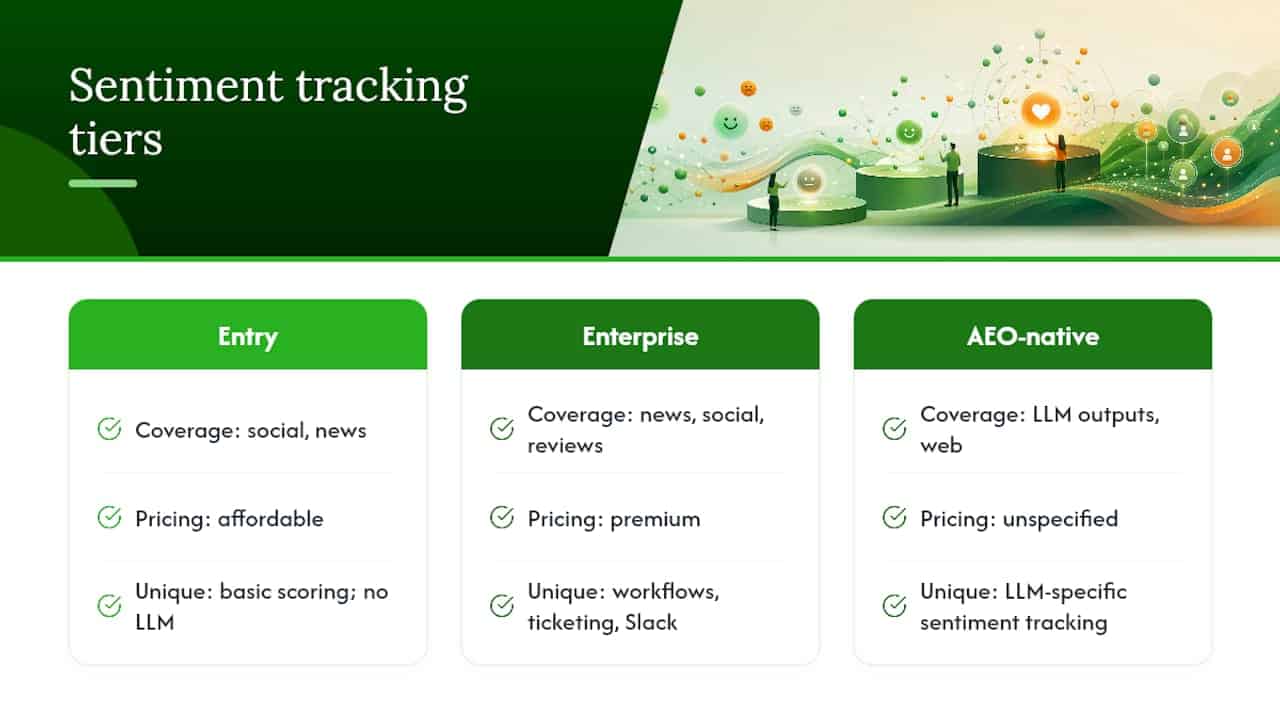
The sentiment tracking market splits roughly into three tiers, and understanding which tier fits your team saves you from overpaying or under-provisioning.
Entry-level social listening tools cover basic social and news mentions with simple positive/negative/neutral scoring. They’re affordable and fast to set up but usually lack aspect-based analysis, LLM coverage, or deep historical data.
Enterprise reputation platforms add unified coverage across news, social, and reviews with workflow integrations into ticketing and Slack, because large teams need action-ready signals routed to the right department automatically. These platforms typically charge premium pricing that reflects broader coverage and dedicated support.
AEO-native platforms represent the newest category, built around the reality that AI search engines now generate a meaningful share of brand-related answers before a customer ever visits a website. This tier tracks sentiment inside LLM outputs specifically, a capability that neither entry-level nor traditional enterprise tools were originally designed to handle. Cairrot sits in this category, alongside its broader AEO audit and optimization features.
The right choice depends on where your customers actually form opinions about you. A brand selling almost entirely through retail partners might prioritize review-platform depth. A B2B software company competing on AI-generated comparison answers needs LLM-specific tracking more than deep TikTok coverage. Match the tool to where your specific sentiment risk concentrates, not to whichever platform has the longest feature list.
Connecting Sentiment Data to Your Broader Analytics Stack
Sentiment scores mean more when they sit next to your other marketing metrics instead of living in an isolated tool. A sentiment dip that coincides with a traffic drop in Google Analytics 4 tells a different story than a sentiment dip with flat traffic and rising branded search volume.

Connect sentiment data to Search Console to see whether negative sentiment correlates with declining click-through rates on branded queries. Feed sentiment trends into BI tools like Databox alongside campaign performance data, so a marketing team reviewing quarterly results sees sentiment as one input among revenue, traffic, and conversion metrics rather than a separate report nobody reads.
This integration matters most during attribution. If sentiment craters the same week a paid campaign launches, cross-referencing against ad spend and impression data tells you whether the campaign itself caused backlash or whether an unrelated event happened to overlap. Without that cross-referencing, teams routinely misattribute cause and either kill a working campaign or keep running a damaging one.
API access is what makes this integration realistic rather than theoretical. A platform that exports sentiment data cleanly into your existing BI environment saves a marketing team from manually reconciling numbers across five different dashboards every reporting cycle.
What Are the Legal and Ethical Limits on Sentiment Data?
Collecting public sentiment data comes with real constraints, and ignoring them creates both legal exposure and reputational risk of its own.
Platform terms of service govern what you can scrape or pull through official APIs, and rate limits exist for a reason. Circumventing them to gather more data than a platform’s API permits can violate terms of service and, depending on the platform and jurisdiction, create legal liability.
Personally identifiable information collected through owned channels, like customer service transcripts or survey responses, falls under data protection frameworks that vary by region. Marketing teams handling this data need clear retention policies and a documented basis for how long sentiment data tied to identifiable individuals stays in a system before deletion or anonymization.
There’s also an ethical dimension beyond strict legal compliance. Aggregating public social posts into a sentiment score is standard practice, but publicly attributing negative sentiment to a specific identifiable person, rather than reporting it in aggregate, crosses into territory that can feel invasive even when technically legal. The safer default is aggregate reporting with anonymized examples, reserving individual-level detail for direct customer service follow-up rather than public-facing brand reports.
A Practitioner’s Take on Where to Invest First
Always-on monitoring beats periodic audits because reputational damage moves faster than quarterly research cycles can catch it. Early on, prioritize coverage over precision. A wider net with rougher scoring beats a narrow, highly accurate view that misses where the conversation is actually happening. Choose a full platform over a DIY workflow once you need mention-level traceability or LLM coverage. Building that in-house rarely pays off.
— Patrick
Get Sentiment Tracking That Points Back to the Source
Everything covered here, from picking sources to validating accuracy, to catching a spike before it becomes a headline, comes down to one operational challenge: seeing the signal fast enough to act on it. Cairrot was built around that exact problem, with sentiment tracking that covers Reddit threads, YouTube reviews, and how AI engines like ChatGPT and Gemini describe your brand when someone asks for a comparison.
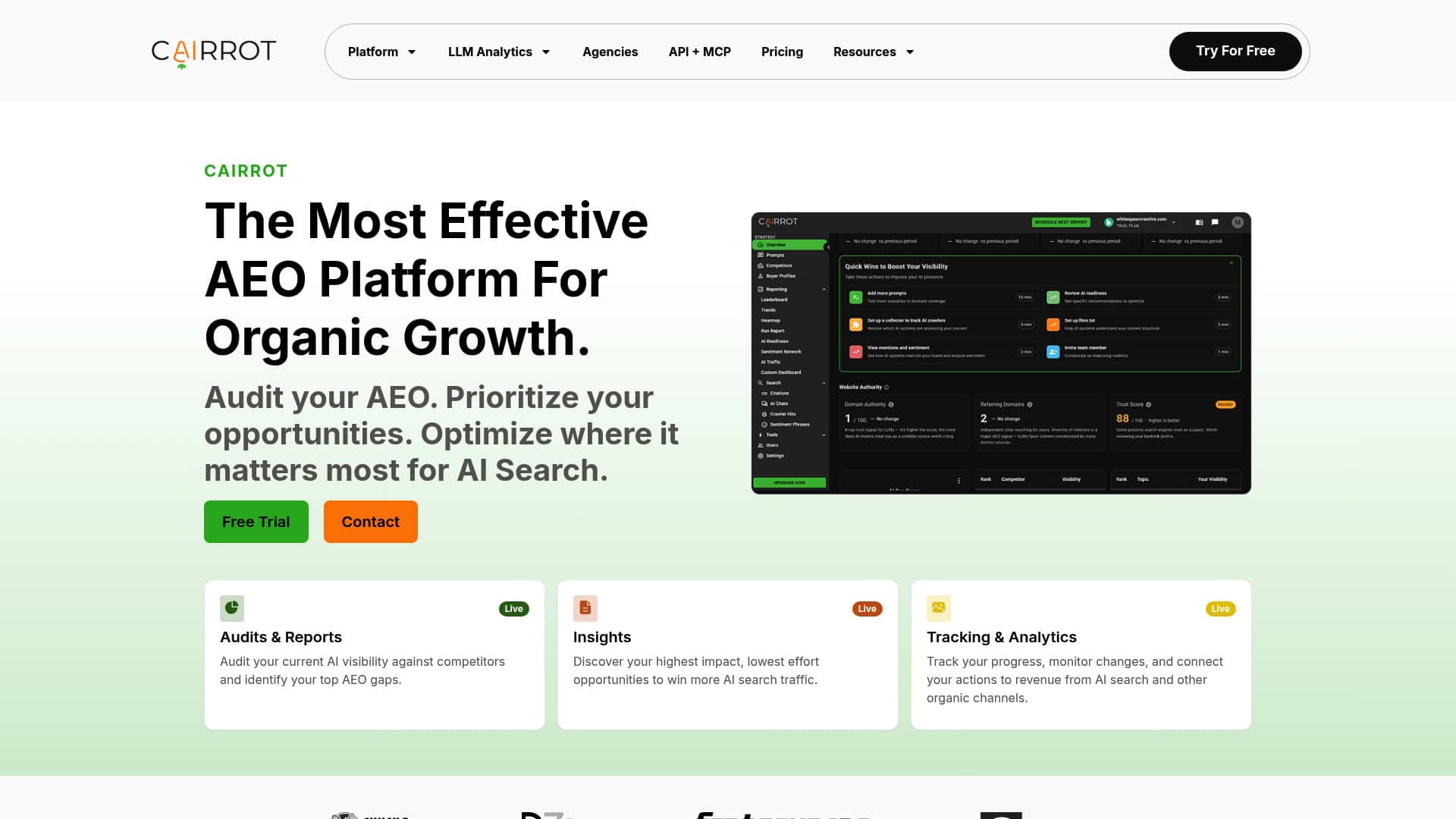
Three things stand out for marketing teams evaluating a platform. Detection happens in real time instead of in a weekly export. Every sentiment score links back to the exact mention that produced it, so a PR or product team can verify a number instead of taking it on faith. And reporting is flexible enough to feed into the dashboards leadership already reviews, rather than forcing another siloed tool into the mix.
If your team is still tracking sentiment manually or relying on quarterly surveys, see how Cairrot’s platform handles brand monitoring and start a trial to see your own brand’s sentiment data within days, not months.
Sources
For readers who want to go deeper on specific pieces of this topic:
- Umbrex — Marketing key performance indicators: brand reputation
- Gartner Peer Insights — Sentiment analysis tools market overview
- CLARIN — Tools for sentiment analysis and opinion mining
Recommended
- AI Brand Sentiment: How AI is Talking About Your Brand – Cairrot
- How to Fix Negative Brand Sentiment in AI Responses and LLMs – Cairrot
- Best AI Brand Monitoring Software: Track Brand Mentions Across LLMs – Cairrot
- LLM Citation and Mention Tracking – Cairrot