Yes, you can optimize for AI Overviews, and the fundamentals aren’t a mystery. Prioritize crawlability, write answer-first sections, and build topic clusters that mirror how Google’s query fan-out actually searches your content. Track results with Search Console’s generative reports and a citation-tracking layer like Cairrot on top of it. Most teams see measurable shifts within weeks, with fuller results by the 60-day mark.
TL;DR:
- Pages must be crawled, indexed, and free of errors such as redirect chains or soft 404s to qualify for AI Overviews.
- Building content in extractable chunks with answer-first sentences, clear formatting, and structured data significantly improves citation chances.
- Focusing on informational, comparative, and research queries rather than transactional or local involves creating comprehensive topic clusters.
- Technical fixes like schema accuracy, proper HTML structure, and core web vitals are essential before optimizing formatting or content.
- Regular audits, citation tracking, and a disciplined workflow help sustain long-term visibility and measure actual AI citation growth.
Table of Contents
- What Are AI Overviews and When Do They Show Up?
- How Do AI Overviews Decide What to Cite?
- Technical Eligibility: What You Actually Need to Fix First
- How Should You Format Content So AI Systems Can Extract It?
- How Do You Build Topic Clusters That Match Query Fan-Out?
- Which Schema Types Actually Help With AI Overview Citations?
- How Do You Measure AI Overview Visibility and Citations?
- What Are the Most Common AI Overview Optimization Mistakes?
- What Does an AEO Workflow Look Like in Practice?
- What Actually Moves the Needle for AI Overview Optimization?
- Get Citation Tracking and AI Visibility Built Into Your Workflow
- Where to Go for More on AI Overview Optimization
- Sources
What Are AI Overviews and When Do They Show Up?
AI Overviews are Google’s generated summaries that sit above traditional blue links, synthesized by Gemini from multiple web sources rather than pulled from a single ranking page. They’re not a separate ranking system with their own technical rulebook. Google Search Central has been direct about this: there are no additional technical requirements beyond what already governs standard indexing and snippet eligibility. If your page can be crawled, indexed, and shown in a regular snippet, it’s eligible for AI Overview citation.
Where they appear is more predictable than most marketers assume. AI Overviews show up most often for:
- Informational queries with a clear factual answer (“what is,” “how does,” “why do”)
- Multi-step or comparative queries that require synthesizing several sources
- Long-tail questions where a single page rarely covers the full intent
- Queries where users are researching rather than transacting
They show up less reliably for highly transactional or local-intent searches, where Google still leans on traditional results, maps packs, or ads. That distinction matters for prioritization. If you’re chasing AI Overview visibility on a “buy now” query, you’re fighting the wrong battle. Save that effort for the research-stage content your audience reads before they’re ready to convert, and let those pages do the citation-earning work.
How Do AI Overviews Decide What to Cite?
Gemini doesn’t scan the web fresh for every query. It runs what’s known as query fan-out: it breaks a single search into several related sub-queries, retrieves results for each, and stitches the synthesis together from whichever pages answer those pieces best. A query like “best time to aerate a lawn” might fan out into sub-queries on soil type, climate zone, and seasonal timing, each pulling from a different source.
Query fan-out typically draws several supporting sources per overview, according to Semrush’s analysis of AI Overview behavior. Pages that address multiple fan-out subtopics in one place have a better shot at being one of those sources than pages that answer only a sliver of the query.
What actually gets pulled from your page tends to fall into a few extraction units:
- Short, self-contained definition sentences (one to two sentences that fully answer a discrete question)
- Numbered or bulleted steps that map cleanly to a process
- Small comparison tables with clearly labeled rows and columns
- Statistics with their source and context intact
The practical takeaway: write in extractable chunks. A 400-word paragraph with the answer buried in sentence six is invisible to a system that’s grabbing isolated units, not reading for narrative flow. State the answer, then support it. That structure is what search engine land’s guidance calls “extractable” content, and it’s the single highest-leverage formatting habit you can build across a content team, per Search Engine Land’s AI Overview optimization guide.
Technical Eligibility: What You Actually Need to Fix First
Before touching formatting or schema, confirm the basics that determine whether Google can even consider your page. This is unglamorous work, but skipping it means everything downstream is wasted effort.
- Check indexation status in Search Console. A page that isn’t indexed can’t appear in an AI Overview, full stop.
- Audit robots.txt and canonical tags. A misconfigured canonical can quietly point Google to the wrong version of a page.
- Confirm HTTP status codes are clean. Redirect chains and soft 404s dilute crawl efficiency.
- Verify you haven’t accidentally applied
nosnippetornoindexto pages you want cited. This happens more often than teams admit, usually from a CMS template error. - Use semantic HTML (proper heading hierarchy,
<table>for tabular data,<ul>/<ol>for lists) so machine parsers can identify structure without guessing. - Meet Core Web Vitals thresholds. Page experience isn’t a direct AI Overview ranking factor on its own, but it’s tied to the broader indexing and quality signals that determine eligibility.
Pro Tip: Run a site: search for your target URL before debugging anything else. If the page doesn’t show up in a basic Google search, no amount of schema or formatting will get it into an AI Overview.
Skip the shortcuts that promise faster results. Google’s own guidance and independent AEO analysis both flag chunking content purely to game AI extraction, generating unnecessary AI-specific files, and chasing artificial brand mentions as tactics that backfire more than they help. The best AEO strategies for 2026 lean on the same fundamentals that have always separated durable rankings from fragile ones.
How Should You Format Content So AI Systems Can Extract It?
Every H2 and H3 should open with a one to two sentence direct answer, then follow with supporting evidence, data, or nuance. This is the single biggest structural lever you control, and it costs nothing but discipline.
Write your opening answer sentence at 40 to 60 words. That’s long enough to be genuinely useful and short enough to be lifted whole into a summary without editing. Compare the two approaches:
- ✗ “There are a number of factors that influence how quickly a lawn recovers after aeration, and it really depends on your specific situation.”
- ✓ “Lawns typically recover from aeration within 2 to 4 weeks, depending on grass type and watering frequency. Cool-season grasses like fescue bounce back faster than warm-season varieties.”
The second version is a complete, standalone answer. It doesn’t need the rest of the article to make sense, which is exactly what makes it citable.
Beyond the opening sentence, a few formatting habits compound:
- Keep paragraphs to 2 to 4 sentences after the answer sentence; long blocks slow extraction and reader comprehension alike
- Bold the specific fact or number inside a sentence, not the whole sentence, so it visually anchors on scan
- Use tables whenever you’re presenting more than three comparable data points
| Format element | Best use case | Why it helps extraction |
|---|---|---|
| Answer-first sentence | Every H2/H3 | Gives AI a complete, standalone claim |
| Numbered list | Sequential processes | Maps directly to step-based fan-out queries |
| Comparison table | 3+ items with shared attributes | Structured rows are easy to lift cleanly |
| Bolded fact | Key statistic or figure | Visual and semantic emphasis for scanning |
None of this is exotic. It’s the same discipline good editors have always demanded, just now with a machine reader added to the audience.
How Do You Build Topic Clusters That Match Query Fan-Out?
Since fan-out pulls from multiple sub-queries per search, the pages most likely to get cited are the ones that answer several related sub-questions in a single, well-organized location. Building that requires deliberate research, not guesswork.
- Mine the “People Also Ask” box for your target query and its close variants; each entry is a real sub-query Google already associates with the topic.
- Scroll to “related searches” at the bottom of the SERP for adjacent phrasing you might be missing.
- Review competitor H2s and H3s on pages already ranking or getting cited, not to copy them, but to spot gaps in your own coverage.
- Pull internal site search data to see what your own visitors are already asking that your content doesn’t answer yet.
- Group the resulting questions into clusters based on user intent, not keyword similarity, since two differently worded questions often need the same answer.
Once you have the cluster, prioritize ruthlessly. Not every sub-question deserves equal space. Rank them by search volume where you have it, and by how directly they support the page’s core intent. A sub-question that’s popular but tangential dilutes focus more than it helps.
The consolidation decision matters too. If the cluster’s sub-questions all serve one clear intent (say, “how to aerate a lawn”), keep them on one comprehensive page. If a sub-question is substantial enough to be its own search intent with commercial or navigational weight, split it into its own page and link between them. Google’s own generative AI optimization guidance reinforces that covering a topic cluster thoroughly on an authoritative page increases the odds of citation across multiple fan-out queries, not just one.
Which Schema Types Actually Help With AI Overview Citations?
Article or BlogPosting schema and FAQPage schema are the two workhorses for AI Overview extractability, and both come with a strict requirement: the schema data must match the visible text on the page exactly. Schema that claims something the page content doesn’t actually say isn’t a shortcut, it’s a liability.
A few practical rules for on-page citation formatting:
- Label statistics with their source directly in the sentence, not just in a footnote or hover tooltip
- Keep FAQ schema answers identical, word-for-word, to the visible answer text on the page
- Avoid marking up content as a “recipe,” “review,” or “how-to” schema type if the page doesn’t genuinely deliver that format
Pro Tip: Before publishing FAQPage schema, copy the schema’s answer text and paste it next to the visible answer on the page. If they don’t match exactly, Google’s systems may distrust the markup rather than reward it.
Inflated or mismatched schema doesn’t just fail to help. HubSpot’s AI Overview playbook notes that structured data misaligned with visible content can reduce rich result eligibility altogether, which means you risk losing ground you already had. Precision beats ambition here.
How Do You Measure AI Overview Visibility and Citations?
Search Console’s generative AI reporting exists, but it bundles AI Overview impressions and clicks together with standard organic performance rather than isolating them cleanly. That makes it useful for spotting trend shifts, less useful for isolating exactly which queries triggered a citation.
A few practical workarounds and metrics to track:
- Watch for click-through rate anomalies on queries where you suspect an AI Overview is appearing; a drop in clicks with stable impressions is a signal, not noise
- Track dwell time on the sessions you do get, since Pew Research found that clicks occurring alongside AI summaries tend to reflect longer engagement even as overall click volume drops
- Use third-party citation tracking to catch mentions Search Console doesn’t isolate, since HubSpot’s guidance recommends pairing Search Console with dedicated AEO tools for a fuller picture
- Monitor citation velocity, meaning how many new citations you’re earning per week or month, as a leading indicator of momentum
The KPI shift here matters more than the tooling. Raw click count is becoming a less honest measure of content performance. Citation count, supporting-link presence in AI answers, and downstream engagement quality tell you more about whether your content is actually winning visibility. Tools built for AI visibility reporting treat this shift as the baseline, not an edge case.
What Are the Most Common AI Overview Optimization Mistakes?
Most AI Overview failures trace back to a handful of repeated mistakes, and nearly all of them are fixable once you know to look for them.
- Chunking content solely to manipulate extraction. Breaking natural prose into artificial fragments doesn’t improve citation odds and often hurts readability. Fix: write for the human reader first, format for extraction second.
- Seeking synthetic mentions or artificial citations across forums and directories. Fix: earn mentions through genuinely useful content and real community engagement instead.
- Inflating schema markup beyond what the page delivers. Fix: audit every schema field against visible text before publishing.
- Ignoring basic indexation health while chasing formatting tweaks. Fix: run the technical checklist before anything else.
Pro Tip: Run a quarterly self-audit: pull ten pages you expect to be citation-worthy, check their indexation status, confirm schema matches visible text, and verify each has at least one answer-first sentence under 60 words. Most gaps show up in that first pass.
What Does an AEO Workflow Look Like in Practice?
A repeatable operational rhythm beats scattered one-off fixes. The pattern that works across most content teams follows four phases:
- Audit: Identify indexation gaps, missing schema, and pages with buried answers. This phase typically surfaces a prioritized fix list within days, not weeks.
- Cluster: Map fan-out sub-questions to existing pages, and flag topics with no coverage at all.
- Implement: Rewrite opening sentences, restructure headings into questions, add or correct schema, and fix technical issues in priority order.
- Monitor: Track citation velocity and engagement quality, then feed findings back into the next audit cycle.
Teams running this loop consistently, rather than as a one-time project, tend to see measurable citation and visibility shifts within weeks, with clearer patterns by the 60-day mark. A platform like Cairrot’s AEO platform supports each phase directly: audits surface prioritized technical and content gaps, citation tracking shows which pages are actually getting pulled into AI answers, and sentiment monitoring across Reddit and YouTube catches brand mentions traditional tools miss entirely.
For internal teams, start small: assign one editor to the audit, one writer to implement the top five fixes, and run the experiment on one content cluster before scaling it across the whole site.
What Actually Moves the Needle for AI Overview Optimization?
Most of the advice circulating about AI Overviews treats it as a brand-new discipline requiring brand-new tactics. It isn’t. The teams getting cited consistently are the ones who took SEO fundamentals seriously long before Gemini started synthesizing search results, and who now apply that same rigor to a slightly different output format.

The bigger mistake I see is treating AI Overview optimization as a content problem when it’s usually a structure problem. Teams rewrite paragraphs endlessly while ignoring that half their target pages have canonical tag errors or accidental noindex tags. Fix the technical layer first. It’s less exciting, but it’s where most citation opportunities quietly die.
My three priorities for any team starting this work: fix technical eligibility before anything else, build genuine topic clusters instead of keyword lists, and measure citations separately from clicks so you’re not flying blind. Test one cluster, track it for a month, and let the data tell you what to scale next. Evidence beats assumption every time.
— Patrick
Get Citation Tracking and AI Visibility Built Into Your Workflow
Building an AEO workflow by hand, stitching together Search Console exports, manual SERP checks, and spreadsheet trackers, works until you’re managing more than a handful of pages. Cairrot replaces that patchwork with one platform: run audits that surface prioritized technical and content fixes, track citations across Gemini, ChatGPT, and other AI search engines, and monitor sentiment on Reddit and YouTube where brand mentions often surface before they show up anywhere else.
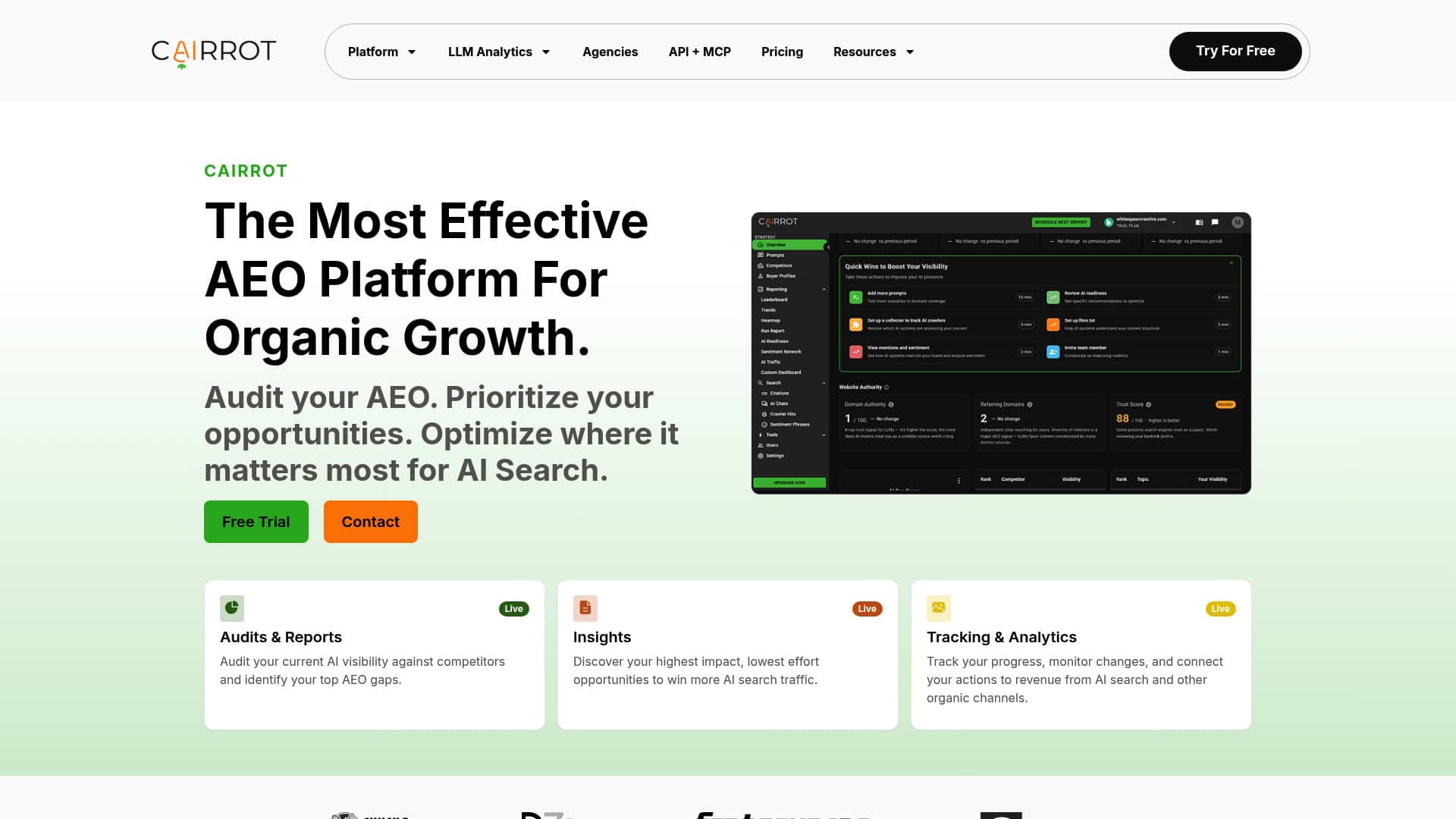
Agencies and enterprise teams use it to manage multiple clients or properties from one dashboard, with customizable reporting that turns citation data into something a client or stakeholder actually understands. Most users see measurable results within about 60 days of starting structured audits and fixes. If you’re ready to see where your own pages stand, start with the Cairrot AEO platform and run your first audit.
Where to Go for More on AI Overview Optimization
For the technical foundation, Google’s own generative AI optimization documentation is the primary source, since it defines eligibility requirements directly rather than through secondhand interpretation. For tactical formatting guidance, Search Engine Land’s AI Overview playbook covers extractable content patterns in depth. HubSpot’s 2026 AI Overview guide rounds out the set with schema-specific detail worth cross-referencing before you publish structured data changes.
Sources
- Optimizing your website for generative AI features on Google Search
- AI Overviews optimization guide: Ranking in Google AI Overviews
- How to optimize for AI overviews (AIOs): A complete 2026 playbook
Recommended
- Best AEO Strategies 2026 (Based on Data and Anecdotes) – Cairrot
- AEO Platform: Monitor Brand Mentions in AI Search & Rank in LLMs like ChatGPT – Cairrot
- Answer Engine Optimization and Generative Engine Optimization – Cairrot
- AI Search – Cairrot