
Entry-level AEO programs typically run within a lower single-digit thousand dollar range per month for a defined set of platforms and content deliverables, mid-market retainers sit in a moderate-to-high single-digit thousand dollar range, and enterprise programs cost more, scaling with organizational complexity. Standalone tracking software runs separately, from about $30 a month for basic citation monitoring to $500-plus for enterprise platforms. The single biggest swing factor is how many AI engines and prompts you ask a vendor to track.
TL;DR:
- Entry-level AEO programs usually cost a few hundred dollars monthly, monitoring up to three AI platforms with limited prompt sets and reporting.
- Broader platform coverage and custom features in mid-market and enterprise tiers significantly increase costs, especially with more prompts, brands, and integrations.
- Pricing varies based on the number of AI engines, prompt volume, content complexity, multi-brand coverage, and reporting frequency, often leading to thousands of dollars differences.
- Vendors often discount long-term contracts by 10-20%, but cancellation policies and scope adjustments can substantially impact final pricing.
- For precise budgets, define your scope first, request itemized quotes, and consider starting with an audit to establish baseline citation measurement.
Table of Contents
- What Does AEO Pricing Look Like Across Tiers?
- Retainer, Project, or Performance: Which AEO Pricing Model Fits?
- How Much Does AEO Software Cost on Its Own?
- What Actually Drives the Price of an AEO Program?
- Should You Hire In-House, Retain an Agency, or Go DIY?
- How Do You Turn a Price Range Into a Firm Budget?
- What Cairrot Offers Buyers Evaluating AEO Vendors
- Do Contract Length and Cancellation Terms Change the Price?
- Does AEO Pricing Vary by Region?
- Can You Negotiate AEO Pricing?
- How Does Pricing Change at Renewal or When You Scale Up?
- What Fees Show Up Beyond the Base Price?
- The Real Question Isn’t the Price, It’s the Scope Behind It
- Get an AEO Program Priced to Your Actual Scope
- Where These Pricing Ranges Come From
- Sources
- FAQ
What Does AEO Pricing Look Like Across Tiers?
Your budget should match your scope, not the other way around. Before you talk to a vendor, know roughly which bracket fits your brand’s footprint, because the deliverables shift meaningfully between them.
Entry tier: This band typically covers one to three AI platforms (usually ChatGPT and one or two others), a defined prompt set, basic schema cleanup, and a handful of optimized content pieces each month. Onboarding is light, and reporting is often monthly rather than continuous.
Mid-market: Here you get broader platform coverage across engines like Gemini, Perplexity, and Claude, a larger content production queue, custom dashboards, and usually a dedicated account contact rather than a shared support queue.
Enterprise: This tier is built for multi-brand or multi-location organizations. Expect full-time account management, custom reporting infrastructure, deeper API access, and monitoring across most major assistants including Grok and DeepSeek.
These figures track closely with the ranges practitioner and agency pricing roundups report across the market in 2026.
- Onboarding or setup fees typically are charged and vary considerably depending on how much schema and technical cleanup a brand needs before optimization work starts.
- Most vendors quote 30 to 90 days before a client sees measurable citation movement, depending on how much content and technical debt existed at the start.
- Entry-tier setups often skip a formal onboarding fee entirely, folding it into the first month’s retainer.
Retainer, Project, or Performance: Which AEO Pricing Model Fits?
AEO vendors bill in roughly four ways, and each one solves a different problem for the buyer.
- Monthly retainers are the default for ongoing programs. They bundle prompt monitoring, content optimization, and reporting into a fixed fee that scales with the tiers above, from $1,500 at the low end to $25,000-plus for enterprise accounts.
- Project sprints work well for a one-time audit, a schema overhaul, or a launch push tied to a product release. These typically run $1,500 to $10,000 as a single engagement, with a clear start and end date instead of an open-ended commitment.
- Performance-based pricing (RaaS, or “results as a service”) ties fees to measurable visibility gains, such as citation rate increases or share-of-voice movement across tracked prompts. AEO-as-a-Service pricing comparisons show this model gaining traction because the feedback loop for AI visibility is fast enough to score results monthly or quarterly rather than waiting a full year, as traditional SEO often requires.
- Hourly and audit-only pricing suits companies that just need a diagnostic. A standalone audit typically costs a few thousand dollars and gives you a baseline before you commit to a bigger retainer.
Pro Tip: Ask any vendor pitching a performance-based model exactly which metric triggers payment, and over what measurement window. A vague “visibility improvement” clause is a red flag; a defined citation rate across a named prompt set is not.
Performance-based pricing appeals to finance-minded buyers because it aligns cost with outcome, but it only works if both sides agree on the measurement method before signing.
How Much Does AEO Software Cost on Its Own?
Buying a platform is a different budget line than buying a managed service, and the price bands are far wider than most buyers expect.
- Entry-level trackers run $30 to $150 a month. These tools typically monitor citation frequency across a handful of AI engines and prompts, enough for a single-location business to see whether it’s showing up in ChatGPT or Perplexity answers.
- Mid-range platforms cost roughly $100 to $500 a month and add API access, multi-brand tracking, and integrations with tools like Google Search Console or GA4.
- Enterprise platforms run $500 a month and up, or move to custom pricing entirely once you’re tracking large prompt sets, multiple brands, or need seat-based access for bigger teams.
Pricing analysis from Datavessel puts many small-business setups squarely in the $40 to $150 range, which lines up with what most entry-tier buyers actually pay once they compare a few platforms.
One thing worth weighing before you buy standalone software: if you already run an SEO suite for keyword tracking or backlink audits, bundling AEO monitoring into that existing tool often delivers better value than adding a second subscription, since you’re not duplicating dashboards, logins, or reporting cadences.
What Actually Drives the Price of an AEO Program?
Quotes for what looks like the same service can vary by thousands of dollars a month, and the gap almost always traces back to a short list of variables.
- Number of AI engines monitored. Tracking ChatGPT alone costs far less than tracking ChatGPT, Gemini, Perplexity, Claude, Grok, and DeepSeek together.
- Prompt and query volume. A 50-prompt tracking set costs less to monitor and report on than a 500-prompt set spanning multiple product lines.
- Content volume and schema complexity. Optimizing ten pages is a different job than restructuring a 10,000-page catalog with layered schema markup.
- Multi-brand or multi-location coverage. Each additional brand or location typically adds incremental cost, even when the underlying platform is shared.
- Integrations. API access, custom dashboards, and connections to tools like Search Console, Bing, or Cloudflare add engineering overhead that shows up in the invoice.
- Reporting cadence and staffing. Weekly reporting with a named account manager costs more than a quarterly PDF with shared support.
Gartner’s forecast that traditional search volume will drop as AI agents take over more queries is a big part of why brands are now budgeting for AEO as its own line item, separate from classic SEO spend.
Should You Hire In-House, Retain an Agency, or Go DIY?
The cost math here depends less on total dollars and more on how fast you need results and how much internal bandwidth you have.
- In-house hire. A dedicated AEO or GEO lead runs roughly $80,000 to $180,000 a year fully loaded, plus $300 to $1,500 a month in tooling. That’s real money, but it buys full-time attention and institutional knowledge that no outside vendor replicates. Astral’s cost analysis shows this range holding fairly steady across company sizes once benefits and overhead are included.
- Agency retainer. Once your in-house cost (salary plus tools) exceeds what a mid-market retainer would cost, the agency route usually wins on pure economics, especially if you don’t have a full-time role to justify.
- DIY with software. Buying a platform and running it internally with existing marketing staff costs $100 to $500 a month in tooling, but demands real time. Expect several hours a week from someone who already understands your content and technical stack.
Pro Tip: Add up turnover risk before you decide. Losing an in-house AEO specialist six months into a program often costs more in lost momentum than the salary itself, because AI visibility work depends heavily on accumulated prompt and platform knowledge.
Hidden costs tend to hide in the gaps between these models: tool stacking when DIY software doesn’t talk to your reporting stack, or measurement blind spots when nobody owns the baseline before work starts.
How Do You Turn a Price Range Into a Firm Budget?
Converting a ballpark figure into a number you can defend to a CFO takes a short checklist, not a leap of faith.
- Define your target prompts and platforms before requesting proposals. A vendor can’t quote accurately without knowing whether you need three engines tracked or six.
- Require itemized deliverables. Ask for a breakdown tied to prompt counts, platform counts, and content pieces per month, not a single lump-sum number.
- Insist on a baseline measurement and a 90-day monitoring window. You need a “before” snapshot of your citation rate to judge whether the program is working, and 90 days is a reasonable window given how quickly AI visibility can shift compared to traditional SEO.
- Check reporting cadence. Monthly PDFs versus live dashboards changes both the price and how quickly you can react.
- Confirm IP ownership. Make sure optimized content and schema markup belong to you, not the agency, once the contract ends.
- Look for exit clauses. Month-to-month terms cost more per month but protect you from being locked into an underperforming vendor.
Vendors that resist itemizing deliverables by prompt and platform count are usually the ones padding their retainer.
What Cairrot Offers Buyers Evaluating AEO Vendors
Cairrot approaches AEO pricing the way this article recommends buyers should shop: transparent tiers tied to clear deliverables, not a black-box quote.
- Starter, Pro, and Enterprise plans scale from single-brand monitoring up to multi-client, multi-location coverage, with pricing published directly on the site rather than buried behind a sales call.
- AEO Audits & Reports, AEO Insights, and Unified AEO Analytics give buyers a managed-service option alongside the self-serve platform, covering the audit and ongoing monitoring needs discussed above.
- Sentiment tracking across Reddit and YouTube, unified API access, and a WordPress plugin round out the toolset for agencies and developers who need integrations beyond basic dashboards.
- Clients typically see measurable AEO results within roughly 60 days, a timeline worth confirming in writing in any contract, regardless of vendor.
Agencies managing multiple client accounts benefit from bulk management and white-label reporting built into the agency-focused feature set.
Do Contract Length and Cancellation Terms Change the Price?
Yes, and often by a wider margin than buyers expect going in. Vendors routinely discount monthly retainer rates by 10% to 20% in exchange for a six or twelve-month commitment, since a longer contract reduces their client acquisition cost and gives them room to plan staffing.
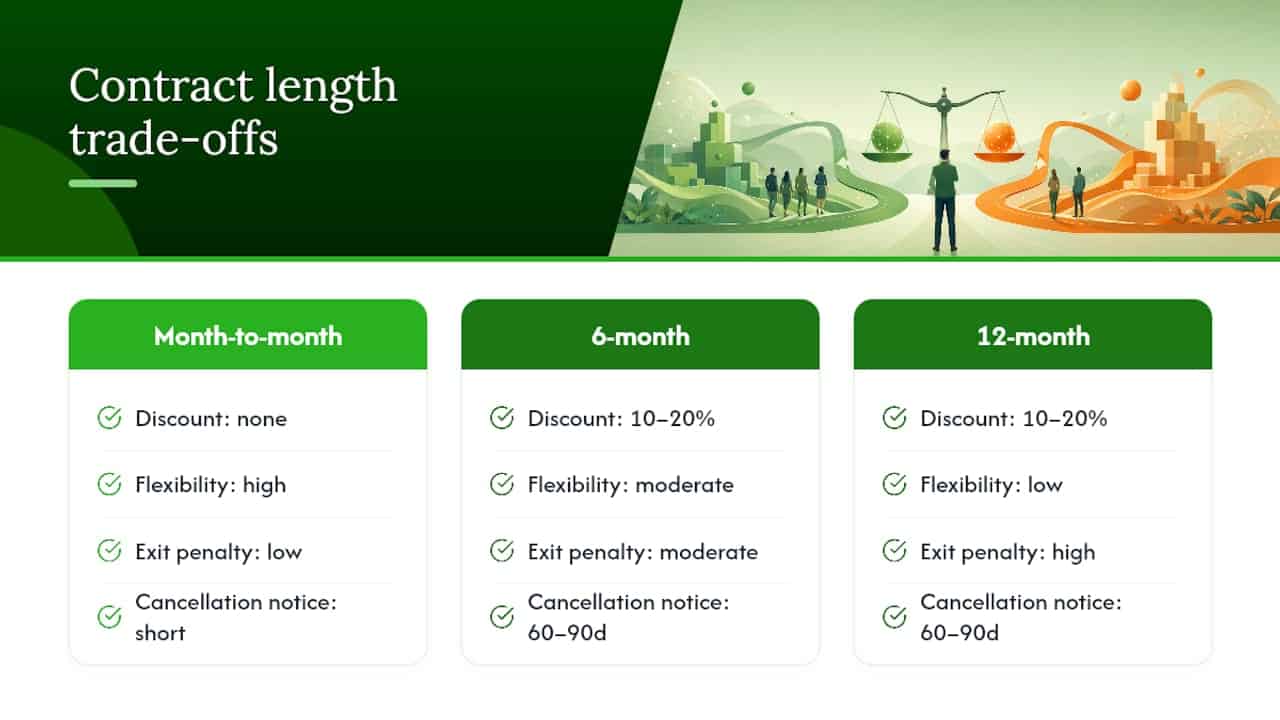
The trade-off is flexibility. A month-to-month contract costs more per month but lets you exit if a vendor underperforms or your priorities shift. A twelve-month contract with a steep early-termination penalty can trap you in a program that isn’t delivering, especially if the vendor’s baseline measurement was weak from the start.
Cancellation policies deserve as much scrutiny as the headline price. Some agencies require 60 or 90 days’ notice before termination, which effectively extends your financial commitment well past whatever the contract’s stated term implies. Others tie cancellation to a performance review, letting either party exit if agreed citation targets aren’t hit by a set date.
Before signing anything longer than three months, ask what happens if the relationship isn’t working. A vendor confident in their results will usually offer a shorter initial term or a performance checkpoint rather than locking you into a year with no off-ramp. That confidence, or the lack of it, tells you almost as much as the price itself.
Does AEO Pricing Vary by Region?
Geography still moves the needle on AEO pricing, largely because agency labor costs and market maturity differ sharply between regions. Agencies based in major U.S. metro markets, particularly the coasts, tend to price retainers at the higher end of the mid-market and enterprise bands, reflecting local salary costs for the specialists doing the work.
Agencies in smaller markets or with fully remote teams often price 15% to 30% lower for comparable scope, since their overhead is lower and they’re not competing for the same talent pool. This isn’t a quality signal either way. It’s simply a reflection of where the team sits and what it costs to retain them.
Localized pricing strategy also matters on the client side, not just the vendor side. A national brand needs prompt sets and content optimized for how people phrase questions differently across regions, which adds cost. A single-location business gets away with a narrower, cheaper prompt set focused on local intent.
If you’re comparing quotes from agencies in different regions, normalize for scope before you compare price. A cheaper quote from a lower-cost market only makes sense if the deliverables, platform coverage, and reporting cadence actually match what a pricier competitor is offering.
Can You Negotiate AEO Pricing?
Negotiation room exists in AEO pricing, but it shows up in scope adjustments more often than straight discounts. Vendors are generally reluctant to cut their base rate, since that erodes margin across their whole client base, but they’re often willing to trim the prompt set, reduce platform coverage, or lengthen the onboarding timeline to hit a target number.
The most effective lever is precision about scope. Naming the exact platforms and prompt volume you need, rather than asking for “AI visibility coverage,” lets a vendor quote tighter and gives you room to negotiate specific line items instead of a bundled price.
Discounts do appear at renewal, particularly for clients willing to commit to a longer term or add a second brand or location to an existing contract. Agencies also sometimes offer a reduced setup fee for clients who sign during a slower sales quarter, though this varies too much by vendor to treat as a reliable pattern.
Multi-year commitments and referral relationships can unlock modest discounts as well, but be wary of any vendor offering a steep cut in exchange for a long lock-in with no performance checkpoints built in. A discount that removes your leverage to exit isn’t really a discount.
How Does Pricing Change at Renewal or When You Scale Up?
Most AEO contracts see a price increase at renewal, typically in the 5% to 15% range, reflecting added platforms, expanded prompt sets, or simply the vendor’s standard annual rate adjustment. This is normal and worth building into your second-year budget from the start rather than treating it as a surprise.
Scale-up phases move the number more dramatically. Adding a second brand, expanding into new markets, or increasing content volume can push a client from mid-market into enterprise pricing within a single renewal cycle. This isn’t a bait-and-switch. It reflects real added scope, more prompts to track, more content to optimize, more platforms to monitor.
The smarter approach is asking your vendor upfront what a 25% or 50% scope increase would cost, before you’re mid-negotiation at renewal with limited leverage. A vendor who can answer that question cleanly, with a clear per-unit cost for additional prompts or platforms, is one that’s pricing rationally rather than pricing whatever the market will bear.
Watch for renewal quotes that jump well beyond what scope changes justify. If your prompt count and platform coverage stayed flat but your invoice went up 40%, that’s a conversation worth having before you sign, not after.
What Fees Show Up Beyond the Base Price?
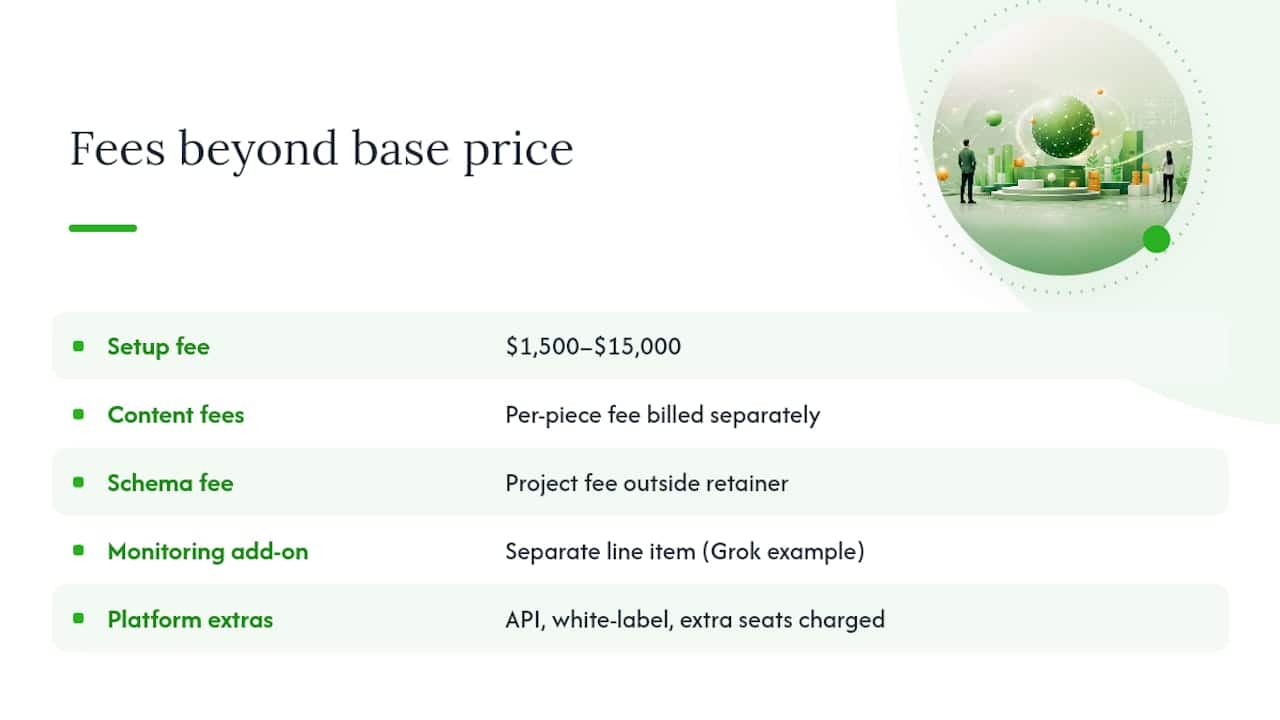
The quoted retainer or software price rarely tells the whole story. Setup and onboarding fees, already noted at $1,500 to $15,000 depending on scope, are the most common addition, but they’re far from the only one.
Content production is frequently billed separately from strategy and monitoring. A retainer might cover prompt tracking and reporting, while each piece of optimized content carries its own per-piece fee, especially at high volume. Schema markup implementation, particularly for large or complex sites, sometimes carries its own project fee outside the monthly retainer too.
Platform-specific monitoring add-ons are increasingly common as the AI engine landscape expands. Grok monitoring, for instance, is often priced as a separate line item from core retainer pricing rather than bundled in by default, since not every client needs every engine tracked from day one.
API access, white-label reporting, and additional user seats can also carry incremental charges on software platforms, even when the base subscription looks inexpensive. Before signing anything, ask for a full fee schedule, not just the headline monthly number. A $3,000 retainer that turns into $4,500 once content, schema work, and platform add-ons get added isn’t a $3,000 program.
The Real Question Isn’t the Price, It’s the Scope Behind It
Most of the confusion around AEO pricing has nothing to do with vendors overcharging. It comes from buyers comparing quotes that describe wildly different scopes using the same vague language. A $2,000 quote and a $12,000 quote can both claim to deliver “AI visibility optimization,” and only one of them is tracking six engines with a 300-prompt set.
The conventional advice, get three quotes and pick the middle one, falls apart here because it assumes the quotes are measuring the same thing. They almost never are. The better move is defining your prompt set, platform list, and content volume first, then asking every vendor to price that exact scope. That single step eliminates most sticker shock.
If there’s one thing business leaders underestimate, it’s how fast AI visibility can be measured compared to traditional SEO. A 90-day window is usually enough to know if a program is working. Vendors who resist that kind of accountability, or who dodge specifics about prompt counts and platform coverage, are telling you something about the quote itself.
— Dr. Patrick McAvoy
Get an AEO Program Priced to Your Actual Scope
Cairrot removes the guesswork this article just walked through. Instead of negotiating a vague retainer, you pick a plan built around what you’re actually tracking: Starter fits a single-location business monitoring a handful of engines, Pro suits growing brands that need multi-platform coverage and custom reporting, and Enterprise covers agencies and multi-brand organizations running full-scale programs with API access and dedicated dashboards.
If you’re not sure which tier matches your prompt volume and platform mix, start with an AEO audit to get a baseline citation measurement before committing to a monthly plan. Agencies managing multiple client accounts can explore the bulk management and white-label features built specifically for that workflow. Whichever tier fits, published pricing means you’ll know your monthly cost before you ever get on a call.
Where These Pricing Ranges Come From
The figures in this article draw from published market data rather than a single agency’s price list, which matters when you’re building a defensible budget.
- Untap Web’s 2026 cost breakdown supplied the tiered retainer ranges from entry through enterprise.
- Datavessel’s software cost analysis grounded the standalone tool pricing bands.
- Astral’s GEO cost guide provided the in-house salary and tooling comparison figures.
Sources
- Gartner press release on search volume changes
- How Much Does AEO Software Cost? — Datavessel
- How Much Does Answer Engine Optimization Cost in 2026? — Untap Web
FAQ
Is AEO Worth the Investment?
For most brands with meaningful search visibility to protect, yes. Gartner’s forecast of declining traditional search volume as AI agents grow means brands that skip AEO risk losing visibility in the exact channels replacing classic search results.
What Is AEO and How Does It Work?
Answer Engine Optimization is the practice of optimizing content, schema, and entity data so AI assistants like ChatGPT, Gemini, and Perplexity cite your brand when answering user questions. It works by combining structured data, content clarity, and ongoing monitoring of how often and how favorably your brand appears in AI-generated answers.
What Are the Different AEO Pricing Categories?
AEO pricing splits into four main models: monthly retainers, one-time project sprints, performance-based (RaaS) fees, and hourly or audit-only rates. Retainers dominate ongoing programs, while performance-based pricing is gaining ground because AI visibility can be measured on a monthly or quarterly cycle.
How Much Does Cairrot Cost?
Cairrot offers three published plans: Starter at $39 a month, Pro at $99 a month, and Enterprise at $299 a month, with Grok monitoring and analytics available from an additional $25 a month. Full details and current pricing are available on the Cairrot pricing page.
How Long Before an AEO Program Shows Results?
Most vendors quote 30 to 90 days before measurable citation gains appear, depending on how much technical and content work was needed at the start. Cairrot states that clients typically see measurable results within about 60 days, a timeline worth confirming in your specific contract terms.