
If you’re not tracking traffic from AI search yet, you’re flying blind in the fastest-growing search channel on the planet. This guide covers multiple methods for tracking AI search traffic and rankings over time, as well as tips for improving your position LLMs and AI Search engines.
ChatGPT, Perplexity, Gemini, Claude, Grok, and more… these tools are sending high value visitors to business websites right now (and it turns out these visitors convert at higher rates than other marketing channels). And the brands that know how to measure it? They’re the ones growing. The brands that don’t? They’re watching traffic numbers shift and have no idea why.
This guide gives you everything you need to start tracking LLM traffic and visibility today. We’re covering multiple free methods, the best paid tools, and the exact tips we use at Cairrot and with our Garden Partners to aggressively grow AI search performance.
No fluff or theory. Just the tactics that actually work for tracking and improving LLM rankings.
How do we know? Because we’ve tested all these methods on ourselves and in experiments with our Cairrot Garden Partners, who are enjoying absurd growth in AI search just like we are.

Key Summary
- You can track LLM referral traffic for free using GA4 custom channel groups or a free Looker Studio template. For a full-featured solution, tools like Cairrot automate the entire process.
- AI traffic converts at higher rates than traditional organic search traffic. Users who get a recommendation from an LLM are further down the funnel by default.
- AI Search boosts more than one channel. Users who discover your brand through an LLM often visit via Direct or Organic Search, not just the citation link. This spillover effect is at least 2x stronger than traditional SEO.
- “Rankings” don’t exist in AI Search the way they do in Google. The right KPI is “Visibility” — a combination of mention rate, share of voice, citation frequency, and actual referral traffic.
- Great AEO is still built on great SEO. The fundamentals haven’t changed, but the measurement has.
- 5 actionable tips at the end of this guide to start growing your AI visibility today.
Why Tracking LLM Traffic & Visibility Is Now Non-Negotiable
Before we get into the how, let’s talk about the why. Because if you don’t understand what makes AI traffic different from traditional search traffic, you’ll undervalue it.
AI/LLM Traffic Converts Higher
Think about how someone ends up on your site from ChatGPT vs. Google.
On Google, a user types a broad keyword, scans 10 blue links, and maybe clicks yours. They’re browsing. Comparing. Window shopping.
On ChatGPT? A user asks a specific question and gets a specific recommendation. “What’s the best AEO tool for agencies?” and the model names your brand, explains why, and links to your site. That user is already sold on the concept. They just need to see your pricing page.
That’s high-intent traffic by default. And the data backs this up. We consistently see AI / LLM channels posting engagement rates and conversion rates that rival or beat Organic Search.
[Screenshot: GA4 Channel Breakdown showing AI/LLM with 58.6% engagement rate — light mode, page 4 from uploaded images]
AI/LLM Visibility Lifts More Than One Channel
Here’s something most marketers miss. When someone sees your brand mentioned by an LLM, they don’t always click the citation link. A lot of them open a new tab, Google your brand name, or type your URL directly.
That means AI visibility is driving traffic to your Direct and Organic Search channels too. And this spillover effect is at least 2x stronger than what you’d see from traditional SEO brand lift.
If you’re only looking at the “AI / LLM” row in your GA4 reports, you’re seeing maybe half the picture.
Stop Thinking “Rankings.” Start Thinking “Visibility.”
In traditional SEO, you track positions. Rank #1 for “best CRM software.” Rank #3 for “email marketing tools.” Clean. Simple. Linear.
AI Search doesn’t work like that.
There’s no fixed list. No positions 1 through 10. Every time someone asks a question, the model generates a fresh response. Your brand might appear in 6 out of 10 answers today, 3 out of 10 tomorrow, and 8 out of 10 next week depending on the prompt, the model, and the context.
That’s why the right metric isn’t “rank.” It’s Visibility — a suite of KPIs that includes mention rate, citation frequency, share of voice against competitors, and actual referral traffic from LLMs.
Great AEO Is Still Built on Great SEO
Let’s be clear: AI Search optimization (AEO) isn’t replacing SEO. It’s an expansion of it.
LLMs are trained on web content. They pull from the same authoritative sources that Google values. If your SEO foundations are weak (e.g. thin content, bad site structure, no original thoughts, no branded assets) your AI visibility will be weak too.
The brands winning in AI Search right now are the ones that already have strong SEO fundamentals and are layering AEO-specific strategies on top.
3 Ways to Track LLM Traffic
There are several ways to see how much traffic LLMs are sending to your website. Here are three methods, ranked from most manual to most comprehensive.
Method 1: Track LLM Traffic in GA4 (The Manual Way)
This is the DIY approach. It’s free and uses data you already have — you just need to set up a custom channel group so GA4 properly categorizes AI referral traffic instead of lumping it into “Referral” or “Unassigned.”
Here’s how to do it:
- In your GA4 property, go to Admin → Custom Channel Groups
- Clone your Default Channel Group
- Add a new channel, label it AI Traffic (or AI / LLM)
- Set the condition to “Source matches regex” and paste this:
(chatgpt|openai|anthropic|deepseek|grok)\.com|(gemini|bard)\.google\.com|(perplexity|claude)\.ai|(copilot\.microsoft|edgeservices\.bing)\.com|edge\scopilot
- Save, then click Reorder and move AI Traffic above “Referral” in the priority list
That’s it. You can now see referral traffic from every major LLM source broken out as its own channel.
For a more detailed walkthrough with screenshots for each step, check out our full guide on AEO Metrics and SEO KPIs for AI Visibility.
The good: Free. Uses data you already have. Takes 10 minutes.
The catch: Doesn’t scale across multiple properties. Only shows traffic volume — no visibility data, no competitive intelligence, no ranking tracking. And you’ll need to manually update that regex as new LLM sources emerge.
Method 2: Free Looker Studio Dashboard (Easy Fix for Today)
If you don’t want to mess with GA4 settings and just need a quick visual, there’s a free Looker Studio LLM Traffic Template that auto-pulls AI referral traffic data from your GA4 property.
It’s a solid option for quick checks. Pull it up, connect your GA4, and you’ll have a visual snapshot of how much traffic LLMs are sending your way.
The good: Free. Fast to set up. Visual dashboard you can screenshot and share.
The catch: Not scalable. If you’re an agency managing 15 clients, you’re not setting up 15 separate Looker Studio dashboards and manually checking each one. There’s no competitive data, no visibility metrics, and no way to automate reporting or integrate with your internal tools.
Good for a quick sanity check. Not a long-term solution.
Method 3: Use a Tool Like Cairrot (Easiest + Most Comprehensive)
If you’re serious about AI Search as a channel, and you should be, a dedicated tool is the move.
Cairrot integrates directly with your GA4 and Google Search Console to surface AI Traffic reports automatically. No regex. No manual channel groups. No Looker Studio templates that break when Google updates their API.
Examples of what you get:
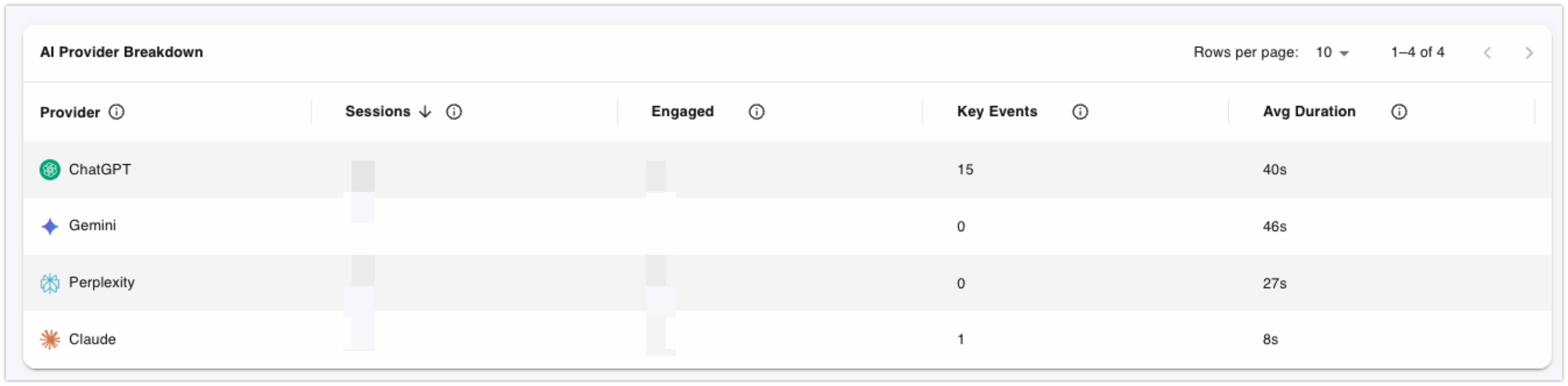
AI/LLM Provider Breakdown
See sessions, engaged sessions, key events, and average duration broken out by LLM source. Know exactly how much traffic ChatGPT vs. Gemini vs. Claude vs. Perplexity is sending you.
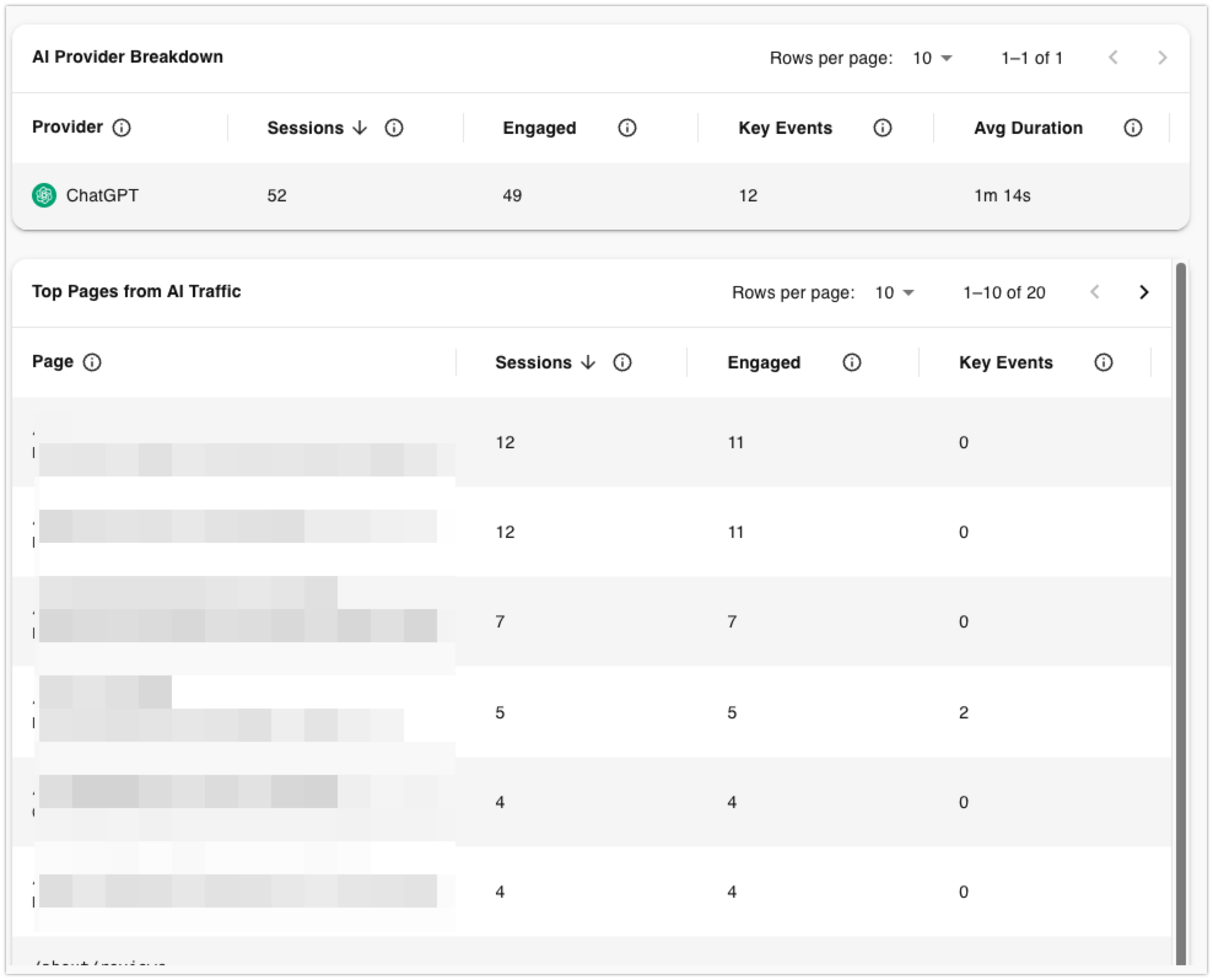
Top Pages from AI Traffic
Which of your pages are LLMs actually sending users to? This tells you what content is getting cited and driving clicks.
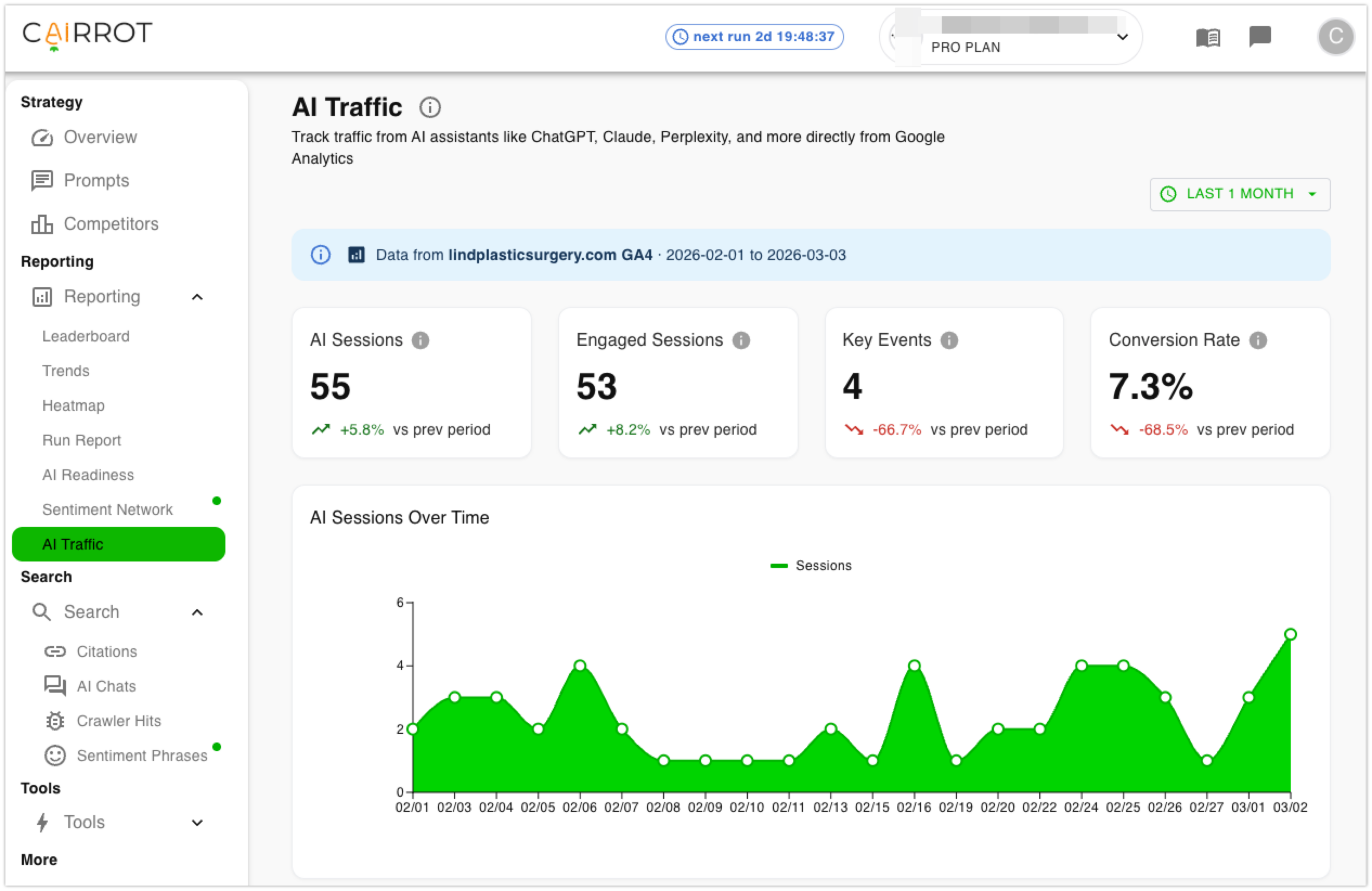
AI Sessions Over Time
Trend lines showing your AI traffic trajectory, with period-over-period comparisons. This is how you prove growth to stakeholders (or clients).
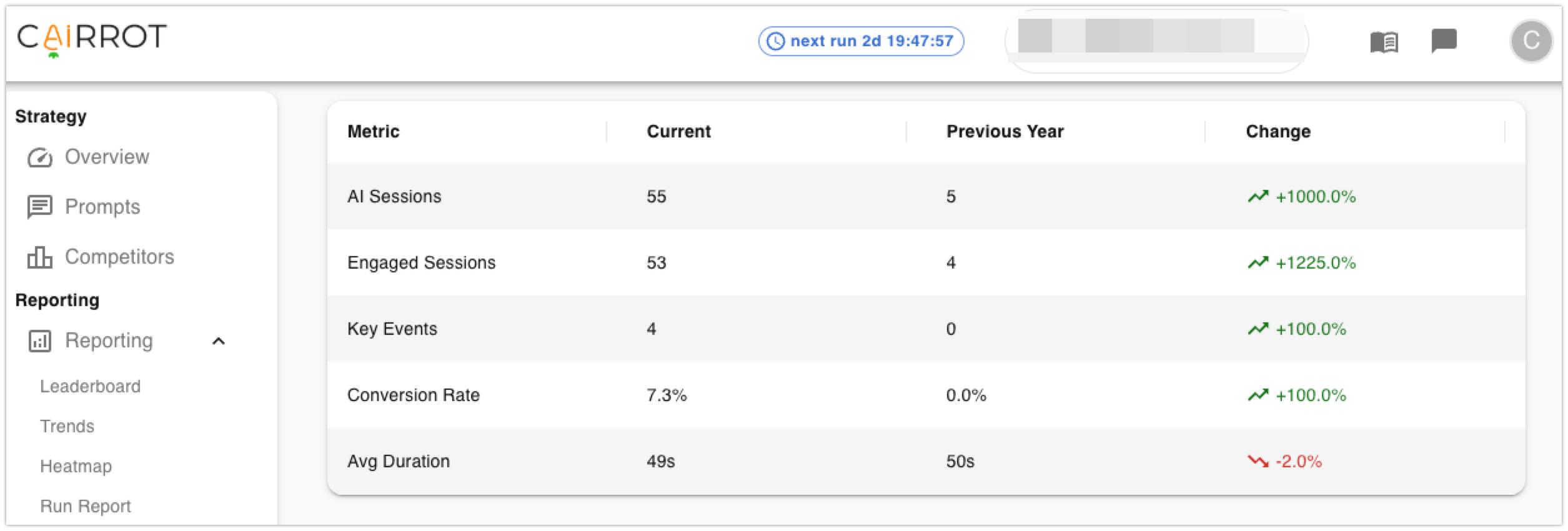
Full Channel Comparison
See AI / LLM traffic side-by-side with every other channel (Organic, Direct, Paid, Social, etc.) so you can put AI Search performance in context.
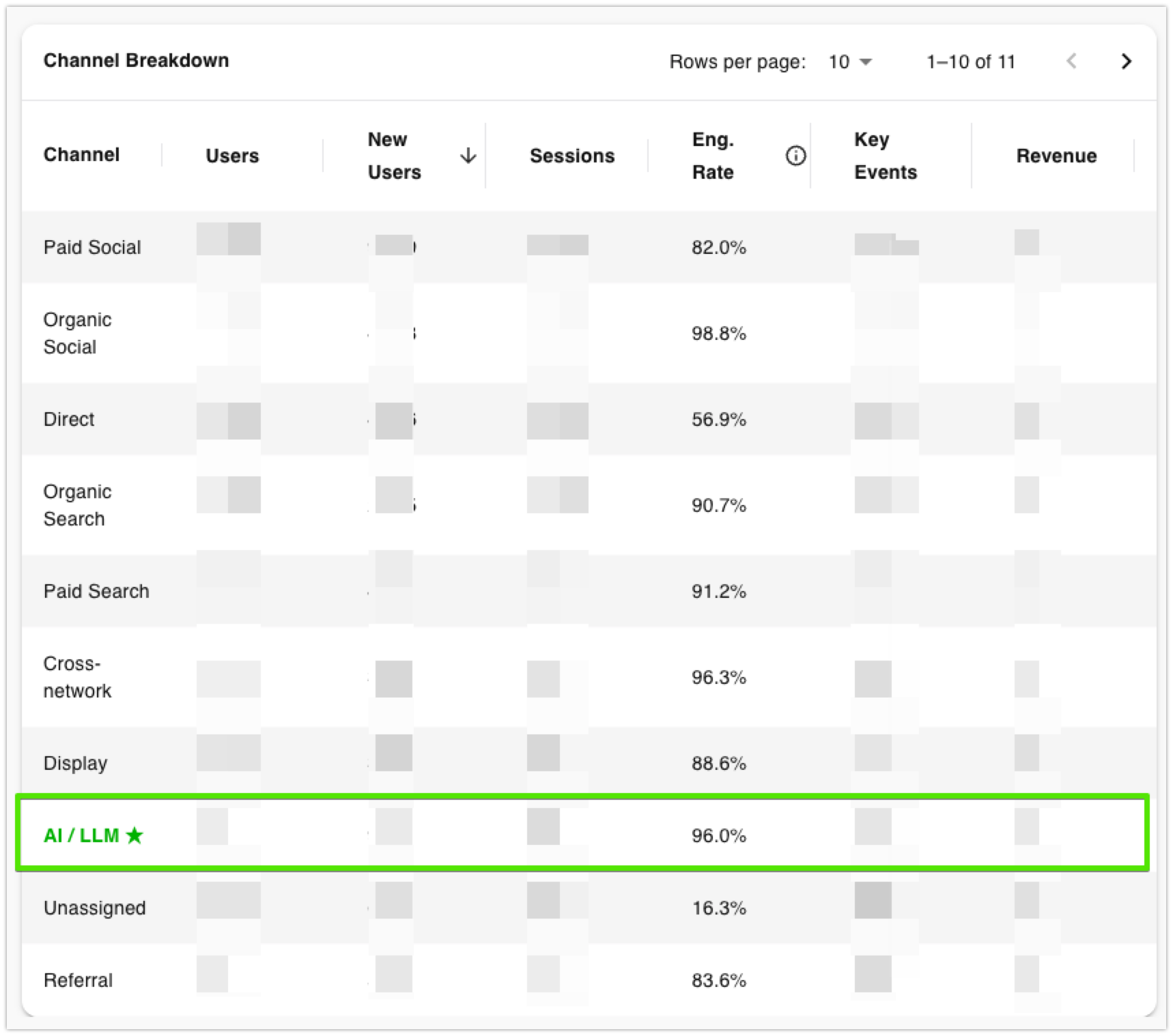
And because Cairrot is built on an open data philosophy, all of this data is yours. Pull it via API, pipe it into your own dashboards, or connect it to your reporting stack. No walled gardens. No vendor lock-in.
The good: Automated. Comprehensive. Tracks traffic + visibility + competitive data in one platform. Open API on all plans. Scales across clients and properties.
The catch: Requires a subscription. But pricing starts under $40/month for ChatGPT and Perplexity tracking, and under $100/month for 5 LLMs. Compared to what you’d spend on manual hours or the limitations of free tools, the ROI is pretty clear.
How to Track “Rankings” in LLMs
Rank tracking in LLMs is where things get interesting. And where most marketers get confused.
Why LLM “Ranking” Doesn’t Mean What You Think
In Google, you have a position. Rank #1 means your URL is the first organic result. Rank #7 means you’re buried. Simple.
AI Search doesn’t work that way. When someone asks ChatGPT “What are the best AI visibility tools?”, the model generates a new answer from scratch. There’s no fixed list. The brands it mentions, the order it puts them in, and whether it includes citations can all vary between queries.
So when people ask “What’s my rank in ChatGPT?” — the honest answer is: it depends on the prompt, the model version, the user’s context, and sometimes just randomness.
What you can measure is how frequently your brand appears across a consistent set of prompts over time. That’s Visibility.
The Only Way to Track LLM Visibility Over Time
There’s no free method for this. No GA4 hack. No Looker Studio template.
Tracking how often your brand appears in LLM responses — across multiple models, multiple prompts, over weeks and months — requires a tool that’s querying those models on a schedule and recording the results.
This is what Cairrot (and a handful of other LLM rank tracking tools) are built for.
Here are examples of what LLM Visibility reporting looks like in practice:
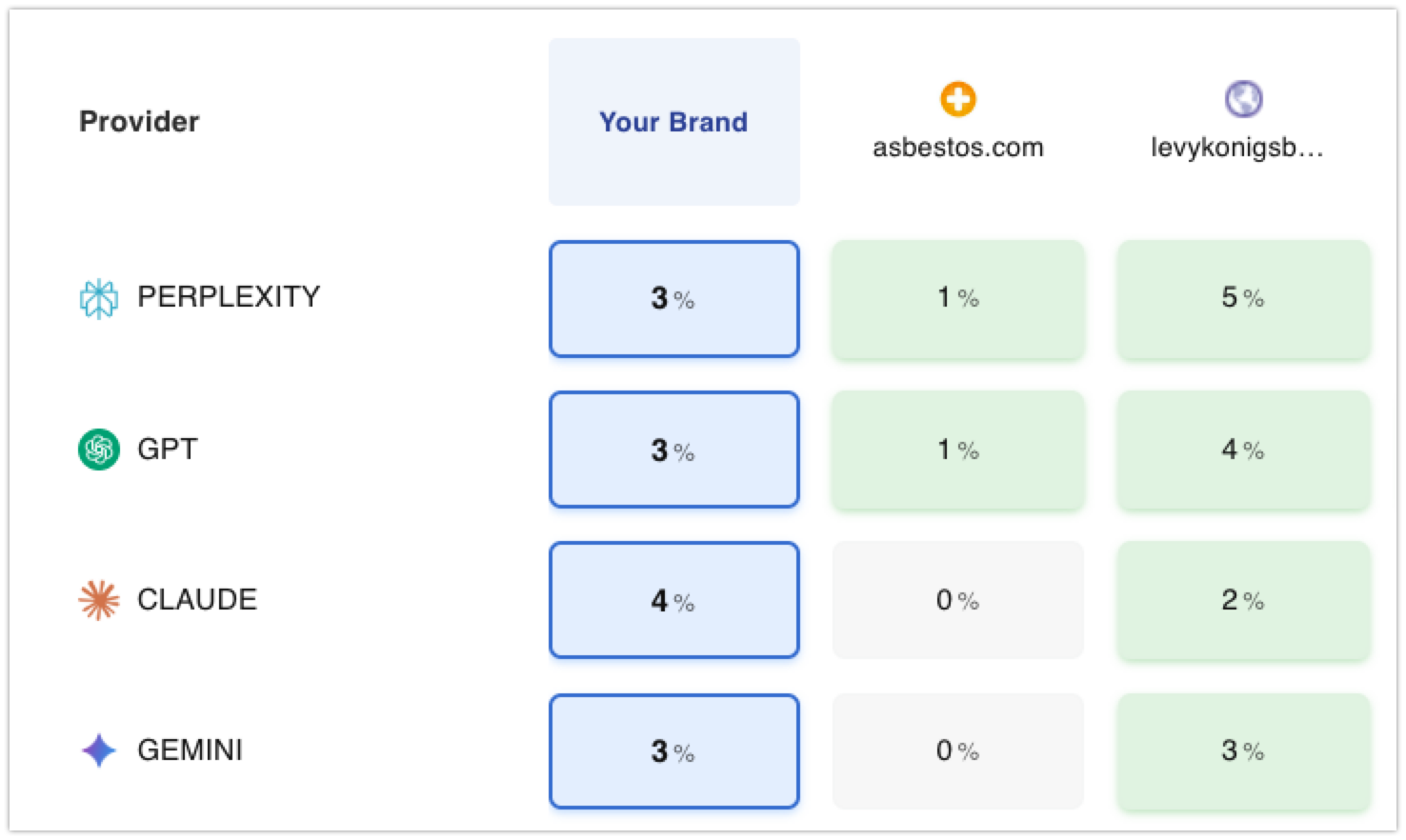
Model x Competitors Heatmap
See exactly how your brand stacks up against competitors across every major LLM. Gemini. Claude. GPT. Perplexity. DeepSeek. All in one view.
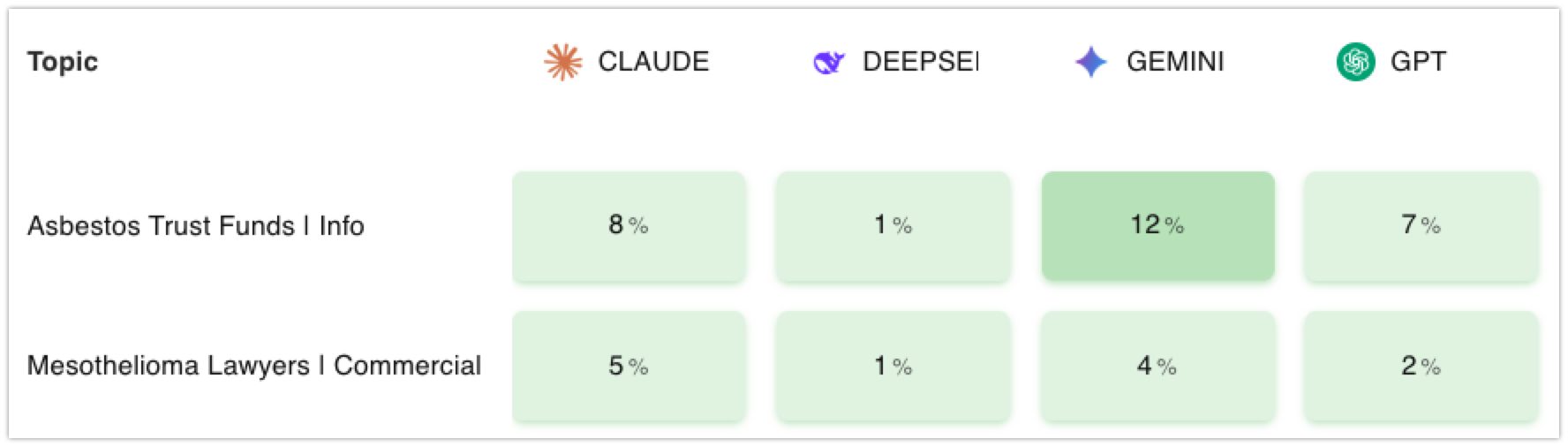
Topic x Competitors Heatmap
Not just model-level, but topic-level. Which topics does your brand dominate? Where are competitors gaining ground? This is how you prioritize content.
AI Visibility Trend Charts
Visibility over time so you can see whether your AEO efforts are actually moving the needle. This is the AI Search equivalent of watching your keyword rankings climb in Ahrefs.
You can’t improve what you can’t measure. If you’re serious about AI Search, getting baseline visibility data is step one.
5 Tips for Growing Your AI Visibility
Tracking is important. But tracking alone doesn’t move the needle. Here’s what we’ve seen work — both for Cairrot’s own growth and for our Garden Partners across dozens of industries.
1. Set Up Google Search Console and Bing Webmaster Tools
This is table stakes. If you don’t have visibility into what queries are driving traffic to your website, you can’t optimize content for those queries. Period.
Register your site in both Google Search Console and Bing Webmaster Tools if you haven’t already.
Cairrot insight: We’ve observed that when websites register in Bing Webmaster Tools, the frequency with which ChatGPT crawls their website increases. This makes sense — Bing and OpenAI have a deep partnership, and Bing’s index is a primary data source for ChatGPT. Don’t sleep on Bing.
2. Prioritize High-Intent Content
This is one of the biggest differences between traditional SEO and AEO. In Google, informational content dominates volume. “What is CRM?” gets more searches than “Best CRM for small business.”
In AI Search, the pattern flips.
Cairrot insight: High-intent content like competitor comparisons, pricing guides, “best of” listicles, and product reviews are cited by LLMs far more frequently than informational or educational content. LLMs are answering decision-stage questions, and they’re pulling from content that directly helps users make decisions.
If you’re only producing top-of-funnel blog posts, you’re leaving AI visibility on the table.
3. Build Dedicated Product, Service, and Solution Pages
This one sounds obvious but it trips up more brands than you’d think.
If your website doesn’t explicitly say you offer a product or service, LLMs won’t recommend you. Even if you think it’s obvious from context. Even if “everyone in the industry knows” what you do.
LLMs are literal. Build pages that clearly explain every product you sell, every service you offer, every solution you specialize in, who you help, and what problems you solve. Be specific. Be thorough. Leave nothing to inference.
4. Use Structured Formatting
Bullets. Tables. Subheaders. Bold text. These aren’t just user experience best practices — they’re proven to improve both SEO results and the frequency with which LLMs cite specific details from your pages.
Think about it from the model’s perspective. When an LLM is scanning your page to decide whether to cite it, a clean bulleted list of features is infinitely easier to parse than a wall of paragraph text.
Make it easy for the model to find and extract your key points.
5. Optimize Your Images
Most pages should include images. And every image should have relevant keywords in the filename, alt text, and description.
Not “IMG_4392.jpg.” Not “screenshot.png.”
Something like cairrot-ai-traffic-dashboard-ga4-integration.png with alt text that actually describes what the image shows. Be detailed. Be truthful. LLMs and Google both use this metadata to understand your content.
Check, Track, and Optimize Your Rank in ChatGPT, Perplexity, Gemini, and Every Other LLM (First Report is Free)
Whether you’re an agency managing dozens of clients or a brand trying to understand your AI search footprint, Cairrot gives you the full picture; traffic, visibility, competitive intelligence, and optimization recommendations in one platform.
Your first report is free. No credit card required. See where your AI visibility stands today.