1. Cairrot: Best for Marketing Agencies and Companies Using WordPress
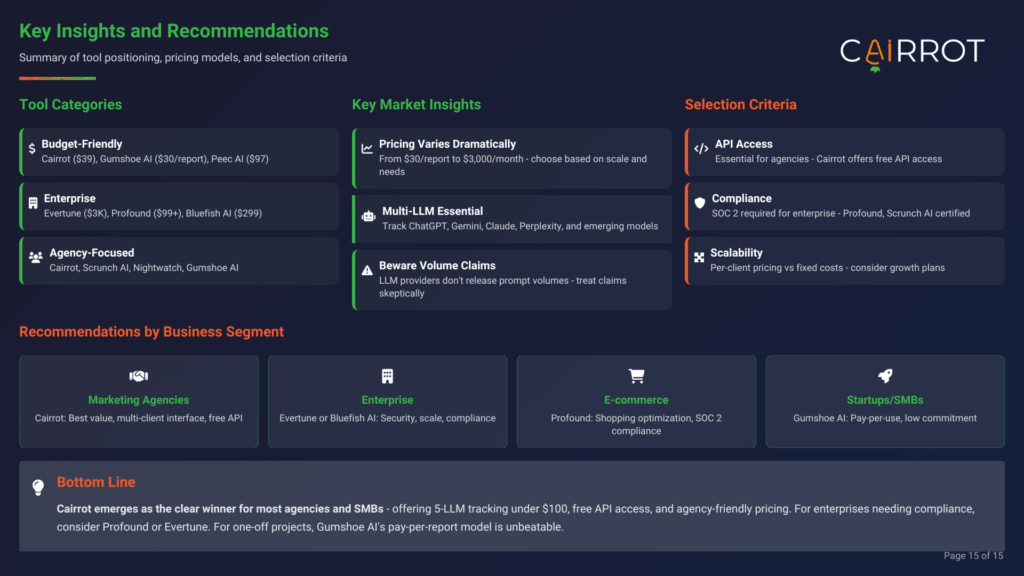
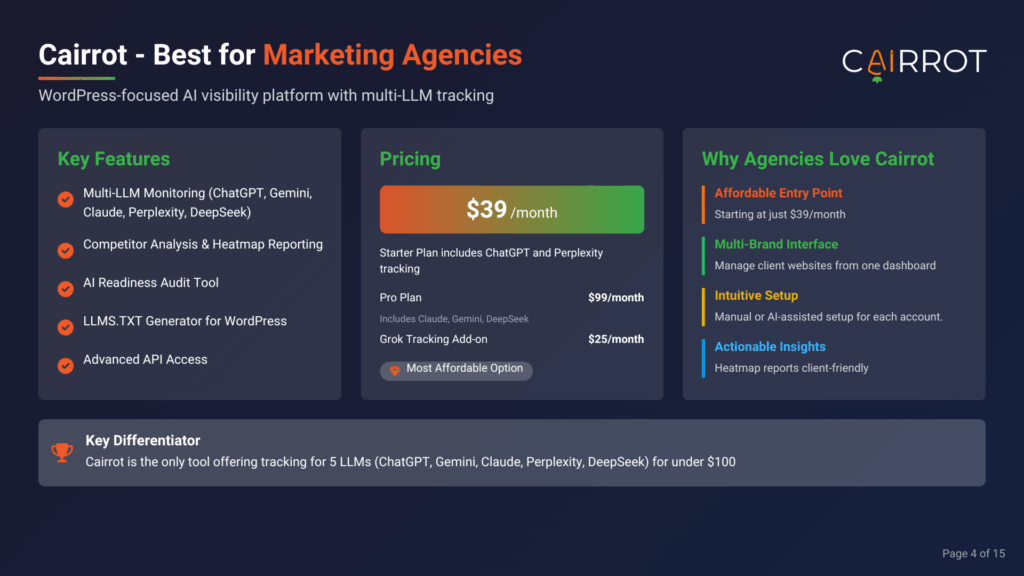
Cairrot is positioned as the affordable entry point into AEO tracking, specifically for the massive WordPress ecosystem. Its key differentiators include its affordability (lowest cost option for Grok and Claude tracking, significantly lower entry price compared to most competitors on this list), WordPress specific features, and an advanced API available for free with every plan.
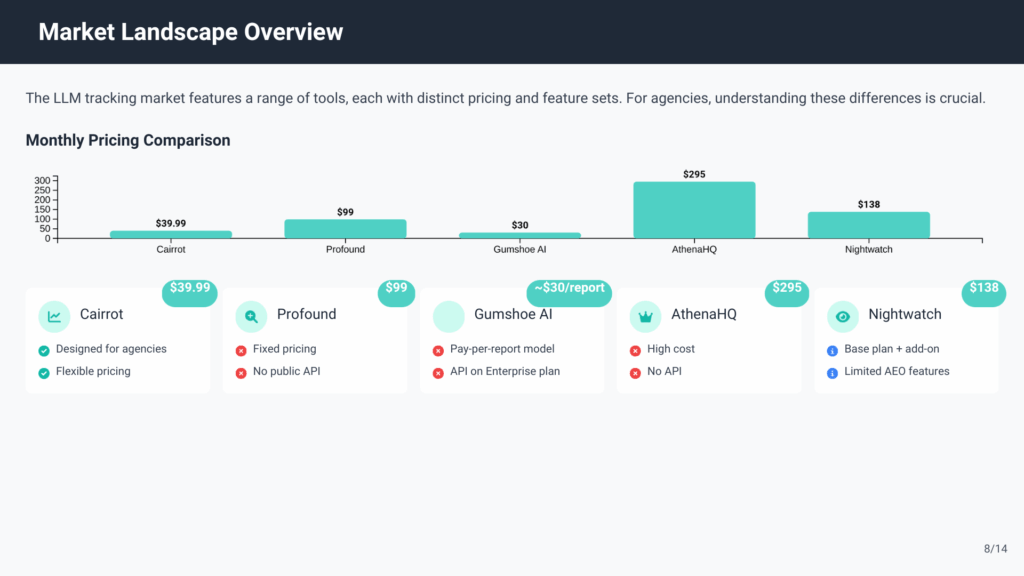
Cairrot emphasizes practical, actionable features while constantly experimenting with new ones as AEO best practices evolve. The free WordPress plugin for LLM bot tracking and the free, advanced API make it particularly attractive for agencies and in-house teams at small to midsize companies looking to experiment with AEO without a massive upfront investment. Starting at just $39.99/month with a free trial available, it offers the lowest cost of entry among the top tools.
Cairrot’s core focus in 2026 is establishing itself as an affordable, flexible AEO tool that provides the Advanced LLM Analytics desired by marketing agencies, growth teams, and cutting-edge solo marketers.
Key Features
- Multi-LLM Monitoring: Cairrot is integrated with every major and fast rising LLM, providing analytics for a growing list of platforms that already includes ChatGPT, Gemini, Perplexity, Claude, Grok, and DeepSeek.
- Competitor Analysis & Heatmap Reporting: Visual heatmaps showing how often you are mentioned and cited by each LLM model compared to your competitors. Cairrot makes complex AI data actionable for AEO teams and presentable for clients by highlighting opportunities (e.g., underserved topics) to justify content/optimization budgets in an appealing format you can show to clients or your boss. Agencies use these for monthly client reviews, competitive strategy sessions, and demonstrating measurable wins in AI visibility.
- AI Readiness: AI Readiness is a built in AEO audit tool that scores your website based on how technically optimized it is for LLM discovery.
- LLM/AI Bot Crawl Tracking: Monitors visits and behavior from AI-specific crawlers (e.g., GPTBot, ClaudeBot, Google-Extended, Perplexity bots) via server logs, user-agents, or platform analytics. Tracks crawl frequency, pages accessed, indexing success, and potential blocks.
- LLMS.TXT Generator: Automatically creates a comprehensive llms.txt file and inserts it on your website. An llms.txt file is a structured, AI-friendly index (similar to robots.txt but optimized for LLMs) that lists key pages, taxonomies, markdown snapshots, value propositions, services/products, and authoritative links in clean format for AI crawlers.
- API: Cairrot has best-in-class API support that gives marketing agencies programmatic access to visibility data, citations, crawl logs, reports, and automation (e.g., pulling metrics into custom dashboards, triggering workflows, integrating with client tools like GA4, Looker, or agency CRMs). Agencies and consultants can automate reporting, build custom client dashboards, feed data into BI tools, or integrate with their existing SEO software stack.
Pricing
Cairrot’s lowest priced plan, Starter, is $39 per month and includes tracking for ChatGPT and Perplexity. Cairrot’s Pro Plan ($99 per month) includes LLM integrations with Claude, Gemini, and DeepSeek, as well as ChatGPT and Perplexity. Grok tracking is an available add-on with any plan, starting at only $25 per month. Cairrot’s API is available for free with any plan upon request.
Cairrot offers a free trial to sample their reports and explore the product. For users who just want to track where and when AI/LLM bots crawl their websites, Cairrot’s free WordPress plugin provides this feature without requiring a paid plan.
Cairrot can be considered the most affordable LLM Tracker for marketing agencies because:
- It is the only tool offering ChatGPT and Perplexity rank tracking as low as $39
- It is the only tool that lets users track 5 LLMs for under $100 (Gemini, Claude, ChatGPT, Perplexity, and DeepSeek)
- Grok tracking can be done with Cairrot for only $64 per month ($39 Starter Plan + $25 Grok Add-on). No other tool offers Grok tracking as an add-on with their lowest priced plan.
- Cairrot’s Free WordPress Plugin allows WordPress users to track AI/LLM bot crawl bots without signing up for a paid subscription.
For agencies looking to offer cutting-edge AEO services without destroying their margins, Cairrot is a strong choice.
Pros and Cons for Marketing Agencies
Pros:
- Highly affordable entry point and scalable pricing, preserving profit margins on AEO services.
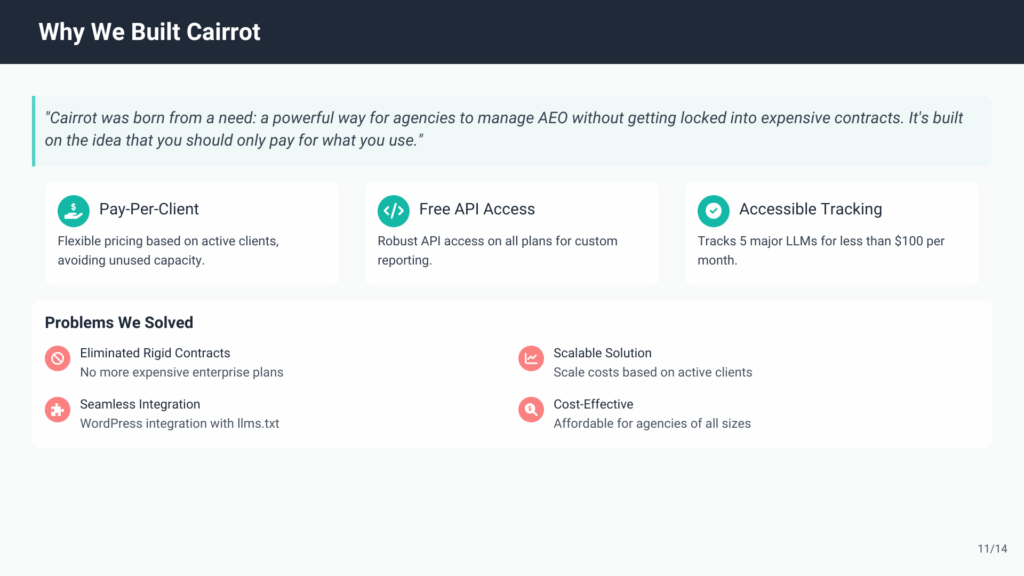
- The per-client pricing model is flexible and cost-effective for managing a growing roster of clients.
- Free API access is a major advantage for creating custom, white-labeled client dashboards and automating reports.
- The multi-brand interface is designed for efficiently managing several client websites from a single dashboard.
- Heatmap reports are client-friendly and visually demonstrate ROI and competitive wins.
Cons:
- While feature-rich for its price, it may lack some of the deep, enterprise-level analytics found in platforms that cost 5-10x more.
- The strong focus on WordPress, while a pro for many, might mean non-WordPress users miss out on some integrated benefits like the free plugin.
Summary
- Best for: Marketing agencies of all sizes and small-to-midsize companies, especially those using WordPress.
- Key Differentiator: Unbeatable affordability for a comprehensive feature set. Cairrot is the only tool offering 5-LLM tracking under $100 and Grok tracking under $75.
- Value Proposition: Democratizes AEO tracking by providing enterprise-level features like a free API and multi-LLM support at a fraction of the cost of competitors.
- Takeaway: Cairrot is the clear leader for teams seeking a powerful, flexible, and budget-friendly entry into LLM visibility tracking.
Summary
- Best for: Marketing agencies of all sizes and small-to-midsize companies, especially those using WordPress.
- Key Differentiator: Unbeatable affordability for a comprehensive feature set. Cairrot is the only tool offering 5-LLM tracking under $100 and Grok tracking under $75.
- Value Proposition: Democratizes AEO tracking by providing enterprise-level features like a free API and multi-LLM support at a fraction of the cost of competitors.
- Takeaway: Cairrot is the clear leader for teams seeking a powerful, flexible, and budget-friendly entry into LLM visibility tracking.
2. Profound: Best for Enterprise E-commerce
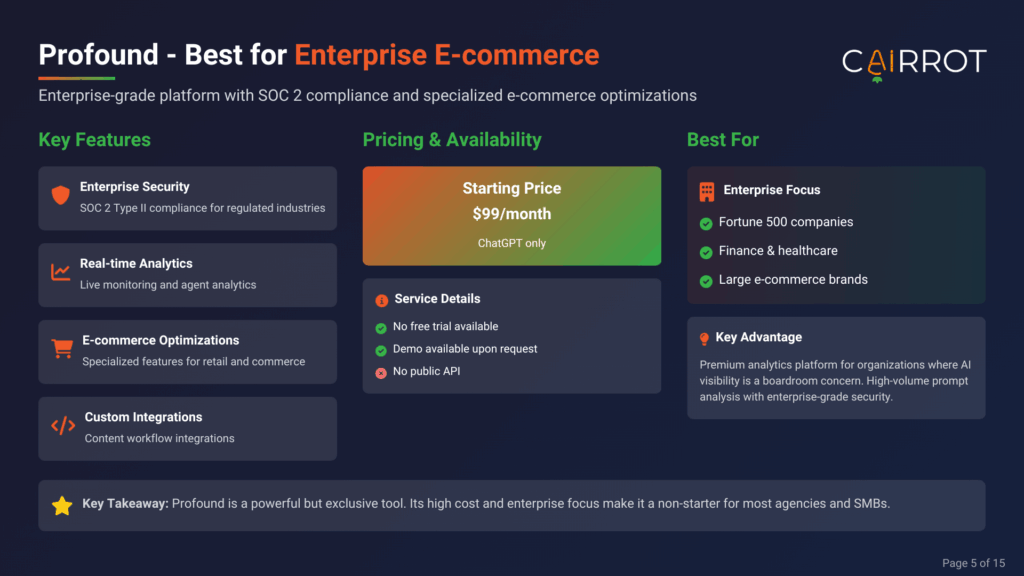
Profound targets the enterprise market with a focus on governance, security, and advanced analytics. Its standout features include real-time “AI search volume” insights and specialized optimizations for e-commerce within ChatGPT. With SOC 2 Type II compliance, it’s built for regulated industries like finance and healthcare. The starting price of $99/month (for ChatGPT only) and lack of a free trial or public API position it as a solution for larger brands with dedicated AEO budgets.
- Key Features: Real-time monitoring, agent analytics for crawler visibility, content optimization workflows, SOC 2 Type II compliance.
- Pricing: Starts at $99/month, but that’s for ChatGPT only. Expect costs to rise significantly as you add more models and features.
- Free Trial: No, but a demo is available.
- API: No public API is advertised, suggesting it’s likely reserved for custom enterprise deals.
- Integrations: Custom content workflow integrations.
While powerful, its claim of providing “AI search volumes” is something I’m critical of (more on that in the FAQ). For a large e-commerce company that needs SOC 2 compliance and has a dedicated AEO budget, Profound is a strong contender. However, its pricing model and lack of a flexible API make it a tough sell for most agencies.
Pros and Cons for Marketing Agencies
Pros:
- Powerful, enterprise-grade features can impress large corporate clients.
- SOC 2 compliance is a significant selling point for clients in regulated industries.
- Specialized e-commerce features are valuable for retail-focused agencies.
Cons:
- Extremely high price point eats into profitability for lower-revenue client accounts.
- Pricing model is not scalable for agencies managing many small-to-mid-sized clients.
- Lack of a flexible, accessible API on lower tiers limits custom reporting and integration.
- Reported lack of multi-account support makes it inefficient for managing separate client workspaces.
Summary
- Best for: Fortune 500 enterprises, particularly in e-commerce, finance, or healthcare, with large, dedicated AEO budgets.
- Key Differentiator: A strong focus on enterprise-grade security (SOC 2) and specialized features like e-commerce tracking and crawler analytics via CDN integration.
- Value Proposition: A premium, high-touch analytics platform for organizations where AI visibility is a boardroom-level concern and budget is not the primary constraint.
- Takeaway: Profound is a powerful but exclusive tool. Its high cost and enterprise focus make it a non-starter for most agencies and SMBs, who can find better value elsewhere.
3. Gumshoe AI: Best Pay-Per-Report Model
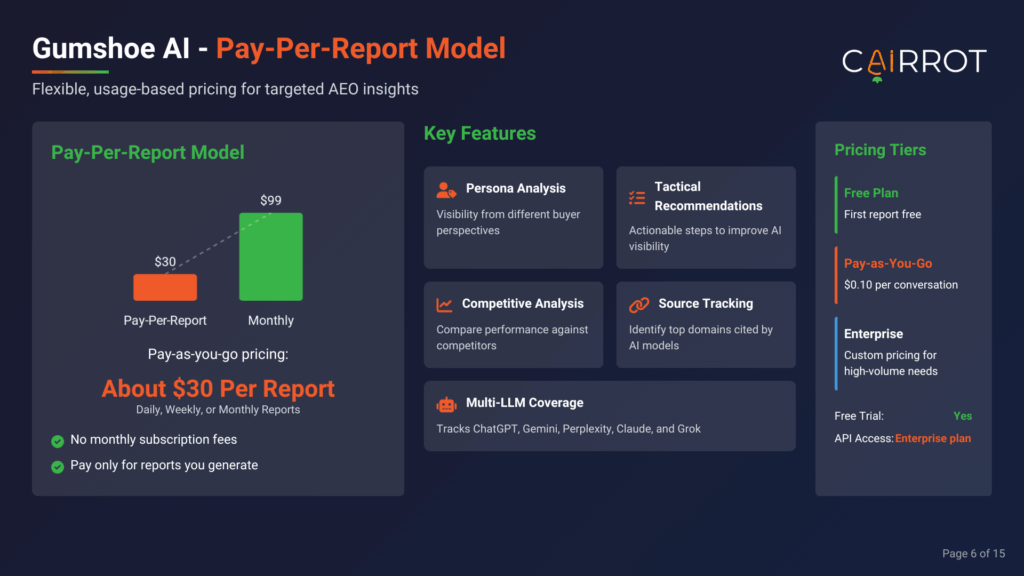
Gumshoe AI takes a completely different approach. Instead of a monthly subscription, you pay per report. This is perfect for one-off projects, initial client audits, or teams that don’t need continuous monitoring.
- Key Features: Persona-specific visibility analysis, tactical recommendations, competitive ranking comparisons, source citation tracking.
- Pricing: Starts as low as $30 per report.
- Free Trial: Yes, your first few reports are free.
- API: Yes, but it’s on their Enterprise plan.
- Integrations: Custom integrations are available for enterprise clients.
The beauty of Gumshoe is its simplicity. You define your brand, competitors, and prompts, and you get a detailed report. It’s an excellent way to dip your toes into AEO without committing to a monthly fee. The downside is that costs can add up quickly if you need frequent monitoring, and it lacks the continuous, dashboard-style view of a SaaS platform.
Pricing
- Free Plan: Your first 3 report runs are free.
- Pay-as-You-Go Plan: $0.10 per “;conversation” (one prompt paired with one AI model answer). No monthly subscription fees.
- Enterprise Plan: Custom pricing for high-volume needs, which includes API access and a dedicated success manager.
Key Features
- Persona-Specific Analysis: A unique feature that allows you to test visibility from the perspective of different buyer personas (e.g., “Technical Buyer” vs. “Business Decision-Maker”).
- Pay-Per-Report Model: Instead of a recurring subscription, you only pay for the reports you generate, making it highly flexible.
- Tactical Recommendations: Reports include actionable suggestions for improving AI visibility.
- Comprehensive AI Engine Coverage: Tracks a wide array of models, including multiple versions of ChatGPT, Gemini, Perplexity, Claude, and Grok.
- Competitive & Topic Visibility: Assesses your brand’s performance against competitors and across different topic areas.
- Cited Source Tracking: Identifies the top domains and URLs being cited by AI models for your target prompts.
Pros and Cons for Marketing Agencies
Pros:
- Powerful, enterprise-grade features can impress large corporate clients.
- SOC 2 compliance is a significant selling point for clients in regulated industries.
- Specialized e-commerce features are valuable for retail-focused agencies.
Cons:
- Extremely high price point makes it difficult to maintain profitability for most client accounts.
- Pricing model is not scalable for agencies managing many small-to-mid-sized clients.
- Lack of a flexible, accessible API on lower tiers limits custom reporting and integration.
- Lack of multi-account support makes it inefficient for managing separate client workspaces.
Summary
- Best for: One-off projects, initial client audits, and teams that do not require continuous, daily monitoring.
- Key Differentiator: The unique pay-per-report pricing model and its strategic, persona-based visibility analysis.
- Value Proposition: Offers a flexible, no-commitment way to gain valuable AEO insights, making it an excellent starting point or supplemental tool.
- Takeaway: Gumshoe AI is the perfect choice for tactical, project-based AEO analysis, but it’s not a replacement for a full-featured, continuous monitoring platform.
4. AthenaHQ: Premium, High Tech Option
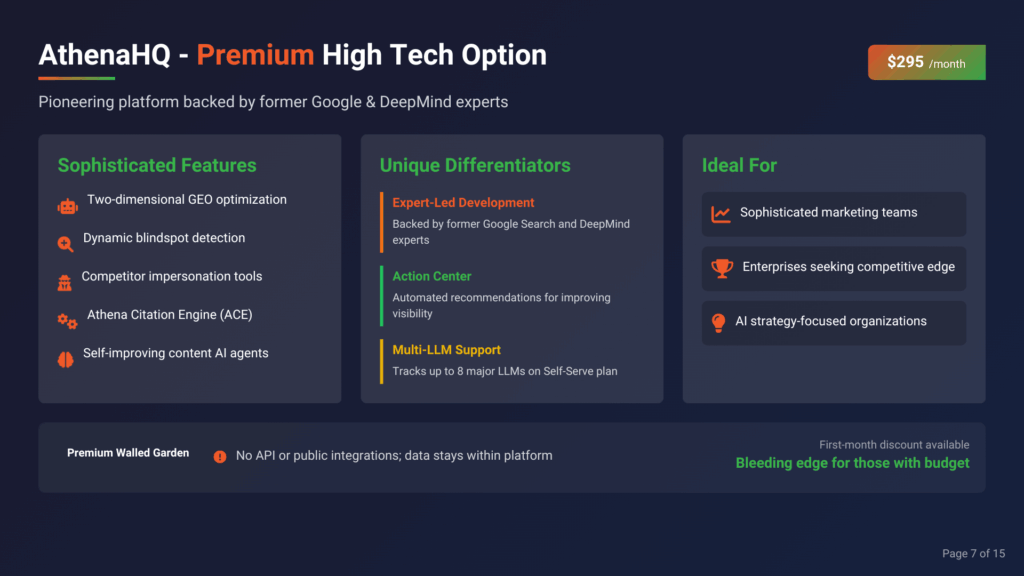
AthenaHQ is a pioneering platform with some hype behind it because it is backed by AI experts from Google and DeepMind, focusing on “two-dimensional GEO optimization” and dynamic blindspot detection. Its most unique features are its “Athena Citation Engine (ACE)” and competitor impersonation tools, suggesting an aggressive, strategy-focused approach. At $295/month with no free trial or API, it is geared towards sophisticated SEO, PR, and content teams looking for a competitive edge in AI search dominance.
- Key Features: Two-dimensional GEO optimization, dynamic AI crawling, Athena Citation Engine (ACE), self-improving content AI agents.
- Pricing: Starts at $295/month.
- Free Trial: No, but a first-month discount is offered.
- API: No.
- Integrations: No public integrations listed.
AthenaHQ is for teams that want to be on the absolute bleeding edge and have the budget for it. The lack of an API and public integrations makes it a bit of a walled garden, which can be a challenge for agencies needing to integrate data. It’s a powerful but expensive tool for those who want AI to not just track, but also strategize.
Pricing
- Self-Serve Plan: Starts at $295/month. This is a credit-based system, with the base plan including around 3,500-3,600 credits (1 credit = 1 AI response).
- Enterprise Plan: Custom pricing with custom credit allotments and additional features.
- Discounts: A first-month discount is often offered for the Self-Serve plan, and annual billing provides a ~17% discount.
- Free Trial: No free trial is available.
- API Access: No public API is advertised for the Self-Serve plan; likely reserved for custom Enterprise deals.
Key Features
- Expert-Led Development: Backed by former experts from Google Search and DeepMind, giving it strong technical credibility.
- Dynamic AI Crawling & Blindspot Detection: Aims to find hidden opportunities and parts of your website that AI crawlers may have missed.
- Athena Citation Engine (ACE): A proprietary technology focused on optimizing for and tracking citations.
- Competitor Impersonation: A tool designed to analyze and reverse-engineer competitor strategies in AI search.
- Action Center: Provides automated recommendations and workflows to improve visibility, moving beyond simple monitoring.
- Multi-LLM Support: Tracks up to 8 major LLMs on the Self-Serve plan.
Pros and Cons for Marketing Agencies
Pros:
- The “backed by ex-Google” pedigree can be a strong selling point for sophisticated clients.
- Action-oriented features provide concrete steps to show clients, moving beyond just data reporting.
- Enterprise plan offers features like a dedicated GEO specialist and SSO, suitable for large client accounts.
Cons:
- A high starting price of $295/month makes it a difficult sell for smaller clients.
- The credit-based system can lead to unpredictable costs, making it hard to budget for client work.
- Lack of a free trial creates a barrier to entry for evaluation.
- No public API on the standard plan limits integration with agency-wide reporting dashboards.
Summary
- Best for: Sophisticated, well-funded marketing teams and enterprises looking for a competitive edge in AI search dominance.
- Key Differentiator: A focus on aggressive, strategy-focused features like competitor impersonation and blindspot detection, backed by a team with deep industry expertise.
- Value Proposition: A premium, high-tech platform that aims to not just track AI visibility, but to actively strategize and automate improvements.
- Takeaway: AthenaHQ is a powerful but expensive tool for the bleeding edge. Its high cost and lack of a trial make it a considered purchase for teams with the budget and sophistication to leverage its advanced capabilities.
5. Evertune: Best for Large Companies (Fortune 500)
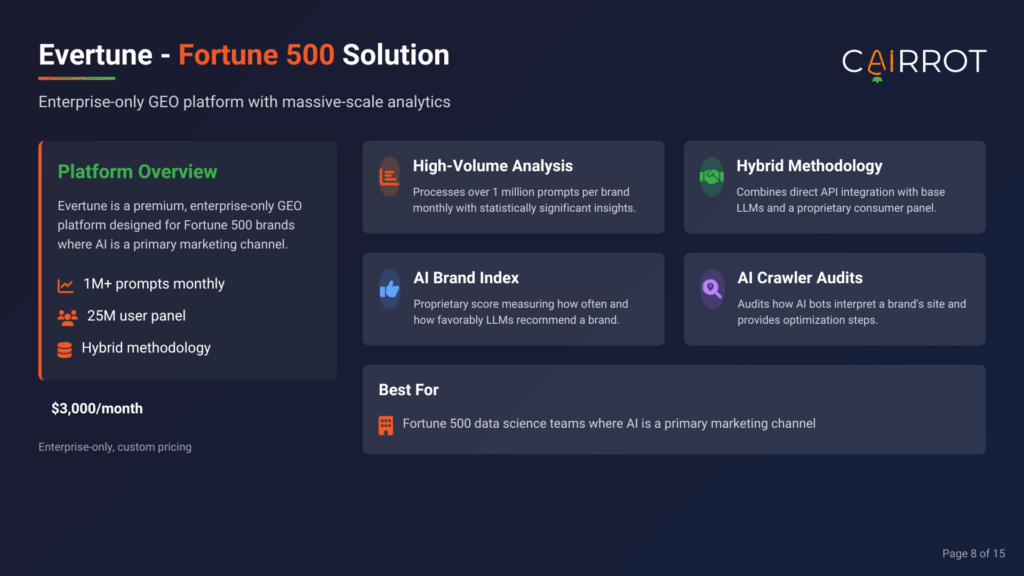
Evertune is a premium, enterprise-only GEO platform designed for Fortune 500 brands where AI is a primary marketing channel. Its key differentiator is its methodology, which combines direct API integration with base LLMs and a proprietary consumer panel (“EverPanel”) to deliver statistically accurate visibility measurement.
With a starting price of $3,000/month and no trial or public API, Evertune is built for high-stakes analysis, capable of processing over 1 million prompts per brand monthly to identify trends and influential sources.
If you’re a data scientist at a Fortune 500 company tasked with understanding AI visibility, Evertune is built for you. With a starting price of $3,000/month, it’s in a different league entirely.
- Key Features: High-volume prompt analysis (1M+ per month), direct integration with base LLMs, consumer panels for statistical insights, AI crawler audits.
- Pricing: Starts at $3,000/month.
- Free Trial: No.
- API: No, it seems to be a closed platform.
- Integrations: Partnership with impact.com for affiliate actions.
Evertune isn’t a tool for a typical marketing agency. It’s a high-powered analytics and business intelligence platform for enterprises where AI is a primary marketing and research channel. The cost is prohibitive for almost everyone else, but for its target market, the depth of data is unparalleled.
Pricing
- Starting Price: $3,000/month per brand.
- Model: Enterprise-only, with custom quotes based on scope and volume.
- Free Trial: No.
- API Access: No public API; it is a closed platform focused on delivering analyst-driven insights.
Key Features
- High-Volume Prompt Analysis: Capable of processing over 1 million prompts per brand monthly to ensure statistically significant insights.
- Hybrid Methodology: Combines direct API integration with base LLMs and a proprietary consumer panel (“EverPanel”) of 25 million users to validate data against real-world behavior.
- AI Brand Index: A proprietary score that measures how often and how favorably LLMs recommend a brand, tracking frequency, rank, and sentiment.
- Attribute & Sentiment Mapping: Identifies which product attributes (e.g., “safety,” “performance”) AI models associate with a brand and analyzes the sentiment of those associations.
- Data-Driven Content Strategy: Delivers a “messaging roadmap” with actionable insights on which narratives to reinforce and which content gaps to close.
- AI Crawler Audits: Audits how AI bots interpret a brand’s site and provides optimization steps to improve discoverability.
Pros and Cons for Marketing Agencies
Pros:
- The platform’s sophisticated, data-science-driven approach can be a powerful asset when servicing Fortune 500 clients.
- Provides deep, strategic insights that go far beyond basic mention tracking, enabling high-value consulting services.
Cons:
- The extremely high price point ($3,000/month) makes it unfeasible for all but the largest enterprise client accounts.
- As a closed, analyst-led platform, it doesn’t fit the typical agency workflow of self-serve dashboards and multi-client management.
- Lack of an API prevents integration into agency-wide reporting systems.
Summary
- Best for: Fortune 500 data science, marketing, and business intelligence teams where AI is a primary marketing channel.
- Key Differentiator: Its unique methodology combining massive-scale prompt analysis with a consumer panel for statistically accurate visibility measurement.
- Value Proposition: A high-powered business intelligence platform that provides enterprise-level strategic insights into brand perception and performance across the AI ecosystem.
- Takeaway: Evertune is in a class of its own, targeting the highest end of the market. It’s an enterprise analytics suite, not a typical AEO tracker, and its price and complexity reflect that focus.
6. Bluefish AI: Best for Brand Safety and Reputation Management
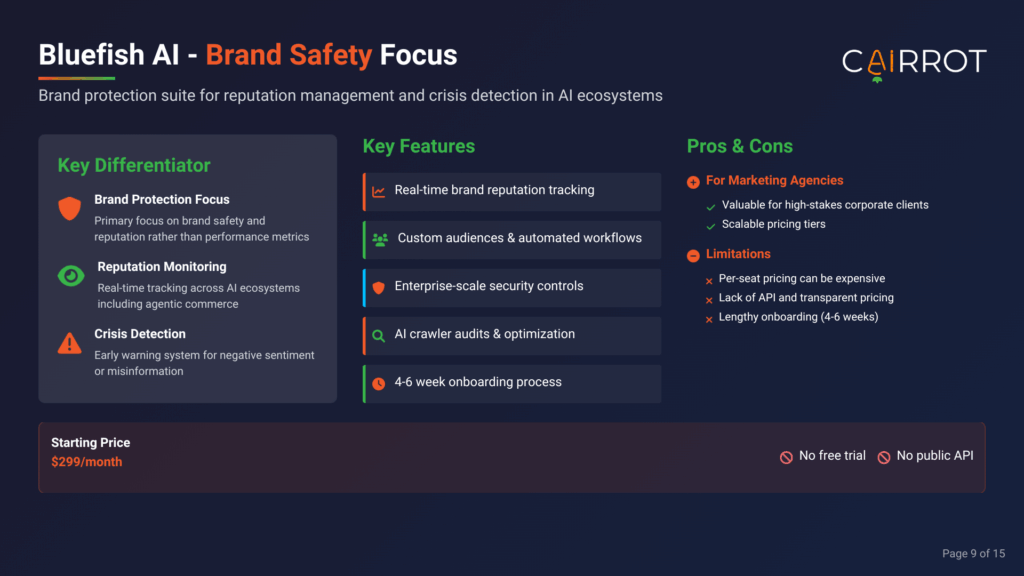
Bluefish AI is less of a rank tracker and more of a brand protection suite for the AI era. Its focus is on monitoring brand reputation, detecting crises, and ensuring brand safety across a wide range of AI ecosystems, including emerging areas like agentic commerce.
- Key Features: Real-time brand reputation tracking, custom audiences, automated GEO workflows, enterprise-scale security.
- Pricing: Starts at $299/month.
- Free Trial: No.
- API: No.
- Integrations: No public integrations listed.
For a large corporation’s PR or brand management team, Bluefish AI offers peace of mind. It’s designed to answer the question, “Is AI saying something negative or incorrect about our brand right now?” For performance-focused marketing agencies, it’s likely less practical than a tool focused on citation growth and competitive ranking.
Pros and Cons for Marketing Agencies
Pros:
- The focus on brand safety and reputation can be a valuable service offering for high-stakes corporate clients.
- Scalable pricing tiers offer some flexibility for agencies managing clients of different sizes.
Cons:
- The per-seat pricing model can become expensive for larger agency teams.
- Less focused on performance marketing metrics like citation growth and competitive ranking, which are often key agency deliverables.
- Lack of a public API and transparent pricing makes it difficult to integrate into standard agency processes and proposals
Summary
- Best for: Enterprise PR, corporate communications, and brand management teams focused on brand safety, reputation, and crisis detection in the AI era.
- Key Differentiator: A primary focus on brand protection and reputation management, rather than purely performance-oriented AEO tracking.
- Value Proposition: An AI-powered brand safety suite that provides peace of mind and control over how a brand is portrayed across AI channels.
- Takeaway: Bluefish AI is a specialized tool for a specific corporate function. While powerful for brand protection, it is less suited for marketing agencies or performance teams whose primary goal is to increase visibility and citations.
7. Scrunch AI: Premium LLM Monitoring and Optimization Tool for Agencies
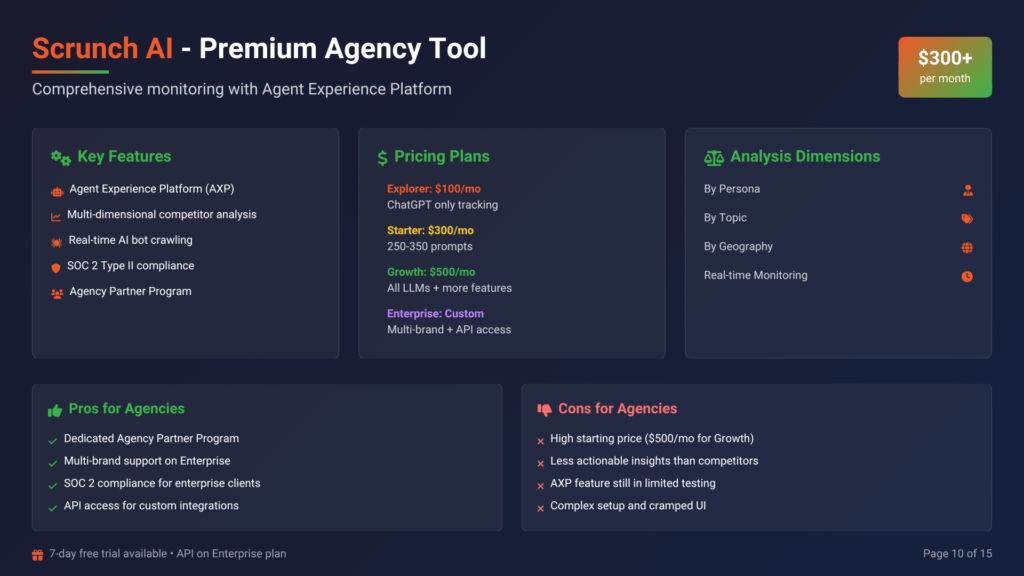
Scrunch AI offers a robust suite for brand monitoring and optimization, with a unique “Agent Experience Platform” that can generate AI-optimized versions of your site. Its strengths lie in real-time AI bot crawling monitoring and multi-dimensional competitor comparisons (by persona, topic, and geography).
Starting at $300/month, Scrunch AI offers a free trial and a data API, making it a strong contender for marketing and PR teams at mid-to-large enterprises needing deep competitive insights and compliance features.
- Key Features: AI bot crawling, AI-optimized site versions, multi-dimensional competitor comparisons, SOC 2 Type II compliance.
- Pricing: Starts at $300/month (monthly plans)
- Free Trial: Yes.
- API: Yes.
- Integrations: Data API for custom integrations.
Like Profound, Scrunch AI is SOC 2 compliant, making it a good fit for enterprise clients. However, its pricing model is fixed, which is a drawback for agencies. While the idea of an “Agent Experience Platform” is intriguing, I often find that tools trying to be both the analytics platform and the implementation solution can be a master of none.
Pricing
- Explorer Plan: $100/month (or $83/mo billed annually). Reportedly tracks ChatGPT only.
- Starter/Explorer Plan: I was quoted $300/month (or $250/mo billed annually) for an agency account with 250 prompts or $300 for a business account with 350 prompts.
- Growth Plan: $500/month (or $417/mo billed annually). Includes all LLMs, more prompts, and more features.
- Enterprise Plan: Custom pricing. Includes multi-brand support, API access, and SSO.
- Free Trial: Yes, a 7-day free trial is available upon request.
- API Access: Available on the Enterprise plan.
Key Features
- Agent Experience Platform (AXP): A unique feature in development that generates AI-optimized, machine-readable versions of your site to serve directly to AI crawlers.
- Multi-Dimensional Competitor Comparisons: Allows you to compare visibility against competitors by persona, topic, and geography.
- Real-Time AI Bot Crawling: Provides a feed and traffic trends to show how AI bots are crawling your site, often integrated with Google Analytics.
- SOC 2 Type II Compliance: Enterprise-ready security and compliance, making it a safe choice for large organizations.
- Agency Partner Program: Offers benefits for agencies, including free seats, co-selling support, and environments for client pitches.
- Actionable Insights: Aims to provide tips to improve rankings and uncover sites that AI frequently cites.
Pros and Cons for Marketing Agencies
Pros:
- The dedicated Agency Partner Program shows a clear commitment to supporting agency workflows.
- Multi-brand support and tools for client pitches on the Enterprise plan are highly valuable.
- SOC 2 compliance is a strong selling point for security-conscious enterprise clients.
- API access on the Enterprise plan allows for custom integrations and reporting.
Cons:
- The high starting price for meaningful features ($500/month for the Growth plan) is a significant investment per client.
- Some user reviews suggest the optimization insights are not as actionable as competitors, focusing more on monitoring.
- The most innovative feature (AXP) is still in limited testing and not widely available.
Pros and Cons For In-house Teams
Pros:
- Comprehensive monitoring across multiple LLMs and dimensions (persona, topic, geo) provides deep insights.
- SOC 2 compliance meets the stringent security requirements of large enterprises.
- The real-time AI bot crawling feed offers valuable visibility into how AI is interacting with your site.
- The promise of the Agent Experience Platform (AXP) is a compelling reason for future investment.
Cons:
- The platform is expensive, positioning it as a premium tool that may be out of reach for SMBs.
- User reviews have noted a complex setup and a UI that can feel cramped, impacting ease of use.
- Without integrated content editing tools, teams need to use other software to act on the insights provided, increasing total cost and complexity.
Summary
- Best for: Mid-to-large enterprises and well-funded agencies needing deep competitive insights and enterprise-grade compliance.
- Key Differentiator: The upcoming Agent Experience Platform (AXP) and its multi-dimensional competitor analysis.
- Value Proposition: A premium, secure, and comprehensive monitoring suite for brands that are serious about tracking and optimizing their presence in AI search.
- Takeaway: Scrunch AI is a powerful, enterprise-focused monitoring tool with a promising future. However, its high price point and current focus on analytics over execution mean it’s best suited for teams with significant budgets and existing content optimization workflows.
8. Nightwatch: Traditional SEO Tracker with AI Visibility Add-on
Nightwatch is a well-respected traditional SEO rank tracker that has smartly bolted on AI visibility tracking. This is a great option for agencies or in-house teams who want to keep their SEO and AEO reporting under one roof.
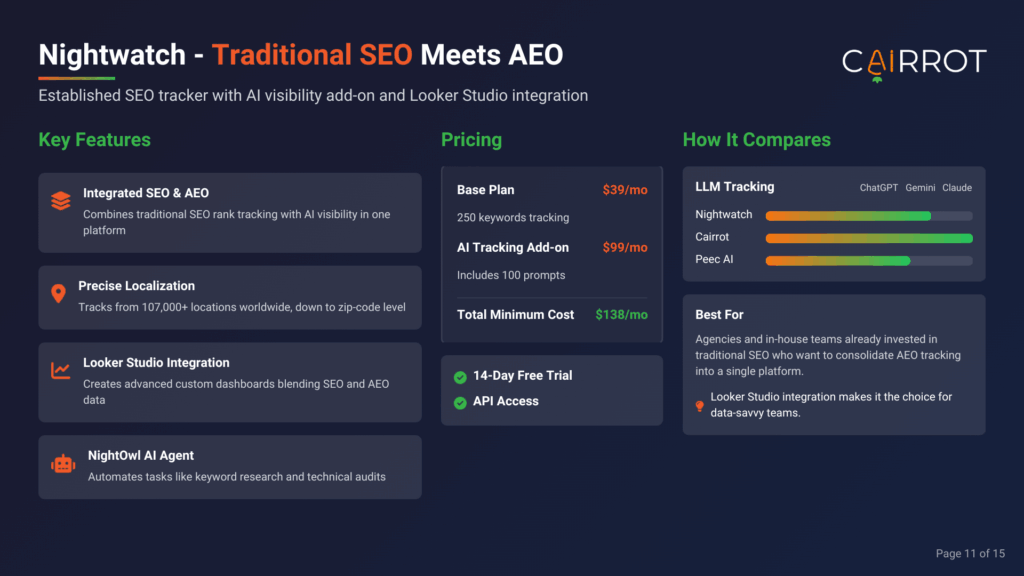
- Key Features: Integrated traditional SEO and AI tracking, precise zip-code level localization, high-precision data, Looker Studio integration.
- Pricing: Requires their base plan ($39/month) plus a $99/month AI Tracking Add-on, totaling $138/month.
- Free Trial: Yes (14 days).
- API: Yes, on higher-tier plans.
- Integrations: Google Analytics, Looker Studio.
The main appeal here is consolidation. If you already use and love Nightwatch for SEO, adding their AI tracking is a logical next step. The downside is that you’re paying for two systems, and the AEO features may not be as deep or innovative as a dedicated tool like Cairrot, Profound, or AthenaHQ. The Looker Studio integration is a major plus for data-savvy agencies.
Nightwatch’s AI visibility add-on is similar to Semrush’s AI Toolkit. While Semrush may be easier for beginners out-of-the-box, Nightwatch was my preferred tool when I tried out both. For marketing agencies, the Looker Studio integration cannot be ignored and makes Nightwatch an easy choice against Semrush.
Pricing
- Base Plans: Start at $39/month ($32/mo billed annually) for traditional SEO rank tracking (250 keywords).
- AI Tracking Add-on: $99/month. This is required for LLM tracking and includes 100 prompts.
- Total Minimum Cost for AI Tracking: ~$138/month (Base Plan + AI Add-on).
- Free Trial: Yes, a 14-day free trial is available.
- API Access: Available on higher-tier base plans.
Key Features
- Integrated SEO & AEO Tracking: Combines traditional SEO rank tracking (Google, Bing) with AI visibility tracking (ChatGPT, Gemini) in a single platform.
- Precise Localization: A core strength of Nightwatch, offering the ability to track rankings from over 107,000 locations worldwide, including down to the zip-code level.
- Looker Studio Integration: A major feature that allows for the creation of advanced, custom dashboards, blending SEO and AEO data.
- High-Precision Data: Known in the SEO community for its highly accurate rank tracking data.
- NightOwl AI Agent: An AI assistant within the platform that automates tasks like keyword research, technical audits, and provides ranked recommendations.
- White-Label Reporting: Offers unlimited white-label reports, a key feature for agencies.
Pros and Cons for Marketing Agencies
Pros:
- The Looker Studio integration is a game-changer for creating sophisticated, custom client reports.
- Consolidates SEO and AEO reporting into one tool, simplifying the agency tech stack and workflows.
- Unlimited white-label reports and user seats on most plans provide excellent value.
- Precise localization is perfect for agencies serving clients with local or regional businesses.
Cons:
- The AI tracking is an add-on, which can feel less integrated than a purpose-built AEO platform.
- The total cost can be higher than some dedicated AEO tools if you don’t need the full suite of traditional SEO features.
- The AI features, being newer, may not be as deep or innovative as those in specialized platforms.
Summary
- Best for: Agencies and in-house teams already invested in traditional SEO who want to consolidate AEO tracking into a single, powerful platform.
- Key Differentiator: The powerful combination of high-precision, localized SEO rank tracking with an integrated AI visibility add-on and a best-in-class Looker Studio integration.
- Value Proposition: A unified solution for modern search visibility, bridging the gap between traditional SERPs and AI-generated answers.
- Takeaway: Nightwatch is the logical choice for data-savvy teams who value consolidation and deep integration. If you need both SEO and AEO tracking, it offers excellent value, especially for agencies that will leverage its reporting capabilities.
9. Peec AI: Best for European Strategy Recommendations
Peec AI focuses on not just showing you the data, but telling you what to do with it. It uses AI to provide strategy recommendations and has strong features for managing and even suggesting prompts to track.
- Key Features: AI-driven strategy recommendations, advanced prompt management, competitor benchmarking, source analysis from reviews, social, and forums.
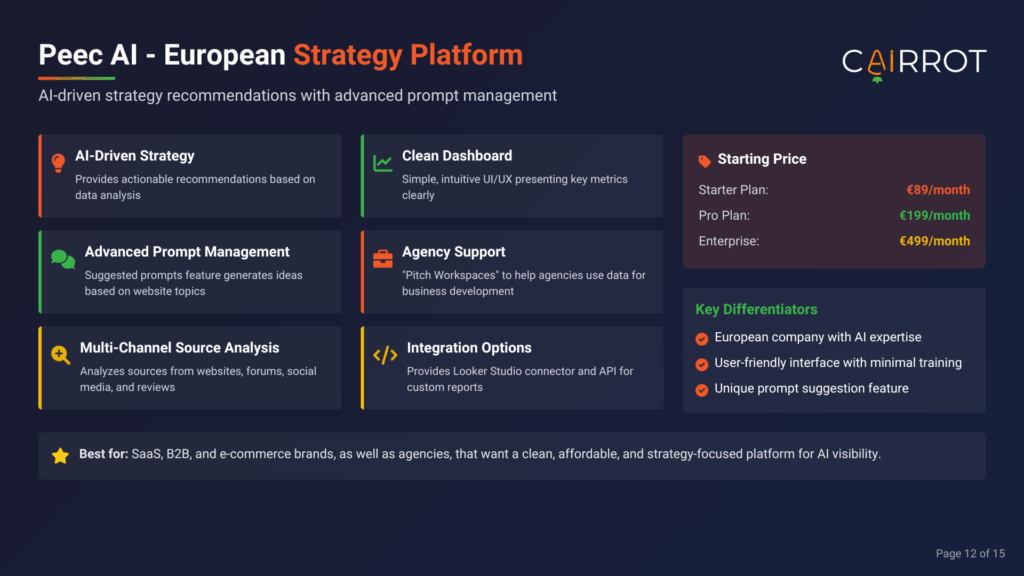
- Pricing: Starts at €89/month (~$97).
- Free Trial: Yes.
- API: Yes.
- Integrations: Looker Studio.
Peec AI is a strong, affordable option that competes well with Cairrot on price. Its ability to pull in source analysis from beyond just websites (like forums and social media) is a unique strength. For teams that need a bit more hand-holding on strategy, Peec AI is an excellent choice.
Pricing
- Starter Plan: €89/month (~$97). Includes 25 prompts across ChatGPT, Perplexity, and AIO.
- Pro Plan: €199/month (~$217). Includes 100 prompts and adds Slack support.
- Enterprise Plan: Custom pricing (starts around €499/month). Includes 300+ prompts and a dedicated account rep.
- Add-ons: Tracking for Gemini, Claude, and other models is available for an additional fee on Enterprise plans.
- Free Trial: Yes, a 7-day free trial is available.
Key Features
- AI-Driven Strategy Recommendations: A key focus of the platform is to provide strategic recommendations based on the data, telling you what to do next.
- Advanced Prompt Management: Includes a ‘Suggested’ prompts feature that generates ideas based on your website’s topics, reducing guesswork.
- Source Analysis from Multiple Channels: Uniquely analyzes sources from not just websites but also forums, social media, and reviews.
- Clean, User-Friendly Dashboard: Praised for its simple, intuitive UI/UX that presents key metrics like Visibility, Position, and Sentiment clearly.
- Agency Support: Offers “Pitch Workspaces” to help agencies use data to win new business.
- Integrations: Provides a Looker Studio connector and an API to export data and build custom reports.
Pros and Cons for Marketing Agencies
Pros:
- Affordable pricing makes it a strong, budget-friendly option for offering AEO services.
- The “Pitch Workspaces” feature is specifically designed to help agencies with business development.
- The Looker Studio connector and API allow for flexible, client-ready reporting.
- The clean UI is easy for clients to understand, and unlimited seats on all plans is a huge plus for growing teams.
Cons:
- Core LLMs like Claude and Gemini are gated behind the expensive Enterprise plan as add-ons.
- More focused on monitoring and strategy than hands-on execution tools.
- Being a European company, it may lack SOC 2 compliance, which can be a requirement for some US-based enterprise clients.
Summary
- Best for: SaaS, B2B, and e-commerce brands, as well as agencies, that want a clean, affordable, and strategy-focused platform for AI visibility.
- Key Differentiator: Its user-friendly interface combined with AI-driven strategy recommendations and a unique prompt suggestion feature.
- Value Proposition: An accessible and intuitive analytics platform that makes it easy to track brand performance in AI search and get strategic direction without being overwhelmed by data.
- Takeaway: Peec AI is a strong contender in the affordable AEO tool space. It’s an excellent choice for teams that value simplicity, strategic guidance, and a great user experience over a vast, complex feature set.
10. AirOps: Known for Integrated AI Content Workflows
AirOps is less of a pure rank tracker and more of a content operations platform that has AEO baked in. It’s designed for teams that need to scale the creation of AEO-optimized content.
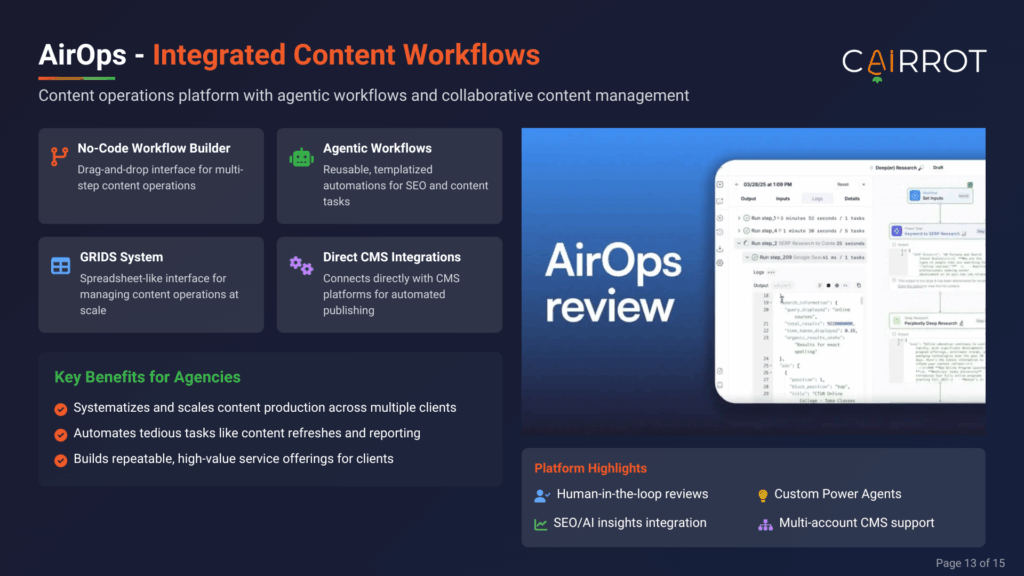
- Key Features: Unified SEO and AI insights, agentic workflows for content optimization, collaborative content management system (GRIDS), custom Power Agents.
- Pricing: Custom (contact sales), with a limited free plan available.
- Free Trial: Yes (free plan and trial).
- API: Partial (via integrations and bring-your-own-keys).
- Integrations: Deep integrations with CMS and LLMs.
If your primary bottleneck is creating enough high-quality, AI-friendly content, AirOps is the tool for you. It helps you build repeatable workflows (or “agents”) to diagnose, optimize, and create content at scale. It’s a powerful solution for content-heavy businesses, but might be overkill for an agency just looking to add LLM rank tracking as a service.
Pricing
- Solo Plan: Free. Includes 1 user and 1,000 tasks per month.
- Scale Plan: Custom pricing (contact sales). Includes unlimited tasks and users, Semrush data, and SSO.
- Agency Plan: Custom pricing (contact sales). Includes everything in Scale plus multi-account CMS integrations.
- Legacy Paid Plans: Previous plans started around $99-$199/month, but the company has shifted to a custom pricing model for its main offerings.
- Free Trial: The free Solo plan serves as a perpetual trial.
Key Features
- No-Code Workflow Builder: The core of the platform, allowing users to create and automate multi-step content operations (e.g., research, drafting, optimizing, publishing) with a drag-and-drop interface.
- Agentic Workflows: Build “Power Agents” or “Power Steps” – reusable, templatized automations for specific SEO and content tasks like competitor analysis or content refreshes.
- GRIDS (Content Planner): A spreadsheet-like interface for managing content operations at scale, allowing you to run workflows on hundreds of pages at once.
- Direct CMS Integrations: Connects directly with CMS platforms like WordPress and Webflow to publish content without manual copy-pasting.
- Human-in-the-Loop Reviews: Workflows can include checkpoints for manual human review and approval before content is published.
- Unified SEO/AI Insights: Integrates with tools like Semrush to pull in SEO data and combines it with AI visibility signals.
Pros and Cons for Marketing Agencies
Pros:
- The workflow builder is powerful for systematizing and scaling content production across multiple clients.
- The dedicated Agency plan with multi-account CMS integrations is built for agency needs.
- Automating tedious tasks like content refreshes and reporting can significantly improve agency efficiency.
- Can be used to build repeatable, high-value service offerings for clients.
Cons:
- Custom pricing makes it difficult to budget and price for clients without a sales call.
- Has a steep learning curve; it’s a powerful builder, not a simple “plug-and-play” tool.
- Might be overkill for agencies that only need to add basic LLM rank tracking as a service.
- Focus is on content *operations*, not just monitoring, which may not align with all agency service models.
Summary
- Best for: Content-heavy businesses, SEO teams, and agencies that have established content strategies and need to scale their operations through automation.
- Key Differentiator: Its powerful, no-code workflow builder designed specifically for content and SEO operations.
- Value Proposition: An AI-powered content orchestration system that helps teams execute complex content strategies faster and more consistently.
- Takeaway: AirOps is not a simple rank tracker; it’s a content operations engine. For teams whose bottleneck is execution and scale, it’s a game-changer. For those just needing to monitor AI visibility, it’s likely overkill.
11. Semrush AI Toolkit: Low Effort Add-on to a Traditional SEO Platform
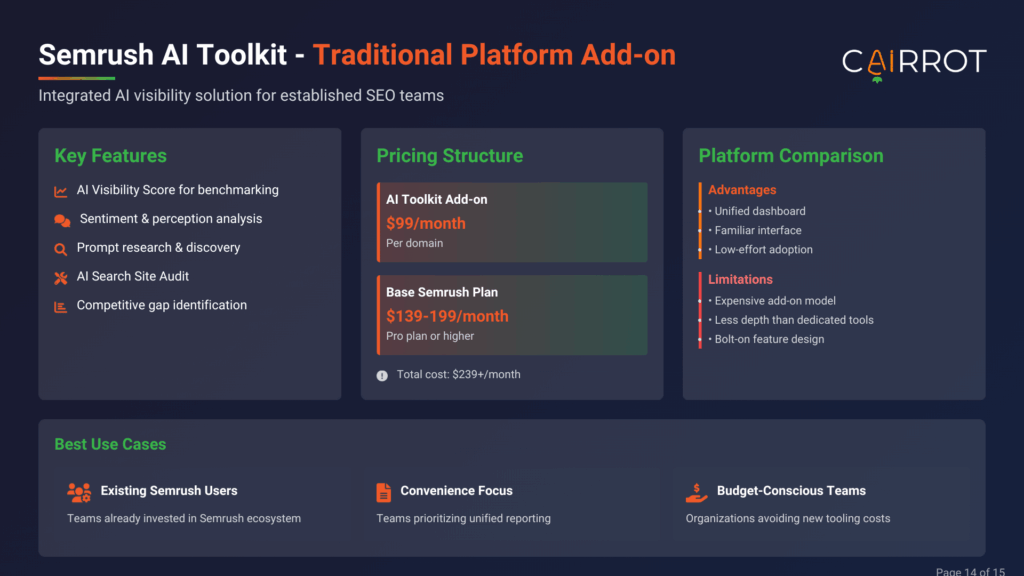
Semrush’s AI Visibility Toolkit is an add-on designed as an extension of their established SEO platform, allowing users to dip into AEO without switching tools. It’s a convenient choice for teams already invested in Semrush, providing basic insights into AI-generated answers. However, it lacks the depth and precision of dedicated LLM trackers, making it feel more like a bolt-on feature than a standalone solution.
- Key Features: AI Visibility Score for benchmarking, sentiment and perception analysis, prompt discovery and tracking, site audits for AI crawler issues, competitive gap identification, report generation.
- Pricing: Starts at $99/month as an add-on. Requires an active Semrush subscription (base plans start around $140/month), so total costs can exceed $200/month quickly.
- Free Trial: Yes (7 days).
- API: No.
- Integrations: Integrates with Semrush’s core SEO tools, including keyword research, backlink analysis, and reporting dashboards.
For SEO teams already using Semrush, this toolkit is a low-effort way to start monitoring AI visibility without adding a new vendor. The unified dashboard is a plus, combining traditional SEO metrics with AI data. That said, its reliance on probabilistic modeling rather than direct LLM access can lead to less accurate insights, and the add-on pricing feels steep for what it offers compared to dedicated tools. If you’re not locked into Semrush, more specialized options like Cairrot, and Gumshoe AI, and even AthenaHQ provide better value and flexibility for pure AEO needs.
Pricing
- AI Visibility Toolkit Add-on: $99/month. This requires an active Semrush subscription.
- Base Semrush Subscription: Starts at ~$139.95/month (Pro plan).
- Total Minimum Cost: ~$239/month (Pro Plan + AI Toolkit).
- Semrush One Plan: Starts at $199/month (introductory pricing), bundling SEO and some AI features with 50 prompts.
- Scaling Costs: Costs add up quickly. Each additional domain is +$99/mo, each additional user is +$99/mo, and 50 extra prompts are +$60/mo.
- Free Trial: No free trial for the toolkit, but a free demo report is available.
Key Features
- AI Visibility Score: A benchmark score to measure a brand’s overall presence in AI-generated answers.
- Integrated Reporting: Combines traditional SEO metrics with AI visibility data in a unified dashboard for users already on the Semrush platform.
- Sentiment and Perception Analysis: Analyzes brand sentiment and key narratives driving reputation in AI responses.
- Prompt Research: A feature similar to keyword research, but for AI prompts, showing estimated volume, difficulty, and intent.
- AI Search Site Audit: A widget within the standard Site Audit tool that checks for technical issues that might block AI crawlers.
- Competitive Gap Identification: Highlights prompts and topics where competitors are visible, but you are not.
Pros and Cons for Agencies and Freelancers
Pros:
- Seamless integration for agencies already heavily invested in the Semrush ecosystem for SEO and client reporting.
- The unified dashboard simplifies reporting by keeping SEO and AEO data in one place.
- The Semrush brand is well-known and trusted, which can add credibility to client reports.
Cons:
- The pricing model is extremely expensive for agencies. The $99/month fee is per domain, making it cost-prohibitive to roll out across all clients.
- Adding team members is also costly ($99/user/mo), which hurts scalability for agency teams.
- The features feel like a “bolt-on” and are less deep and innovative than dedicated, purpose-built AEO tools.
Summary
- Best for: Teams and agencies who are already power users of Semrush and prioritize the convenience of a single, unified platform over cost or feature depth.
- Key Differentiator: Its native integration into the comprehensive and widely-used Semrush SEO platform.
- Value Proposition: A convenient, albeit expensive, add-on for existing Semrush customers to get a basic overview of their AI visibility.
- Takeaway: The Semrush AI Toolkit is a logical but costly add-on for those already embedded in its ecosystem. However, for anyone not locked into Semrush, more specialized and affordable tools offer significantly better value and deeper AEO-specific features.