
01
Multi-LLM Monitoring
Track visibility across ChatGPT, Gemini, Perplexity, Claude, Grok, and DeepSeek from one dashboard.
6 major LLMs
One view
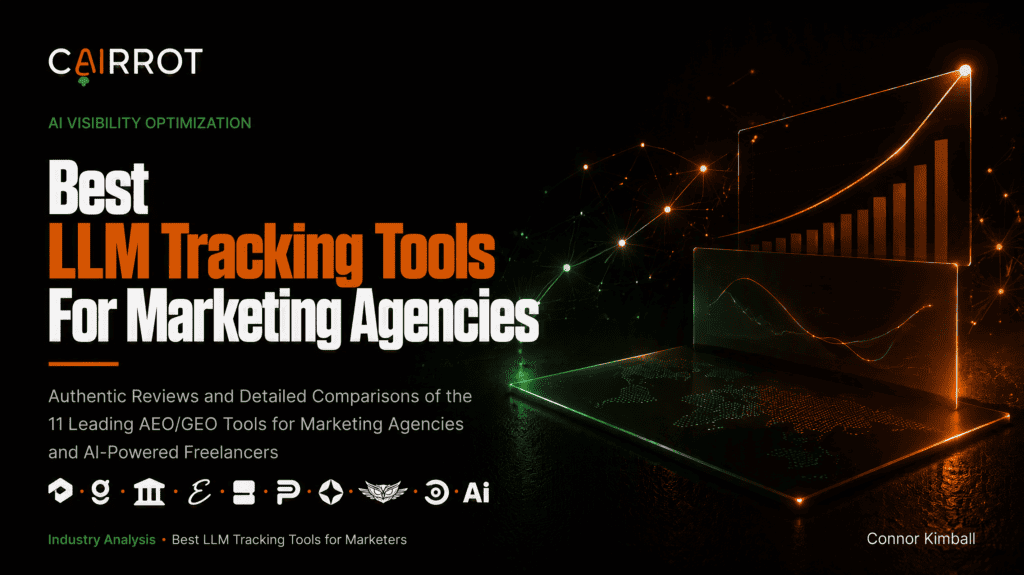
As digital marketers like us navigate the new world of Answer Engine Optimization (AEO), knowing how to track and optimize websites for AI search and Large Language Models (LLMs) is no longer optional, it’s required for survival.
The range of AEO/GEO tools available includes several categories, with LLM rank trackers, also called AI visibility tools, emerging as a newer software category alongside traditional SEO rank trackers.
AI/LLM visibility tools are crucial for tracking brand mentions and source citations within AI-generated answers from platforms like ChatGPT, Gemini, Perplexity, Claude, and Grok.
For most marketing agencies, flexibility and affordability are key, along with a multi-agent interface that makes it easy to manage several websites.
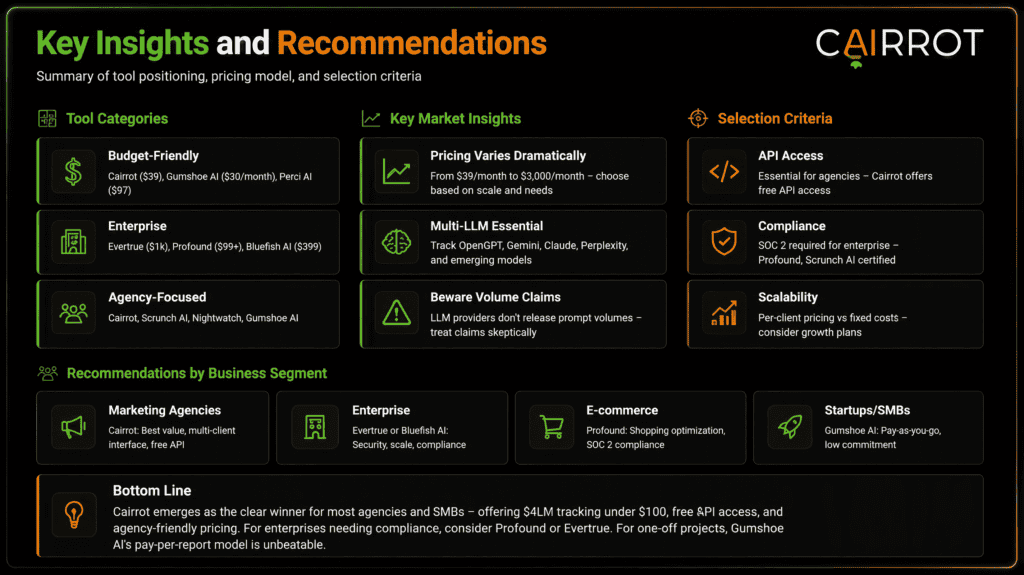
Cairrot and Gumshoe AI stand out for marketing agencies because of their pricing models and interfaces designed for managing multiple brands. Scrunch AI also targets marketing agencies, but starts at a much higher price and does not offer as significant an upgrade in features compared with alternatives.
Bluefish AI and Evertune stand out for enterprise companies due to their security and compliance standards and customizable setups. With its API, Cairrot is an affordable alternative for growth teams at midsize and enterprise companies that need detailed AEO/GEO tracking data inside their own analytics setup. Profound is another advanced option focused on ecommerce brands.
Claims of “prompt volume” data from tools like Profound and Scrunch AI should be viewed critically, since LLM providers do not currently release this information publicly.
Cairrot is the only tool that tracks five major LLMs for under $100 (ChatGPT, Perplexity, DeepSeek, Claude, Gemini). It is also the only option for Grok rank tracking under $100 ($39 Starter Plan + $25 Grok add-on).
LLM Rank Trackers, also known as AI Visibility, LLM Monitoring, or Answer/Generative Engine Optimization (AEO/GEO) tools, are a new class of software designed to help marketers measure and improve their presence in the answers generated by AI models. Unlike traditional SEO rank trackers that monitor a URL’s position for a keyword on a SERP, these tools analyze the output of conversational AI.
At their core, they help you answer critical questions like:
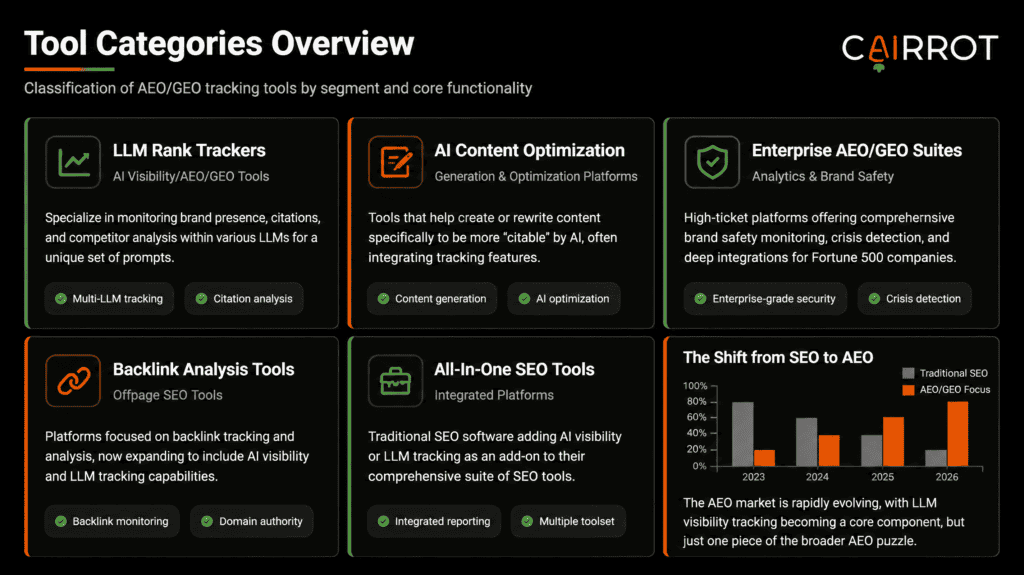
The world of GEO is new, and the tools supporting it are rapidly evolving. LLM visibility tracking is a core component, but it’s just one piece of the puzzle. The SEO tools market is generally segmented into five key categories: LLM Rank Trackers (AEO/GEO Trackers), AI SEO Content Generation Platforms, Enterprise AEO/GEO Platforms, Backlink Analysis Tools, and All-In-One SEO/GEO Platforms.
The primary focus of this guide. LLM trackers tools specialize in monitoring brand presence, citations, and sentiment across various LLMs for a given set of prompts.
AI Content Optimization & Generation Platforms are the tools (like AirOps) help you create or rewrite content specifically to be more “citable” by AI, often integrating tracking features to measure the impact.
Enterprise AEO/GEO Suites are high-ticket platforms (like Evertune or Bluefish AI) that offer comprehensive brand safety monitoring, crisis detection, crawler analytics, and deep integrations for Fortune 500 companies.
Integrated SEO/AEO Platforms are traditional SEO tool sets (like Semrush or Nightwatch) that are adding LLM tracking as a feature or add-on to their existing suite of tools.
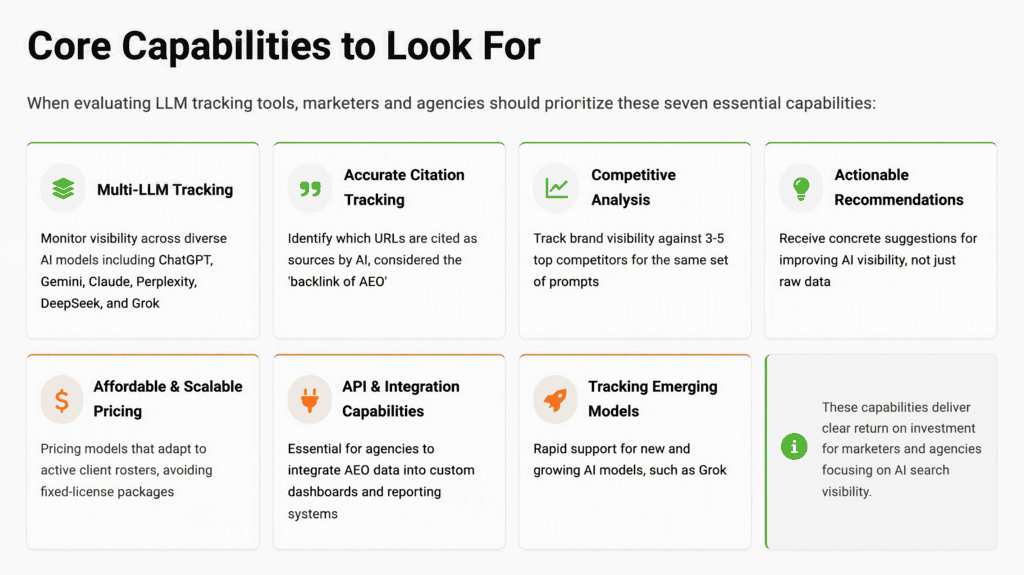
When evaluating LLM tracking tools, most digital marketers and agencies are looking for a specific set of features and outcomes that deliver clear ROI. Here’s what matters most:
Here’s a a quick-view table comparing the top tools on the market. We dive deeper into each software in the subsequent reviews.
| AI Visibility Tool | Starting Price | Key Differentiators | API | Free Trial |
|---|---|---|---|---|
| Cairrot Featured | $39.99/month |
|
Yes · Free | YesContact for details |
| Profound | $99/month |
|
No | Demo availableNo free trial |
| Gumshoe AI | ~$30/report |
|
Enterprise | YesFirst 3 reports free |
| AthenaHQ | $295/month |
|
No | No |
| Evertune | $3,000/month |
|
No | No |
| Bluefish AI | $299/month |
|
No | No |
| Scrunch AI | $250/month |
|
Yes | Yes |
| Nightwatch | $138/month |
|
Higher plans | Yes · 14 days |
| Peec AI | ~$97/month |
|
Yes | Yes · 7 days |
| AirOps | Custom |
|
PartialIntegrations / BYO keys | YesFree plan + trial |
| Semrush AI Visibility Toolkit | $99/month |
|
No | NoFree demo report available |
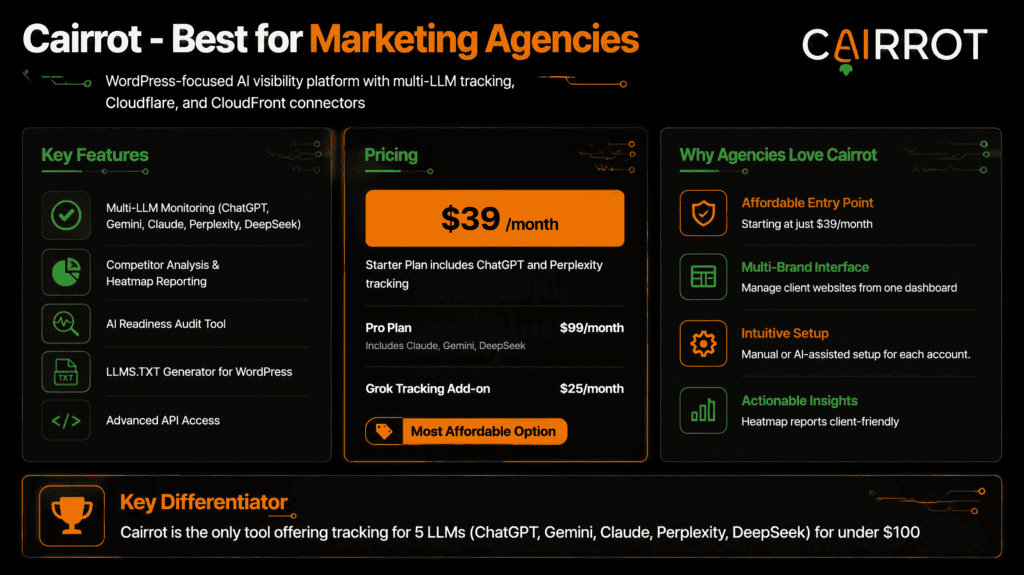
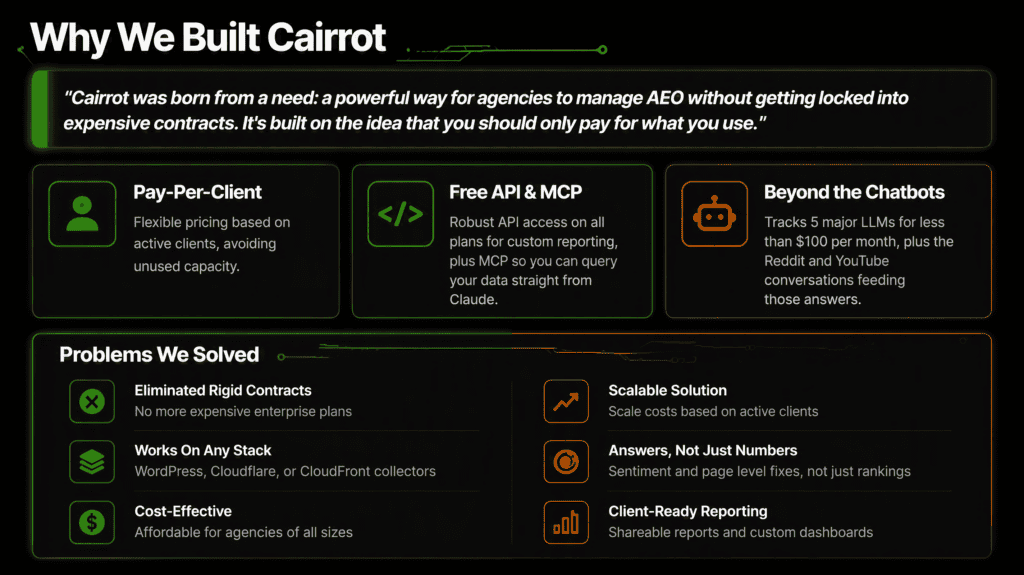
Cairrot is positioned as the affordable entry point into AEO tracking. Crawler tracking runs through three server side collectors, a WordPress plugin, Cloudflare, and CloudFront, so it drops into most stacks rather than just WordPress sites. Its key differentiators include its affordability (lowest cost option for Grok and Claude tracking, significantly lower entry price compared to most competitors on this list), and an advanced API and MCP available for free on every plan. The MCP connection means you can hook Cairrot up to your own LLM chat and pull visibility data straight into a conversation.
Cairrot emphasizes practical, actionable features while constantly experimenting with new ones as AEO best practices evolve. The free plugins for LLM bot tracking and the free, advanced API make it particularly attractive for agencies and in-house teams at small to midsize companies looking to experiment with AEO without a massive upfront investment. Starting at just $39.99/month with a free trial available, it offers the lowest cost of entry among the top tools.
Cairrot’s core focus in 2026 is establishing itself as an affordable, flexible AEO tool that provides the Advanced LLM Analytics desired by marketing agencies, growth teams, and cutting-edge solo marketers.
Track visibility across ChatGPT, Gemini, Perplexity, Claude, Grok, and DeepSeek from one dashboard.
Measure how much of the AI conversation you own, then benchmark it against every competitor you track.
See who gets mentioned and cited by model or topic, making underserved conversations easy to spot.
Get page-by-page health scores, opportunity levels, and specific actions to improve AI visibility.
Monitor the Reddit and YouTube conversations feeding AI answers, including citations, mentions, sentiment, and source threads.
Understand the language AI uses about your brand, from positive and neutral phrases to competitive comparisons.
Share month-over-month traffic, AI visibility, citations, and channel performance in one presentation-ready view.
Programmatic access to visibility data, citations, and crawl logs so agencies can automate reporting, power BI tools, or connect Cairrot to an existing SEO stack.
Compare how your AI visibility shifts city by city, so you can see which markets you own and which ones a competitor holds.
Cairrot’s lowest priced plan, Starter, is $39 per month and includes tracking for ChatGPT, Perplexity, and Claude. Cairrot’s Pro Plan ($99 per month) adds Gemini and DeepSeek. Grok tracking is an available add-on with any plan, starting at only $25 per month. Cairrot’s API and MCP are available for free on every plan, where you can find how to connect here , including the $39 Starter, so you can pull visibility data into your own dashboards or query it straight from Claude or any other LLM chat.
Cairrot offers a free trial to sample their reports and explore the product. For users who just want to track where and when AI/LLM bots crawl their websites, Cairrot’s free WordPress plugin provides this feature without requiring a paid plan, and Cloudflare and CloudFront collectors cover sites that don’t run WordPress.
Social tracking is the newest addition and one of the harder features to find elsewhere at any price. Reddit and YouTube are two of the sources AI leans on most heavily when answering questions about brands, and Cairrot monitors both, showing your citation share, brand mentions, and sentiment across those conversations, ranking every competitor by mentions, and surfacing the exact threads and videos the models are pulling from.
Cairrot can be considered the most affordable LLM Tracker for marketing agencies because:
For agencies looking to offer cutting-edge AEO services without destroying their margins, Cairrot is a strong choice.
Reddit + YouTube tracking surfaces the exact threads and videos feeding AI answers in a client's market.
Free API and MCP access on every plan makes it easier to build white-labeled dashboards, automate reporting, and query client data through Claude.
Sentiment tracking shows how AI describes a brand, not just whether the brand appears.
On-page insights give teams a page-level fix list, turning visibility data into a ready-made content queue.
Affordable, scalable pricing helps agencies preserve healthy margins as they add more AEO clients.
Prompt caps can feel tight at some tiers for agencies tracking broad topic coverage or managing larger client rosters.
Cairrot is focused on tracking and diagnostics. It shows teams what to fix, but it does not automatically create the content that makes those fixes.
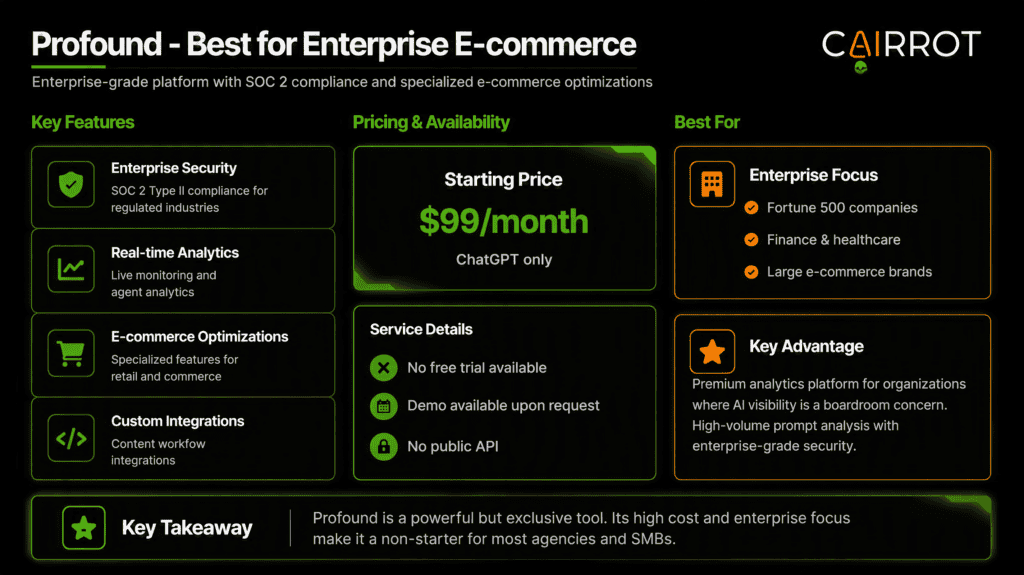
Profound targets the enterprise market with a focus on governance, security, and advanced analytics. Its standout features include real-time “AI search volume” insights and specialized optimizations for e-commerce within ChatGPT. With SOC 2 Type II compliance, it’s built for regulated industries like finance and healthcare. The starting price of $99/month (for ChatGPT only) and lack of a free trial or public API position it as a solution for larger brands with dedicated AEO budgets.
While powerful, its claim of providing “AI search volumes” is something I’m critical of (more on that in the FAQ). For a large e-commerce company that needs SOC 2 compliance and has a dedicated AEO budget, Profound is a strong contender. However, its pricing model and lack of a flexible API make it a tough sell for most agencies.
Powerful enterprise-grade features can impress large corporate clients.
SOC 2 compliance is a significant selling point for clients in regulated industries.
Specialized ecommerce features are valuable for retail-focused agencies.
Extremely high pricing can eat into profitability for lower-revenue client accounts.
The pricing model is difficult to scale for agencies managing many small to mid-sized clients.
No flexible, accessible API on lower tiers limits custom reporting and integrations.
Reported lack of multi-account support can make separate client workspaces inefficient to manage.
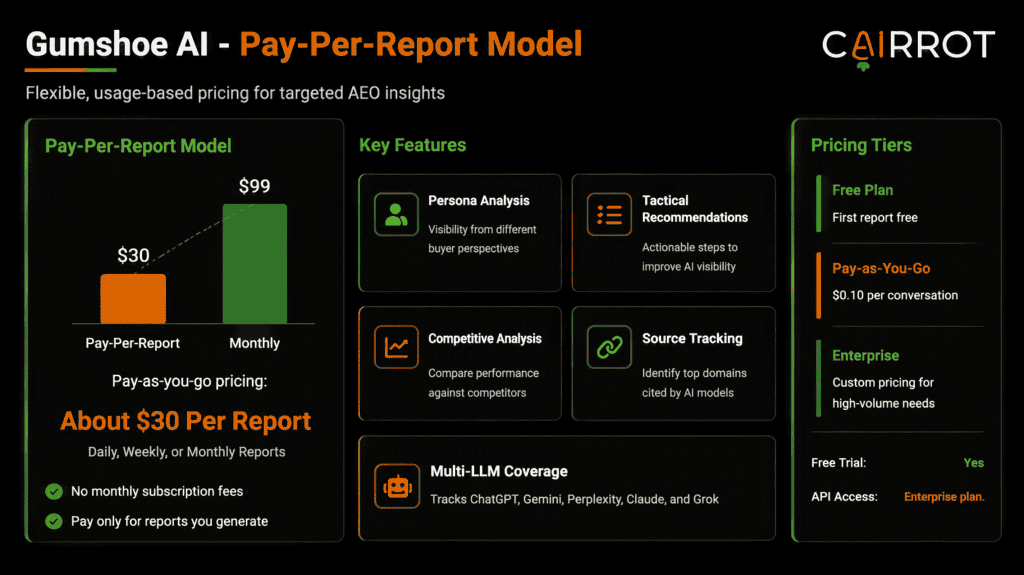
Gumshoe AI takes a completely different approach. Instead of a monthly subscription, you pay per report. This is perfect for one-off projects, initial client audits, or teams that don’t need continuous monitoring.
The beauty of Gumshoe is its simplicity. You define your brand, competitors, and prompts, and you get a detailed report. It’s an excellent way to dip your toes into AEO without committing to a monthly fee. The downside is that costs can add up quickly if you need frequent monitoring, and it lacks the continuous, dashboard-style view of a SaaS platform.
Powerful enterprise-grade features can impress large corporate clients.
SOC 2 compliance is a significant selling point for clients in regulated industries.
Specialized ecommerce features are valuable for retail-focused agencies.
Extremely high pricing makes it difficult to maintain profitability for most client accounts.
The pricing model is not scalable for agencies managing many small to mid-sized clients.
Lack of a flexible, accessible API on lower tiers limits custom reporting and integration.
Lack of multi-account support makes it inefficient for managing separate client workspaces.
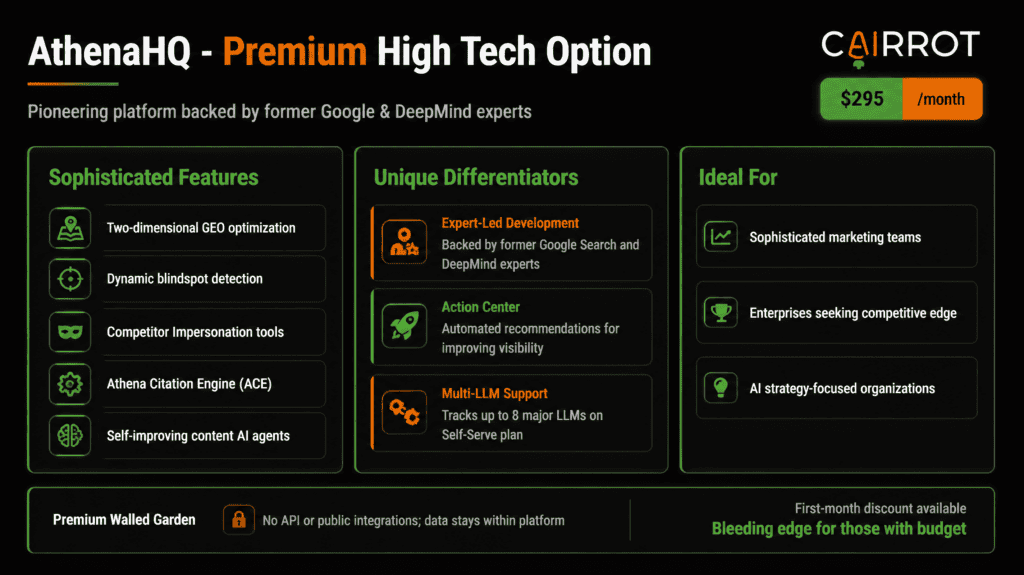
AthenaHQ is a pioneering platform with some hype behind it because it is backed by AI experts from Google and DeepMind, focusing on “two-dimensional GEO optimization” and dynamic blindspot detection. Its most unique features are its “Athena Citation Engine (ACE)” and competitor impersonation tools, suggesting an aggressive, strategy-focused approach. At $295/month with no free trial or API, it is geared towards sophisticated SEO, PR, and content teams looking for a competitive edge in AI search dominance.
AthenaHQ is for teams that want to be on the absolute bleeding edge and have the budget for it. The lack of an API and public integrations makes it a bit of a walled garden, which can be a challenge for agencies needing to integrate data. It’s a powerful but expensive tool for those who want AI to not just track, but also strategize.
Backed by ex-Google talent can be a strong selling point for sophisticated clients.
Action-oriented features provide concrete steps to show clients, moving beyond basic data reporting.
Enterprise plan features like a dedicated GEO specialist and SSO are suitable for large client accounts.
$295 per month starting price can make it a difficult sell for smaller clients.
Credit-based pricing can create unpredictable costs, making client work harder to budget.
No free trial creates a higher barrier to entry for evaluation.
No public API on the standard plan limits integrations with agency-wide reporting dashboards.
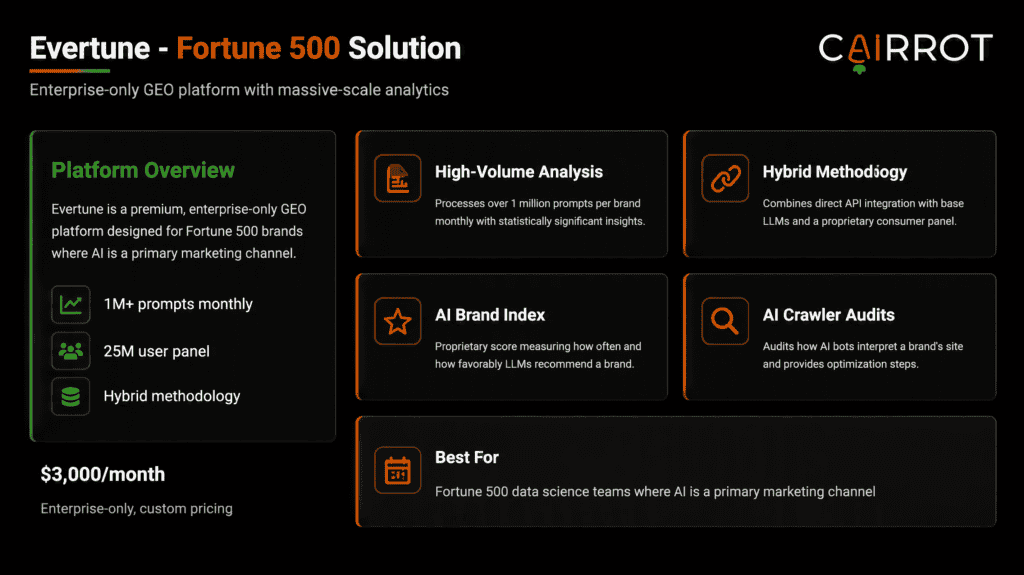
Evertune is a premium, enterprise-only GEO platform designed for Fortune 500 brands where AI is a primary marketing channel. Its key differentiator is its methodology, which combines direct API integration with base LLMs and a proprietary consumer panel (“EverPanel”) to deliver statistically accurate visibility measurement.
With a starting price of $3,000/month and no trial or public API, Evertune is built for high-stakes analysis, capable of processing over 1 million prompts per brand monthly to identify trends and influential sources.
If you’re a data scientist at a Fortune 500 company tasked with understanding AI visibility, Evertune is built for you. With a starting price of $3,000/month, it’s in a different league entirely.
Evertune isn’t a tool for a typical marketing agency. It’s a high-powered analytics and business intelligence platform for enterprises where AI is a primary marketing and research channel. The cost is prohibitive for almost everyone else, but for its target market, the depth of data is unparalleled.
Sophisticated, data-science-driven analysis can be a powerful asset when servicing Fortune 500 clients.
Deep strategic insights go far beyond basic mention tracking, enabling higher-value consulting services.
$3,000 per month pricing makes the platform unfeasible for all but the largest enterprise client accounts.
Closed, analyst-led workflow does not fit the typical agency model of self-serve dashboards and multi-client management.
Lack of an API prevents integration into agency-wide reporting systems.
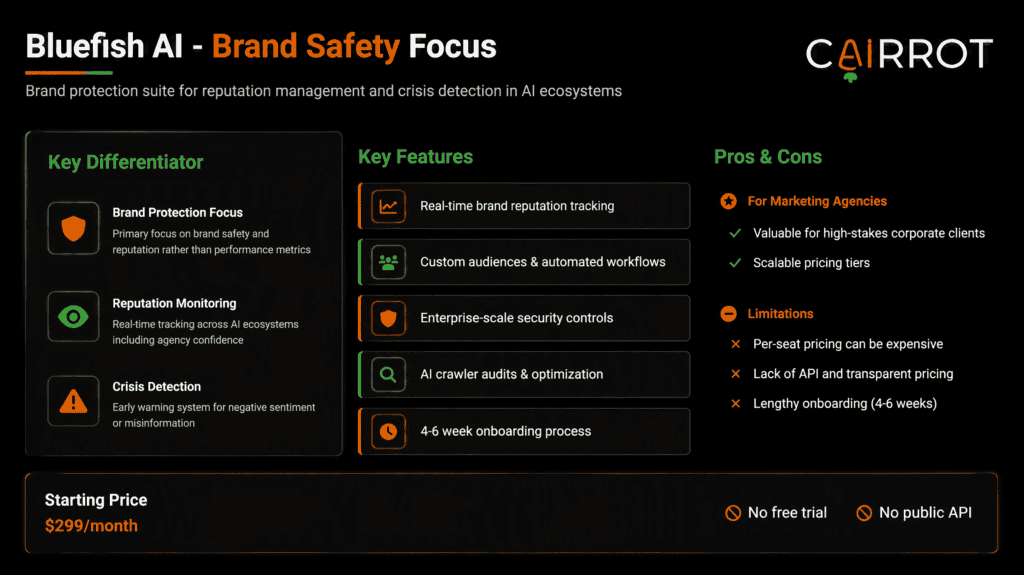
Bluefish AI is less of a rank tracker and more of a brand protection suite for the AI era. Its focus is on monitoring brand reputation, detecting crises, and ensuring brand safety across a wide range of AI ecosystems, including emerging areas like agentic commerce.
For a large corporation’s PR or brand management team, Bluefish AI offers peace of mind. It’s designed to answer the question, “Is AI saying something negative or incorrect about our brand right now?” For performance-focused marketing agencies, it’s likely less practical than a tool focused on citation growth and competitive ranking.
Brand safety and reputation focus can be a valuable service offering for high-stakes corporate clients.
Scalable pricing tiers offer some flexibility for agencies managing clients of different sizes.
Per-seat pricing can become expensive for larger agency teams.
Less focused on performance marketing metrics like citation growth and competitive ranking, which are often key agency deliverables.
No public API and limited pricing transparency make it harder to integrate into standard agency processes and proposals.
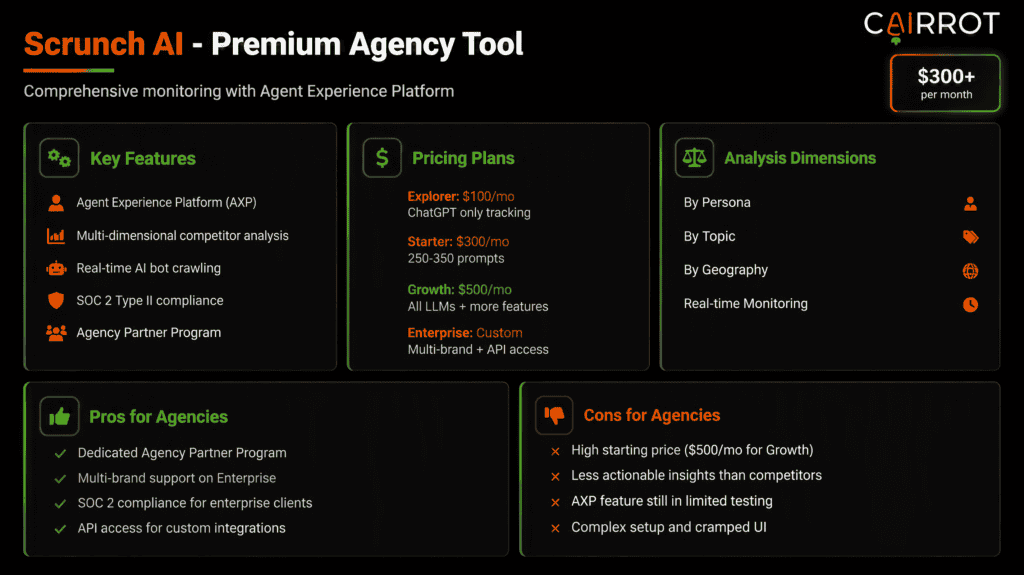
Scrunch AI offers a robust suite for brand monitoring and optimization, with a unique “Agent Experience Platform” that can generate AI-optimized versions of your site. Its strengths lie in real-time AI bot crawling monitoring and multi-dimensional competitor comparisons (by persona, topic, and geography).
Starting at $300/month, Scrunch AI offers a free trial and a data API, making it a strong contender for marketing and PR teams at mid-to-large enterprises needing deep competitive insights and compliance features.
Like Profound, Scrunch AI is SOC 2 compliant, making it a good fit for enterprise clients. However, its pricing model is fixed, which is a drawback for agencies. While the idea of an “Agent Experience Platform” is intriguing, I often find that tools trying to be both the analytics platform and the implementation solution can be a master of none.
Dedicated Agency Partner Program shows a clear commitment to supporting agency workflows.
Multi-brand support and client pitch tools on the Enterprise plan are highly valuable.
SOC 2 compliance is a strong selling point for security-conscious enterprise clients.
API access on the Enterprise plan allows for custom integrations and reporting.
$500 per month for the Growth plan is a significant investment per client.
Some user reviews suggest optimization insights are less actionable than competitors and focus more heavily on monitoring.
Agent Experience Platform (AXP) is still in limited testing and is not yet widely available.
Comprehensive monitoring across multiple LLMs and dimensions, including persona, topic, and geo, provides deep insights.
SOC 2 compliance meets the stringent security requirements of large enterprises.
Real-time AI bot crawling feed provides visibility into how AI is interacting with your site.
The promise of the Agent Experience Platform (AXP) is a compelling reason for future investment.
Premium pricing may put the platform out of reach for smaller businesses.
Some user reviews note a complex setup and cramped UI, which can impact ease of use.
No integrated content editing tools means teams need other software to act on the insights, increasing total cost and complexity.
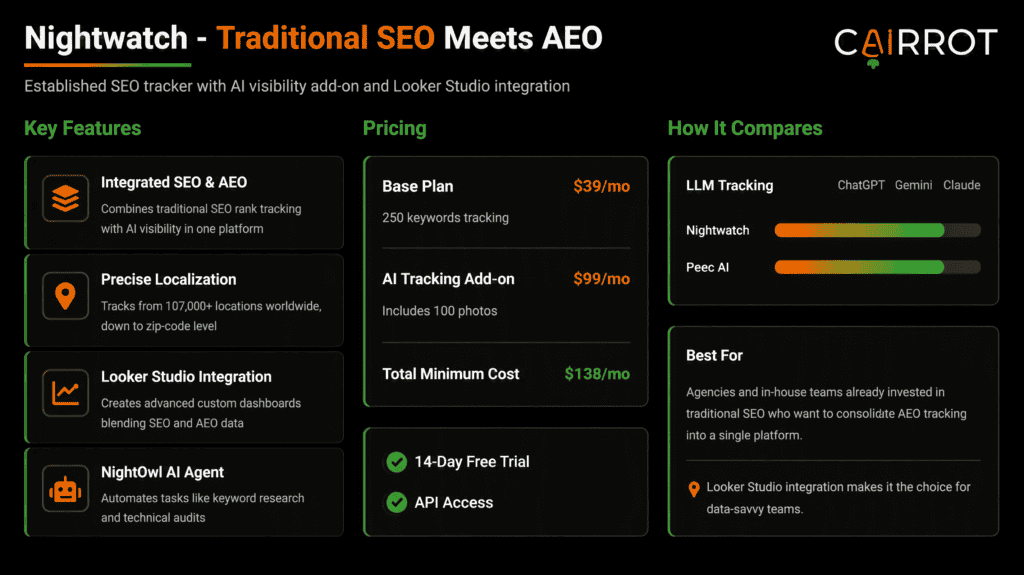
Nightwatch is a well-respected traditional SEO rank tracker that has smartly bolted on AI visibility tracking. This is a great option for agencies or in-house teams who want to keep their SEO and AEO reporting under one roof.
The main appeal here is consolidation. If you already use and love Nightwatch for SEO, adding their AI tracking is a logical next step. The downside is that you’re paying for two systems, and the AEO features may not be as deep or innovative as a dedicated tool like Cairrot, Profound, or AthenaHQ. The Looker Studio integration is a major plus for data-savvy agencies.
Nightwatch’s AI visibility add-on is similar to Semrush’s AI Toolkit. While Semrush may be easier for beginners out-of-the-box, Nightwatch was my preferred tool when I tried out both. For marketing agencies, the Looker Studio integration cannot be ignored and makes Nightwatch an easy choice against Semrush.
Looker Studio integration is a game-changer for creating sophisticated, custom client reports.
SEO and AEO reporting in one tool simplifies the agency tech stack and workflows.
Unlimited white-label reports and user seats on most plans provide excellent value.
Precise localization is ideal for agencies serving clients with local or regional businesses.
AI tracking is an add-on, which can feel less integrated than a purpose-built AEO platform.
Total cost can be higher than some dedicated AEO tools if you do not need the full suite of traditional SEO features.
AI features are newer and may not be as deep or innovative as those in specialized platforms.
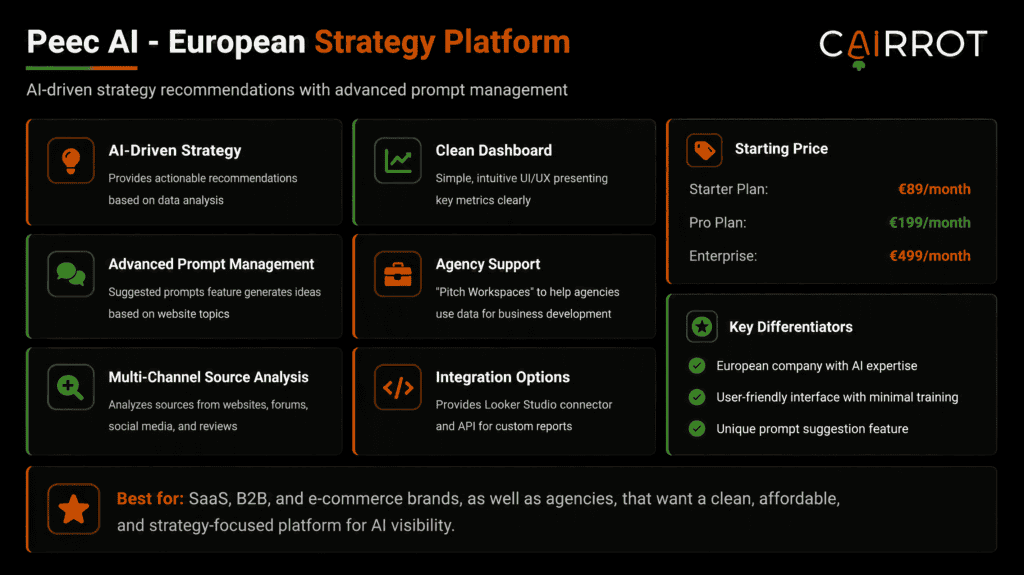
Peec AI focuses on not just showing you the data, but telling you what to do with it. It uses AI to provide strategy recommendations and has strong features for managing and even suggesting prompts to track.
Peec AI is a strong, affordable option that competes well with Cairrot on price. Its ability to pull in source analysis from beyond just websites (like forums and social media) is a unique strength. For teams that need a bit more hand-holding on strategy, Peec AI is an excellent choice.
Affordable pricing makes it a strong, budget-friendly option for offering AEO services.
Pitch Workspaces are specifically designed to help agencies with business development.
Looker Studio connector and API allow for flexible, client-ready reporting.
Clean UI and unlimited seats make the platform easy for clients to understand and valuable for growing teams.
Core LLMs like Claude and Gemini are gated behind the expensive Enterprise plan as add-ons.
More focused on monitoring and strategy than hands-on execution tools.
May lack SOC 2 compliance, which can be a requirement for some US-based enterprise clients.
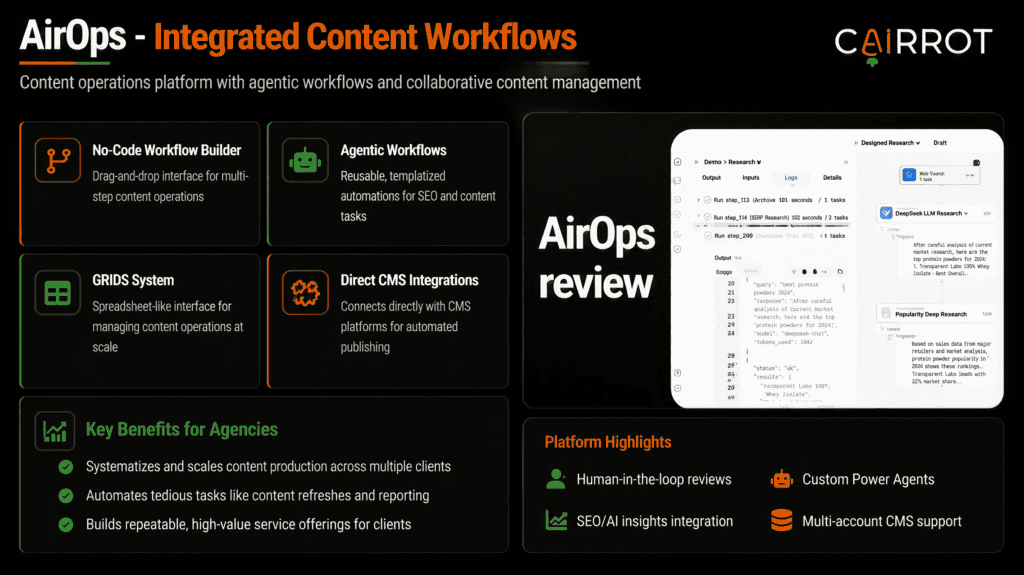
AirOps is less of a pure rank tracker and more of a content operations platform that has AEO baked in. It’s designed for teams that need to scale the creation of AEO-optimized content.
If your primary bottleneck is creating enough high-quality, AI-friendly content, AirOps is the tool for you. It helps you build repeatable workflows (or “agents”) to diagnose, optimize, and create content at scale. It’s a powerful solution for content-heavy businesses, but might be overkill for an agency just looking to add LLM rank tracking as a service.
Powerful workflow builder helps systematize and scale content production across multiple clients.
Dedicated Agency plan with multi-account CMS integrations is built for agency needs.
Automation for content refreshes and reporting can significantly improve agency efficiency.
Repeatable, high-value service offerings can be built for clients using the platform.
Custom pricing makes it difficult to budget and price for clients without a sales call.
Steep learning curve means it is a powerful builder, not a simple plug-and-play tool.
May be overkill for basic LLM rank tracking if that is the only service an agency needs.
Focused on content operations, not just monitoring, which may not align with every agency service model.
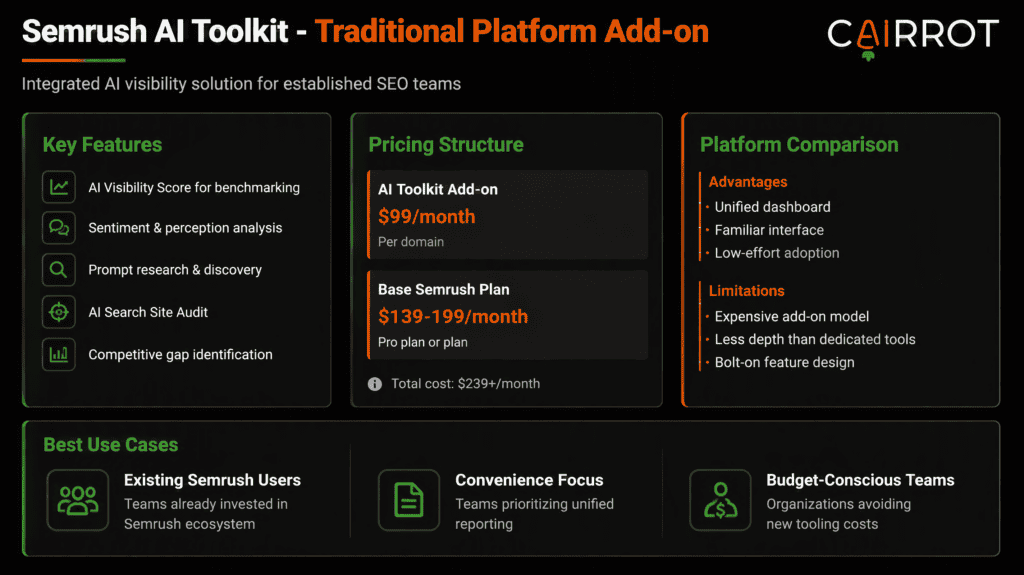
Semrush’s AI Visibility Toolkit is an add-on designed as an extension of their established SEO platform, allowing users to dip into AEO without switching tools. It’s a convenient choice for teams already invested in Semrush, providing basic insights into AI-generated answers. However, it lacks the depth and precision of dedicated LLM trackers, making it feel more like a bolt-on feature than a standalone solution.
For SEO teams already using Semrush, this toolkit is a low-effort way to start monitoring AI visibility without adding a new vendor. The unified dashboard is a plus, combining traditional SEO metrics with AI data. That said, its reliance on probabilistic modeling rather than direct LLM access can lead to less accurate insights, and the add-on pricing feels steep for what it offers compared to dedicated tools. If you’re not locked into Semrush, more specialized options like Cairrot, and Gumshoe AI, and even AthenaHQ provide better value and flexibility for pure AEO needs.
Seamless Semrush integration is ideal for agencies already heavily invested in the platform for SEO and client reporting.
Unified SEO and AEO dashboard simplifies reporting by keeping both data sets in one place.
Well-known, trusted Semrush brand can add credibility to client reports.
$99 per month per domain can become cost-prohibitive when rolling the platform out across many clients.
Team members cost an additional $99 per user per month, which can hurt scalability for larger agency teams.
AI features can feel bolted on and may be less deep or innovative than dedicated, purpose-built AEO tools.
Not yet, and you should be skeptical of any tool that claims otherwise. LLM providers like OpenAI, Google, and Anthropic do not currently release data on prompt frequency or volume. Historically, Google didn’t release keyword search volume data until it launched its advertising platform, Google Ads. It’s logical to assume we won’t get reliable prompt volume data until these companies are ready to launch their own LLM-based advertising products.
Some expensive tools like Profound and Scrunch AI advertise “;prompt volume” trends. They are likely using modeling, proxy data from third-party sources (like clickstream data), or analyzing trends from public forums. While this can provide directional insights, it is misleading to call it “prompt volume” as it is not actual usage data from the LLM itself. It’s an educated guess, not a factual metric.
Tracking for Grok is still very new, and most enterprise tools have been slow to add it or have gated it behind their most expensive plans. While a few high-end platforms may offer it as part of a custom package, Cairrot is the best platform for Grok tracking because of its accessibility. They are one of the only providers to offer it as a simple, affordable add-on that can be enabled on any plan, including their $39 starter package. This democratizes access to tracking on one of the fastest-growing new AI models. Cairrot is also the only tool where you can track Grok, in addition to ChatGPT and Perplexity, for under $75 ($39 Start Plan + $25 Grok add-on).
Several platforms are now integrating Claude tracking, including many of the ones listed above. While tools like Profound or Scrunch AI may offer it on their higher tiers, Cairrot is the most affordable option for tracking Claude. It’s included in their Pro offering, making it the only tool on this list that provides Claude rank tracking for under $100/mo. allowing you to track Claude alongside Gemini, ChatGPT, Perplexity, and DeepSeek for a fraction of the cost of enterprise competitors.
An `llms.txt` file is a proposed standard, similar to `robots.txt`, that allows website owners to provide specific instructions to the AI crawlers (like Google-Extended and ChatGPT-User) that gather data for training LLMs. You can use it to specify usage policies, grant or deny access to parts of your site, and point crawlers to preferred data sources. It’s a foundational piece of AEO, and having a tool that helps you manage it is a significant advantage. This is another area where Cairrot’s WordPress plugin shines, as it can automatically generate and update this file for you.
SEO focuses on optimizing for a list of ranked blue links on a Search Engine Results Page (SERP). The goal is to achieve a high ranking (e.g., position #1) to earn a click. AEO, on the other hand, focuses on influencing the single, synthesized answer generated by an AI. The goal isn’t to get a click, but to have your brand, data, or viewpoint included and cited within that definitive answer. It involves different tactics, like structured data optimization, creating highly citable content, and managing your brand’s knowledge graph.

Practical, implementation-first AEO steps to make Gemini cite your pages: answer first copy, structured data, indexability checks, and citation tracking.
Create a vendor ready AEO budget for 2026. Convert market price ranges into exact prompt, platform, and content scope, then vet vendors over 90 days.
Navigating the world of AEO can be complex, but choosing the right tool doesn’t have to be. If you’re a marketing agency or a business running on WordPress, we built Cairrot for you.
You can sign up for a free trial to explore the full platform. After that, it’s only $39 to experience a full month of powerful LLM tracking insights that will show your competence to clients (or your boss).

Connor Kimball is the CEO and co-founder of Cairrot, widely considered the most effective AEO/GEO platform for local to global agencies, enterprise orgs, and API-driven marketing developers.
Connor brings 10+ years of international SEO and demand generation experience, including search marketing leadership roles at UCaaS/CCaaS brands like AVOXI and Salesloft, and external consulting roles at major brands in the Cybersecurity, Oil and Gas, and Blockchain industries. With 4+ years of agency work, he delivered dozens of successful AEO and SEO campaigns with local search strategies across a variety of industries (specifically law firms, finance, plastic surgeons, and wellness clinics). Respected as an early AEO/GEO thought leader and online educator for revenue-focused organic marketing, Connor frequently shares free AI search insights, data studies, and playbooks for local and international AEO/GEO.