
Answer Engine Optimization (AEO)
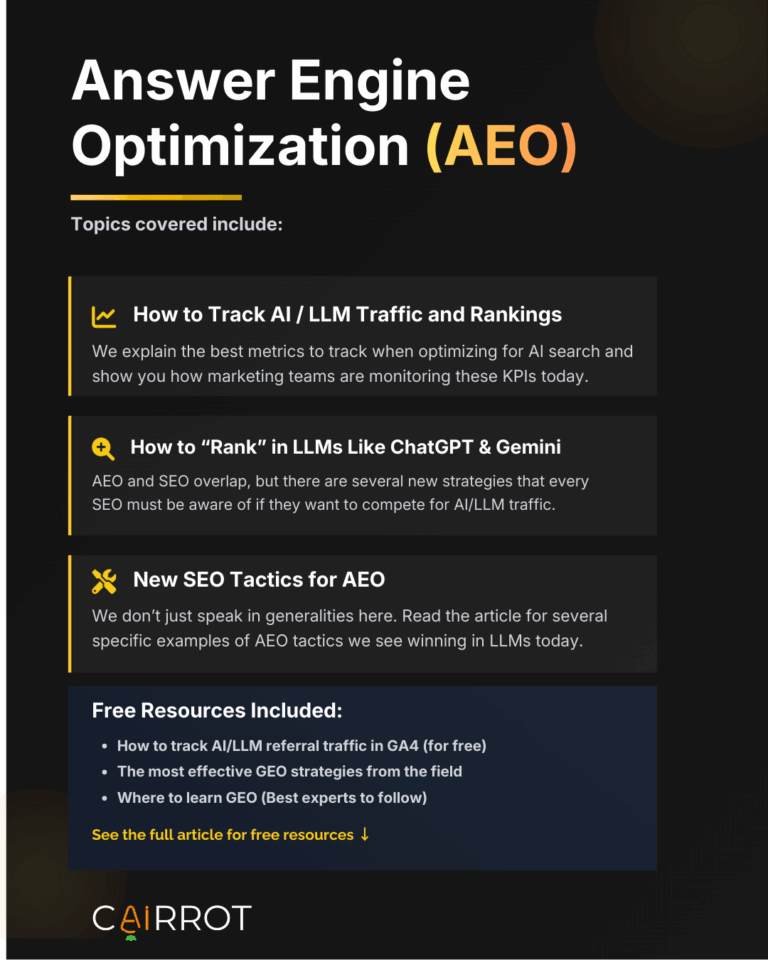
Discover the latest and greatest in the developing world of answer engine optimization. This guide covers:
- Most effective AEO strategies based on data and field observations
- Tips for learning AEO quickly (including experts worth following)
- How to track traffic and visibility from from AI search and LLMs
- Several more resources for marketers learning AEO
Key Takeaways
- Answer Engine Optimization (AEO) is the evolution of traditional SEO, focused on getting brands mentioned and cited directly in AI-generated answers from LLMs like ChatGPT, Perplexity, Gemini, Claude, and Grok, rather than just ranking in link-based search results.
- AEO builds on SEO fundamentals (site speed, mobile optimization, backlinks) but adds layers like optimizing for conversational queries, scannable content formats (question headings, lists, tables), enhanced E-E-A-T signals, schema markup, and content repurposing across platforms (e.g., Reddit, YouTube, X).
- Key AEO tactics include whitelisting AI bots for crawling, implementing llms.txt files (shown to drive significant traffic increases), digital PR for authority, marketing on UGC sites, and platform-specific adjustments (e.g., PDFs for Claude, X posts for Grok).
- Primary AEO KPIs shift from traditional rankings and organic traffic to prompt tracking, AI visibility (mentions/citations), share of voice in LLMs, and referral traffic from AI platforms.
- A range of AEO tools exist for tracking visibility across LLMs, from affordable options like Cairrot (with WordPress integration and Grok support) and pay-per-report tools like Gumshoe, to enterprise solutions like Evertune; tool choice depends on budget, needs (e.g., API access), and scale.
- In a hybrid SEO-AEO world, brands should prioritize multi-platform content distribution, freshness, and manual/automated monitoring to build authority and capture emerging AI referral traffic.
- AEO and GEO (Generative Engine Optimization) are largely interchangeable terms, with AEO likely to become the standard due to broader adoption and less ambiguity.
Table of Contents
What is Answer Engine Optimization (AEO)?
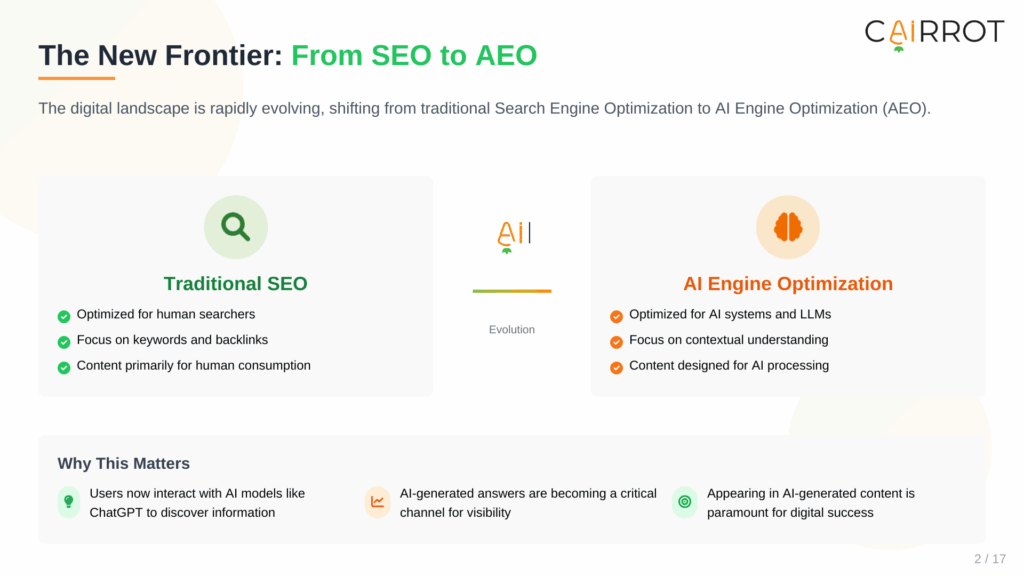
In digital marketing, Answer Engine Optimization (AEO) is the evolution of Search Engine Optimization (SEO) for the era of Large Language Models (LLMs) and AI-driven search. In other words, AEO is the strategic process of optimizing websites, content, and brand presence to be found, understood, and cited by AI search platforms like ChatGPT, Google Gemini, Perplexity, Claude, and Grok.
Unlike traditional SEO, which primarily focuses on ranking a webpage in a list of blue links, AEO aims to have your brand’s information, data, and perspective woven directly into the AI-generated answers themselves. As Conductor CEO Seth Besmertnik describes it, AI has created a “parallel surface of visibility,” an invisible layer where brand discovery and credibility are established before a user ever clicks a link (ALM Corp, 2025).
The goal is no longer just to rank; it’s to become the definitive, citable source that AI search tools trust to inform their users.
SEO vs. AEO (Yes, There Is a Difference)
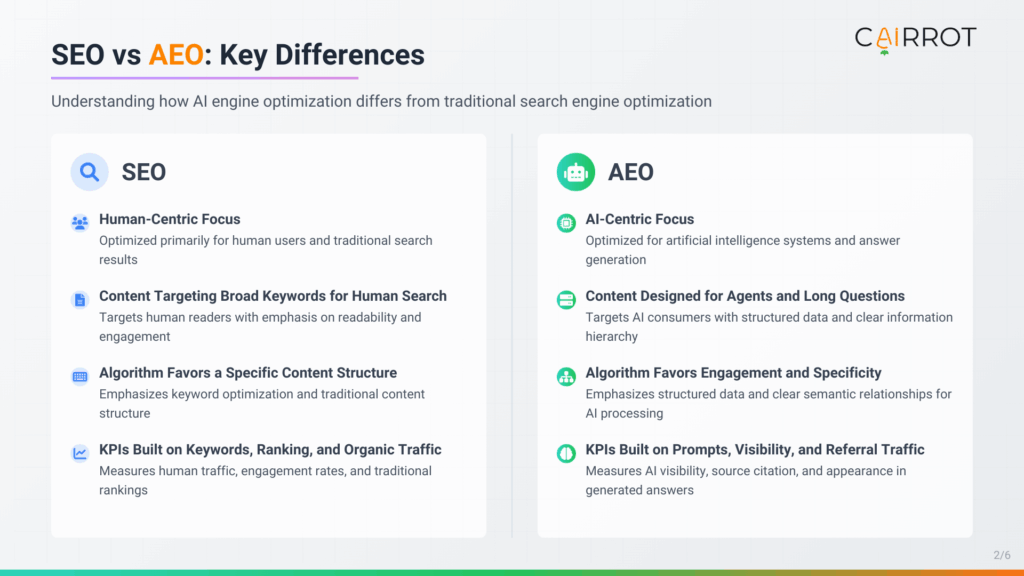
While AEO builds upon the foundation of SEO, it introduces fundamental shifts in three key areas: the metrics you track, the sources of your traffic, and the optimization strategies you employ. Understanding these differences is crucial for adapting your marketing efforts to the new search landscape.
At their core, they help you answer critical questions like:
- Is my brand being mentioned when users ask relevant questions?
- What is the context and sentiment of those mentions?
- Are my competitors showing up more often than I am?
- Which of my web pages or data sources are being cited by the AI?
- How is my visibility changing over time across different AI models?
KPIs: AEO Metrics vs. SEO
The way we measure success in search is changing. While traditional SEO metrics remain important, AEO introduces a new set of KPIs focused on influence and visibility within AI responses.
- Traditional SEO Metrics: Success has long been measured by leading indicators like target keyword rankings, average position in SERPs, and lagging indicators like organic traffic volume and conversions from organic search.
- AEO Metrics: The new scorecard prioritizes target prompts (the conversational queries your audience uses), AI visibility (how often your brand is mentioned or cited), share of AI voice, and conversions from LLM referral traffic.
According to extensive research, the most critical AEO metric is citation frequency, the number of times your domain or brand is referenced as a source in AI-generated answers. This shift means success is measured by influence and authority, not just clicks (ALM Corp, 2025; DigitalScouts.co, 2025).
While you can track basic referral traffic from LLMs for free in Google Analytics 4 by filtering for sources like chatgpt.com, advanced AEO requires specialized tools. Platforms like Cairrot offer a more sophisticated suite for tracking AEO-specific metrics, including AI visibility, prompt performance, and brand mentions across different LLMs.
AI Traffic vs. Organic Traffic
For most companies, traditional organic traffic is overwhelmingly dominated by a single player: Google, which often accounts for over 90% of organic visits. The AI traffic landscape, however, is more dynamic.
Today, research from Conductor shows that ChatGPT accounts for a staggering 87.4% of all AI referral traffic, establishing it as the “Google of AI search” (ALM Corp, 2025). However, this market is far from settled. Competitors like Google Gemini, Anthropic’s Claude, and Perplexity are rapidly innovating and capturing niche audiences.
We are already seeing industry-specific preferences emerge. For example:
- If you are marketing a complex SaaS product, your ideal users may gravitate towards the sophisticated reasoning capabilities of Claude.
- If you are in media or an emerging industry, you might find that users on X’s Grok, which leverages real-time social data, convert at higher rates.
- Conductor’s research also found that Google Gemini has an unusually high market share (21%) in the Utilities sector, suggesting that different LLMs may develop vertical-specific strengths (ALM Corp, 2025).
This evolving ecosystem means that unlike the Google-centric world of SEO, a successful AEO strategy must be mindful of a multi-platform environment.
Differences in AEO Strategies vs Traditional SEO
AEO is not a replacement for SEO; it’s an expansion of it. The majority of your search strategy should still be grounded in SEO fundamentals, as traditional search continues to drive the lion’s share of traffic. However, digital marketers and SEO experts widely agree that specific AEO strategies must be layered on top of existing SEO checklists to ensure visibility in AI search.
As Pat Reinhart, VP at Conductor, advises, marketers should recognize that AI search “will grow over time and eventually ruin your long-term plans if you don’t account for it” (ALM Corp, 2025). The consensus at major SEO conferences is clear: you must integrate AEO tactics now to future-proof your brand. Key principles include:
- Build AEO tactics on top of a strong SEO foundation.
- Optimize content for conversational, question-based queries.
- Adhere to content structure best practices (e.g., clear headings, lists) that benefit both humans and AI.
We will explore these strategies in greater detail in the sections below.
Are AEO and SEO Different Roles?
Given that AEO tactics are typically implemented on top of existing SEO tasks, does this necessitate a new role? For most teams, the answer is no. AEO is an evolution of the SEO skillset.
However, that doesn’t mean roles can’t be specialized within a larger marketing team. It is becoming common for marketing agencies that specialize in AI search to have a division of labor. For instance, an AI / LLM Search Strategist might oversee the client account and define the high-level AEO strategy, while internal SEO Specialists focus on implementing the specific on-page, technical, and content optimizations required to achieve those goals.
Core Pillars of an Effective AEO Strategy
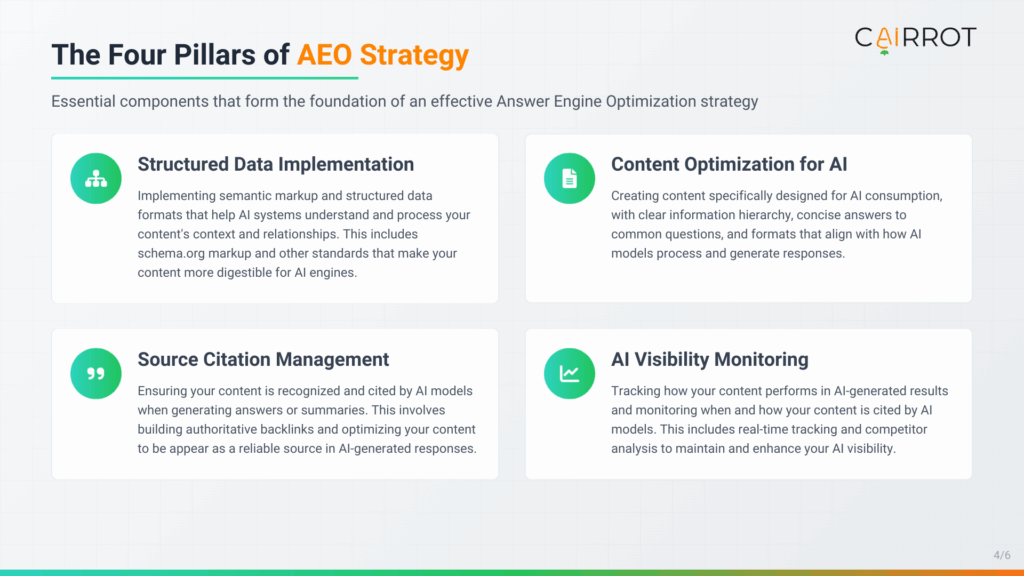
To win in AI search, digital marketers must adopt a hybrid approach that blends proven SEO principles with new, AI-focused optimizations. Here are the five core strategies that form the foundation of a successful AEO program.
1. Build on SEO Fundamentals Without Abandoning Them
First and foremost, do not abandon your core SEO practices. AI search engines, including Google’s AI Overviews, still rely heavily on the same signals that traditional search has used for years to determine authority and relevance. Factors like site speed, mobile optimization, a logical site architecture, and a healthy backlink profile are prerequisites for both SEO and AEO success (SEO.com, 2025).
Research confirms we are living in a “hybrid, two-channel world” where both traditional and AI search matter. While AI referral traffic is growing, organic search still drives a substantial portion of website traffic—as high as 42.4% in Health Care and 39.6% in Communication Services (ALM Corp, 2025). Therefore, AEO should be treated as an evolution, not a replacement.
Tactic: Audit your top-ranking pages—the ones already validated by Google—and refresh them with AI-friendly elements like conversational Q&As and concise summary sections. This enhances existing assets rather than starting from scratch.
2. Optimize Topics for Conversational Queries and Search Intent
The biggest shift in content strategy for AEO is moving from targeting fragmented keywords to answering complete, conversational questions. Users interact with AI assistants using natural language, asking things like, “What are the best noise-canceling headphones for under $200?” instead of just typing “best headphones.”
Your content must reflect this shift. Use tools like AnswerThePublic, Google’s “People Also Ask” (PAA) boxes, and your own customer service chat logs to identify the exact questions your audience is asking. This approach aligns your content directly with user intent, making it a prime candidate for citation in an AI response (HubSpot, 2025).
Tactic: Build topic clusters around core subjects. Create a central pillar page that provides a broad overview, then surround it with cluster pages that answer specific, long-tail questions. This structure demonstrates comprehensive expertise to AI models (Insidea, 2025).
3. Update Your Onpage SEO Checklists for AEO
AI models are not patient readers; they are efficient parsers. They scan HTML for structural and semantic cues to quickly extract information. To make your content easy for AI to parse and summarize, use clear, scannable formats:
- Headings (H1, H2, H3): Phrase headings as direct questions (e.g., “How Do You Implement Schema Markup?”).
- Lists: Use bullet points and numbered lists to break down information into digestible steps or points.
- Tables: Use tables for comparisons (e.g., product features, pricing tiers).
- Short Paragraphs: Avoid dense walls of text. Keep paragraphs to 2-4 sentences.
- Answer Capsules: Begin articles or key sections with a concise, 40-100 word summary that directly answers the main question before elaborating further (ALM Corp, 2025).
Furthermore, implement schema markup (structured data) to give AI engines explicit context about your content. Key schema types for AEO include FAQPage, HowTo, Article, and Organization. This acts as a “blueprint” for answer engines, dramatically increasing the chances your content will be interpreted correctly and featured (PBJ Marketing, 2025).
Tactic: Add a dedicated Q&A or FAQ section to your most important pages, marked up with FAQPage schema. This directly maps your content to the question-answer format that LLMs favor.
4. Emphasize E-E-A-T (Trigger Expertise Signals)
E-E-A-T (Experience, Expertise, Authoritativeness, and Trustworthiness) is Google’s framework for content quality, and it’s more critical than ever for AEO. AI models are designed to prioritize credible, trustworthy sources to avoid propagating misinformation, especially for “Your Money or Your Life” (YMYL) topics like health and finance.
Demonstrate E-E-A-T by:
- Featuring Author Bios: Showcase the credentials and real-world experience of your authors.
- Citing Reputable Sources: Link to high-authority studies, government data, and expert analysis to back up your claims.
- Including Original Data: Publish unique research, surveys, and statistics. Content with original data is heavily favored by LLMs (ALM Corp, 2025).
- Getting Expert Endorsements: For relevant content, have it medically or professionally reviewed to build trust.
Conductor’s research on the Health Care industry provides a clear example: AI models overwhelmingly cite institutions like the Mayo Clinic and Cleveland Clinic because they are world-renowned hospital systems with massive libraries of expert-vetted health information (ALM Corp, 2025).
Tactic: Associate your brand with trusted entities through consistent naming (brand entity optimization) and by securing mentions and links from high-authority sites in your industry.
5. Repurpose Content on Several Websites (Build on Rented Land)
LLM search and agent tools search through dozens of web results and summarize their findings when users ask them a question. The implication is that repetition is key for staying visible in LLM search. Don’t just post content showing why you are the best option for your target customer on your own website; reformat that content and make it available on several websites (preferably ones with search traffic), as well as UGC and social media platforms (Reddit, YouTube, X, Linkedin, Threads, etc. are all great choices for various LLMs.
Tactic: Take blog content from your website, rewrite it so that at least 25% of the words are different, make sure it links back to another article on your website, and publish it on 3rd party websites like Medium.com and Linked in Pulse, as well as on any friendly websites in your industry that are interested in content sharing.
6. Prioritize Engagement and Freshness Over Volume
In the AEO era, the goal is to enhance a few high-quality, comprehensive pieces rather than churning out a high volume of thin content. AI models favor content that is up-to-date and thorough. Regularly refresh your key articles with the latest statistics, facts, and insights to maintain their “freshness” score and signal ongoing relevance (Rellify, 2025).
This also involves being selective with bot access. While you want retrieval bots (like GPTBot and Google-Extended) to crawl your site for visibility in answers, you may want to block training bots if you are concerned about your proprietary content being used to train future models without compensation.
- Tactic 1: Instead of just tracking traffic, test your content’s performance directly in AI tools. Query ChatGPT, Perplexity, or Gemini with your target prompts and track metrics like citation frequency, brand mentions, and the sentiment of the response.
- Tactic 2: Take blog content from your website, rewrite it so that at least 25% of the words are different, make sure it links back to another article on your website, and publish it on 3rd party websites like Medium.com and Linked in Pulse, as well as on any friendly websites in your industry that are interested in content sharing.
7. Add LLM Specific Adjustments to Your SEO Strategy
AI visibility tools like Cairrot reveal trends in every LLM, making it easier to see which types of tactics are preferred by specific LLMs. Staying on top of these revelations and incorporating them into your AEO strategy is a quick way to boost yourself ahead of competition because so few people know about these optimizations, let alone have the willpower to implement them.
By working with tools like Cairrot, marketers become aware of effective tactics like:
- Reposting your content as PDFs is great for visibility in Claude
- Getting your company mentioned regularly on Reddit is great for visibility in Gemini
- Setting up Bing Webmaster Tools makes your website more likely to be surfaced by both Microsoft Copilot and OpenAI’s ChatGPT
This also involves being selective with bot access. While you want retrieval bots (like GPTBot and Google-Extended) to crawl your site for visibility in answers, you may want to block training bots if you are concerned about your proprietary content being used to train future models without compensation.
8. Stay Focused on KPIs
At the end of the day, the most important metrics for any performance marketer the ones directly tying your channel to revenue, while your leading metrics that signal future growth in your revenue. For SEO teams, that used to mean keyword targeting and rank tracking in Google.
For modern AEO teams, it means prompt tracking and visibility monitoring in your most important LLMs (usually ChatGPT, Gemini, Claude, Perplexity, and Grok), as well as checking AI referral traffic trends.
Tools like Cairrot are required to “rank track” your position in LLMs, but anybody can check their website’s AI traffic for free in Google Analytics ->
Specific Examples of High-Impact AEO Tactics
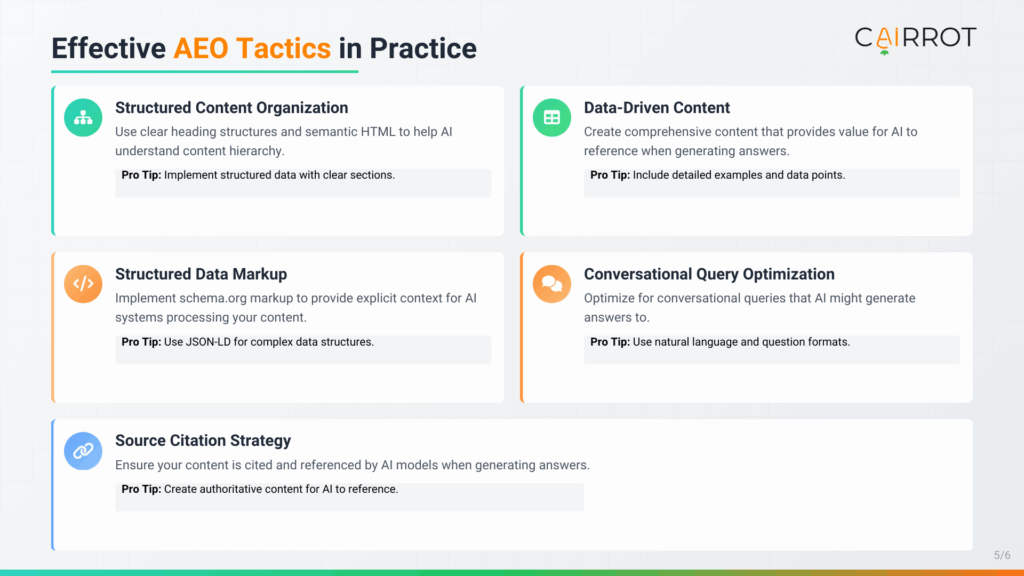
Beyond broad strategies, several specific tactics have proven effective for digital marketers looking to gain an edge in AI visibility. Here are some of the most impactful examples we see working today.
Technical Crawl Optimizations
Your content can’t be cited if AI crawlers can’t access it. This goes beyond a standard robots.txt file. Ensure your server and firewall configurations explicitly allow crawls from all major AI bots, including non-LLM crawlers like Amazonbot and Applebot, which are used for various AI-driven product and platform features. Common AI crawler user-agents to whitelist include GPTBot, ClaudeBot, and PerplexityBot (Powered by Search, 2025). Additionally, pay close attention to URL structures—parent pages and a clear content hierarchy matter more than ever for establishing topical context.
Generate LLMS.TXT In Addition to Schema Markup
While not yet an officially confirmed ranking factor, many AEO experts believe the llms.txt file will become to AI search what sitemap.xml is to traditional SEO. This simple text file, placed in your site’s root directory, allows you to specify which content you want LLMs to prioritize (or ignore) and can provide licensing information.
Some early AEO pioneers insist they see a tangible improvement in LLM visibility after implementing a well-structured llms.txt file. A case study by Concurate, for example, reported a 5x increase in AI-generated traffic after optimizing their llms.txt file to guide bots toward high-intent pages (SERanking, 2025). To simplify this process, tools like Cairrot’s llms.txt generator can help you create an optimized file and automatically insert it into WordPress websites.
Digital PR (and Link Building)
Backlinks and brand mentions have always been important for SEO, but their value is amplified in AEO. The correlation between a strong authority profile (built through high-quality backlinks and mentions on reputable sites) and visibility in LLM responses is remarkably strong. AI models use these external signals as a proxy for trust. As a result, digital PR and strategic link building are becoming dedicated, critical functions within marketing teams focused on AEO.
Content Consolidations (Large Websites Only)
If your site has a large volume of blog posts with low or zero traffic, you may be suffering from content cannibalization or thin content issues. Consolidating multiple weak articles into a single, comprehensive, long-form piece under a new URL is a powerful tactic. This strategy often improves both SEO traffic and AI visibility because you not only create a more authoritative and helpful resource but also trigger a new “freshness” score by publishing it on a new URL.
Market on UGC Platforms Like Reddit, Quora, and Stack Overflow
LLM search and agent tools search through dozens of web results and summarize their findings when users ask them a question. The implication is that repetition is key for staying visible in LLM search. Don’t just post content showing why you are the best option for your target customer on
User-generated content (UGC) platforms, especially Reddit, have become major sources for AI models. Following its licensing deal with Google, Reddit content has seen a massive surge in visibility in search results. ChatGPT and other LLMs also frequently cite Reddit discussions to provide authentic, real-world perspectives and troubleshooting advice that corporate websites often lack. The Conductor AEO/GEO Benchmarks Report found that Reddit was one of the top-cited domains in the Communication Services industry. Having a strong, positive presence in relevant subreddits is no longer just a community management task, it’s a core AEO tactic.
Example: Regularly take blogs from your own website; reformat that content and make it available on several websites (preferably ones with search traffic), as well as UGC and social media platforms (Reddit, YouTube, X, Linkedin, Threads, etc. are all great choices for various LLMs.
Reinforce E-E-A-T Signals Directly
Demonstrating E-E-A-T (Experience, Expertise, Authoritativeness, and Trustworthiness) remains essential for GEO success. AI models are specifically designed to favor credible sources, particularly for high-impact “Your Money or Your Life” topics.
Effective E-E-A-T reinforcement includes:
Author Attribution: Prominently display author bios with relevant credentials and real-world experience
Credible Citations: Reference authoritative studies, government publications, and expert research
Original Data: Publish proprietary studies, surveys, or datasets—original research is heavily weighted by LLMs (ALM Corp, 2025)
Professional Review: Where appropriate, obtain medical, legal, or industry expert validation
Conductor’s research in the Health Care sector highlights this clearly: AI systems consistently cite institutions such as the Mayo Clinic and Cleveland Clinic due to their global reputations and extensive libraries of expert-reviewed content (ALM Corp, 2025).
Tactic: Strengthen brand entity signals through consistent naming and by earning mentions and backlinks from trusted industry authorities.
YouTube Content
Modern transcription technology is far more powerful than most marketers realize. AI platforms can easily transcribe the audio from every video on YouTube, turning spoken words into a searchable, indexable text database. This means every video you publish contains at least as much informational content as a standard blog post. Conductor’s research highlighted this by revealing youtube.com as the most-cited domain in the Communication Services sector (ALM Corp, 2025). If you aren’t telling your brand’s story and sharing your expertise through video, you are missing a massive opportunity to influence what LLMs learn and say about you.
Repurpose Content on Key Platforms
This harkens back to the “build on rented land” tip we mentioned earlier.
Every LLM has its preferred sources and data inputs. To maximize your visibility, you must “build on rented land” by creating and repurposing content on the platforms that matter most to each AI engine. For example:
- To appear more often in Grok, you should post engaging, authoritative content on X (formerly Twitter).
- To improve your chances of being cited by Google Gemini and other LLMs that rely on Google’s index, share valuable content on platforms that rank well in Google search, such as Reddit, YouTube, LinkedIn, and even Instagram and TikTok.
This strategy involves understanding where AI models source their information and ensuring your brand is a prominent and trusted voice across that ecosystem. The level of control you have over your brand’s narrative varies significantly across these platforms, from full control on your own website to no control over news and forums.
7 Leading AEO Tools for Tracking AI Visibility

Here’s a a quick-view table comparing the top tools on the market. We dive deeper into each one below. See the next section for our master table comparing all these software tools in detail.
| AI Visibility Tool | Starting Price | Key Differentiators | API | Free Trial |
|---|---|---|---|---|
| Cairrot | $39.99/month |
|
Yes (free) | Yes (contact for details) |
| Profound | $99/month |
|
No | Demo available (no free trial) |
| Gumshoe AI | ~$30 per report |
|
Yes (Enterprise plan) | Yes (first 3 reports free) |
| AthenaHQ | $295/month |
|
No | No |
| Evertune | $3,000/month |
|
No | No |
| Scrunch AI | $250/month |
|
Yes | Yes |
| Semrush AI Visibility Toolkit | $99/month |
|
No | No (free demo report available) |
We review each tool in great detail in our LLM Tracker Comparison ->
1. Cairrot (Affordable, Effective Option for Marketing Agencies and Companies Using WordPress)
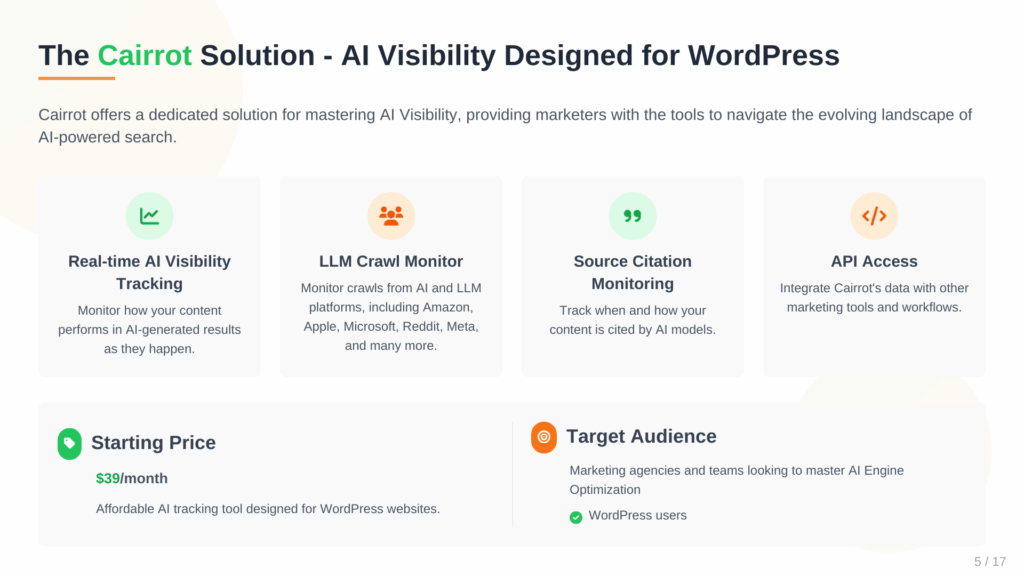
We built Cairrot because we needed powerful, flexible, and affordable way for our marketing agencies to manage AEO for their clients without getting locked into expensive, rigid contracts. We also believe most tools were not inspired, and the few that delivered what we wanted were obnoxiously expensive.
Cairrot was created on the idea that you should only pay for what you use, and that powerful features like an API shouldn’t be hidden behind an enterprise paywall.
- Key Features: LLM rank tracking (ChatGPT, Perplexity, Gemini, Claude, DeepSeek), competitive analysis, citation monitoring, AEO recommendations.
- Pricing: Starts at $39.99/month for ChatGPT and Perplexity tracking. Its pricing model is per-client, so you only pay for active profiles.
- Free Trial: Yes, a full-featured free trial is offered.
- API: Yes, a robust API is included for free on all plans. This is, in my opinion, the best API for integrations in its price class.
- Integrations: The standout feature is its deep integration with WordPress. The free AI Logger WordPress plugin automatically tracks LLM bot crawls on your site and can generate and manage your `llms.txt` file, a crucial optimization task. This makes it uniquely designed for WordPress websites.
What truly sets Cairrot apart for agencies is the combination of its most affordable pricing model (pay-per-client, cancel anytime) and its commitment to accessibility. It’s the only tool that offers Grok tracking as an add-on for any plan, and the only tool that will track 5 major LLM platforms for under $100. For agencies looking to offer cutting-edge AEO services without destroying their margins, Cairrot is the clear winner.
2. Profound (Best for Ecommerce Visibility)
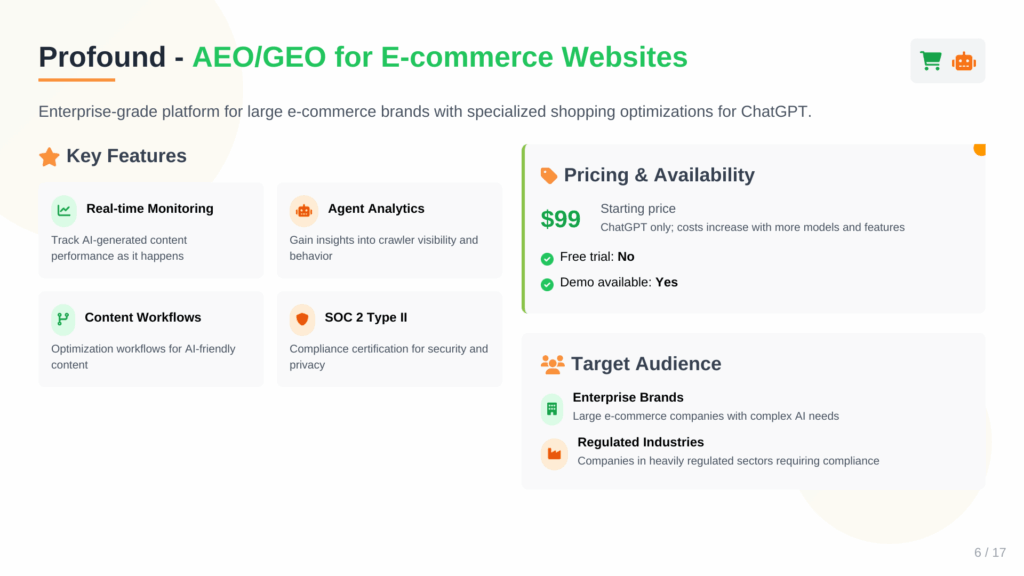
Profound positions itself as an enterprise-grade platform, and it has the feature set and price tag to match. It’s particularly strong for large e-commerce brands due to its specialized shopping optimizations for ChatGPT.
- Key Features: Real-time monitoring, agent analytics for crawler visibility, content optimization workflows, SOC 2 Type II compliance.
- Pricing: Starts at $99/month, but that’s for ChatGPT only. Expect costs to rise significantly as you add more models and features.
- Free Trial: No, but a demo is available.
- API: No public API is advertised, suggesting it’s likely reserved for custom enterprise deals.
- Integrations: Custom content workflow integrations.
While powerful, its claim of providing “AI search volumes” is something I’m critical of (no LLM offers this data publicly, yet). For a large e-commerce company that needs SOC 2 compliance and has a dedicated AEO budget, Profound is a strong contender. However, its pricing model and lack of a flexible API make it a tough sell for most agencies.
3. Gumshoe AI (Best Pay-Per-Report Visibility Tool)

Gumshoe AI takes a completely different approach. Instead of a monthly subscription, you pay per report. This is perfect for one-off projects, initial client audits, or teams that don’t need continuous monitoring.
- Key Features: Persona-specific visibility analysis, tactical recommendations, competitive ranking comparisons, source citation tracking.
- Pricing: Starts as low as $30 per report.
- Free Trial: Yes, your first few reports are free.
- API: Yes, but it’s on their Enterprise plan.
- Integrations: Custom integrations are available for enterprise clients.
The beauty of Gumshoe is its simplicity. You define your brand, competitors, and prompts, and you get a detailed report. It’s an excellent way to dip your toes into AEO without committing to a monthly fee. The downside is that costs can add up quickly if you need frequent monitoring, and it lacks the continuous, dashboard-style view of a SaaS platform.
4. AthenaHQ (Premium AEO Tool for High Tech Companies)
AthenaHQ comes with an impressive pedigree, backed by experts from Google, DeepMind, and OpenAI. It’s a premium tool focused on sophisticated strategies like “competitor impersonation” and “blindspot detection.”
- Key Features: Two-dimensional GEO optimization, dynamic AI crawling, Athena Citation Engine (ACE), self-improving content AI agents.
- Pricing: Starts at $295/month.
- Free Trial: No, but a first-month discount is offered.
- API: No.
- Integrations: No public integrations listed.
AthenaHQ is for teams that want to be on the absolute bleeding edge and have the budget for it. The lack of an API and public integrations makes it a bit of a walled garden, which can be a challenge for agencies needing to integrate data. It’s a powerful but expensive tool for those who want AI to not just track, but also strategize.
5. Evertune (Best Enterprise AEO Tool for Fortune 500 Size Companies)
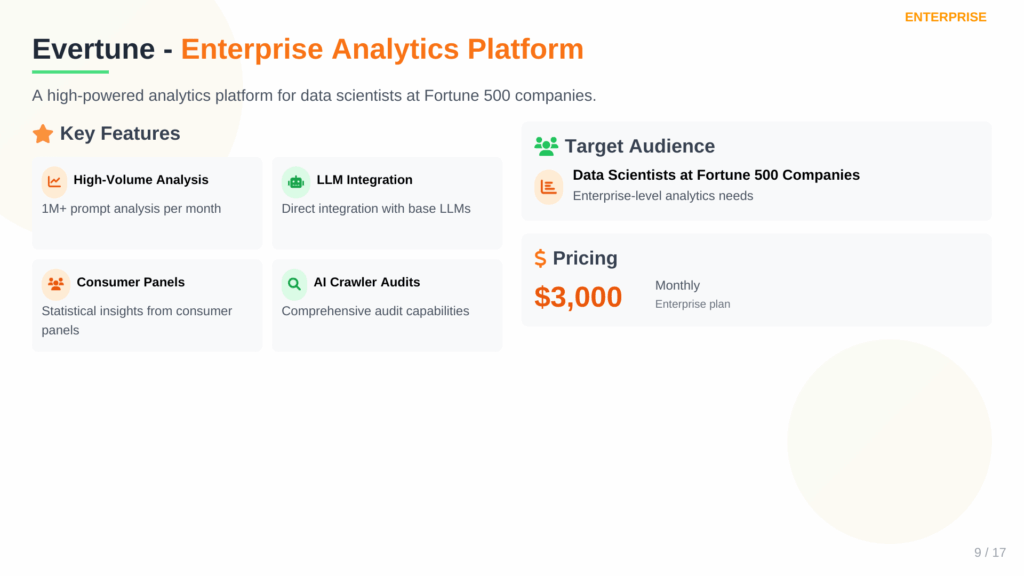
If you’re a data scientist at a Fortune 500 company tasked with understanding AI visibility, Evertune is built for you. With a starting price of $3,000/month, it’s in a different league entirely.
- Key Features: High-volume prompt analysis (1M+ per month), direct integration with base LLMs, consumer panels for statistical insights, AI crawler audits.
- Pricing: Starts at $3,000/month.
- Free Trial: No.
- API: No, it seems to be a closed platform.
- Integrations: Partnership with impact.com for affiliate actions.
Evertune isn’t a tool for a typical marketing agency. It’s a high-powered analytics and business intelligence platform for enterprises where AI is a primary marketing and research channel. The cost is prohibitive for almost everyone else, but for its target market, the depth of data is unparalleled.
6. Scrunch AI (Premium AI Monitoring and Optimization Tool for Agencies)
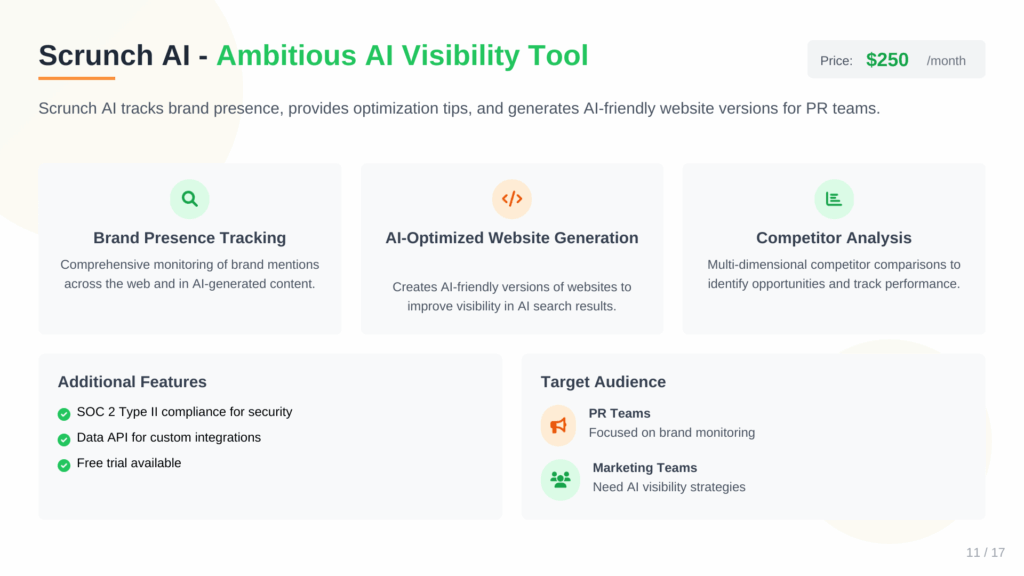
Scrunch AI is an ambitious platform that tries to do it all: track brand presence, provide optimization tips, and even generate AI-friendly versions of your website through its “Agent Experience Platform.”
- Key Features: AI bot crawling, AI-optimized site versions, multi-dimensional competitor comparisons, SOC 2 Type II compliance.
- Pricing: Starts at $250/month.
- Free Trial: Yes.
- API: Yes.
- Integrations: Data API for custom integrations.
Like Profound, Scrunch AI is SOC 2 compliant, making it a good fit for enterprise clients. However, its pricing model is fixed, which is a drawback for agencies. While the idea of an “Agent Experience Platform” is intriguing, I often find that tools trying to be both the analytics platform and the implementation solution can be a master of none.
7. Semrush AI Visibility Toolkit (Best for Marketing Agencies Not Specialized in SEO)
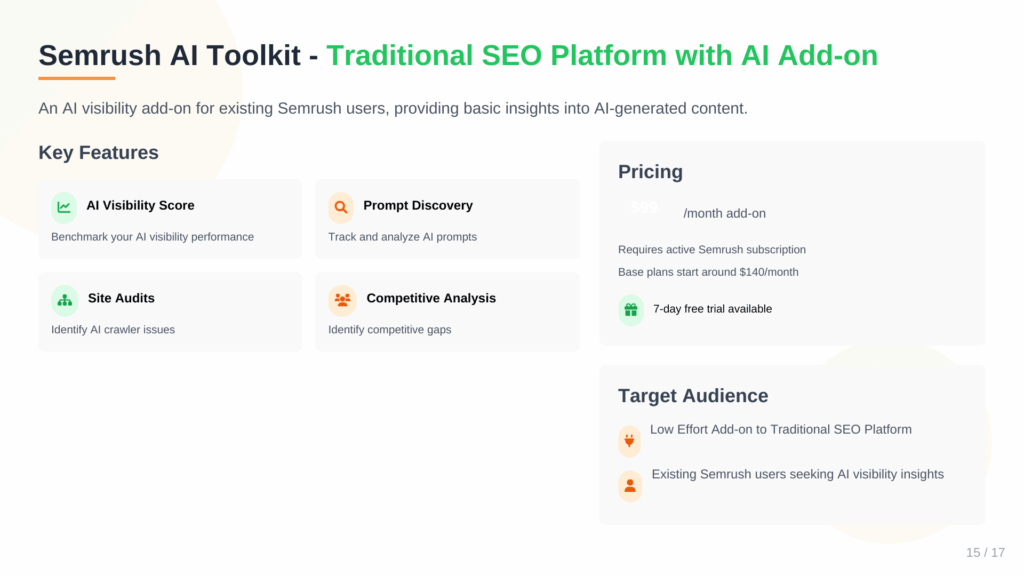
Semrush’s AI Visibility Toolkit is an add-on designed as an extension of their established SEO platform, allowing users to dip into AEO without switching tools. It’s a convenient choice for teams already invested in Semrush, providing basic insights into AI-generated answers. However, it lacks the depth and precision of dedicated LLM trackers, making it feel more like a bolt-on feature than a standalone solution.
- Key Features: AI Visibility Score for benchmarking, sentiment and perception analysis, prompt discovery and tracking, site audits for AI crawler issues, competitive gap identification, report generation.
- Pricing: Starts at $99/month as an add-on. Requires an active Semrush subscription (base plans start around $140/month), so total costs can exceed $200/month quickly.
- Free Trial: Yes (7 days).
- API: No.
- Integrations: Integrates with Semrush’s core SEO tools, including keyword research, backlink analysis, and reporting dashboards.
For SEO teams already using Semrush, this toolkit is a low-effort way to start monitoring AI visibility without adding a new vendor. The unified dashboard is a plus, combining traditional SEO metrics with AI data. That said, its reliance on probabilistic modeling rather than direct LLM access can lead to less accurate insights, and the add-on pricing feels steep for what it offers compared to dedicated tools. If you’re not locked into Semrush, more specialized options like Cairrot, and Gumshoe AI, and even AthenaHQ provide better value and flexibility for pure AEO needs.
Find Detailed Comparisons of AEO Tools
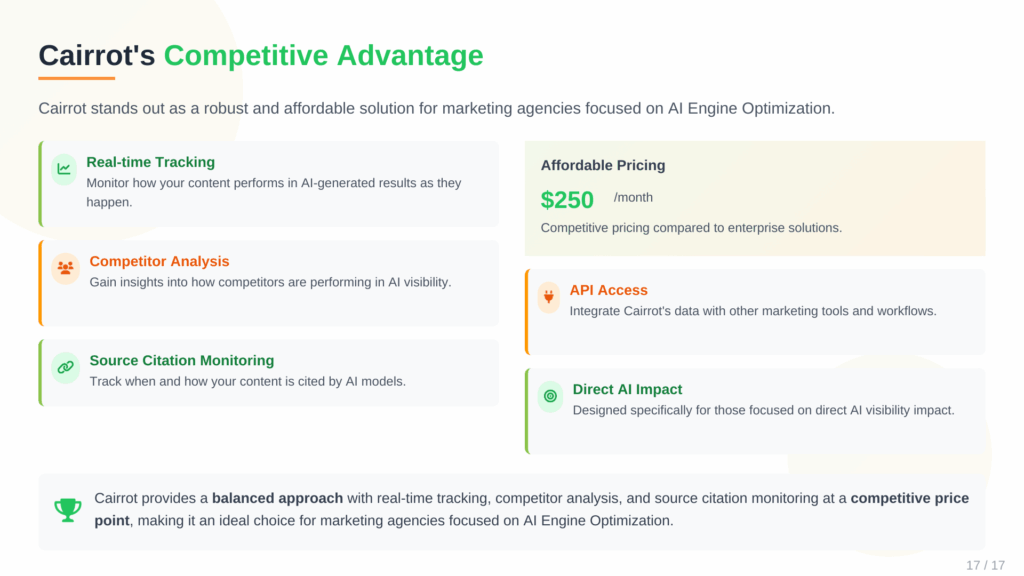
Among the seven software tools mentioned so far, there is a strong option for pretty much every type of marketer (or marketing agency) that wants to break into AI visibility tracking. But we go into greater detail for each competitor (and review 4 others) in our comparison of the 11 Best LLM Tracking Tools ->
But a complete AEO/GEO software stack doesn’t stop at tracking; it includes categories like AI SEO Content/Content Optimization (Jasper, Surfer SEO) and Technical SEO (Wordlift, Search Atlas), among others. Check out WordPress Dynamic’s AI SEO Tool Guide (33 AEO Tools Compared) for a zoomed out perspective ->
AEO vs. GEO: Are They Actually Different?
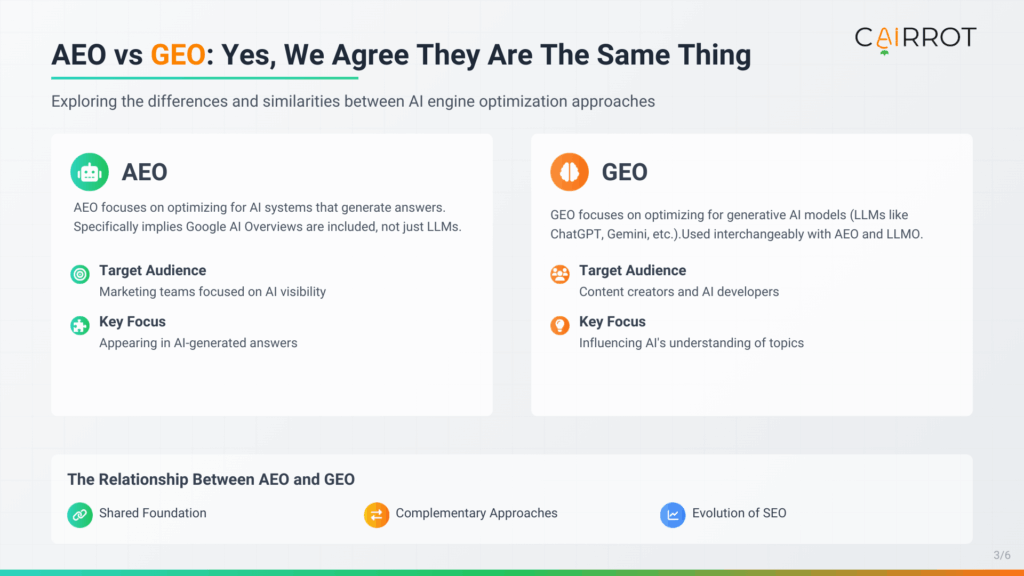
As the field of AI search optimization has emerged, so have new acronyms. The two most popular are AEO (Answer Engine Optimization) and GEO (Generative Engine Optimization).
Some SEO experts and industry analysts argue for a technical distinction between the two terms. In this view:
- AEO should refer to optimizing for answer-focused features within traditional search engines, such as Google’s AI Overviews, featured snippets, and knowledge panels.
- GEO should refer specifically to optimizing for visibility within standalone conversational LLM tools like ChatGPT, Gemini, and Claude.
However, many other marketing leaders and practitioners argue that this distinction is largely academic. The vast majority of people use the terms interchangeably to describe the overall practice of optimizing for AI-generated answers, regardless of the platform. The underlying strategies for both often overlap significantly, focusing on structured content, authority, and clarity.
Do We Treat AEO and GEO the Same? Yes.
At Cairrot, our team uses AEO and GEO interchangeably. We recognize that while a technical difference can be argued, in practice, they refer to the same strategic goal: ensuring your brand is visible and trusted in the age of AI search. We believe that forcing a rigid distinction creates unnecessary confusion for marketing teams who are simply trying to adapt to this new landscape.
Will AEO or GEO Become the More Popular Term?
While GEO is currently very popular, we believe AEO will win in the long term.
We debated this internally, and even though some of personally prefer to say “GEO,” we all agreed that most SEO experts will eventually get annoyed when they try to optimize for GEO.
The acronym “GEO” is already commonly used in other contexts (e.g., geography, geology, geostationary orbit), which could create SEO challenges and ambiguity for tools, agencies, and experts trying to rank for the term. Because “AEO” is more unique and directly describes the goal (optimizing for AI-generated answers regardless of which platform they are served in, not just generative tools like LLMs), we predict it will become the standard acronym in the years to follow, even if GEO remains more popular through 2026.
Tips for Learning AEO
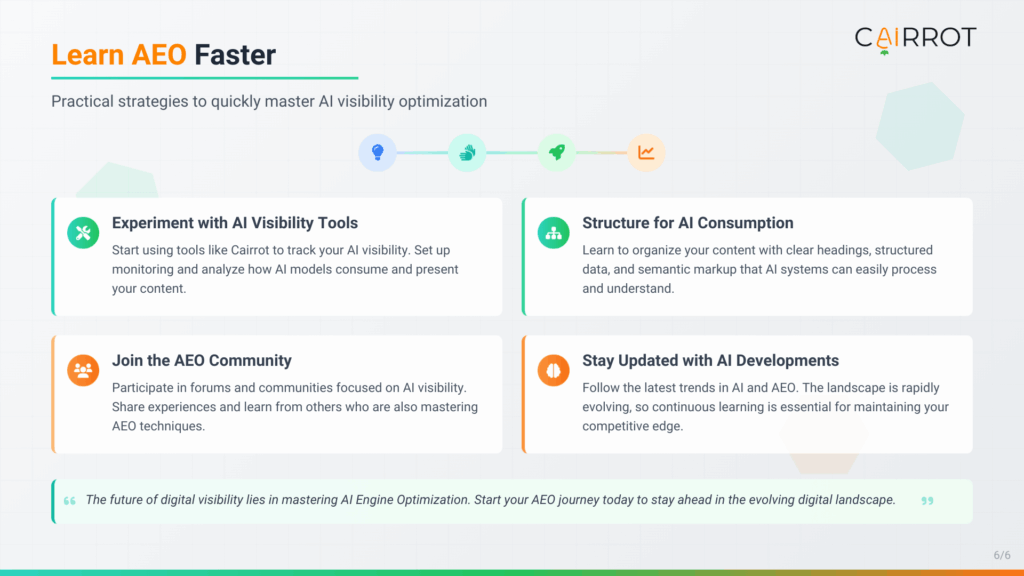
The field of AEO is evolving at a breakneck pace, but you can get up to speed quickly by focusing on a combination of foundational knowledge, practical application, and following the right experts. Here are some tips to accelerate your learning:
- Follow Key Experts: The AEO community is highly active on platforms like LinkedIn and X. Following leading practitioners will give you access to real-time insights, case studies, and emerging tactics. See our recommended list below.
- Add AI Traffic as a Channel in GA4: You can’t improve what you don’t measure. If your website already receives over 1,000 clicks per month from organic search, you probably receive enough referral traffic from LLMs that it is worth checking. Anybody can do this in a few minutes, just follow the steps laid out here: How to track your AI Search Traffic (referral traffic from LLMs) for free ->
- Conduct Manual Audits: The best way to learn is by doing. Take your top 10 business-critical queries and manually test them in ChatGPT, Gemini, and Perplexity. Analyze the results: Who is being cited? What sources are used? What is the structure of the content that wins? Document your findings in a spreadsheet.
- Experiment with Different Tools: And not just free trials of AI visibility tools like Cairrot. You should experiment with content generation tools, Use them to run an audit on your own site. Seeing real data on your AI visibility (or lack thereof) is a powerful motivator and learning tool.
11 Respected Industry Experts to Follow When Learning AEO
| AEO Expert | What They Share | Most Active Platform |
|---|---|---|
| Mike King (iPullRank) | Deeply technical and strategic playbooks on "relevance engineering" for AI Mode and GEO. Mike launched the SEO Week conference in 2025, widely cited by many SEO experts (including myself) as the best American conference for new AEO/GEO tactics. | LinkedIn / Blog |
| Jori Ford | Focuses on "Hybrid Engine Optimization," blending product, marketing, and SEO for visibility in "agent-led discovery." Jori taught Connor Kimball how to track crawls from LLM agents at SEO Week in 2025, which eventually became the inspiration for Cairrot’s AI Logger plugin. | |
| Cyrus Shepard (Zyppy) | Publishes research and experiments on how AI Overviews shift clicks and impact visibility. Cyrus regularly shares his insights on X and his website, and he is a regular on SEO industry podcasts. | X / Blog |
| Lily Ray (Amsive) | Provides deep, ongoing analysis of the impact of AI Overviews and shares practical experiments. Lily also has some of the more humorous commentary on the evolution of Google’s AI Overviews and AI Mode. | X / LinkedIn |
| Aleyda Solís | Creates actionable "AI Search" checklists and visuals that bridge classic SEO with AEO/GEO. Aleyda is a known workhorse in the SEO industry, always bringing actionable checklists to speaking events and podcast appearances. | |
| Connor Kimball (Cairrot) | Actively shares results from AEO campaigns and experiments for websites in several niches, including global SaaS, B2B industrials, law firms, financial services, cosmetic clinics, and ecommerce stores. As part of his role at Cairrot, Connor frequently shares observations about LLM ranking behavior based on the most up-to-date data in virtually every online niche. | YouTube / LinkedIn |
| Matthew Bertram (EWR Digital) | As the Head of Marketing at EWR Digital, a premier AI SEO agency serving B2B energy companies, and the host of The Best SEO Podcast, Matthew (Matt) regularly shares field observations and interviews the top names in AI on his podcast. | LinkedIn / Podcast |
| Kyle Roof (Page Optimizer Pro) | Uses scientific on-page SEO testing and data to create blueprints for ranking in generative answers. | YouTube / Website |
| Clint Butler (Digitaleer) | Expert in structured data, schema optimization, and entity-based visibility for AI search. | LinkedIn / YouTube |
| Ted Kubaitis (seotoollab.com) | Provides data-driven analysis of SEO ranking factors and their correlation with AI visibility. | LinkedIn / YouTube |
| Jono Alderson | Focuses on the intersection of WordPress, structured data, and building for an AI-mediated web. | Blog / LinkedIn |
At Cairrot, our team uses AEO and GEO interchangeably. We recognize that while a technical difference can be argued, in practice, they refer to the same strategic goal: ensuring your brand is visible and trusted in the age of AI search. We believe that forcing a rigid distinction creates unnecessary confusion for marketing teams who are simply trying to adapt to this new landscape.
Will AEO or GEO Become the More Popular Term?
While GEO is currently very popular, we believe AEO will win in the long term.
We debated this internally, and even though some of personally prefer to say “GEO,” we all agreed that most SEO experts will eventually get annoyed when they try to optimize for GEO.
The acronym “GEO” is already commonly used in other contexts (e.g., geography, geology, geostationary orbit), which could create SEO challenges and ambiguity for tools, agencies, and experts trying to rank for the term. Because “AEO” is more unique and directly describes the goal (optimizing for AI-generated answers regardless of which platform they are served in, not just generative tools like LLMs), we predict it will become the standard acronym in the years to follow, even if GEO remains more popular through 2026.
Related Resources


Run an AEO Audit for Free
Navigating the world of AEO can be complex, but choosing the right tool doesn’t have to be. If you’re a marketing agency or a business running on WordPress, we built Cairrot for you.
You can sign up for a free trial to explore the full platform. After that, it’s only $39 to experience a full month of powerful LLM analytics and AEO insights.